The praying mantis is an unusually large insect whose forelimbs are adapted for capturing food. Praying mantises come in white, pink, brown, or green; females are always larger than males. These insects are found throughout the world. Raising them is easy and quite enjoyable. The choice of praying mantis species depends on where you live and how you got your mantis (from a pet store or from the street). If you follow the proper care guidelines, a praying mantis can make an ideal pet. In this article, we'll cover the basics of caring for a praying mantis at home.
Content
Domestic praying mantises - species
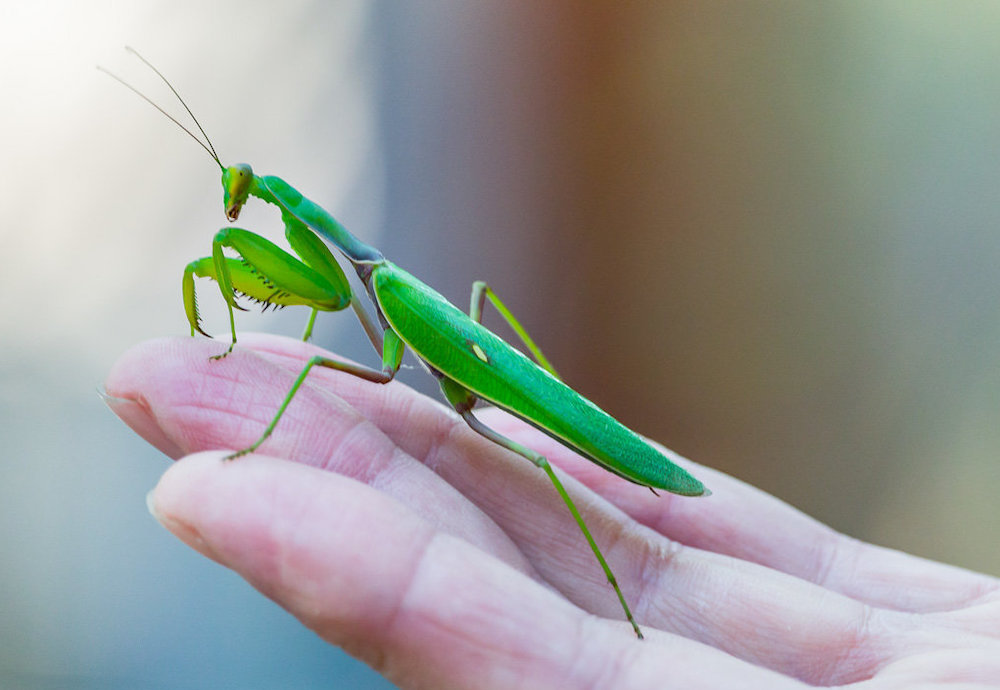
There are many species of praying mantises. Here are the most popular ones for keeping at home:
- Common Praying Mantis, or religious mantis (Mantis religiosa)The largest species (body length can reach 75 cm), common in Russia and Europe, with well-developed wings. Typically green. This is an inexpensive species, available for 500-1000 rubles.
- Orchid (Hymenopus coronatus) — a miniature species, up to 8 cm. Its coloring resembles an orchid flower, hence its name. It has a small head, wide legs, and thin antennae. Price: around 3,000 rubles.
- Spiked flower (Pseudocreobotra wahlbergii) – another miniature species, it has a growth on the underside of its abdomen (called a "spike") and a bright spiral in the shape of the number 9 on its forewings. It's easy to breed and costs between 2,000 and 4,000 rubles.
- African mantis, Sphodromantis centralisThe body length is up to 10 cm, and the color ranges from green to brown. It is easy to care for. It can be purchased for 500-1000 rubles.
- Devil's Flower or King of the Praying Mantis (Idolomantis diabolica) – the most expensive species, costing over 10,000 rubles. It resembles a flower in appearance. Its body length reaches 14 cm.
Beginners are better off choosing easy-to-keep species, such as the African praying mantis.
Praying mantis at home: features of keeping
Praying mantises are predatory animals that feed on other, smaller insects. Many species of praying mantises naturally live in Africa and Asia, so when kept at home, they need a suitable microclimate and a suitable diet.
What to feed pet praying mantises
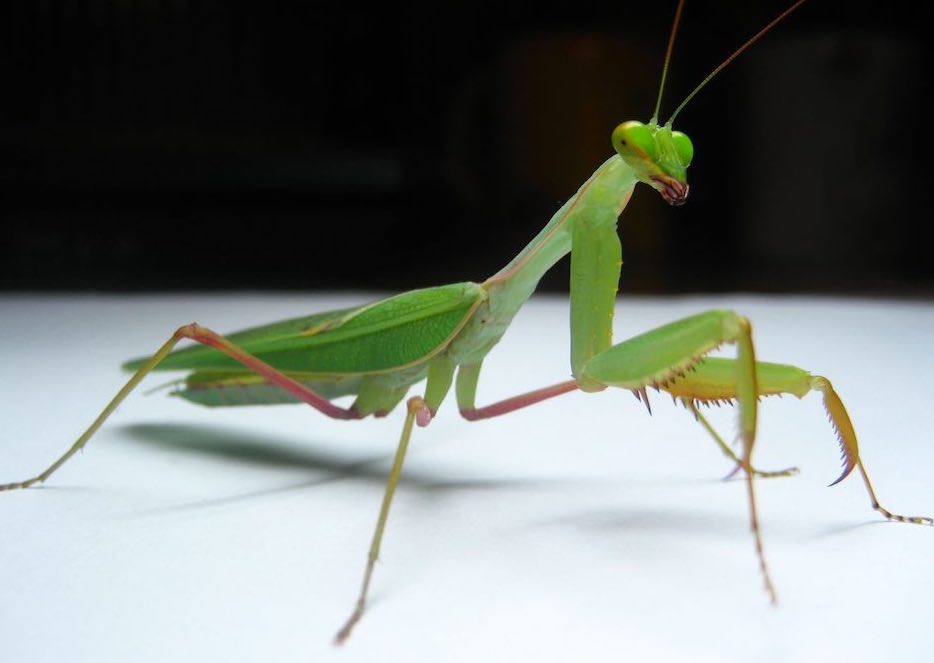
Pet mantises need to be fed until they're full: a hungry insect's abdomen is flat, while a well-fed one swells. They're typically fed every other day or every three days, with two live insects per meal. Keep in mind that they won't touch dead or motionless prey; their prey must be moving. Female mantises are larger and therefore slightly more voracious than males.
Newly hatched mantises are fed gnats or midges, while older ones are fed flies, cockroaches, and crickets. The size of the prey should roughly correspond to the length of the mantis's forearms. As the mantis grows, the size of these insects should also increase. You can catch the food yourself or buy it at a pet store.
Observe the feeding process to ensure the prey doesn't escape or hide in the terrarium. If the mantis doesn't respond to food, try choosing a more active animal.
If the insect refuses to eat or does not finish its prey, it should be removed from the cage within 30 minutes. Furthermore, the cage should be regularly cleaned of food remains and animal droppings.
Read also: 7 Most Beautiful Insects.
Favorable habitat
The cage/terrarium should be at least twice the width and three times the length of the insect. It should have a tight-fitting lid and a ventilation hole at the top. Glass, plastic, or fine mesh are suitable materials: large mantises will enjoy clinging to these. For smaller species, even a glass jar with a ventilation hole will do.
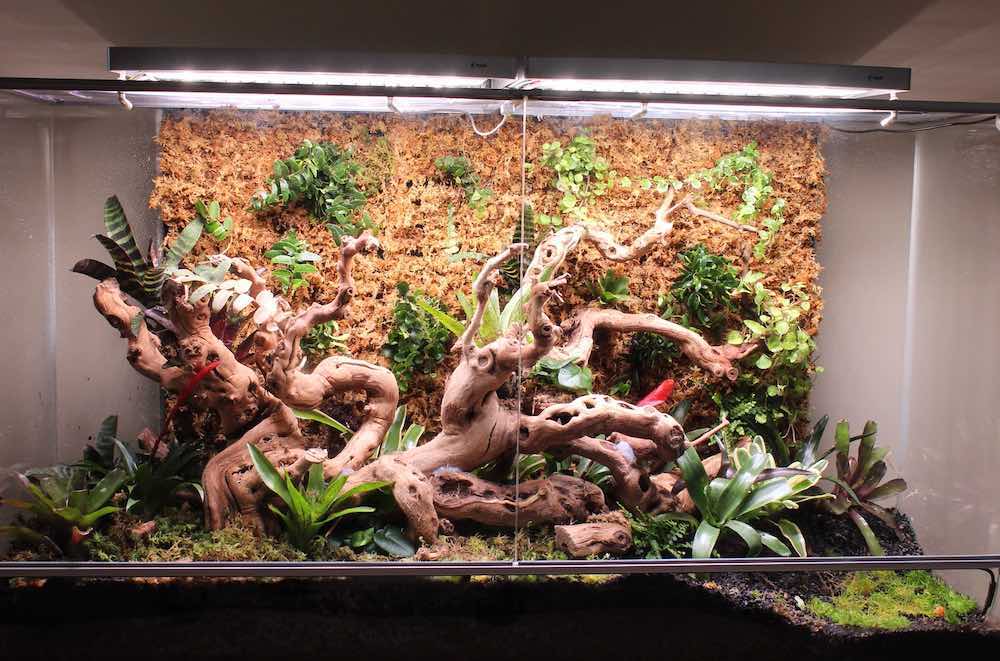
The terrarium should not be too large, otherwise it will be difficult for your pet to catch prey.
It's best to place a bedding material no more than 2.5 cm thick (soil or sand) on the bottom. This will absorb water and make cleaning the cage easier. You should also add bark and branches, placing them at various angles to ensure the mantis feels comfortable and can climb around its enclosure. Anything climbable, including rocks, is suitable. At least one stick should reach all the way to the top—this is important for the mantis during molting (it will hang down from there).
The animal requires high humidity: this can be achieved by providing a water dish or by misting it daily. Praying mantises themselves rarely drink water, but humidity levels are critical.
The optimal temperature depends on the insect species, but most praying mantises thrive at room temperature or slightly warmer—20–25°C. If your animal requires warmth, install a heat lamp and a thermometer above the terrarium.
Praying mantises are kept in separate cages to prevent them from attacking each other. Sometimes, males or newborns can be kept together.
How long does a praying mantis live at home?
Lifespan also depends on the insect species, but they typically live no more than a year, up to a maximum of eighteen months. As adults, most praying mantises live no more than 2-3 months. Their age is difficult to determine, so if you buy an adult praying mantis, be prepared for it to die quickly. Males are usually the first to die—either they are eaten by the female after mating, or they become lethargic, lose interest in hunting, and quickly die.
Read also, How to keep a spider at home.
Tips and nuances
A few nuances regarding maintenance and care:
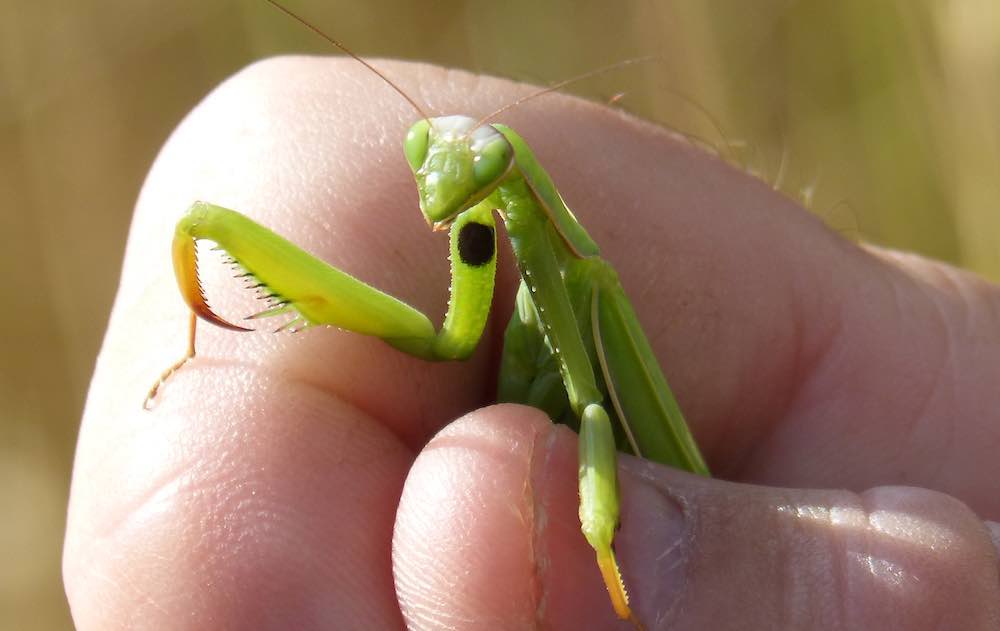
- Most praying mantises are small (up to 10 cm) green or brown animals that are well camouflaged in the wild: they can be difficult to see.
- Praying mantises are considered fragile insects, so don't force them into your hands. Instead, offer your hand, preferably after your pet has eaten. With patience, the mantis will eventually crawl onto your hand. This is usually done when removing the animal from its cage for cleaning.
- You can try catching a praying mantis yourself, especially in late summer, using a net, for example. If you're afraid to touch the animal, you can use a twig to transfer it to the cage.
- In pet stores, praying mantises are most often sold in the form of pupae, each located in a separate container.
- A praying mantis is incapable of seriously injuring a human, although larger species may grab a finger with their forepaws if they perceive it as prey and bite. However, the insect's bite is not dangerous. They also have hairs on their legs that can lightly scratch the skin; some mistake this for a bite.
- Adult mantises grow wings, so it's important to keep all windows closed when removing the animal. The wings are the most distinctive feature of an adult mantis.
- When using soil as bedding, add springtails to make cleaning the cage easier.
- Do not touch the insect during molting under any circumstances if you do not want to harm it.
- Before molting, the mantis appears plumper as it grows new skin. During this time, it will stop eating, its wing bases may enlarge, its skin may become cloudy, and it will act lethargic. It should not be fed during this period, and all other insects should be removed from the terrarium.
- During molting, it will hang upside down from a branch. Do not touch it or the cage under any circumstances. A fall can cause a 75% death risk. The molt itself lasts only 20 minutes, but it takes another 24 hours for the mantis to dry off.
- Sometimes an animal loses a limb after a molt. In this case, increase the humidity in the terrarium. The limb often grows back after the next molt.
- Up to 250 animals can hatch from a single clutch of eggs.
- A praying mantis can die if it hasn't completely shed its old skin. In this case, for humane euthanasia, it's best to put it in a freezer.
The praying mantis is an unusual insect that can be purchased at a pet store or caught yourself. Keeping one at home requires a suitably sized tank with ventilation, an optimal temperature, and regular feeding (every 2-3 days) of live insects of a suitable size. Although the praying mantis is unlikely to live more than a year, this elegant, exotic insect will delight its owners.
Read also about scorpion at home.