 For centuries, people have been interested in raising chickens, as with minimal labor, time, and money, these birds can produce eggs, down, meat, and chicks. Today, the science of raising chickens has advanced significantly, and many are venturing into the realm of experimentation—building their own chicken coop at home. The resulting products are often used not only by the family but also sold, making the "chicken business" a primary source of income. How feasible is this?
Content
The main stages of breeding
The following stages can be identified as ones that novice chicken breeders should focus on:
 arrangement of premises;
- choosing a chicken breed;
- feed preparation;
- purchasing and caring for poultry;
- receipt and sale of products.
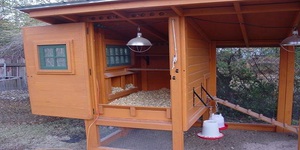 arrangement of premises;
The most important stage is creation of a "house"" for the bird population. The future success or failure of the enterprise will largely depend on this. First of all, you need to choose the type of breeding: cage or floor.
Cellular content
You can find countless videos online that clearly demonstrate the process of building a chicken coop yourself. You'll see that it's not difficult at all; the key is to approach the task wisely and put in the effort and diligence. You can raise chickens alone or with the whole family.
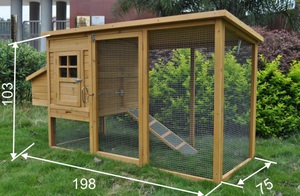
Calculating the required size of the laying room is very simple: no more than four birds should be housed per square meter. Only then will the hens feel comfortable and free. The standard size of a chicken coop is approximately 3 square meters.
Floor keeping of laying hens
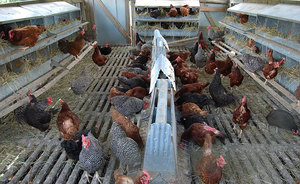 When choosing this method of breeding, you should tidy up the floor in the room: to avoid hypothermia and a drop in the productivity of chickens, it must be insulate with clay or earth, you can cover the top with peat, straw or sand.
Necessary provide natural light, but for winter, artificial insulation should also be provided. The room itself should be dry, well-ventilated, but free of drafts. The floor is covered with crushed stone and sand, and then a thin layer of sawdust.
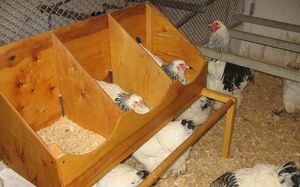
You will also need nests for eggs (one nest per four hens), a perch (easy to make from wooden poles, 20 cm of perch per hen). The optimal nest size is 30 by 40 cm, made of hay or straw, and should be placed in the most remote, dark place.
For additional comfort, birds can be placed indoors. bathtubs, ash boxes, so that chickens can roll around in them, getting rid of parasites like fleas and feather mites. These "baths" are especially important for chickens kept indoors and not allowed outside to roam.
If you plan to work not only with adult chickens, but also hatch chicks, you should prepare in advance prepare the incubatorFor home use, a fan-powered model designed for 70 eggs is best. A standalone power supply is recommended to protect the future chicks from hypothermia in the event of a power outage.
How to choose a breed of laying hens
The success of a start-up business also depends on the right choice of chicken breed for home breeding. First, you need to decide on the cross, that is, the primary product, meat or eggs. These crosses can include:
- Meat (used for large-scale chicken breeding, not recommended for home breeding).
- Egg (high egg production).
- Mixed (difficult to keep at home, it is better to abandon them in favor of purebred chickens).
- Broiler (high productivity, ideal for home conditions).
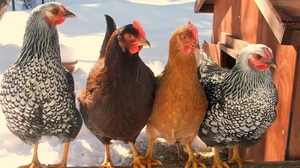 Meat (used for large-scale chicken breeding, not recommended for home breeding).
So, for the maintenance of the house it is best to use egg-laying chicken breedsIf the final product is eggs or broilers (if meat is the intended product). The following egg-laying breeds are most suitable for home breeding:
- Rhodonite (a very prolific, compact breed that tolerates low winter temperatures well and is resistant to diseases).
- Leghorn (high productivity, white shell color, easy to maintain).
- Russian White (they tolerate cold very well, they are neat white hens with good fertility).
- Pushkinskaya.
- Loman Brown (German breed, prolific, tolerates feed changes well).
- Kuchinskaya Yubileinaya (high productivity at an early age, large eggs).
- Hisex (Brown or White, lay large eggs, ideal for beginners, easy to keep).
The age of the chickens depends on the intended purpose: if it is meat production, then the age of broilers is one day (it is very easy to determine this by the cover - they have soft down instead of feathers), for egg-laying breeds it is more significant - 3-4 weeks (in such chickens the feathers are already developed).
Selection and purchase of feed
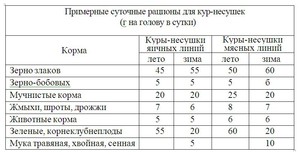 If the chickens require specialized feed compositions, then adult birds will gladly taste grain (suitable buckwheat, wheat, barley) or compound feed. To ensure the bird's healthy development, it is recommended to periodically feed it mineral and vitamin supplements.
Calculating the required amount of feed is not difficult: one bird will require up to 100-120 grams of grain daily. Feeding is carried out twice a day, while access to clean water must be provided at all times.
In winter, green grass, pre-prepared hay, eggshells, and crushed chalk should be added to the diet. During the autumn molt, flax and sunflower seeds and oilcake are added to the feed.
Main - choose a balanced dietOtherwise, a lack of feed will affect egg production. You can watch a video on feeding and caring for laying hens at home.
Keeping laying hens at home
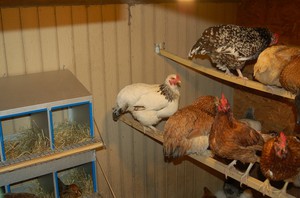 So, you've acquired everything you need, now it's time to properly care for your flock of birds to achieve the desired results. First of all, you should adhere to the main rule of care: cleanliness in the chicken coop.
It's important to regularly clean up the birds' droppings and clean the bedding in the cages at least a couple of times a week. Layers absolutely adore fresh air, so it's important ensure regular ventilationThe video demonstrates the specifics of keeping laying hens at home.
In winter, laying hens need special care. First of all, you should insulate the roomCompletely eliminate drafts. Temperature and lighting conditions should be similar to those of spring; this will maximize egg production. It's best to include green grass and vegetables (carrots and cabbage pieces) in the diet to provide the birds with vitamins.
In spring and autumn carry out cullingWeak hens and those with low productivity are removed, which helps identify good layers. These are the ones that should be used for breeding. There are several secrets for identifying productive layers.
First of all, this is an active, cheerful bird, with a smooth comb and a short, elastic beak. Also, pay attention to the distance between the pelvic bones: in good layers, it is quite wide, about 6 cm, while in unproductive birds, it is significantly smaller, with fat clearly visible on the bones.
With proper care, the resulting eggs will surpass factory-raised eggs in many ways, be more nutritious, and have a natural yolk color. If you produce a large quantity, you should have them veterinarily inspected and sell them with confidence! Demand for these eggs is always higher than for factory-raised eggs.
Breeding laying hens at home
Productive layers are good in every way, except for one thing: their maternal instincts are weak. Therefore, those who want to try their hand at breeding should invest in an incubator.
For convenience, the incubation process is divided into three periods, each of which has different conditions:
- the first day - the eleventh (the highest possible temperature is required, about 38 degrees, with high humidity);
- 12-18 days (temperature drops to 37.4 °C, humidity should also be reduced);
- 19-21 days (the temperature drops to 37 degrees, but the humidity increases to 70%).
It is important to remember that in the incubator ventilation must be carried outto promote proper development of embryos.
Useful tips from experienced poultry farmers
We invite you to familiarize yourself with the wonderful tricks shared by experienced chicken breeders:
- For a chicken, a day lasts from 6 am to 7 pm, so in winter, the bird can be “tricked” by turning on artificial lighting.
- If the goal is to obtain eggs, then purchasing a rooster is not necessary, however, his presence will contribute to an increase in egg production.
- At home, you can keep about 30 laying hens.
- Statistics show that a single hen lays an egg every two days, and the active production period lasts for about six months, after which the coop's inhabitants need to be replenished. To avoid major, one-time expenses, you can gradually add young birds to the coop.
- Since laying hens are not known for their neatness, it is advisable to choose closed-type drinkers; this will help keep the water clean and fresh for longer.
- Layers are known for their sociability, so even novice poultry farmers need to buy at least three hens to keep them from getting bored.
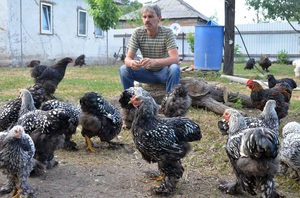 For a chicken, a day lasts from 6 am to 7 pm, so in winter, the bird can be “tricked” by turning on artificial lighting.
The costs of keeping laying hens are minimal, with proper care these feathered beauties will faithfully produce eggs, environmentally friendly fresh product, which can be consumed directly or, if scaled up, sold in stores and markets. Even a beginner can handle caring for these unpretentious birds.