Care and love aren't the only things our four-legged charges require. Sometimes, in an emergency, a pet may need immediate help. While treating wounds or cleaning ears is easy for cat owners, not everyone is brave enough to give a cat an injection. Intravenous and intra-articular injections are best left to a specialist.
Anyone can learn how to administer medications intramuscularly if they're willing. Professionals, of course, already have the skills and experience. However, often, even after receiving recommendations from a veterinarian, owners aren't prepared to take their pet for treatments several times a day or on weekends. The only solution is to master the injection technique themselves. The simple procedure of administering an intramuscular injection won't pose any problems, even for a novice, if you follow the generally accepted procedure.
Content
How to choose a syringe for injection
Experts say that the easiest injection for cats is one into the scruff of the neck. Injections containing anesthetic medications are the least painful.
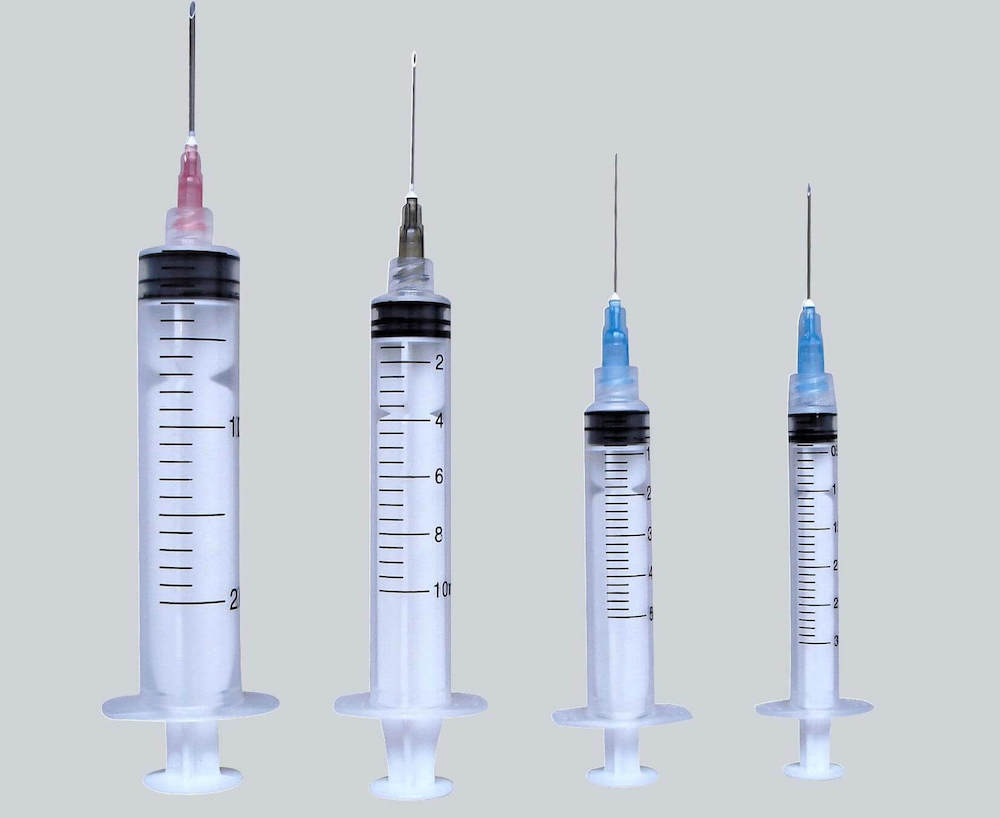
In any case, depending on the method of drug administration and its purpose, specialists recommend choosing different syringes, and the thickness of the needle also matters:
- For large-volume intramuscular injections, select standard 1 ml syringes with a seal; for subcutaneous administration, select 5 ml syringes.
- Graduated insulin syringes with a fine needle are ideal for administering medication into the shoulder or thigh muscles of cats, and are also ideal for kittens. The fine needle, plunger, and convenient small size allow for precise injections without damaging the sciatic nerve or joint.
- Oily viscous medications are administered using regular syringes with a volume of at least 5 or 10 ml - since their needle diameter is larger (4 * 0.7 mm) than that of insulin, they help to carry out the procedure quickly and painlessly.
- For animals weighing up to 3 kg, 1 ml syringes are used. For cats over 3-4 kg, 5 or 10 ml syringes are convenient for subcutaneous administration.
To give an injection to a cat, the instrument is selected based on the dosage and consistency of the prescribed medication.
How to prepare a cat for an injection
Administering medications to a cat is not difficult, but it does require some preparation. If you decide to administer the injection yourself, you won't be able to complete the procedure immediately.
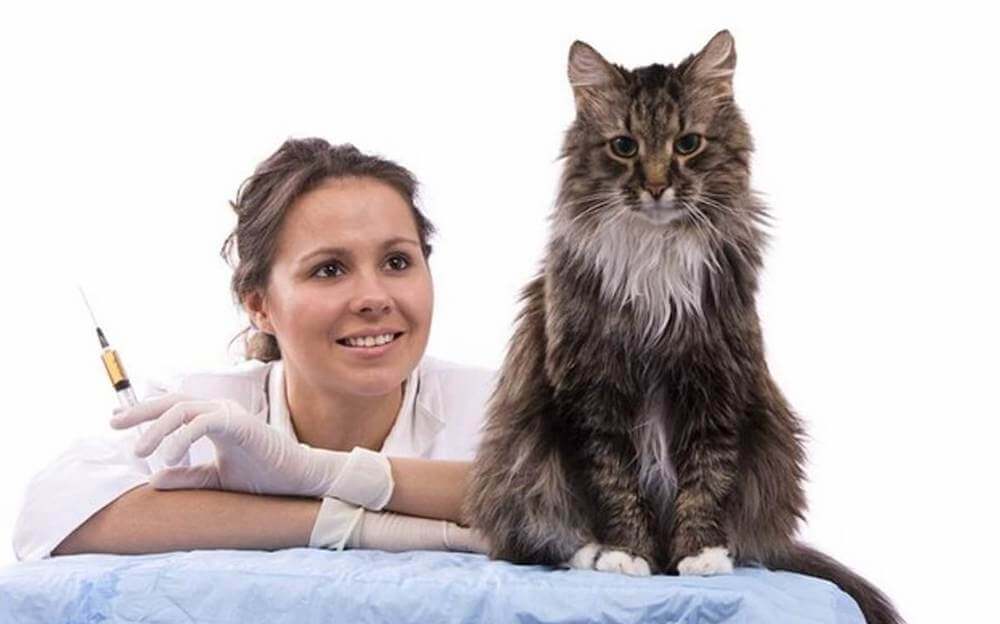
Preparing your furry friend is half the battle.
- We prepare medical instruments and drugs in advance.
- Please note that a new sterile needle is required for each injection.
- Next, read the instructions for the medication. After removing the medication from the refrigerator, it should be warmed to room temperature. Simply hold the ampoule in your hand for a few minutes (or place it in a container of warm water (up to 40 degrees Celsius) for a couple of minutes).
- We fix the cat on a hard, flat and non-slip surface - this can be a table or the floor.
- Kindness and gentle address by name certainly won't make your cat endure everything, but it will inspire trust and a positive attitude. You'll be able to calmly prepare the medications for administration and draw them into the syringe.
- It is best and most convenient to give intramuscular injections together, with one person holding the animal and the other performing the procedure.
- If no one is nearby, it's easier to use a blanket and wrap the cat, completely covering its paws. Leave only the rear area accessible—specifically the thigh, or, if using subcutaneous injection, the withers.
- It's crucial to administer the injection into a relaxed muscle. If the paw is tense, the intramuscular injection is administered after massaging the limb.
- The medication is drawn into the syringe barrel in the volume specified in the instructions. Powdered medications are first diluted with novocaine (saline or any pharmacy product specified in the package insert or recommended by a veterinarian).
All movements must be clear, precise and accurate.
Where can I get an injection?
Intramuscular injections are most often administered to cats in the thigh muscle or under the skin at the withers. Alternatively, you can inject the cat in the elbow—the most fleshy area of the muscle—but this is a bit more difficult than in the thigh. The reason is that the muscle in this part of the body is smaller and thinner.
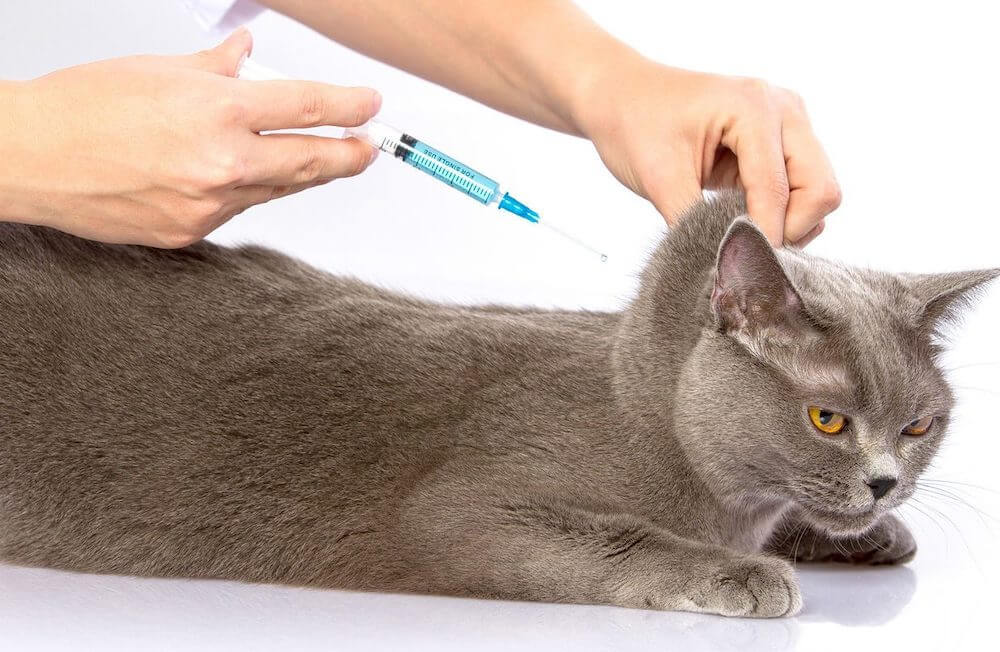
Subcutaneous injection is practiced exclusively in the withers - under the pulled back skin.
How to give an intramuscular injection to a cat
There is an average calculation generally accepted by specialists: on average, 1 ml of medication should be administered per body part for a cat weighing 4-5 kg, with an injection rate of 2-3 seconds. If a larger amount of medication is required, as recommended by a veterinarian, it is advisable to divide the dosage into several injections at different sites.
It's important to remember that intramuscular injections are always more painful than injections into the scruff. This is why veterinarians recommend enlisting the help of a partner before beginning the procedure. It's a good idea to have a partner nearby to help stabilize the animal. The outer central (softest) side of the thigh should be exposed and accessible.
We remove the syringe from the packaging and draw up the required dosage of the medicine, firmly placing the needle on the syringe.
Release the air bubbles and put the syringe aside:
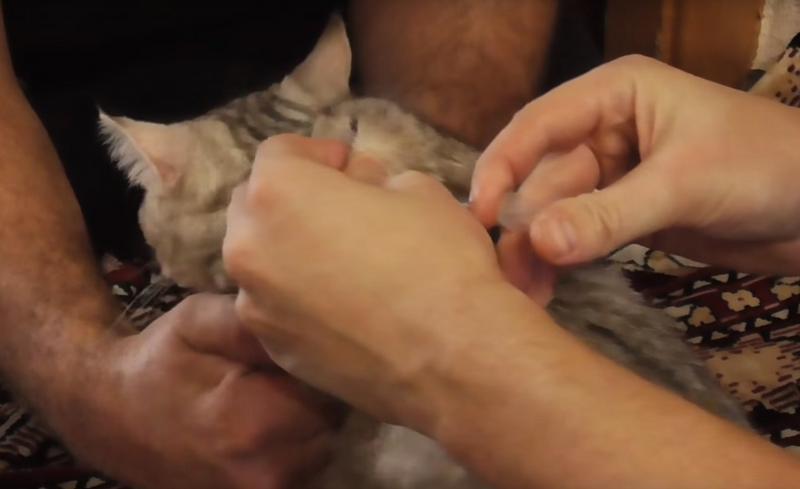
- One person holds the cat by the scruff, close to the ears. We secure the head and gently grasp the front paws.
- The second person presses the hind legs firmly, but without squeezing them together, with his left hand.
- With the right hand, insert a regular needle one-third at an acute angle to the surface of the skin, and an insulin needle halfway into the muscle.
- The medicine is administered slowly, without applying excessive pressure.
Read also about First aid for a cat in case of poisoning.
How to give a cat an injection in the thigh
An injection into the thigh is more painful than subcutaneous injections. Therefore, even the calmest animal may exhibit aggressive behavior and may twitch. It is crucial to securely hold the limb in your hand and the animal.
Step-by-step instructions for administering medications into a cat's thigh:
1. Fix the thumb on top and the palm on the bottom.
- We palpate the muscle—gently, carefully, and gently, without causing aggression or pain to the cat. Palpation allows us to feel the muscle thickness to avoid puncturing the femur during the injection.
- Quickly (but not abruptly) insert the needle one-third of the way through—no more than 1 cm—at a 45-degree angle. To ensure the needle hasn't entered a blood vessel, pull back slightly on the syringe plunger. If no blood enters the cylinder, everything is fine.
- We push the medicine out with the plunger. If the medication is painful, do this slowly.
- If the procedure is being performed without assistance and the pet breaks free, don't immediately pull the syringe out of the muscle. Release the instrument and re-hold it with your hands, securing the animal again. The cat's initial pain from the needle insertion will have subsided by this point, so simply administer the medication carefully – the pet will be fine.
When a veterinarian prescribes treatment for several days, the drug is administered alternately to both limbs.
Subcutaneous injections
Firstly, subcutaneous injections are less painful for pets. Secondly, a larger volume of medication can be injected into the withers than into muscle tissue. On average, experts recommend injecting up to 50 ml of medication per subcutaneous area. Here's how it's done:
- Using three fingers, pull the skin upward in the withers area (where the shoulder blades are located). This pulls the skin upright, creating a space between the back and the skin held in place by the fingers.
- In this case, the drug will be delivered subcutaneously, rather than deep into the muscle. Therefore, the needle should be inserted halfway at an angle of approximately 45 degrees (almost parallel to the back).
- Slowly inject the drug and remove the needle.
Only after this do we release the animal.
Useful tips and recommendations
Here are a few features you need to know:
- No-shpa, analgin, ceftriaxone are very painful medications, they are administered carefully and the animal must be well immobilized.
- It is recommended to dilute Ceftriacon only with novocaine.
- When you need to give a cat an injection in a very small dose - up to 0.1 ml, choose only an insulin syringe - with conveniently located divisions.
- In veterinary medicine, the injection site is not shaved, and the area of skin under the fur is not disinfected.
Read also, How to prepare a cat for vaccination.
What happens if you give the injection incorrectly?
An untrained owner is always afraid of making a mistake when administering medication to their pet. There are a number of mistakes made with intramuscular and subcutaneous injections, but they can and should be corrected.
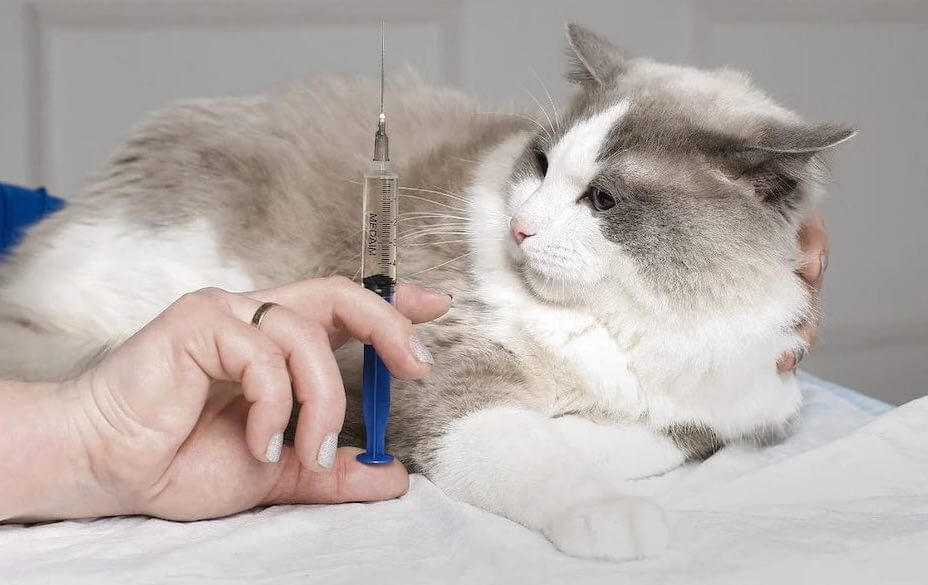
If the medication isn't absorbed well and your pet begins to limp, gently massage the affected area (without causing discomfort). Typically, the cat will be able to walk again the next day. If this doesn't happen, consult an experienced specialist immediately. They will prescribe topical applications for the hematoma and, if necessary, drain any fluid accumulated in the soft tissue.
If a subcutaneous injection is required, be careful not to puncture the skin fold. If droplets appear on the back of the needle, it may have penetrated too deeply, creating holes in the adjacent fold. To correct this, pull the plunger back slightly and try injecting the medication, carefully monitoring for any leakage.
Avoid allowing oil-based medication to enter your bloodstream.
It is not recommended to administer several drugs at once in one syringe.
Any lumps, bumps, or pus at the injection site should alert the owner. The pet should be examined by a veterinarian to rule out infection.
After the procedure, monitor your cat's well-being - the drug is not always suitable for animals.
Naturally, errors in dosage and drug selection must be avoided, as such mistakes can be fatal for pets. Therefore, any treatment should only be initiated after consultation with a veterinarian.
The entire process of administering medications to cats consists of several steps. It's important to seek qualified advice and follow the entire process step by step. Remember, the most important outcome is the health of your furry friend.
Read also, How to make a collar for a cat with your own hands.