Feeding a chick that has fallen from its nest and been picked up by compassionate passersby is difficult. This is primarily due to the fact that young birds are almost constantly hungry up to a certain point. After all, it's well known that the parents—both male and female—fly tirelessly, often taking turns, chasing bugs, and upon arriving at the nest, they are met by several wide-open, screaming mouths. Therefore, the best course of action in the event of such a discovery is to find the nest and return the unfortunate wanderer to it.
If you decide to take him with you, you'll have to forget about work and everything else. And don't feed the chicks just any food: they won't eat everything a person considers edible.
Content
Peculiarities of home care for fallen chicks
Raising a fallen chick to adulthood in an apartment is often impossible: this only happens to certain bird species. However, if there are no other options, you can try to raise it to the point where, if released into the wild, it can survive independently without dying on the first day. However, the first step upon discovering a chick on the ground is to try to find its nest. This is often in a nearby tree: the young bird won't "crawl" far. However, nests are always well camouflaged, so you need to keep an eye out.
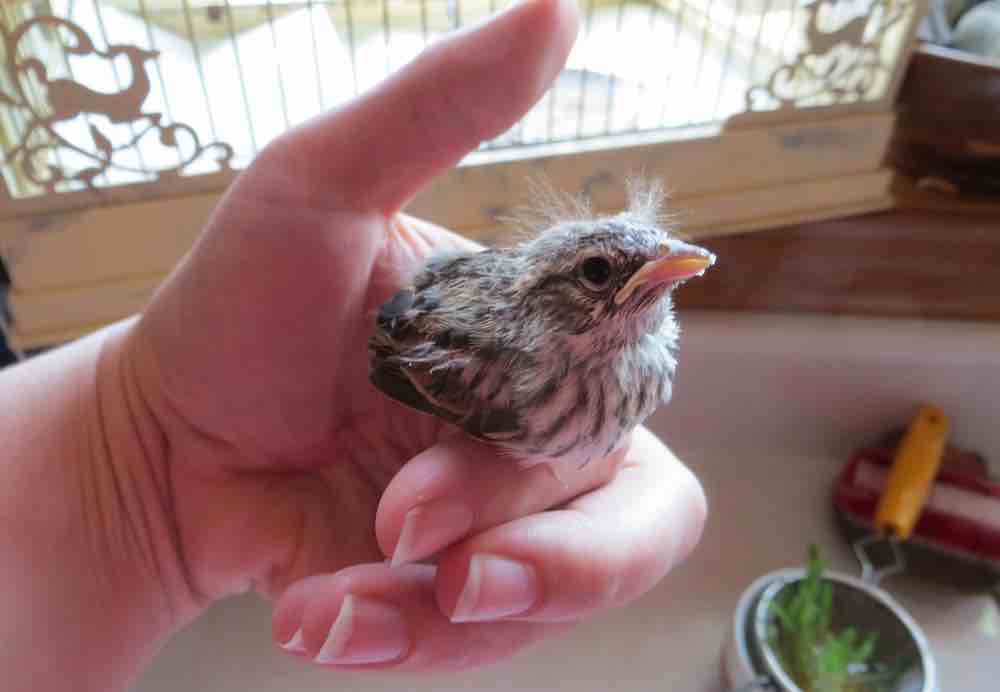
Having found the bird's nest, place the chick inside with both hands. While doing this:
there is no need to worry that the parents will not accept the baby, this happens extremely rarely;
To avoid frightening the bird family, you should carefully move away from the nest;
If no signs of life are found in the nest, you should not place the chick in it; you will have to continue to take care of it.
What does this care entail? It depends on the situation. Sometimes, not just one chick is found, but several siblings, and a nearby nest has been blown away by the wind or destroyed by unkind hands or paws. In this case, the best solution is to secure the nest to a tree and return the chicks to it. If the nest is severely damaged, you can secure a basket or box in its place. The likelihood that the parents will return to their young is quite high.
If it's not a nest destruction, but the disappearance of a bird family, it's worth trying to find a rehabilitation center: such organizations exist in many cities. They employ specialists who will definitely help a chick, even one injured in a fall. And in the most extreme case, taking it home and feeding it is a good idea.
Beyond feeding, the pet will need at least some semblance of a nest. This could be a box or bowl lined with straw, small branches, and sprinkled with sand and sawdust. For easy cleaning, it's a good idea to line the nest with paper towels, as these will need to be changed frequently. To protect the chick from drafts, and especially pets, the nest is often placed in a large glass container (an empty aquarium) and covered with gauze. As the chick ages, the nest is replaced with a regular cage. Very young chicks will need to be fed not only frequently but also by hand.
What to feed
You can't feed a chick food from your own table, but it's also impossible to completely replicate the diet its parents provide. The nature of the food will change over time, but fortunately, the smallest birds, regardless of species, are fed roughly the same diet.
The following formula is suitable for newborns:
- food for kittens (3/5);
- hard-boiled eggs (1/5);
- mealworms (1/5).
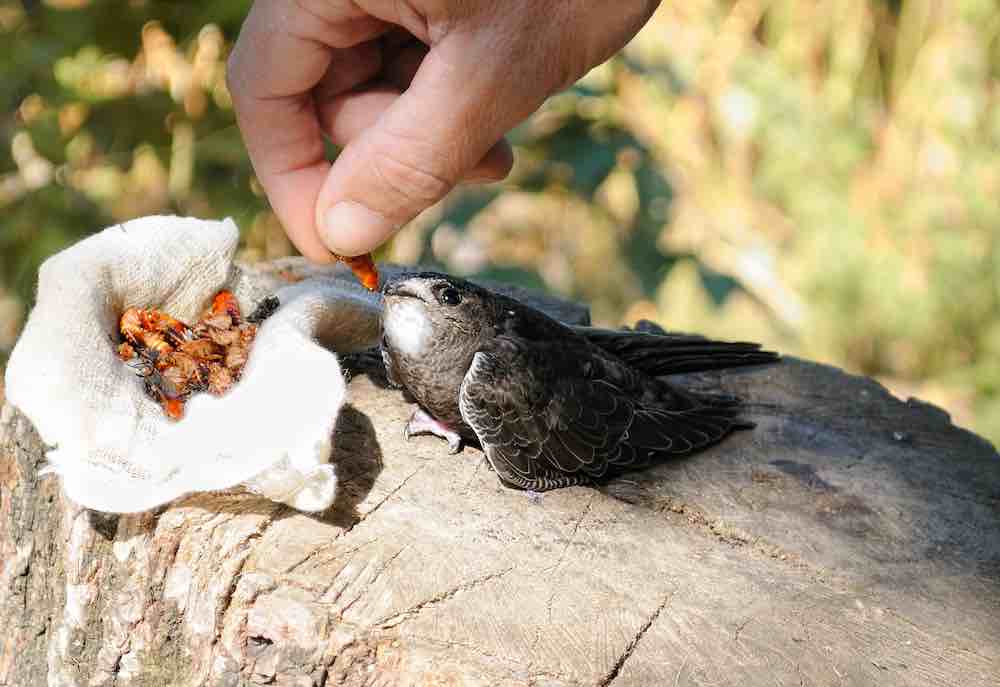
The cat food is soaked until it forms a soft, but still water-free, paste. Hard-boiled eggs and mealworms (available at bird markets and pet stores) are ground to a consistency that the chick can easily swallow in individual pieces.
As the bird matures, the composition of its food gradually changes. A sign that porridge is no longer enough is activity, which leads to the chick jumping around the nest.
At this time, they begin to give more “adult” food, the nature of which depends on the type of bird:
- For insectivores, finely chopped earthworms and grasshoppers, flies, and crickets are added to the starter food;
- those who prefer plant foods are given fresh berries and soaked raisins;
- Chicken or turkey are suitable for predators.
It's not difficult to feed baby pigeons: they will eat unsalted porridge from birth.
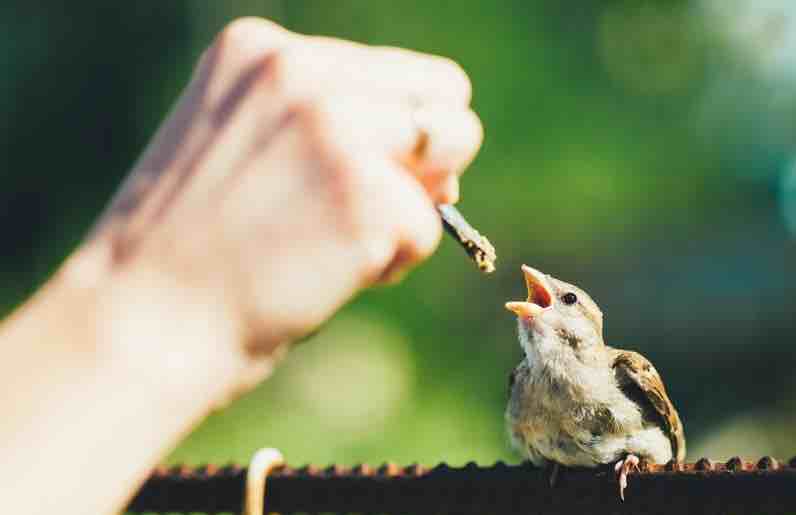
An important question: how to feed a chick? This should be done with extreme caution, as the baby bird must have food placed directly into its mouth. To avoid injury, blunt-tipped tweezers or plastic clamps are suitable.
Taking a little food with this tool, they give the cub the command for lunch:
- when the beak is open, food is immediately placed into it;
- If the chick is still completely clueless and keeps its beak closed, lightly tap it with tweezers;
- If this fails, the owner has to carefully open the chick's beak with his hands.
Immediately after swallowing the first portion, the bird realizes it needs to open its beak again. Food is given until it stops doing so.
How often to feed
It's known that in the wild, birds will drop food into their young's beaks not just dozens, but over a hundred times a day. A chick left without food for just a few hours risks starvation. Therefore, even in captivity, a young bird, not yet leaving the nest, needs to be fed at least every 15-20 minutes. This leaves the willing owner with only a few hours to rest at night.
The chick's first breakfast should be before 6:00 a.m., and its last dinner after 10:00 p.m. Only after the chick's eyes have reliably opened and feathers have begun to emerge will the intervals between meals double. Once it begins to move around the box, feedings will be required every 45-50 minutes. As the bird ages, feedings become less frequent, but the volume consumed increases significantly. However, this will become easier for the owner: the bird will become more intelligent with age, and it will be possible to leave food in or near the nest so that it can feed itself.
Read also about the kingfisher bird.
What you shouldn't feed a chick
It's natural for humans, and especially for children, to give their young milk and bread crumbs. While this is suitable infant food for many animals, this isn't the case for young birds. Chicks cannot drink or digest milk, and bread lacks the nutrients necessary for proper development. As the chick matures, it will begin to peck at the bread crumbs, but during infancy, they are useless. As for older chicks who are given insects, experts warn against feeding them bedbugs and Colorado beetles.
Water is a separate issue. Adult birds are known to drink even from puddles. Young chicks don't need water as such: they don't know how to drink it, and there's a high risk of water getting into their lungs, which can have serious consequences. However, the food should be moistened so that water can be absorbed. A little later, water is given from a pipette (2-3 drops per meal). When the chicks reach a certain age (start jumping around the nest), they are given a small container of water, from which they learn to drink independently; human assistance is not required.
Tips and nuances
Don't expect that feeding a chick found on the street will become significantly easier with time. While very young, featherless, fledglings are clueless and unafraid of humans, adolescents are already beginning to be frightened: most birds, unlike kittens or puppies, never understand that the person who has sheltered them is a friend, not an enemy. While young chicks quickly open their mouths at the sound of tweezers containing food, older ones are already beginning to be frightened, and feeding them requires even more caution.
Since not every city has a pet store, finding specialized food can be difficult. While puppy and kitten food is now sold even at Magnit and Pyaterochka, the same doesn't apply to mealworms. Suitable substitutes have to be found. This is usually not a major problem, and other products are gradually added to the boiled eggs.
This, for example:
- cottage cheese;
- grated carrots;
- boiled beef or chicken breast;
- fresh herbs (chickweed, dandelion, lettuce);
- dry daphnia or gammarus;
- finely crushed eggshells.
Ant eggs are a wonderful food for slightly grown chicks, but you have to go into the forest to get them.
Experts advise against taking home fledglings—grown chicks that leave the nest temporarily, even though they haven't yet fully learned to fly. Even if a fledgling sits on the ground, this is normal: it hasn't fallen out of the nest. To confirm this, simply observe the bird.
Most likely, it's capable of moving independently, and its parents are still feeding it, including on the ground, and they will also help it return to the nest. The only thing a person can do to help is to move such a bird away from traffic or where cats are waiting for it.