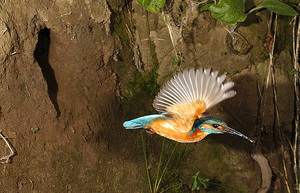
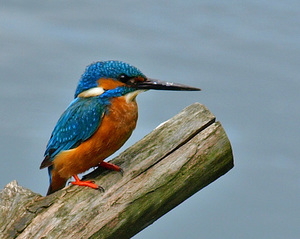
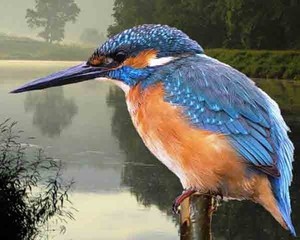
 The kingfisher is a very beautiful bird found throughout the Russian Federation except for its northern regions, as well as in Belarus, Ukraine, Europe, and Central and Southern Asia. The most well-known kingfisher in Russia is the common kingfisher, also known as the blue kingfisher. This bird gets its name from the blue color of its wings and back. Two yellow stripes run from the sides of its head to the nape, and a distinctive white patch can be seen on its neck, which in females can have an orange tint.
The kingfisher is small: the distance from its bill to the tip of its tail is only 18 centimeters. Its wingspan is 8 centimeters. weight reaches 45 gramsThe bird's plumage is thick, allowing it to dive easily to depths of up to one meter. Its long bill makes it an excellent fisherman, but its very short legs make it almost incapable of walking.
Where it lives and how it hunts
 The kingfisher lives around wooded rivers and lakes. To build its nests, it digs fairly deep burrows, up to 1 meter deep, in steep banks. If the bird cannot find a suitable nesting site, the nest may be located a considerable distance from the water, up to 300 meters, when a suitable cliff is within reach. ends in a round cave, where the female incubates her chicks. Kingfishers don't build nests as such; they usually lay their eggs directly on the ground.
It's very difficult to spot a kingfisher in the wild. It usually stalks its prey from the cover of overhanging trees. Rarely, the bird hunts from a stump or branch protruding from the water, allowing the bird to be seen in all its glory. The usual food of kingfishers is:
- small fish: gobies, white bream, bleak, etc.;
- aquatic insects;
- small mollusks;
- fry of almost any species of fish.
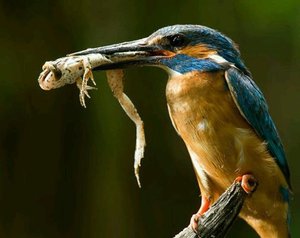
Upon spotting a fry or other prey, the feathered swimmer dives into the water, snatching the food with its long beak, usually across its body. Holding the fish, it returns to its original spot and kills it in the usual fisherman's manner: grabbing it by the tail and slamming its head against a branch repeatedly, after which it swallows it head-first or carries it to the female and her chicks.
It's not difficult to distinguish a kingfisher's burrow from the homes of other animals: it always smells foul. The fact is that this bird is not very cleanOver time, a layer of fish scales, shells, bones, and other debris accumulates on the nest floor. All of this mixes with the excrement of the chicks and parents, becoming a desirable home for flies. The situation is further exacerbated by the fact that kingfishers are monogamous, and a pair returns to the same burrow year after year.
Reproduction
 The male courts the female in a rather trivial manner: by presenting her with a small fish he's caught. If the gift is accepted, the birds become a pair. Most kingfishers, as mentioned above, are monogamous, reuniting annually after wintering, and the same family breeds their young in the same location as last year. Exceptions have been reported, where the male prefers polygamy, caring for several females and their offspring simultaneously.
Worthy of special mention housing construction processBoth birds dig, scraping out the earth with their beaks and feet. If an obstacle is discovered in the ground during construction, they abandon the burrow and begin digging a new one. The entire process usually takes a week.
In the prepared nest, the female lays 7-8 eggs. Both parents take turns incubating the chicks. It's worth noting that the offspring are quite voracious; a single chick can eat more than its own weight in a single day. The young kingfishers are born blind and naked. It takes three weeks for the chicks to fully feather, after which they are ready to leave the nest. This occurs around mid-June. From then on, the parents feed the chicks for a few more days and, most often, lay a new clutch of eggs. Thus, kingfishers can hatch two or, less commonly, three (in southern regions, early spring) offspring during the summer.
The distance between the houses of different pairs is quite large and ranges from 300 meters to 1 kilometerDespite their apparent fertility, the numbers of these birds are declining annually. The reason isn't their natural enemies, of which kingfishers have virtually no predators. It's difficult to hunt a bird that masterfully conceals itself under the canopy of foliage and reaches speeds of up to 80 kilometers per hour in flight. The main reason for the kingfisher population decline is humans, who are destroying their natural habitat. Because of their activities, it's increasingly difficult for the birds to find clean forest water.
The secret of the name
There are several theories as to why this bird has the word "kingfisher" in its name. The most logical explanation is that chicks of this species are born in winterThis theory has long been refuted by scientific observations. Moreover, none of the kingfisher species (for example, the collared, large pied, rufous, or ruby-throated), even those living in the very warm climates of northern Africa or southern China, breeds during the winter months. There is no definitive answer to the question of why this beautiful bird was given this name. Let's consider several theories about the origins of this name.
 The first and most plausible theory, according to the author, is that it is a corruption of the word "shrew." A fairly logical explanation, given the bird's reproductive method.
- There is a suggestion that this name came from the Greeks, who observed this bird only during its wintering period in the Balkans and the Peloponnese Peninsula.
- Legend has it that people couldn't find kingfisher nests for a long time because they were looking for typical bird structures, not burrows. This led researchers at the time to conclude that this species breeds in the winter.
 The first and most plausible theory, according to the author, is that it is a corruption of the word "shrew." A fairly logical explanation, given the bird's reproductive method.
Be that as it may, we now know perfectly well that this name has nothing to do with winter. Incidentally, other cultures call the bird by more appropriate epithets, for example, in England, "kingfisher." known as the Fisher KingThis avian species appears in the tales and legends of many cultures, always portraying the role of an elusive, magical bird from the forest depths. Some of these stories are quite poetic, evoking the bird's monogamy and its vibrant plumage.
Seeing a kingfisher has long been considered a good omen; people considered it great luck. One can only hope that human-induced changes to nature won't drive kingfishers to extinction, and that fishermen will continue to encounter these beautiful birds in the wilderness.