Rabies in foxes is a fatal disease that also poses a threat to humans who dare to come into contact with the wild animal. It's important to know the signs of rabies in animals and never approach foxes, nor dogs, for that matter: the disease progresses similarly in both, and the risk of infecting humans is extremely high. If a fox bites a person, immediate measures are required to neutralize the virus; medical attention is essential.
Content
What does a rabid fox look like?
Rabies is common in animals, and not just in wild animals: the phrase "rabid dog" is no coincidence. Cats, wolves, and hedgehogs all get the disease. When the rabies virus enters an animal's body (and even humans), it attacks the central nervous system: starting with neurons, it travels through chains, ultimately reaching the brain.

Symptoms progress rapidly, but become especially pronounced only in the later stages of the disease. Constant salivation occurs, and the jaws fail to close completely. Saliva spreads into the environment, and from there, possibly to new hosts. Hunters often become infected in this way from wild animals, unaware of the danger for a long time.
Experienced zoologists can quickly identify a rabid animal in the early stages of the disease; unfortunately, this is difficult for the average person to do at first. The torn-out tufts of fur and the animal's "sad" appearance alert experienced hunters, although these are not yet clear signs of rabies.
The following changes in behavior are dangerous:
- the fox is not afraid to come very close to a person;
- asks for affection;
- on the contrary, it tries to attack a person and even bite him;
- tries to run for no apparent reason in all directions.
Even more indicative of rabies are the symptoms that appear closer to the final stage of infection:
- excessive salivation, foaming at the mouth, hanging tongue, aggression;
- unsteady gait, loss of coordination;
- squint, swollen muzzle.
A non-specific sign of rabies may also be severe exhaustion of the animal.
The most dangerous months are from February to April: it is in late winter and early spring that the highest number of rabies cases is recorded in wild animals, particularly foxes. This is because these months are the mating season, during which males often fight. They injure each other, meaning the risk of the disease spreading increases dramatically.
A somewhat smaller surge in rabies is observed at the end of the year: in December, the young try to assert their rights, the number of fights increases again, and with them, the number of infected individuals. After these outbreaks, rabid foxes quickly die, and the population declines, but the virus persists: infected animals persist throughout the year.
Rabies, like any disease, goes through a series of clearly defined stages:
- Incubation periodIt can last from two weeks to three months. The danger is that the virus is already in the fox's body, but the disease doesn't manifest itself. This is why a person bitten by even a seemingly healthy animal should seek medical attention immediately.
- Prodromal period. The animal notices discomfort (insomnia appears, the temperature rises slightly), but the illness practically does not manifest itself externally: a person will not notice that the fox is sick.
- Peak periodAt this time, all the signs of rabies appear: photophobia, excessive salivation, panic when exposed to water, aggression, etc. It's easy to notice that an animal is clearly suffering from rabies.
- ParalysisThe hind legs begin to fail, then other organs, and the paralysis moves to the head. The fox chews on inedible objects. The paralysis affects the respiratory center, and the animal dies.
Once the slightest signs of illness appear, it's too late to save an animal. Unfortunately, this also applies to humans.
What to do if you meet a fox
A chance encounter with an animal in the forest naturally evokes the desire to at least take a photo. This can be done, but only from a distance. Avoid approaching a fox even within 10-15 meters: remember that a rabid animal is capable of attacking a person or, conversely, fawning over them. Feeding or petting a wild animal is absolutely prohibited (though it's worth training yourself not to do so even when encountering city cats and dogs).
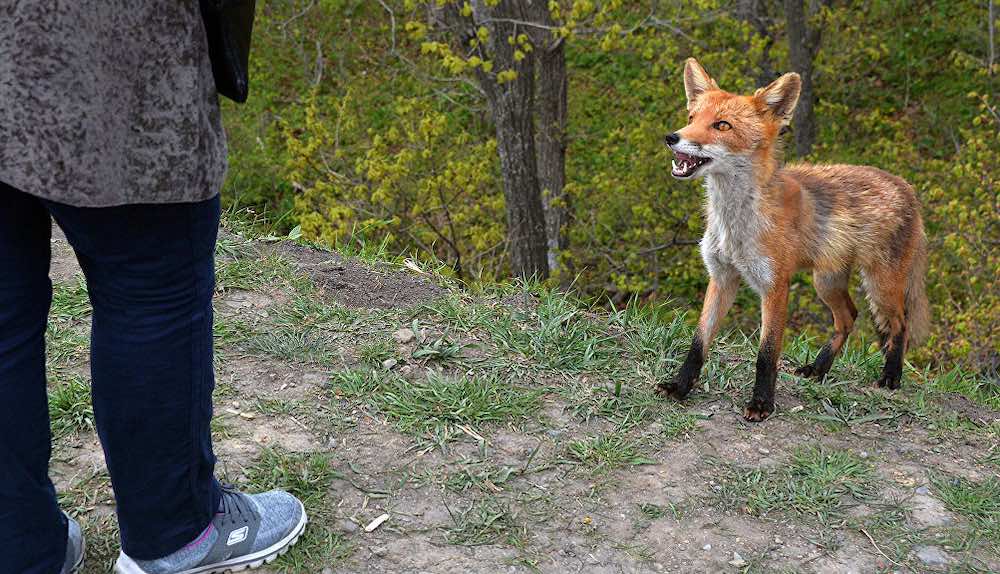
Children always try to catch any hedgehogs they encounter; such attempts are less common with foxes, but they do happen. Never even think about catching a wild fox, even if the goal is to take it to a zoo or a school wildlife area. Only take a photo! Afterward, it's best to leave the area as far away as possible. If you were hiking in the woods with a pet, keep it away from the fox as well.
A healthy fox will never attack a person first, and if the animal tries to do so, it's clearly in pain. A fearless fox lacking self-preservation instinct is almost certainly rabid.
However, wild foxes often carry other diseases, such as intestinal helminthiasis and mange. An encounter with one is not a good sign, and it's essential to immediately get as far away as possible. The question is how to do this if the animal is trying to approach you. Experienced hunters have developed a number of rules of conduct when encountering a fox:
If the urge to feed a wild animal persists, you can toss it a treat from a distance (at least three meters). This, incidentally, is a good way to distract the fox and allow you to escape to a safe distance. Attempts to feed the animal by hand will almost certainly result in a bite: a fox is not a dog and will not eat from your hand.
Before attacking a person, a fox usually growls and coughs. At the same time, the animal flattens its ears. If you see this behavior, you should quickly escape, even if it means climbing a tree.
An attacking fox almost always aims for a person's neck. Therefore, while retreating, it's a good idea to wrap it with any available object: a scarf, a random rag, even a T-shirt.
Trying to outrun a fox by trying to deceive it (for example, by abruptly changing direction like a hare) isn't always successful. A fox can knock down even an adult human with a sudden leap, even though the animal isn't that heavy. Therefore, when retreating, keep an eye on the fox; it's best to act preemptively.
Since the fox is afraid of loud sounds, when meeting it, noise, shouting, hitting a stick on a tree, etc. often help.
A fox loves open space, and a sudden obstacle confuses it. While retreating gradually, it's a good idea to hide behind a large rock or a large tree with a thick trunk. Raising your arms high also intimidates a fox, as it makes you appear larger and more menacing.
When watching a fox retreat, avoid looking it directly in the eyes: most animals perceive such a look as a challenge to fight. Don't smile, showing your teeth.
Waving your arms will not scare the fox, but will make it even more aggressive.
Of course, if you arrived in the forest in a car that was parked nearby, the best option is to slowly retreat to it and lock yourself inside.
Rabies in humans - what to do if a fox bites you
Rabies is fatal to humans, as it is to any mammal. This is important to remember, but don't panic: seeking immediate medical attention and following a doctor's recommendations will prevent the disease from progressing and neutralize the virus once it has entered the body.
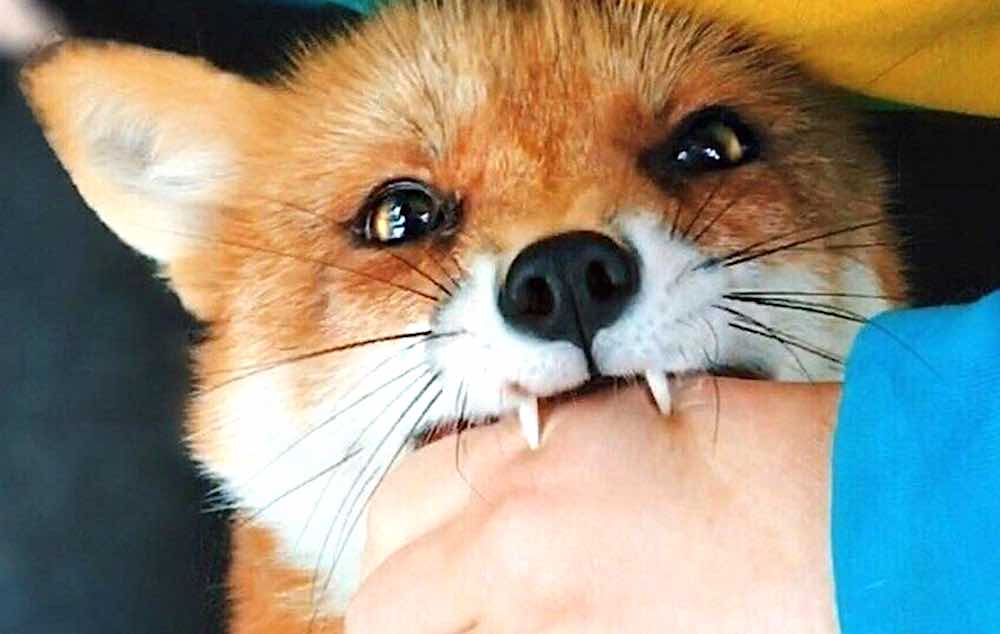
The disease progresses in humans in much the same way as in warm-blooded animals. Infection can be transmitted by foxes, wolves, dogs, cats, raccoons, and other animals, and not necessarily by bite. The disease can also be transmitted by contact of rabid animal saliva with broken skin or even any mucous membranes.
If you do not urgently seek medical attention, you can expect:
- swelling and redness at the bite site, pain;
- headache, photophobia and phonophobia;
- loss of appetite, low-grade fever, diarrhea, panic, insomnia;
- after just a few days – breathing difficulties, convulsions, hallucinations;
- fear of water (even the sight of it);
- paralysis of organs;
- death.
It's clear there's no doctor in the forest. Therefore, the first step is to treat the damaged area of skin. The wound needs to be washed (hydrogen peroxide or at least soap is recommended). Plenty of water is needed, preferably running water. Apply iodine tincture to the bite site, bandage it, and head to the nearest emergency room. An ambulance isn't necessary; you can get to a medical facility on your own.
The first vaccination is required as soon as possible, but no later than three days after the bite or exposure to animal saliva. A tetanus shot is administered simultaneously with the rabies vaccination. If the bite was not a human, but a dog, the animal should be taken to a veterinary clinic.
The number of vaccinations depends on the situation and is administered strictly according to a schedule. What does "depending on the situation" mean? It's important how quickly treatment is started; the doctor needs information about the animal species and the circumstances of the incident. Sometimes, bitten animals are hospitalized for treatment. Medicine isn't what it used to be, and the horror story of "40 injections in the stomach" is no longer valid. A typical course of treatment involves 5-6 injections over the course of a month, according to a schedule. The vaccine is a live, weakened virus, and its timely administration guarantees the absence of health problems.
Read also, How to determine if a dog has rabies.
Rabies in Animals: Tips and Considerations
There are no special nuances when it comes to protecting animals from rabies: the main thing is to try to prevent a bite, and if trouble does occur, don't panic and go to a vet as quickly as possible.

It is important to remember:
- All of the above applies not only to wild foxes: the rabies virus can be present in the body of any animal, including domestic ones;
- When going into the forest, a mini-first aid kit is essential, containing cotton wool, a bandage, disinfectants (hydrogen peroxide, iodine, alcohol, etc.), and a large bottle of clean water;
- When trying to distract a fox with a thrown treat, you must remember that it is a predator that is unlikely to be interested in an apple or a carrot;
- When retreating from an animal, it is better to take small steps, backing away in order to observe it with your peripheral vision and be prepared for anything;
- The virus is especially dangerous for weakened people: children, the elderly, pregnant women, and chronically ill people.
Rabies is a disease that inevitably leads to death without treatment. It's important to teach yourself to avoid contact with unfamiliar animals, especially wild ones, from an early age. An accidental bite isn't a death sentence, but seeking medical attention is essential.
Read also: What to do if a dog bites you.



 Ivanna
1 comment