 The order Trochiliformes contains a single family of hummingbirds (Trochilidae), represented by small, colorful birds. The order is a subspecies of the order Swifts. There are approximately 340 species of these birds, which three centuries ago Europeans considered insects. Their country of origin is considered to be America, from southern Alaska to Tierra del Fuego.
Dimensions Hummingbirds are the smallest birds in the world.In appearance, they resemble stunning, sparkling butterflies or incredibly beautiful, fantastical flowers. Their colors resemble precious gems, sparkling with all the colors of the rainbow. They happily settle in the vast expanses of meadows and fields, inhabiting gardens and building their miniature nests there. Some hummingbird species are sedentary, but some migrate south to Mexico for the winter.
There are such beautiful places on the European continent birds are not commonResidents of these countries can only see their colorful forms in photographs. Kingfishers, whose emerald coloring and small size resemble hummingbirds, live in Udmurtia. They are often confused, but these exotic birds are not found there.
Content
General characteristics of the family
The order includes hummingbirds of various sizes:
 the smallest representatives are called the bee bird (Mellisuga minima) and have a length from the tip of the tail to the tip of the beak of 5–6 centimeters and weigh only one and a half grams;
- The larger birds are called giant hummingbirds (Patagona gigas), they grow just over 21 centimeters long and weigh about 20 grams.
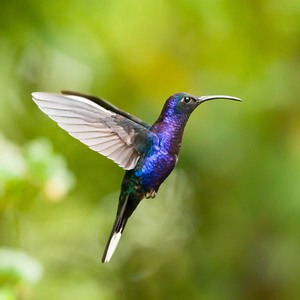 the smallest representatives are called the bee bird (Mellisuga minima) and have a length from the tip of the tail to the tip of the beak of 5–6 centimeters and weigh only one and a half grams;
Birds are found in most countries of the Western Basin Native to South America, this family thrives even at altitudes of 4,000–5,000 meters. These birds constantly migrate from one location to another in search of flowers and plants, from which they extract sweet nectar practically on the fly using their long beaks. These birds thrive in hot weather, but suffer and feel uncomfortable in cold weather. Their normal body temperature is 43ºC, but on cold nights or when food is poor, this temperature drops to 20ºC, under which conditions they enter a restful state, more like hibernation.
Nature did not provide melodic voices for small birds; representatives of many species can produce sounds in the form of chirping, but some species, such as the fly-bird, perfectly entertain garden owners with their sweet singing.
Appearance indicators
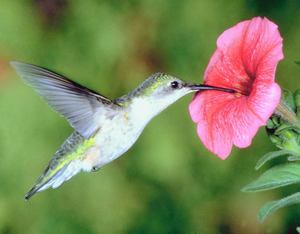
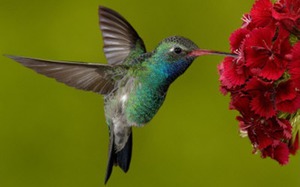
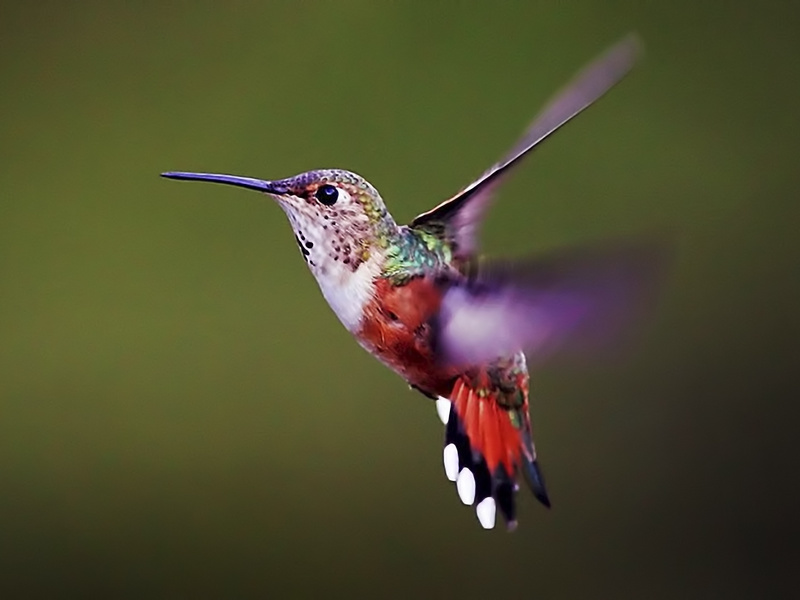
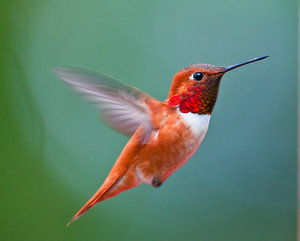
The appearance, as can be seen in the photo, differs from other known bird breeds:
- The beak of birds of the family is thin and long, in different species it can be straight, curved in an arc, directed upward or downward, the upper half hangs down and wraps its edges over the lower half, at the base of the beak there are no feathers or bristles at all;
- the tongue is forked to a sufficient depth, its length allows it to protrude far forward from the mouth;
- strongly developed, sharp wings with a poorly developed forearm are attached to a short shoulder and have 9-10 flight feathers, and about 6 small and short ones hidden under the primary coverts;
- the chest is equipped with a large crest on the central bone;
- weak and very small legs, at the ends of which there are long claws, are absolutely unsuitable for walking;
- the feathers on the crown of the head often form tufts, tufts and other figures, the greatest variety being found in males;
- All hummingbird species have tails of the most varied shapes, created by dozens of feathers; only the racket-tailed species (Loddigesia mirabilis) has only four feathers at the back for steering control of flight;
- Individuals live a lifespan of no more than 9 years.
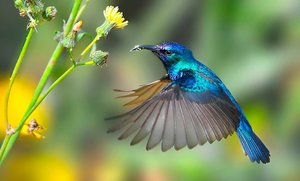 weak and very small legs, at the ends of which there are long claws, are absolutely unsuitable for walking;
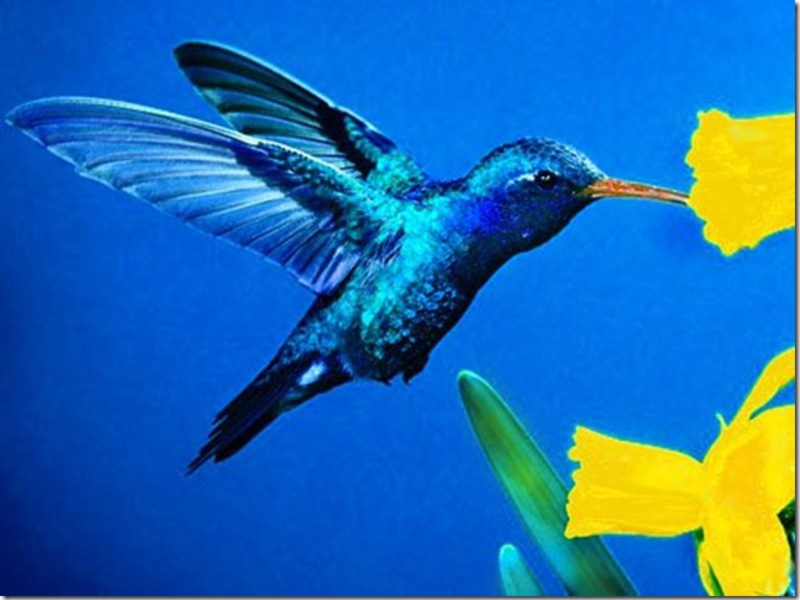
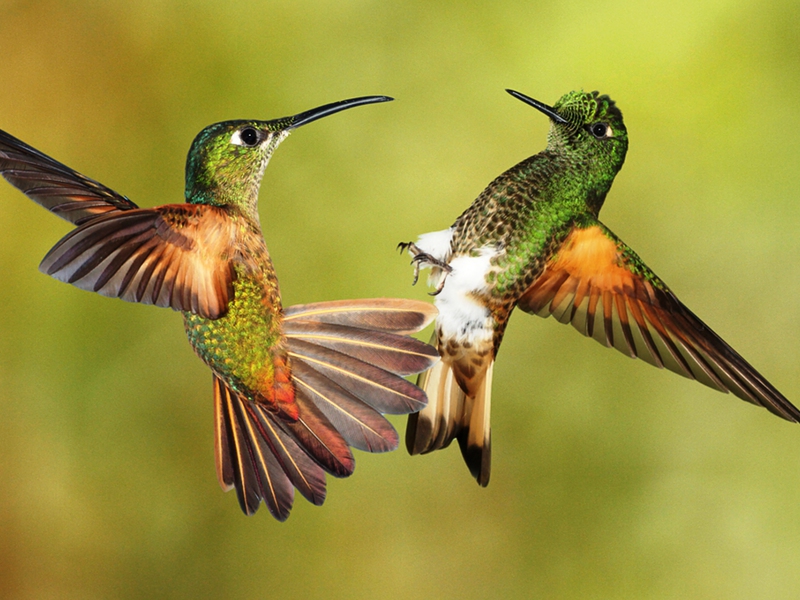
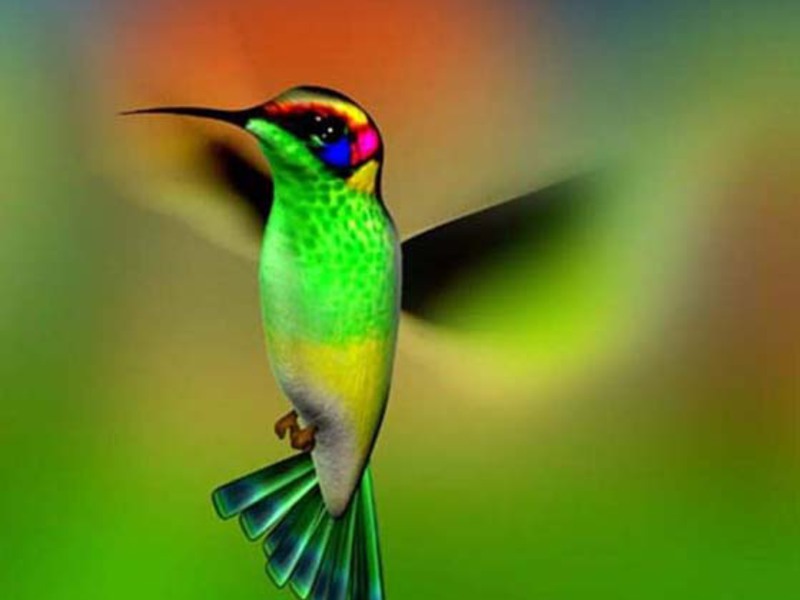
The color of the birds' plumage, if you look at the photo, characterized by very bright shades, metallic sheen, and depends on the hummingbird species and sex. The coloration is influenced by the individual's developmental age, which is also reflected in the tail shape. Males have brighter colors, with whimsical feathers sprouting from their bodies in fairytale shapes, and a riot of crests on their heads. Females have colorful, but duller, colors and a less varied range of shapes.
Some hummingbird species display color depending on the direction of the light beam. In a photograph, only one color can be seen, but in nature, when the lighting changes, the outwardly green bird can sparkle with purple tones or have a blue sheen.
The lifestyle of feathered hummingbirds
Extremely mobile and poorly coexisting birds They very boldly attack representatives of a larger size than themselves, especially during the period of raising offspring.
Flight
Small sparkling birds captivate people with their lightness and grace, which they display when flying in the air:
- Hummingbirds amaze the observer with their dexterous maneuverability, nimble mobility, and high flight speed, which is about 80 km/h.
- Birds of small species, at an average flight speed, flap their wings at a rate of fifty to eighty beats per second; during the courtship period, the male makes up to two hundred flaps; large hummingbirds move their wings eight to ten times per second;
- To feed on nectar, birds hover near a flower, quickly moving their wings; at this time, the wings make a trajectory that resembles a figure eight; at this speed, the feathers merge, and their outlines become invisible;
- It is this figure eight in the air that prevents the bird from moving, the hummingbird remains in one place and maintains balance over the flower;
- the bird performs aerial figures of varying complexity, for example, it takes off vertically and lands in the same way, it flies from side to side, up and down, and can fly forward and backward for a long period of time;
- The small hummingbird pilot can perform such maneuvers thanks to the design of its wings, which, unlike those of other birds, are attached only at the shoulder joint;
- During flight, the hummingbird clicks its tongue, the high speed of rotation of the wings contributes to the appearance of a characteristic sound, due to which a buzzing sound is heard, characteristic of a bee or bumblebee;
- Hummingbirds lead a busy lifestyle only during the daytime, constantly moving in search of food;
- These small creatures have a very high metabolism, which accelerates even more at night, but they cannot go such a long period of the day without food, so with the arrival of the cool of the night they fall into a state of torpor and metabolic processes in the body slow down, which gives the hummingbird time to wait until the morning;
- At night, the body temperature of birds drops to 20ºС, but with the first rays of the sun, the little creatures come to life and continue their bustling life;
- Such a small bird has a strong and large heart, which takes up almost half of the internal space in its body, the stomach is three times smaller than the heart, the main organ contracts at a rate of 1 thousand - 2 thousand beats per minute;
- A calm state gives the heart a frequency of up to 500 beats, and during increased stress the number of contractions will be 1,200 beats per minute.
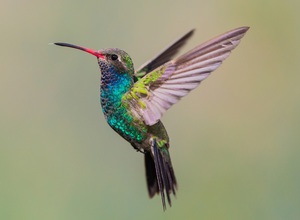 The small hummingbird pilot can perform such maneuvers thanks to the design of its wings, which, unlike those of other birds, are attached only at the shoulder joint;
How do hummingbirds eat?
For such cute fairytale birds and nutrition must be appropriate – nectar. Ornithologists long believed this, seeing birds suck nectar from flowers on the fly. But further study of the birds revealed that the bulk of their food consists of insects, small species of them. The food is hidden inside the flower or on its petals, from where the hummingbirds extract it with their long beaks. Furthermore, the birds don't disdain spider prey caught in its web, sometimes simply catching insects in flight.
Feature nutrition of small hunters Their unique characteristic is that they don't perch on the ground, but feed on the wing, rarely stopping for a rest on a flower petal. These small birds can feed on around 2,000 flowers in the vicinity of a garden or field. This rapid foraging is justified by hummingbirds' voracity, which allows them to consume twice their body weight in a single day. In terms of liquid, the amount consumed in 16 hours is 120 times their body weight.
Procreation of hummingbirds
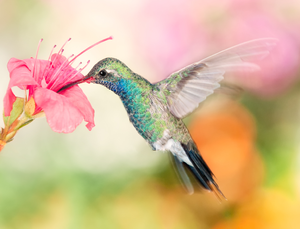 In its existence hummingbirds do not form pairs, and the care of raising the offspring falls to the caring female. She takes full responsibility for building the nest and raising the tiny chicks. The bird's courage and astonishing bravery as a mother are noteworthy. If danger appears within sight, the hummingbird rushes toward the enemy with all the force of a small defender. A swift approach—and the female's long beak slams into the enemy's eye or nose.
Tropical species Hummingbirds produce offspring all year roundFamilies living in northern regions are forced to think about procreation only during the summer months. The male's role in raising the young is limited to mating and defending the nest territory. The female, naturally gifted with the talent of a skilled builder, constructs the nest from available materials—plant fluff, dry grass, moss, and lichen. Most hummingbirds choose bushes and trees for their nests; some attach their nests to leaves, branches, and rocks using saliva.
Nest for offspring depends on the size of the bird itselfSome are very small, about two centimeters in diameter, while others are as small as a cup. By the time the eggs are laid, the nest is ready, and the female places two small white eggs inside. They weigh 0.2 grams each. After two weeks, weak and defenseless chicks hatch, and the female begins to jealously guard and raise them.
Hummingbird breeding
It is known for certain that small hummingbirds can be bred in captivity, but to survive, they need a constant supply of liquid food. Otherwise, even a slight hunger will drain their vitality and they will lie motionless, trying to warm themselves with their wings, carefully covering their bodies with them. These tiny creatures, whose photos resemble fairy-tale butterflies, are a true example of resilience, strength, and inner energy, countering their natural fragility.
Birds are beneficial to humans, being pollinators of flowers and plantsMany bird species are so beautiful that their skins and feathers are used to make jewelry, which is why the populations of some species are gradually declining. Photos of birds and jewelry made from their skins can be found online.
 Some flowers have a structure, which allows pollination only by birds with long beaks. For example, the Datura genus can only be pollinated by the sword-billed hummingbird, which has the longest beak in the bird family. Such exotic flowers include orchids from central and southern America, while the flowers of epiderum, comparettia, cochliod, and ellianthus require hummingbird assistance. Hummingbirds also pollinate the beautiful Rodriguesia and Zegopitalum intermedia, as well as some Peruvian and Colombian varieties of Masdevalia.
If you look at photo of these little birds with multi-colored sparkling feathers, you might think you've been transported to a fairy-tale world, because such beauty is rare in nature.