 The hummingbird is a small and beautiful bird. Nature itself created such a miniature creature. It's not just its diminutive size that's striking, but also its lifestyle and its determined character.
This amazing creature is also called the “bee hummingbird,” and this is justified by the fact that its body length is 7 centimeters, and its weight is just over 2 grams.
Description of hummingbird
But in nature there are also larger hummingbirds, which were named "gigantic"They differ from other representatives in their body length, which reaches 21 centimeters, and their unusual weight for birds of this breed, weighing 20 grams.
The smallest bird belongs to the hummingbird family of the order Colibriformes. In Latin, it would be Trochilidae.
In appearance, one can distinguish the following distinctive features:
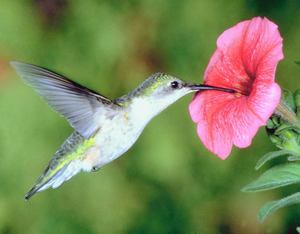
 The beak is long and thin, the upper part of which slightly encircles the lower part with its edges.
- There are no bristles at the base of the beak, as in most birds.
- Forked tongue.
- The wings of this miniature bird are represented by 10 flight feathers, which are very sharp, and another 6 short small feathers, which are almost completely hidden under the covert feathers.
- These birds' small legs are very weak, making them unsuitable for walking. This explains why they spend most of their time in the air.
- Long claws on the paws.
- Bright plumage helps distinguish the bird's sex. Males are more vibrantly colored than females.
- Some species have a tuft on their head or it is colored in an unusual way.
- Each species' tail has its own shape, different from other birds, but all representatives must have 10 feathers in it.
- Not all birds can sing, only some species, but their voice is similar to a weak chirp.
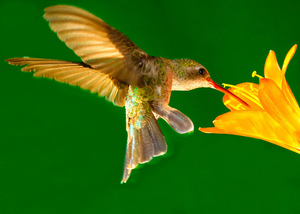 The beak is long and thin, the upper part of which slightly encircles the lower part with its edges.
How many beats per second does a hummingbird make?
Mother Nature has ensured that not all birds are alike. For example, the hummingbird is very different from other birds due to its small size and unusual multi-colored plumage, which is hard to miss and a joy to behold. But what's also surprising is how many times it flaps per second.
Scientists have studied the speed at which hummingbirds flap their wings, and the results are astonishing: while a human can blink only once, a bird can flap its tiny, graceful wings dozens of times. It's been calculated that small hummingbirds flap approximately 80 to 100 times per second. Larger hummingbirds, however, can flap only 10 times per second. Such rapid wing flapping allows this diminutive bird to hover over a flower at any moment and sip nectar with its small beak—or proboscis.
By the way, the flight of a hummingbird is very common compared to the flight of a beautiful butterflyIt's also known that hummingbirds can fly in the opposite direction to other birds. Sometimes, this flight speed can reach up to 80 kilometers per hour. However, such flights are very challenging for hummingbirds, and they expend a considerable amount of energy.
To achieve such high-speed flight, which requires tremendous physical effort, a hummingbird's heart accelerates to 1,200 beats per minute. Compared to a resting state, this bird's heart beats only 500 beats per minute.
Types of hummingbirds
In the modern bird world, in the order of hummingbirds There are more than 350 species of birdsBut only the main types are distinguished:
- A bee, considered the smallest bird in the world, found in Cuba.
- Gigantic.
Where does the hummingbird live?
The hummingbird is known to be found throughout North and South America, as well as Canada. It prefers to nest in any area where flowers are found: fields, mountain meadows, moist forests, and even deserts. This bird is sedentary.
Hummingbird nutrition
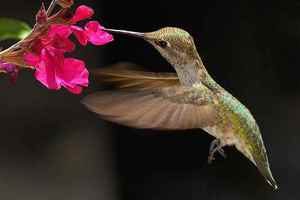 The hummingbird's nickname, "feathered bee," is well-deserved: this bird feeds on flower nectar and also pollinates flowers. They eat on the move, typically feeding not only on pollen but also on small insects.
It is known that the hummingbird, despite its miniature appearance, can be considered one of the most voracious birds. The amount of food it consumes in a day, reaches 2.5 grams And this far exceeds its own weight. A hummingbird also drinks a lot of liquid daily. It's fascinating to watch it devour flower nectar: the bird dips its tongue into the flower's throat at a rate of 20 times per second. Because of this speed, this bird is often compared to lightning.
Hummingbird Reproduction
The nest is very difficult to find because it's so tiny, just like the bird itself. It can be compared to a small cup. The bird builds its nests from a variety of materials found in nature:
- Cobwebs.
- Pieces of bark.
- Fluff.
- Blades of grass.
- Wool.
Hummingbirds build nests in trees or bushes, and some species use their saliva to construct their nests. The female does the nest building. The clutch consists of two eggs. the diameter of which is 10 mmThe female will incubate her eggs for 19 days. However, even after that, she will still be responsible for feeding the chicks.
Interesting facts about hummingbirds
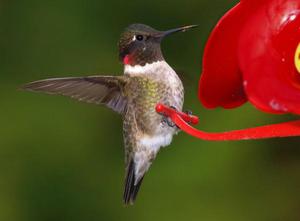 Hummingbirds have many nicknames: "topaz," "flying," "emerald throat," "fiery topaz." But if you're considering buying and taming one, you should think carefully before making such a decision.
Like any other representative of the wild, this bird always needs freedom to live a full life. But unfortunately, it is impossible to create all the necessary conditions for their normal existence in a captive environment. Therefore, conditions can be created only in natural parks, but then you will also need to take care of their nutrition, which is quite difficult.