 For a complete cycle of life on our planet, the presence of birds of prey in nature is an obvious necessity.
Various bird species are naturally gifted at hunting large prey. These include hawks, eagles and falcons, gulls, owls, and others. The unifying criteria for these species are:
- the role occupied in the natural chain;
- method of nutrition;
- lifestyle (time of day when the bird begins hunting).
Content
Diurnal birds of prey
According to the systematization from the point of view of zoology, the orders of diurnal birds of prey include only falcons, these are falcons themselves, hawks, eagles, buzzards, eagles, harriers.
Remarkably, true birds of prey share the same menacing and dangerous appearance: their beaks are hooked, and their talons are curved and very sharp. The coloring of males and females is virtually identical, but females are larger.
Common buzzard
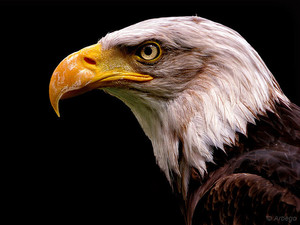 Another name is the rough-legged buzzard. This bird is considered the most famous predator among the tundra forests. It builds its nests throughout the entire Yamalo-Nenets Autonomous OkrugThis predatory species' diet consists of field mice and lemmings. Characteristically, the abundance of rough-legged buzzards directly depends on the abundance of these rodents in the area. Ornithologists claim that buzzards may be abundant or absent altogether in a single area.
External characteristics of the rough-legged buzzard:
- The winter buzzard is a large bird in size;
- has wide wings (this visually makes it even larger);
- general color - light, slightly reddish;
- On the belly and under the wings of the predator there are black spots of varying shapes (they can form an individual plumage pattern).
Buzzards nest in wooded areas, lining their nests with grass. In the tundra, these birds typically nest on coastal cliffs and hills. During a good year for mice, rough-legged buzzards can also nest on flat terrain, in swamps, and in river bottoms.
Buzzards are migratory birds, arriving from warmer climates in early spring. After migrating, they begin to build their nests. Rough-legged Buzzard Egg Size Larger than chicken eggs, rounder in shape, they are spotted and white in color. The richer the year in prey, the more eggs this bird of prey lays. Natural selection plays a significant role in the survival of chicks, especially when food is scarce due to poor rodent production. Many chicks don't even survive to flight age; they are simply eaten by older, stronger chicks.
Buzzards fiercely defend their nests. Attacks on humans are unlikely; more often, the birds simply scream loudly or attack people. However, they fearlessly fight off arctic foxes and dogs, using their strong claws. Rough-legged buzzards have also been observed feeding on dead deer carcasses and their entrails, or on rotten fish.
With the arrival of the autumn period, and throughout it, these predators fly away to the regions of the middle zone.
White tailed eagle
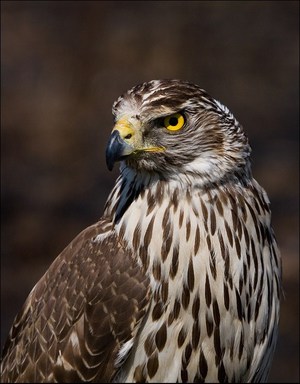 It is one of the largest and most extensive birds of prey in Russia. Its wingspan exceeds two meters, and the bird's weight can reach seven kilograms. Adults over three years of age typically have a pure white tail; others have a dark tail. A young eagle can often be mistaken for a golden eagle. However, the golden eagle's tail is slightly rounded, while the white-tailed eagle's is shaped like a sharp wedge.
White-tailed eagles nest almost throughout the country, avoiding only the northernmost regions and arid areas. They build their nests exclusively in tree canopies, usually deciduous ones. Very rarely, an "eagle house" is located on steep cliffs.
White-tailed eagles feed on fish and water birds. This explains their preference for living near areas rich in water bodies. Their nest is located in the same place every year and has a very massive, layered structure up to a meter high. A white-tailed eagle's nest is extremely rare in the open tundra; it is more common to find it in localized on hills or cliffs.
In early spring, eagles begin arriving from the south. Migration occurs in pairs, which are stable. Females lay one to three eggs in a newly established nest. The eggs are white with spots, similar in size to goose eggs but somewhat smaller. After the first egg is laid, female eagles begin incubation. The chicks hatch around the first half of June. They grow very rapidly, and fledging occurs quickly.
In early August, the chicks leave the nest, but remain under the care of their parents for a long time. White-tailed geese begin their journey to southern regions in early autumn.
White-tailed eagles feed on wild birds: geese, ducks, loons; their diet also includes hares, large fish, and rodents. These birds of prey are also are carrion eaters, or they hunt animals that are wounded or sick and cannot fight back.
White-tailed eagles are rare and valuable birds, listed in both the Russian and international Red Books of Threatened Species. They often fall prey to hunters and poachers, which is very sad for nature and scientists.
Osprey
These birds of prey are small in number, considered rare, and are listed in our Red Data Book.
Species characteristics:
- large size;
- Contrasting coloration: white and yellow underparts; dark stripe running across the bird's crop; dark color on top of the body, tail and wings; wide black stripes on the head;
- yellow eye color;
- In conditions of increased anxiety, these birds make peculiar sounds.
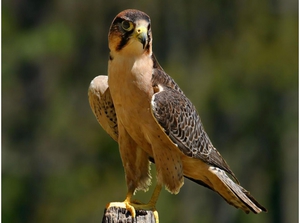 These predators are found worldwide, with the exception of the northernmost regions. They winter in the African and South Asian tropics.
Ospreys choose to provide the necessary living conditions, areas with clean water bodies rich in fishThey nest in tall trees with dry treetops, away from crowded areas. The birds remain faithful to their nests, returning to them annually. An osprey's clutch contains up to four eggs, usually two or three. The eggs are dark in color, with purple spots in various locations.
The chicks live in the nest for approximately two months without leaving it. They reach sexual maturity at two years of age.
The hunting habits of these birds of prey are characterized by their high-flying, stalking fish, their primary food source. Upon spotting their prey, the osprey dives feet first, then takes off sharply upon catching it. This bird disdains carrion; if hunger becomes overwhelming, it may hunt ducks or mice.
The osprey goes into wintering from September to October.
This species' population is inexorably declining due to the direct extermination of predators, unfavorable environmental conditions, and deforestation. All of this makes safe nesting impossible for these birds.
Goshawk
The bird is larger than a crow, weighing up to one and a half kilograms.
Characteristic features:
- distinct stripes running across the underside of the bird's body;
- dark gray upper body;
- eyes are very bright yellow;
- Young goshawks are colored red or brown.
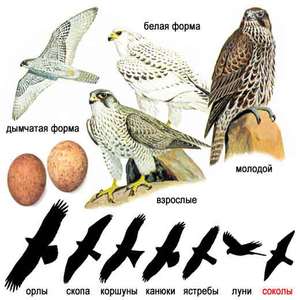 Birds of this species were persecuted for a long time because they were considered particularly harmful predators. As a result, their numbers declined, and they are now protected by law.
Goshawks feed on medium-sized fish and small animals such as hares, squirrels, and other small animals. They hunt dying animals that are doomed or weakened by illness or injury. Because of this, these raptors are considered forest health workers.
The distribution area of goshawks is north of the forest-tundraThey either spend the winter where they nest or fly away to where it is warmer.
Common Harrier
This bird typically inhabits open spaces—forest-tundra zones, forest-steppe zones, and taiga zones. Its primary habitat is an abundance of small rodents.
The harrier is about the size of a crow, but has a longer tail and a more graceful body. The male and female have different coloring.
Features of the male's color:
- white body with an ash-colored coating on top;
- There are black speckles on the tips of the wings.
Female color:
- body red with gray;
- the lumbar region is white.
Hen harriers build their nests on the ground. A clutch consists of three to five white, slightly spotted eggs. They are smaller than hen eggs and more rounded.
The harrier is a migratory bird. It hunts by flying low, not very high above the ground.
Sapsan
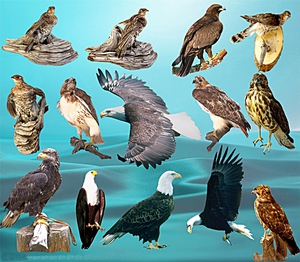 The most famous falcon. This is a rare and valuable bird species. Unfortunately, poachers especially love to capture these raptors, resulting in an extremely tragic fate. Peregrine falcons are almost extinct and are very rare even in uninhabited areas.
In the United States, in order to restore the population of these birds, they kept in specialized enclosuresPeregrine falcon chicks are raised and then released into the wild. However, even taking into account the benefits and importance of these measures, it must be said that they are very costly. Falcons released into the wild are of great monetary value.
The peregrine falcon's distinctive feature and pride are its clear, piercing black eyes, above which stand out black brow ridges. It's no wonder that in Rus', warriors were often called "bright falcons."
Within the Yamal region, the falcon population numbers no more than two hundred pairs of these birds of prey. The most populous part of Russia for falcons is the western Siberian tundra, where the raptor situation is relatively stable.
External characteristics of the peregrine falcon:
 the body above and the wings are very dark;
- the lower part of the body is almost white with a gray pattern that has longitudinal sections in young individuals and transverse sections in adults;
- the presence of black, distinct whiskers, which is a characteristic distinguishing feature of the falcon;
- the bird's body in flight conditions is very slender, dense, and the wings are sharp;
- The color of males and females is identical, but females are larger in size.
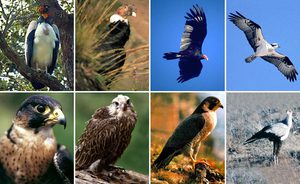 the body above and the wings are very dark;
The falcon is rightfully considered one of the fastest living creatures on the planet, and among birds, it has no equal. It hunts by striking its prey from above, in a steep dive. Among the smaller birds, the peregrine falcon grabs with strong paws, and larger ones, it knocks down at speed with the sharp claws on its hind toes. The raptor then snatches the falling prey in flight.
Peregrine falcons often bring their prey from locations far from the nest. It was previously believed that they do not hunt near their nests, but observations have shown otherwise. Peregrine falcons are often seen hunting near a nesting female.
This species of raptor defends its nest with extreme zeal and aggression. Upon noticing danger, a peregrine falcon lets out a frantic cry and dive-bombs the intruder. A short time later, the female joins the male. Falcons also attack people, but with the intent simply to scare them, rather than harm them.
The peregrine falcon is a sophisticated hunter. Among its prey are entire collections of the rarest birds, the existence of which even ornithologists are unaware.
Falcons nest in a variety of places. These can be rocks, alien, abandoned nests, even tree hollows or simply flat ground. A good view of the surrounding area is essential for nesting. The clutch size is three to five eggs. They are similar in size to chicken eggs.
Characteristically, the grown chicks do not eat the young falcons, unlike the rough-legged buzzards. This is considered a noble trait of this bird species. However, it's worth noting that their numbers are completely independent of the rodent harvest, meaning the peregrine falcon and its chicks will certainly not die of starvation.
Falcons are migratory, non-flocking birds, leading a solitary lifestyle. One pair of peregrine falcons builds a nest far from another. Pairs are permanent and stable. However, their nests are always in the same location. Peregrine falcons arrive in early spring and depart around the same time as other birds.
Merlin
Considered the smallest falcon in size, this raptor's nesting territory is extensive, but it avoids extremely northern regions. This raptor species is quite rare.
Merlins feed on small birds caught and snatched in flight. They nest primarily in trees or abandoned crow nests. They incubate up to five eggs. Both males and females brood, but males are more involved.
Remarkably, the merlin is only the size of a pigeon. Yet, it is a viable predator in the tundra and its forests. This bird is protected by law.
Nocturnal birds of prey
Owls are nocturnal predators. These birds are well-known and have been mentioned many times in children's fairy tales.
Features of the owl's appearance:
- large, bulging eyes;
- disc-shaped oval face with peculiar plumage;
- the size of the female is larger than the size of the male;
- dull, gray color;
- the feathering of the legs extends to the claw area;
- wide, long and rounded wings;
- acute vision and hearing;
- the ability to fly silently, which gives owls an advantage in night hunting.
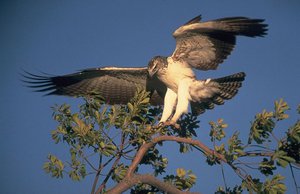 large, bulging eyes;
Owls prey on various rodents, providing enormous benefits to humans. Therefore, they are protected by law from poachers and those who simply enjoy abusing living creatures.
Snowy owl (or white owl)
A very colorful nocturnal predator that lives in the steppes and forests of the tundra. Hunts voles, partridges, hamsters and lemmingsSometimes they catch hares and even arctic foxes and ermines.
Small peoples of the north often used owl meat as food, and for this purpose they hunted it.
Short-eared owl
It is smaller than the snowy owl. It also feeds on rodents and inhabits tundra areas. Short-eared owls have been spotted over the sea.
There are also other types of owls, such as the Lapland owl, the Hawk owl, and the Eagle owl.
It is noteworthy that the hawk owl is a diurnal predator and even resembles a falcon in some ways.
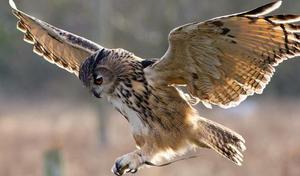
Eagle owls are the largest birds in the owl family. They have ear-flaps on their heads and a mottled, rufous coat. Eagle owls may attack buzzards or hawks, but their diet primarily consists of rodents and small animals.
In northern conditions, the eagle owl can hunt during the day.