 Currently, the Russian Federation is home to over 750 bird species. Among them are birds we often see and others we've never even heard. Few have seen a lark in person or even heard its famous song, but everyone has heard stories about these remarkable birds from their mothers and grandmothers.
Of course, the lark is not one species, but a whole genus of birds, consisting of more than 90 species, and the most famous of them is the skylark (Alauda arvensis).
The lark's call is a drawn-out "chrrr-hick" and the song is sung while the bird is hovering in the air (often at a great height) and resembles a long, ringing trill.
Color description
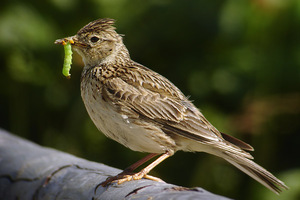
Its back is gray, but more often brownish-yellow (the color of clay) with white and dark spots. The breast of this bird has white or light gray feathers with sparse brown spots. The wings are mottled. The tail itself is white at the edges and tips. The lark's head is also mottled, with darker stripes on top, closer to black or dark gray in color, and light brown on the sides. Above the dark eye is a bright white eyebrow. The male differs from the female in its larger size and bright coloration. This protective coloration helps these birds skillfully camouflage themselves in the grass from predators.
Description of proportions
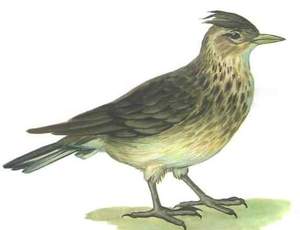 The lark is a small bird, slightly larger in size than a sparrow. His chest is very wide Compared to its basic dimensions, the lark's wings are broad, longer than those of a passerine, with the tips falling under or near the base of the tail. The tail itself is short, making up about half the bird's body length. The lark's beak is more refined than that of a sparrow. The bird itself is also more fragile and elongated than a sparrow. On its long, strong legs, larks have a spur—a long, sharp, curved claw located on the hind toe.
Main food
Skylarks feed mainly on plant food and prefer plant seedsTheir diet includes seeds of plants such as:
- Bird buckwheat;
- Pickle;
- Sparrow;
- Puppy;
- Various types of wild millet;
- Oats;
- Wheat;
Larks rarely eat the oily seeds of barley and rye, preferring the starchier ones. They can often be seen pecking at small pebbles and sand on rural paths. When they reach their stomachs, these pebbles help the bird digest the hard seeds. In early spring, when the soft shoots are just beginning to sprout, larks feed on them, replenishing their vitamins.
Dietary supplements
When insects appear, larks begin to hunt them. They hunt only on the ground. and do not catch flying or crawling insects in tall grass. They hunt primarily for:
- Small beetles;
- Small spiders that live on the surface of the ground or in short grass;
- Larvae of various insects;
- Pupae and caterpillars of butterflies;
Larks quench their thirst with dew that settles on plants.
In late summer and early fall, when the harvest begins, fallen seeds become the birds' main food. Numerous flocks can often be seen flying from field to field, completely unafraid of cars.
These small birds can often be seen bathing in puddles of dust on the sides of roads – this is how they clean their feathers.
Habitat and nesting
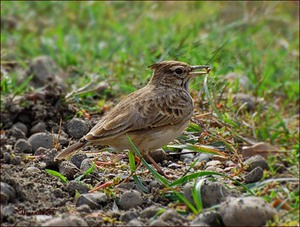 Larks prefer to live open spaces: They inhabit meadows, fields, mountain slopes and hillsides, steppes, and even semi-deserts, but they never live in forests. These birds never perch on tree branches or wires. Larks typically roost in small flocks in open, sun-warmed areas, sheltering from rain and wind at forest edges. They fly high and sing only during the mating season, spending most of their lives on the ground.
This bird's range is extensive, encompassing most of Asia, Europe, and the mountains of North Africa. The lark was introduced and successfully established in Australia, western North America, and New Zealand.
Living in fields, the lark also builds its nest there. Most often, the nest is built on the ground, in a small hole. The female weaves a nest from leaves and grass stems, and lines the inside with down, horsehair, and wool. The nest is about 5 cm high and is reliably camouflaged among the tall grass.
Brood and enemies of the skylark
The female lays 4 to 6 eggs, which are a camouflaging dark yellow with fine black speckles and are small (2.3 cm by 1.7 cm). The chicks hatch completely blind and helpless, covered in sparse down. After just 10 days, the chicks leave the nest, but are still flightless and hide among plants. Adult birds feed them for about two more weeks, and then the chicks fly and learn to forage for food on their own. In June, females often lay a second clutch in the same nest. The chicks from this clutch begin their independent lives only in July.
The lark is very vulnerable when singing high in the sky and is very easy prey for various flying predators, such as the hobby falcon. In this situation, only its the famous fall to the ground like a stoneHowever, the majority of males still perish in the air. On the ground, larks also have many predators: a variety of mammalian predators such as weasels, ferrets, stoats, and foxes. Eggs and defenseless chicks are a favorite prey of crows and harriers.
Reason for wintering
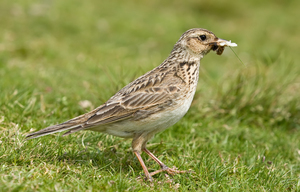 People often wonder: is the lark a migratory bird? It feeds on plant seeds and insects. However, during the cold season, plants stop producing seeds, and in winter, all plants are completely covered with snow. And many insects hide in the ground and tree bark for the winter as early as early spring. This means that larks have nothing to eat during the cold season, and therefore fly away to another place for the winter.
Wintering
They depart in small flocks as early as early September. By mid-October, very few birds, if any, remain in the fields and steppes. They winter primarily in southern Europe. However, skylarks are among the first to return. Mass arrivals begin in early March., even if the snow hasn't melted yet.
In the old days, the arrival of larks was used to indicate whether spring had arrived and whether it was time to plow and sow. Males arrive first. Larks are monogamous. Males occupy sun-warmed thawed patches, where they bask in the sun in small flocks and share territory. Young birds and females arrive later, and while they search for the best nesting site, the male sings and guards.