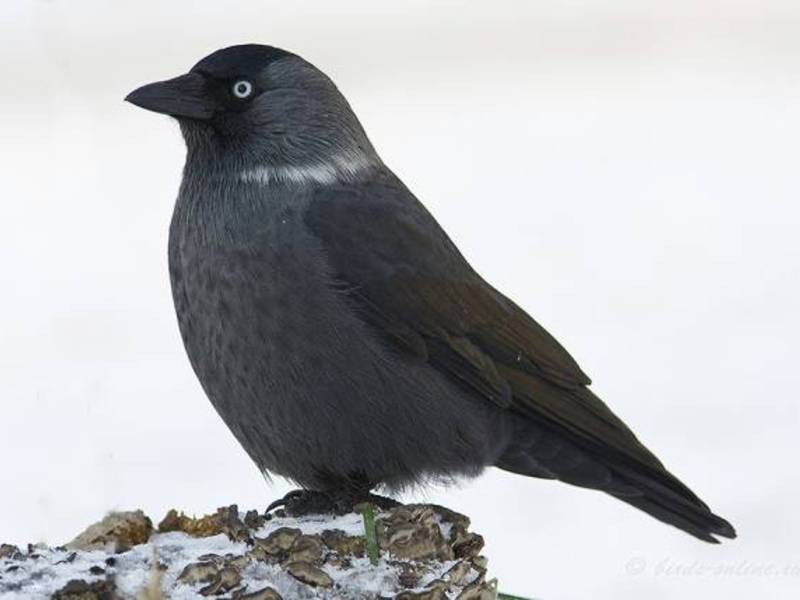
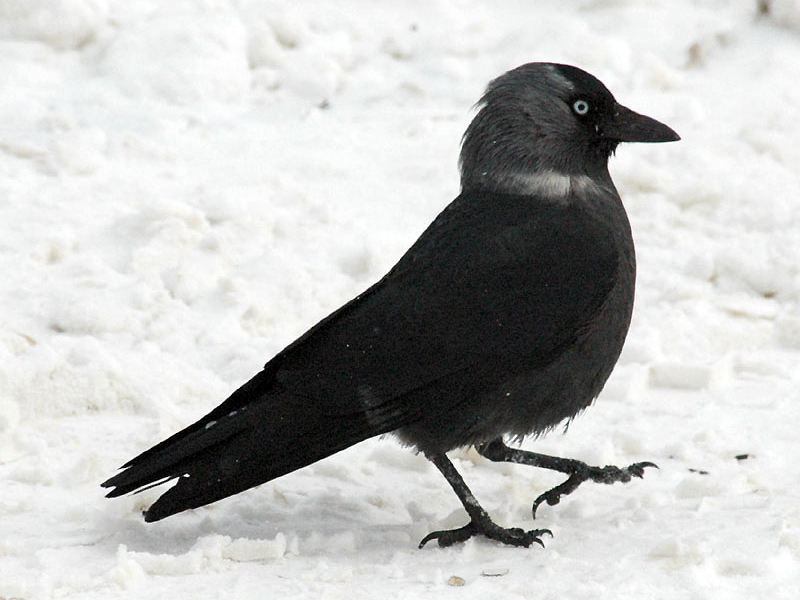
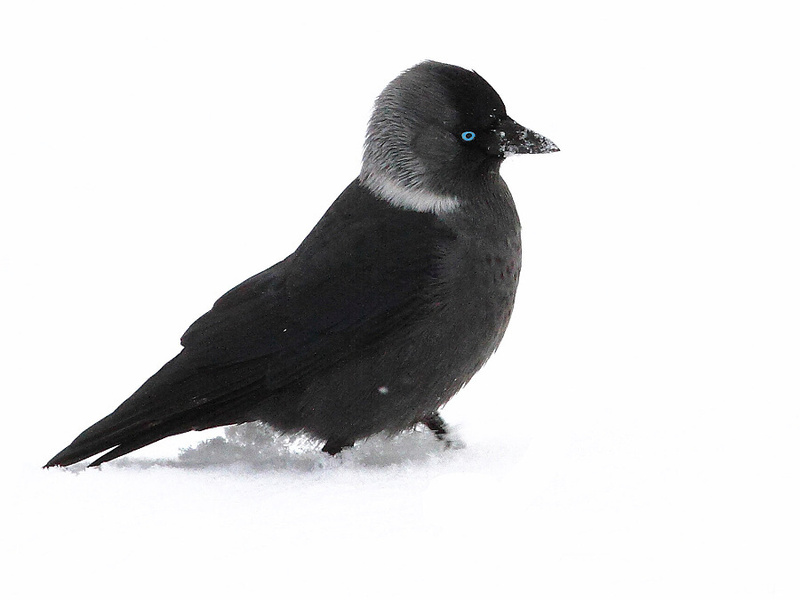
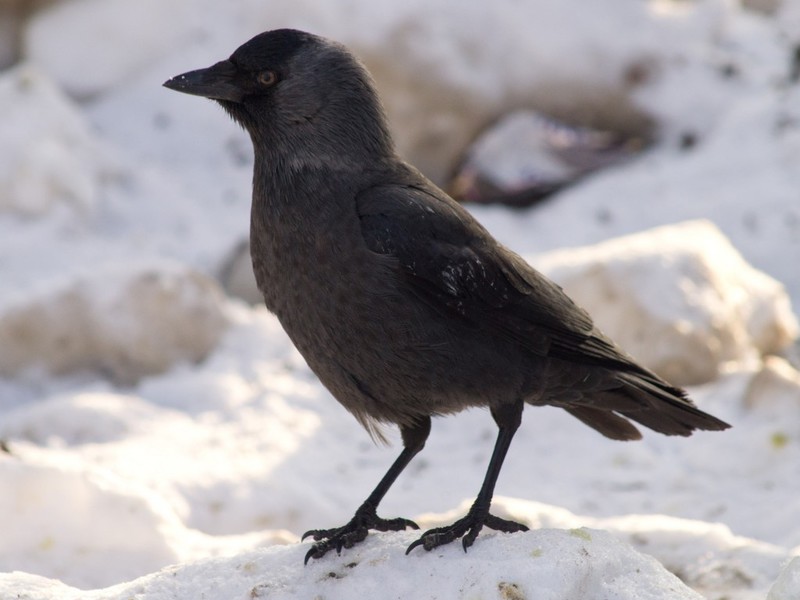
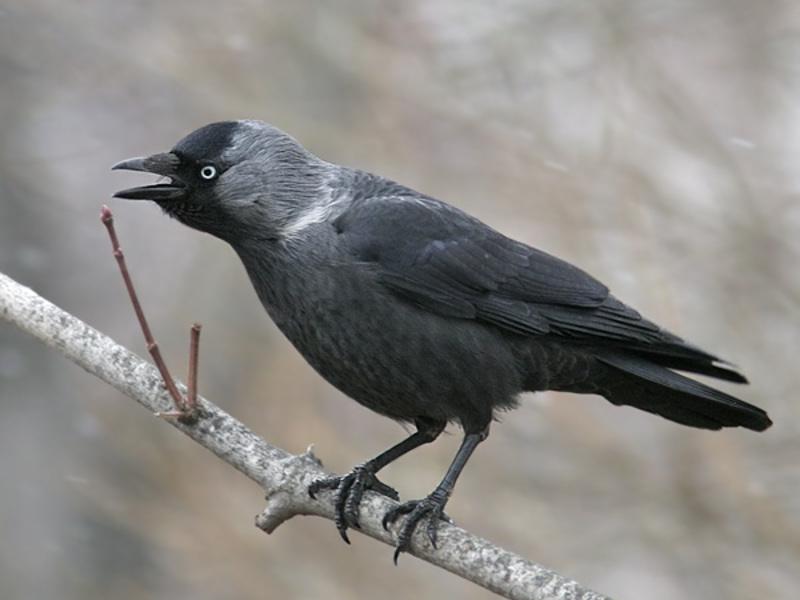
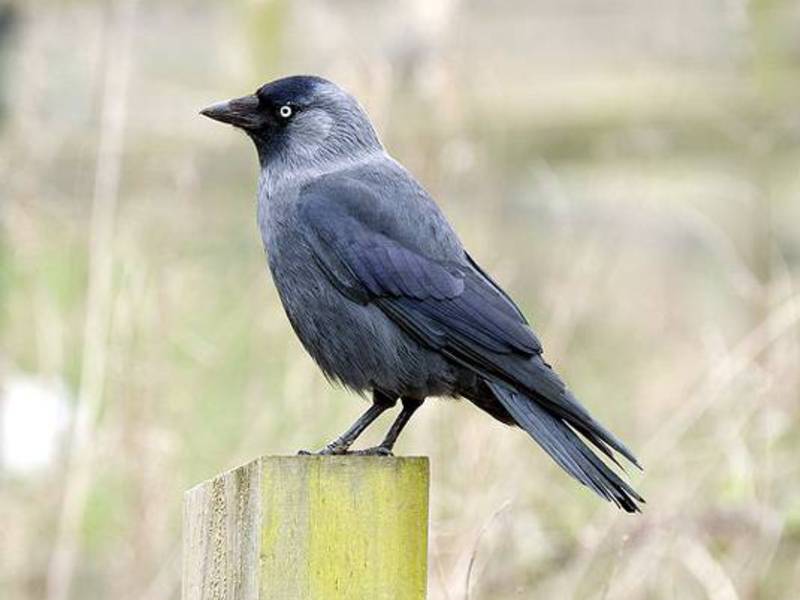
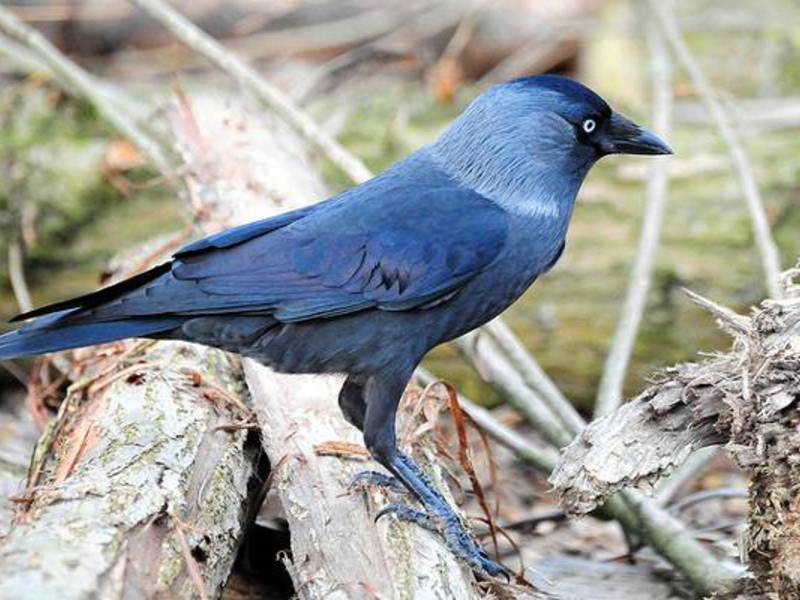
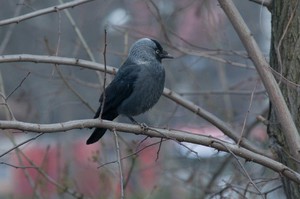
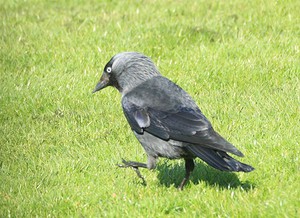
 The jackdaw belongs to the Corvidae family, the Passeriformes order, and the genus Crow. In appearance, it resembles a pigeon, only with a different coloring.
There are slight variations in the bird's size depending on its habitat. The main differences are the presence or absence of a partially whitish collar at the base of the nape, variations in the nape shadow, and the underparts' color.
The bird's appearance
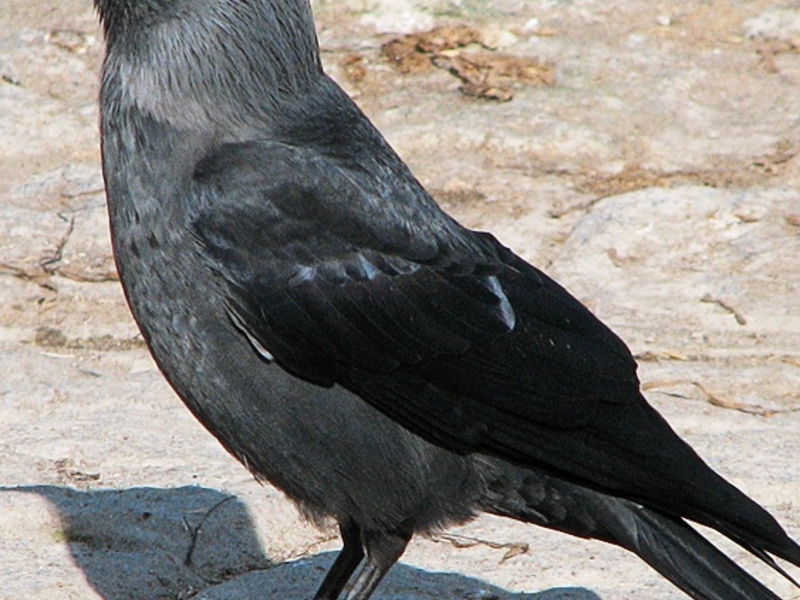
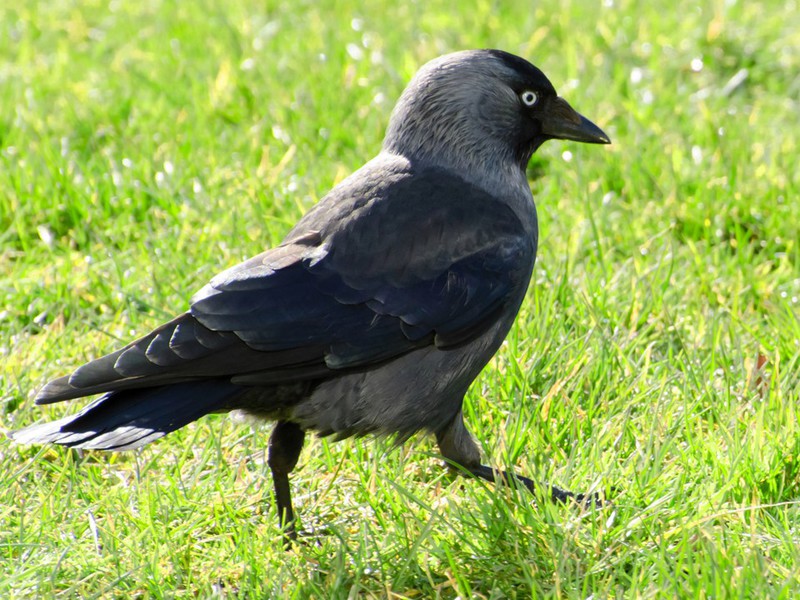
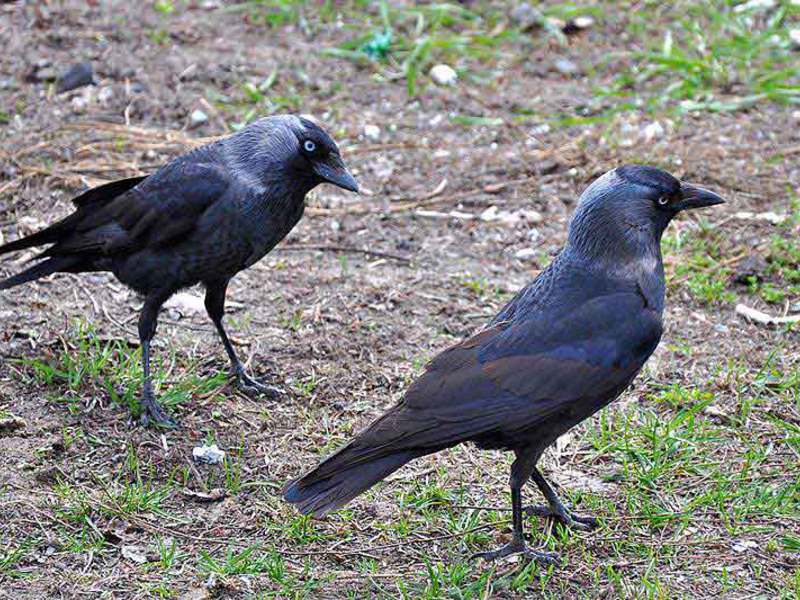
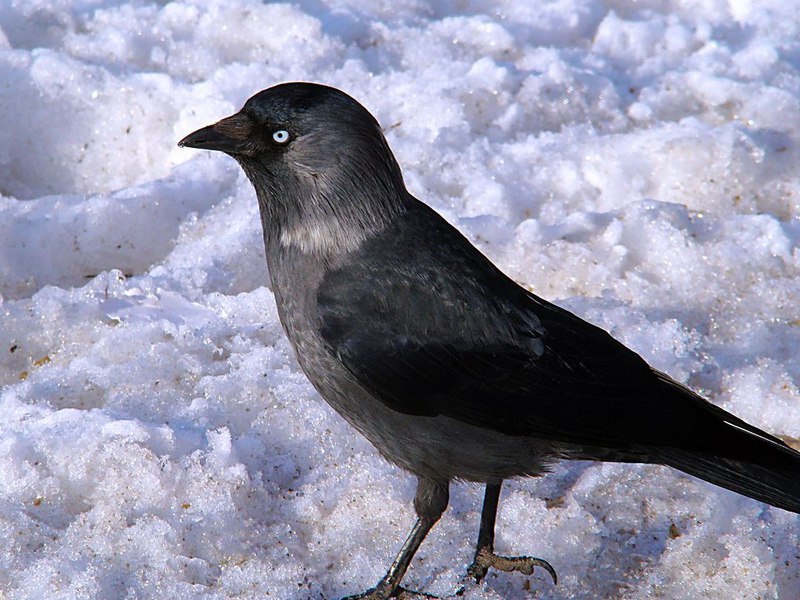
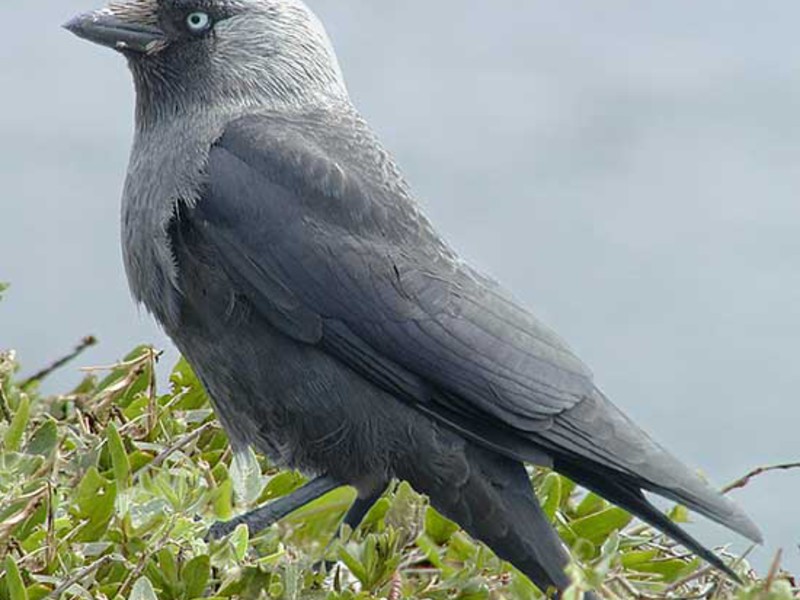
- Externally, the bird has black plumage and a gray neck, the iris of the eyes is light with a blue tint.
- The jackdaw's body length is from 30 to 35 cm, and its weight is from 150 to 280 g.
- It has a wingspan of 65-75 cm, but its wings are shortened and its tail is narrow.
- Black legs and dark beak.
Size and color characteristics
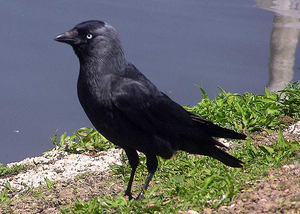 Male birds' plumage fades more with age and wear, especially just before molting. Western jackdaws undergo a complete molt. from June to September In the western parts of the range, and a month later in the east. The purple sheen of the wings becomes most noticeable immediately after the molt. Juveniles undergo a partial molt between June and September. Adults undergo a full annual molt between July and September.
Immature birds have denser, less distinct plumage. The head is sooty black, sometimes with a slight greenish tint and brown feather bases. The back and sides of the neck are dark gray, while the underparts are grayish or smoky black. The tail has narrower feathers and a greenish sheen.
There are slight variations in the bird's size depending on its habitat. The main differences are the presence or absence of a partially whitish collar at the base of the nape, variations in the nape shadow, and the underparts' color. Jackdaws in Central Asian countries have larger wings, while western populations have a darker toneThe tail color becomes darker further north in humid mountainous regions, and paler elsewhere. East Asian jackdaws have distinct coloration features and are often considered a distinct species. They are dimorphic; in addition to gray birds, piebald ones are often found. There are also ecological differences in habitat, nesting habits, and so on.
Description of the jackdaw's voice
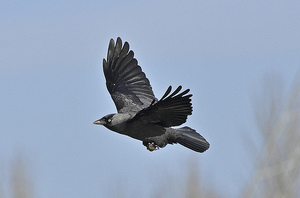 The jackdaw's call resembles the sounds "ke-ke-ke" or "jackdaw...jackdaw." Chicks begin to emit a soft squeak at about a week of age. As they grow, their the voice gets louderAfter this, the voice deepens and softens. By the 25th day, the young stop screaming and become quiet when they hear an unfamiliar noise. The European Jackdaw can be taught to speak, and although it can imitate the human voice, it usually limits itself to only a few words or phrases.
Can the jackdaw be considered a migratory bird?
The jackdaw is migratory, sedentary, and nomadic. It lives in Central and Western Europe, North Africa, and Asia. Birds in northern regions are migratory, while the rest are either nomadic or sedentary. Migratory jackdaws fly south to winter in their range from September to October and return. from February to early MayIn winter, East Siberian jackdaws appear in large numbers in eastern China. In the European part of their range, they are found throughout the year. The jackdaw is a sedentary bird in Central Asia and the Caucasus. However, in some places, jackdaws have been observed migrating within their nesting area during the winter.
Lifestyle
These birds are described as intelligent creatures with a lively demeanor, a noisy voice, and a desire to be around people. They are indeed very social. Jackdaws enjoy the company of their best friends, rooks, until they fly away. Together, they stroll through gardens and fields, communicating with noisy calls of "kaa-kaa." The total number of jackdaws 4-8 million pairsThey live in pairs and form flocks of up to several dozen birds.
The modern jackdaw most often lives near human habitats, where there are old, uninhabited buildings where it nests, or in areas with five-story buildings with roof openings. It doesn't find a home in new city neighborhoods, among block and panel buildings. It prefers being close to people, which makes it easier for it to find food.
When a flock of jackdaws lives in a forested area, they nest in old, tall trees with hollows. They are also found on rocky coastlines, near agricultural fields, and in groves.
What do they eat?
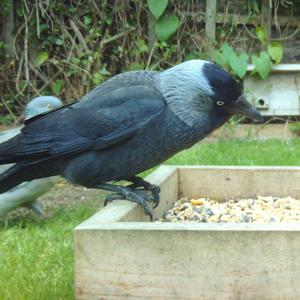
Jackdaw bird omnivorous and eats a variety of foods:
- Vegetation (seeds, grains, berries and fruits).
- Invertebrates (earthworms, spiders, mollusks and others).
- Food waste from urban areas.
- Depending on the area, the jackdaw may be interested in small rodents, voles and mice.
During periods of high food supply, they hoard food, depositing it under tree roots or other hidden places. This hoarding helps them during cold, flight-inhibiting weather.
Description of the breeding habits of jackdaws
Puberty period starts at the age of two, sometimes for as long as a year. Jackdaws form monogamous pairs for life and return to the same nest each year to hatch their young. The mating season begins in late February and is characterized by loud vocalizations, serenades, and fighting. Afterward, the pair searches for a nest site, which they construct from dry twigs, with hairs, pieces of fabric, and feathers placed at the base. Sometimes, they use old corvid nests, having first repaired them.
April brings a pair 3-7 eggs, green or blue with brown spots. The interval between egg laying is 24 hours. If the first clutch perishes, a second one is laid, but in smaller quantities.
At this time, it becomes quiet. The pair will incubate the eggs in turns, and after 18 days, they will hatch. blind chicks with sparse grey fluffDuring this period, parents face the hardest work of finding food. They have to work from morning until night to feed their babies, who are constantly hungry.
A month after hatching, the chicks are grown and fledged, ready to leave home, though they cannot yet fly. If a chick falls from the nest, they circle anxiously above it, trying to help it escape. The parent pair spends another 14-16 days caring for and feeding their brood, after which they become independent. Jackdaws are a common sight among humans.