 Our natural world is home to many amazing birds. Some are quite common, while others are very rare. The osprey falls into this category of both rare and amazing birds. In this article, we'll describe what makes the osprey special, where it lives, and what it looks like.
Osprey predator
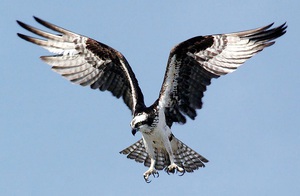
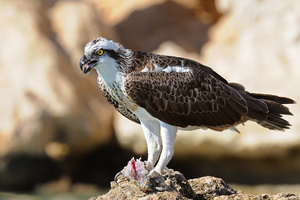
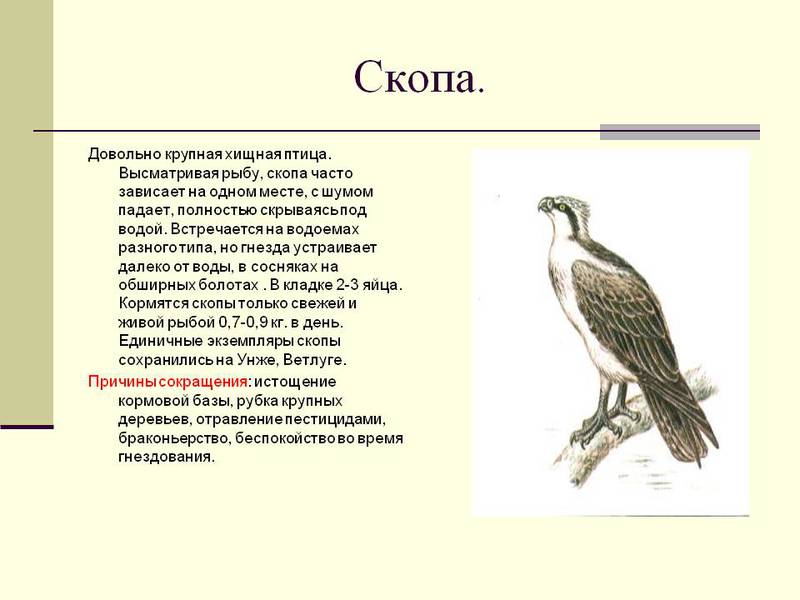
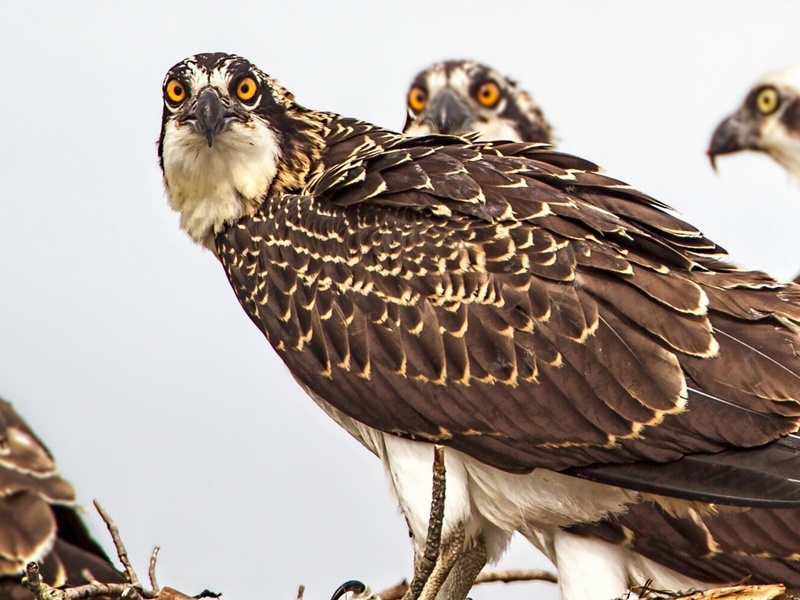
Interesting and the amazing osprey bird The falcon belongs to the falcon family. It is found in both the Southern and Northern Hemispheres. It is a large bird of prey with a wingspan of 145–170 cm and a body length of 55–58 cm. If you look at the photo, you can see that the feathers on the upper side of the body are brown, and the feathers are white:
- back of the head;
- crown;
- lower side of the body.
Dark brown spots cover the wrist joints. Small, necklace-like spots stand out in the neck area. The bird's sides are decorated with brown stripes.They extend through the eye and neck, starting from the beak. It has a short, low, and strongly convex black bill with a long, hooked tip. The cere and feet are lead-colored. The osprey's feet are longer than those of other birds of prey, with curved and convex talons. The bird's outer toe has a unique feature: it rotates in different directions. This allows the bird of prey to easily grasp fish in the water.
 The osprey's wings have a water-repellent effect., and its nostrils are equipped with a special valve. This protects the nostrils from moisture when it dives into the water while hunting. If the bird captures a large fish while hunting, it risks drowning. It has difficulty breaking away from the water's surface and taking off. A special gland above the tail secretes an oily substance, which protects the bird's wings from getting wet in the water.
Juveniles appear more colorful, but adults are distinguished by their beautiful appearance. Their bodies are covered with beautiful, stiff feathers. Ospreys are considered long-lived birds, able to live up to 25 years. In fact, many juveniles die early, usually before the age of two.
Habitat and lifestyle
This species of bird is found on almost all continents. They definitely don't live in AntarcticaOspreys migrate to warmer climates in winter, such as Egypt. There, they settle on the Red Sea islands and nest. In summer, the bird can be spotted throughout almost all of Europe. This raptor reaches the coasts of Iceland and Scandinavia. They prefer to nest near various bodies of water, especially shallow areas. These areas are usually rich in fish, making them excellent hunting grounds.
Only ospreys living in the northern regions of the planet migrate for the winter. Those living in the southern parts of the planet lead a sedentary lifestyle and do not migrate from their nesting sites. In areas with excellent living conditions, they settle in groups, such as along the coastline in warmer climates. These predators can work together to hunt prey and build nests.
 The osprey is not always on guard at its nest, as it is located a little further from the pond and it is not possible for it to be there all the time. In case of attackWhen she's nearby, she actively defends him from enemies. Males pair off and provide food for their female. When a pair is expecting offspring, the male can't always provide both himself and the female with the necessary food. Sometimes, females are forced to beg food from other males in neighboring nests. Usually, the birds don't fly far, only when they have to feed their growing offspring.
Nutrition
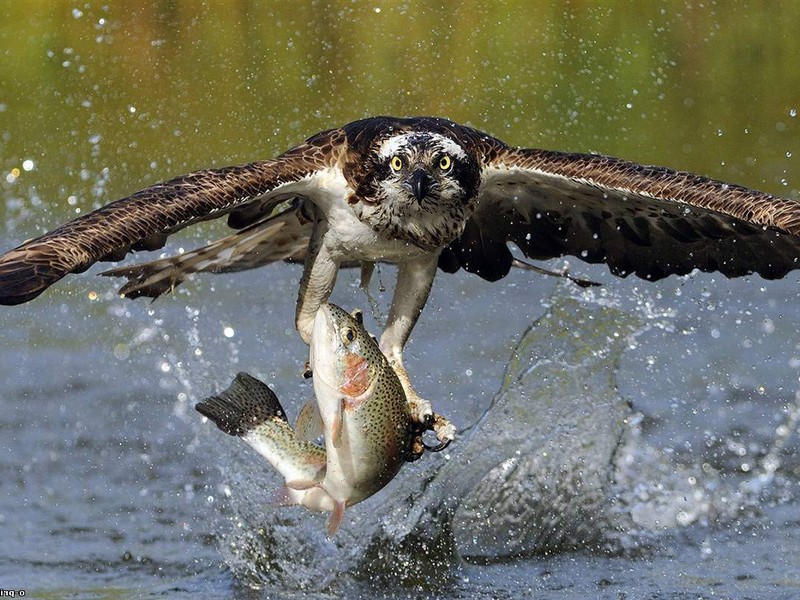
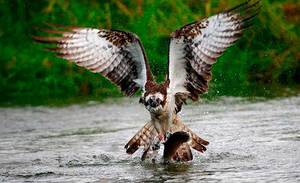
Osprey often called a fisherman or sea eagleThis is because 80% of the predator's daily diet consists of fish. They primarily catch small fish swimming on the surface of the water, as they cannot dive deeply. Hunting always takes place over a body of water. The bird flies above the water at a height of 10-40 meters. When the bird spots its future prey, it dives sharply into the water. As it descends, the osprey's wings are raised and pulled back, while its feet are lowered into the water. As soon as the predator seizes its prey, its wings suddenly and almost horizontally flap upward to quickly break away from the surface.
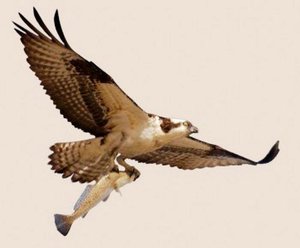
The osprey holds its prey with both paws so that she didn't bother him during the flightThe predator begins eating the head of its prey, and practically ignores the rest. The bird may take the remaining meat back to its nest or discard it. Several factors can influence a successful hunt:
- ebb and flow of the tides;
- weather conditions.
Predators also feed on other food items. These can include small aquatic and terrestrial animals:
 rats;
rats;- snakes;
- field mice;
- muskrats;
- small birds;
- proteins.
 rats;
rats;Ospreys hardly drink water, since there is enough water in the fish for them.
Reproduction
Breeding season of ospreys depends on the type of birdMating occurs at different times for migratory and sedentary birds. For those living in one place, the mating season begins between December and March. For migratory birds from northern regions, the mating season lasts from April to May.
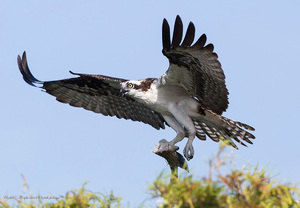
With the appearance of the female, the males begin to circle over the nest, attracting her and repelling other males. After choosing a mate, the pair begins building the nest together. Often, the female finds the nesting materials herself. Typically, the birds collect the following materials for the nest:
- dry branches;
- grass;
- some items from the water (old fishing line, bags).
 dry branches;
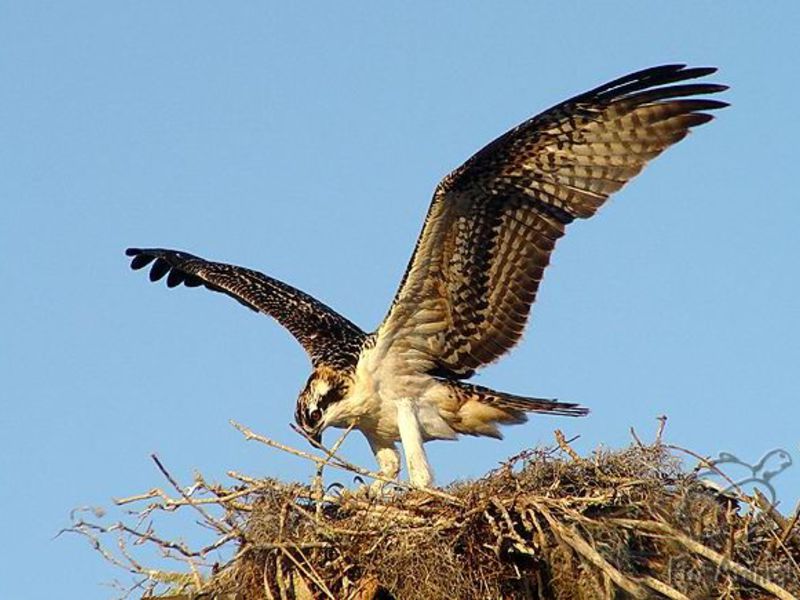
Osprey nest is a place of residence for a long time, so the birds repair and maintain it annually. Females do not lay eggs simultaneously, but rather at intervals. She lays one egg at intervals of 1–2 days. The first chicks are always stronger and healthier than the later ones. They often lack sufficient food for normal development. A litter of 2–4 chicks hatches. Both parents incubate the eggs for 40 days. The parents feed the hatched chicks fish caught by the male.
Caring the female divides the fish between the chicks, tearing it apart. To keep her offspring warm, she covers them with her body. After 1–1.5 months, the cubs begin to learn to forage for food independently by hunting. With the onset of the autumn migration, the cubs become ready for independent life.