 The kestrel is a bird belonging to the falcon order and is a distinct species. They inhabit virtually all of Eurasia except India. They do not inhabit tundra, mountainous, or steppe regions. Their most preferred habitats are sparse forests with numerous clearings.
Description of the Hobby
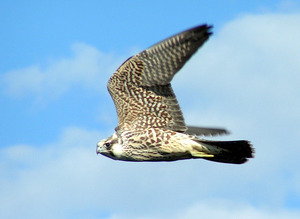
Saker Falcon graceful and beautiful bird, like all members of the Falconidae family. It is characterized by elongated, pointed wings and a wedge-shaped tail. The birds are similar in size to pigeons. The male's body length reaches up to 28 cm and weighs between 200 and 250 g. Females are naturally larger than males, averaging 38 cm in length and weighing 350 g. Their feathers are characteristically mottled. The upper part of the body is a uniform light mouse color. The lower part of the body is whitish with a yellowish tint, with distinct vertical lines. The tail and wings are light on the underside with dark horizontal lines.
The saker falcon's head is almost black, with the cheeks and neck contrasting with white. A distinctive feature of the saker falcon is its so-called "whiskers," which descend in dark stripes from the corner of the bill to the bird's throat. The feathers on the legs and under the tail are rusty in color. The eyes are typically brown. The legs and upper beak are blue or greenish colorYoung birds are distinguished by their bright, richly colored feathers, edged with yellow on their heads, and a lemon-colored belly. Hobbies only call when absolutely necessary, and their calls are sharp, abrupt, and loud. Their flight is characterized by agility and maneuverability. They never soar, but rather gracefully glide through the air.
Lifestyle Features
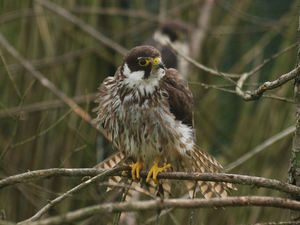 Of all the falcons, the saker falcon is the most restless. It avoids contact with its own kind or with birds of other species. If a bird flies nearby, it will inevitably start a fight.
No living creature has the right to encroach on their territory with impunity. They guard their nest within a one-and-a-half-kilometer radius and deal mercilessly with trespassers.
If they settle near rural lands, they provide invaluable benefits to humans. Hobbies hunt small birds and various flying pests that eat crops.
These birds, like hawks, reach high speeds and can outrun even a train in flight. Hobbies have excellent eyesight. They can spot a large insect 200 meters away.
Getting food
Hobbies love to hunt dragonflies. They soar in the center of a cloud of insects, performing beautiful pirouettes and devouring them in flight. They also enjoy hunting cockchafers, rose chafers, longhorn beetles, and other members of this species. In summer, they also hunt aquatic insects. In hot countries like Africa, hobby feasts on clouds of winged termites.
Smaller birds are a delicacy in their diet. For example: swallows, wagtails, larks, starlings, thrushes, swifts, sparrows, and sandpipers. Hobbies are sometimes caught in the heat of the hunt. attacks a larger bird and often such carelessness ends rather tragically for him.
Sometimes, bats also end up in the hobby's diet. They can pursue them for very long periods.
These birds do not particularly favor small rodents in their diet, but sometimes they take such prey from other feathered representatives.
Mating season
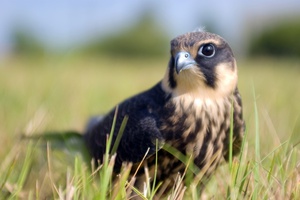 Mating games begin with the end of spring. During the flight, the male usually gives the food he has caught to the chosen female. Their mating dances are mesmerizing, with a variety of graceful circling and pirouettes. During this shared dance, they may even swoop down, clasping their talons.
On one's own Hobbies don't build nests, so they choose a ready-made nesting site created by a crow or magpie. The pair works together to guard the nest and the surrounding area, devoting considerable time and energy to this task. They constantly patrol the area and drive away all potential enemies. These birds often form strong mating relationships that last for many years.
Eggs are laid in the summer. A clutch typically contains 3 to 6 eggs. They are small, brown or yellow with red spots. The female incubates the eggs, while the male provides her with food and protection. After 3 weeks, the shaggy, light-colored chicks begin to hatch. Both birds now share in feeding and caring for the young. They take turns flying in search of prey and spend all daylight hours huntingMature birds fly out of the parental nest after 7 to 9 weeks.
If potential enemies, such as hawks, settle nearby with a pair of birds, the hobbies, due to their feisty nature, begin to fight with their neighbors and become so engrossed in the process that they sometimes forget why the pair was formed and the nest chosen in the first place.
Hobbies are consistent in their nest selection. They always return to the same site after hibernation.
Habitat
They inhabit virtually all of Eurasia. In Russia, this bird lives up to the northern border of the Kolyma Highlands. In the south, its habitat extends to the Mediterranean Sea, the mountains of Iran, and a small part of Afghanistan. The kestrel also inhabits various islands, such as the Southern Kuril Islands and several islands in the Mediterranean Sea.
The geographical habitats are quite diverse and in each location the kestrel chooses for itself the most comfortable zoneFor example, birds from Moldova typically live in gardens, while in the Caucasus they can be found even in small villages. In Germany, saker falcons live primarily in numerous large parks. In Russia, they prefer riverine lowlands, and in the Baltics, lakeside areas.
But the saker falcon will never settle in a dense forest or taiga, and will never choose a clean plain for habitation.
A species of hobby
Saker Falcon subspecies:
 Falco subbuteo subbuteo — The classic specimen of this species. They prefer to live in West Africa, throughout Europe, and Asia, with the exception of the southeast. This subspecies is migratory. In winter, it leaves its breeding grounds and migrates to countries in Africa and Asia.
- Falco subbuteo streichi – a larger member of the falcon family. They live in southern Asia, ranging from China to Myanmar and Indochina. They do not migrate during the winter.
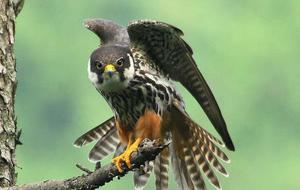 Falco subbuteo subbuteo — The classic specimen of this species. They prefer to live in West Africa, throughout Europe, and Asia, with the exception of the southeast. This subspecies is migratory. In winter, it leaves its breeding grounds and migrates to countries in Africa and Asia.
Related subspecies of the hobby:
- African Hobby Falcon Falco cuvierii — an almost exact replica of the common hobby. It lives in Africa.
- Australian Hobby Falcon Falco longipennis It is quite similar to the common scaly-sided ...
- Eleonora's Hobby Falco eleonorae — much larger than usual. It was named after a medieval queen from Sardinia who issued a decree protecting these birds from humans. They live in Greece, Croatia, Sicily, Malta, and off the African coast.
- Silver-crowned falcon Falco concolor It has a light color, reminiscent of silver. It inhabits Africa.
- Eastern Hobby Falcon Falco severus — very similar in appearance to the African hobby. It inhabits the savannas of northeastern Africa, the tropical forests of Asia, and virtually all of Australia's green areas.