 The unusual and beautiful oriole is virtually impossible to spot in the wild. This is because it lives high in the treetops and builds its nest there. Even the brightly plumaged male is virtually invisible among the foliage.
Habitat
Common Oriole prefers light deciduous forests, choosing poplar, willow, or birch groves. Sometimes found in pine forests and even on isolated trees on uninhabited islands.
The oriole avoids taiga and continuous shaded forests., but it can readily settle in parks, gardens or along roads in forest plantations near people.
The oriole nests in Western Asia up to the Western Sayan, Minusinsk Basin, Yenisei and Dzungarian Alatau. It is quite common in India.The golden oriole also lives in Europe, reaching as far north as Finland and Sweden, and even into European Russia. It rarely nests in the British Isles. It is occasionally found on the southern coast of England, on the Isles of Scilly and Maider, and on the Azov Islands.
Description of the oriole – photo
According to linguists, The bird's name "oriole" has Slavic roots.It shares the same root as the words "vlaga" and "vologa." These birds are believed to be harbingers of rain.
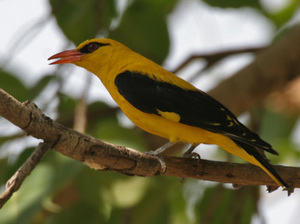
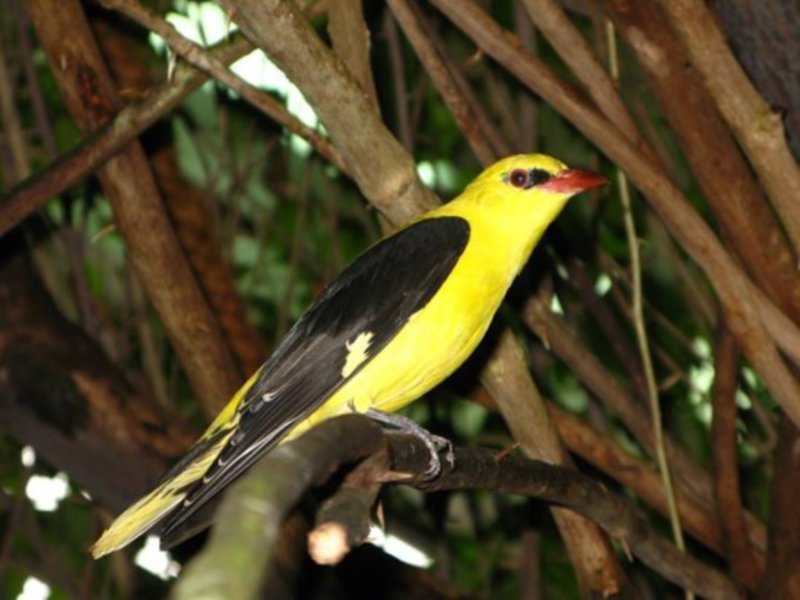
Ordinary The oriole is distinguished by its slightly elongated body, the length of which can reach 25 cm, and the weight - from 50 to 90 g. The bird's wingspan reaches 45 cm. The main external differences of the oriole are:
 dark red strong beak;
- carmine red iridescent eyes;
- a mask-like stripe that extends from the base of the beak to the eyes;
- black flight feathers with yellow edges;
- dark thin paws;
- four fingers with sharp claws.
 dark red strong beak;
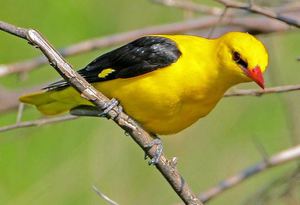
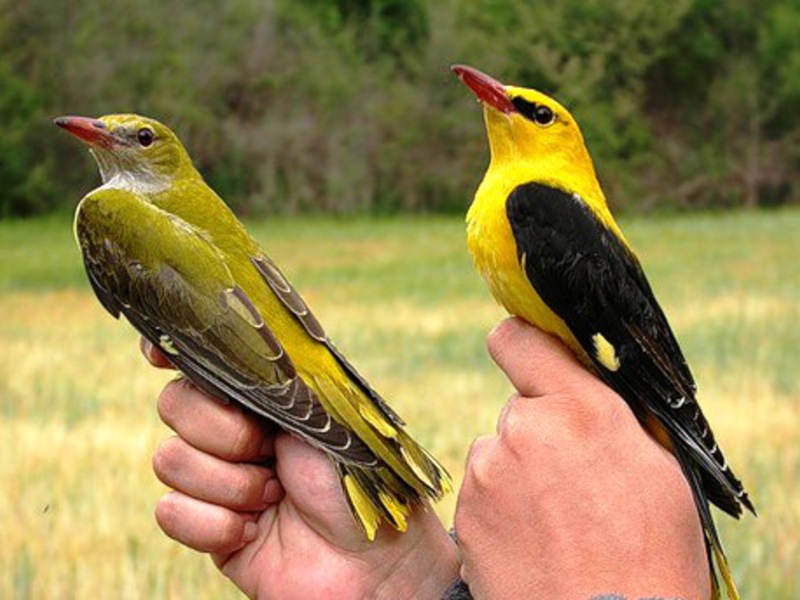
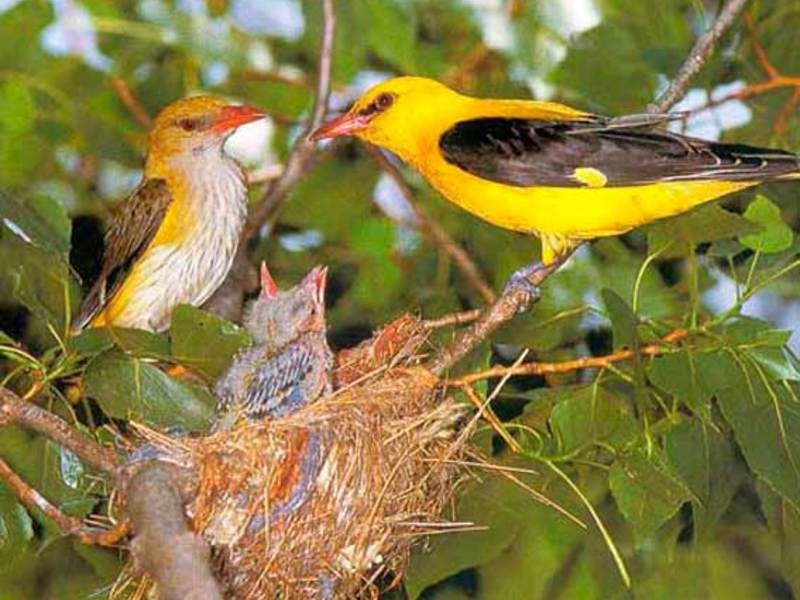
The color of the bird is very beautiful, at the same time, sexual dimorphism can be observed in itThe male oriole stands out among many other birds. It has a bright yellow body and a black tail and wings, edged with small yellow spots.
The female has a whitish underpart with more dark longitudinal stripes, with greenish-yellow upperparts and greenish-gray wings. Young birds of both sexes are similar in coloration to females, but have darker underparts.
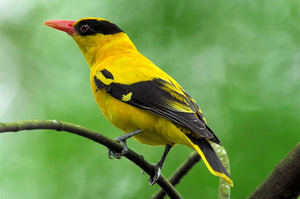 Orioles have a unique voice and can sing in a variety of ways. Their voice can resemble a flute with melodic whistles. Sometimes, a completely unmusical, single, sharp cry can be heard. Quite often, the bird makes sounds that sound like "fee-lee-lee."
The oriole's flight has its own peculiarities. The bird can reach an average speed of 40–45 km/h, and sometimes even 70 km/h. Its flight is undulating, rarely flying out into open air.
Lifestyle and nutrition
To native places living in Orioles arrive in Europe in early MayThe males arrive first. They occupy home ranges, keeping outsiders out, and await the arrival of the females. After three to four days, the females emerge. These birds rarely live in pairs. Outside the nesting season, they prefer solitude. During the nesting season, the males become very pugnacious and constantly engage in combat with each other.
Orioles love to swim, so they tend to choose places near bodies of water for their nests. Once they reach the surface of the water, they eagerly begin to dive in.
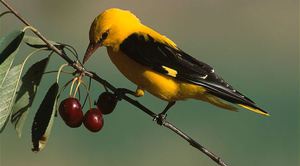
Common orioles can feed both plant and animal feedDuring the ripening period, they readily consume the fruits and berries of bird cherry, currant, grapes, sweet cherry, pear, fig, etc. During the breeding season, the basis of their diet becomes animal food, which includes:
- wood insects in the form of various caterpillars;
- crane flies;
- earwigs;
- dragonflies;
- butterflies;
- wood beetles;
- bedbugs;
- some spiders.
 crane flies;
Sometimes Orioles destroy the nests of smaller birds, which includes the redstart and spotted flycatcher. These birds feed primarily in the morning. In some cases, their feeding may continue until lunch, but after 3:00 PM, it ceases.
Reproduction of the oriole
Birds returning from wintering nests begin to be built quite lateIn mid-May, when the trees are already green, birds build nests in central Russia. Complete clutches are found:
- in Spain at the end of May;
- in East Germany in late May - early June;
- in Sweden, Switzerland and Belgium in early June;
- in Morocco in mid-June.
Reproduction of birds of this species occurs once a year.
During the mating season the male begins to behave demonstratively and assertively and unusual. He tries to show off his best side and courts the female, attracting her with various actions. The male pursues the female, jumping from branch to branch, and literally circling her. He sings in every key and chirps vigorously, spreads his tail, and flaps his wings.
 Several males can fight for one female. Such courtship usually ends in real fightsThe reciprocating female coquettishly wags her tail and whistles. The newly formed pair begins to build a nest.
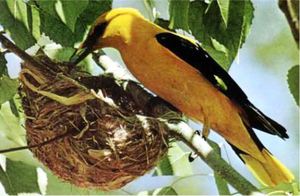
The nest is A hanging, shallow oval basket woven from birch bark, dried grass stems, and strips of bast. Its height is typically 6–9 cm, and its diameter is 12–16 cm. The interior of the nest is lined with cobwebs, down, leaves, or scraps of soft debris.
The birds place their nests far from the ground and tree trunk, in the fork of thin horizontal branches or between two branches. To prevent a gust of wind from blowing it away, they securely fasten the nest and camouflage it from intruders with grass stems and pieces of moss.
The clutch may contain from 3 to 5 white-cream or white-pink eggs. Sometimes eggs with reddish-brown inclusions may be foundThe female incubates the eggs, while the male provides food and protection. In some cases, the male sits on the eggs for a short time.
The chicks hatch in about two weeks. After the female lays her eggs, they are lightly covered with yellow down and completely blind. At first, the parents feed the chicks caterpillars, which they first crush with their beaks. The parents fly to the nest approximately fifteen times an hour. The number of feedings per day can reach two hundred. This is a very difficult task, which the parents perform selflessly.
Those who cannot fly The chicks are sitting on the branches and waiting for their parents.This period is the most dangerous in the oriole's life, as the chick can fall from the tree. The fall itself is harmless, but the chick is unable to fly yet, making it vulnerable to predators.
The young begin to fly at 15–17 days of age. The first fledglings appear in southern Russia as early as the second half of June. They disperse in early August, and by the end of the month, they begin to gather for winter quarters.

Orioles, By destroying harmful beetles and other insects, they benefit the forestAt the same time, their numbers remain stable. This is explained by the birds' swift, quick movements and their ability to hide well in tree canopies.