 Our planet is home to many different species of birds. In the spring and summer, they are always busy with nesting and raising their young. There are also birds that raise their chicks in the bitter cold. Crossbills fall into this category, raising their young in extreme weather conditions. What kind of birds are these, and why are they such dedicated parents?
Description of the Crossbill
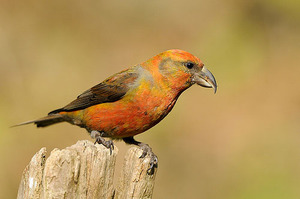 The bird belongs to the order of passerines of the genus Crossbills of the family Cervidae. Crossbill listed in the Red Book of Moscow, as it belongs to the second category of rarity. The bird is slightly larger than a sparrow and very unusual, weighing an average of 50 grams and measuring 17 cm in length. It lives only in coniferous forests and is unique in that it raises its chicks in winter.
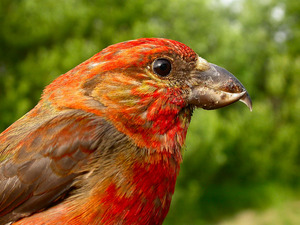
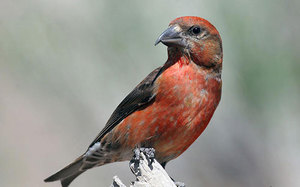
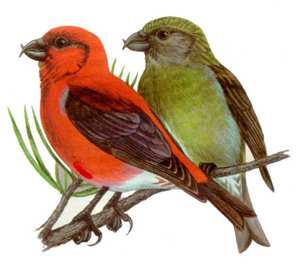
Females have gray-green plumage with yellow spots on the wingtips. Males are even more attractive, truly dandy. Their upperparts are crimson with a gray bib. The bird's distinctive appearance is not its plumage, but its beak. Its distinctive structure is very similar to that of a parrot. It is very powerful, with the upper and lower mandibles crossed, and sharp points protruding from the sides. This strong beak allows them to easily break:
- cones;
- spruce bark;
- branches.
The bird climbs trees and feeds on the seeds of spruce and other conifers. The unique structure of its beak helps the spruce crossbill extract seeds from coniferous forests. This is its favorite and primary food, but it also eats other foods:
- seeds of other plants;
- insects.
Lifestyle
The crossbill can be called a noisy and rather active diurnal birdUsing a wavy flight pattern, it flies quickly from place to place. Songbirds call to each other when flying in flocks. They make a characteristic "kep-kep-kep" sound.
 Not all birds migrate to warmer climates for the winter. Many remain in their permanent habitats for the winter. They stay because they have access to other food besides midges. Bugs are preserved under fallen leaves, suitable food is found in plant pods, and seeds in pine cones are also found. Such food helps them survive the winter, remaining in their usual habitats. The crossbill can be considered a permanent resident. The bird not only... a distinctive beak, but also tenacious pawsThe birds find the pine cones and pick out the seeds from them.
It often happens that birds abandon an area where the cones have run out and fly to another forest in search of food. Many people know that coniferous trees produce a harvest once every four to five years. The cones ripen only toward the end of summer, and by winter, they are brittle and dry. When warm weather arrives, the cones open and the seeds fall to the ground, where they then give rise to new coniferous shoots. This time of year is the most pleasant for crossbills, as they have an abundance of food.
Crossbills and offspring
 The crossbills' main food source is conifer cones from coniferous trees, primarily spruce and pine. The most abundant cone harvest is considered to be early winter. This explains why crossbills breed in winter. The birds are confident of an abundant supply of food and are not afraid that their chicks will go hungry. Parents also need strength not only to produce their young but also to raise them to a healthy state.
At this time of year there are almost no birds, and squirrels sleep almost all the time in their hollows, so Crossbills have the ability to eat as much as they wantDuring this period, birds begin to build nests, as they believe that the most favorable time has come.
The female chooses the nest in the densest spruce trees. When snow covers the dense branches of the spruce trees, the female can reliably protect the nest from piercing winds and cold in such a secluded location. Caring parents use the most insulating material for nest construction:
- feathers;
- lichen;
- moss;
- animal hair.
The resulting nest looks very secure, warm, and cozy. Besides the nest's warmth, there's also the mother's warmth, as she lovingly warms her young. When the chicks hatch, their beaks are normal. This allows the parents to feed them crushed nuts, stuffing the nut mush into their mouths. After the chicks are two months old, their beaks begin to curve. The young gradually begin to learn to forage for food themselves, pecking it out of pine cones. There's still plenty of food around them; all that remains is to get it out of the shell.
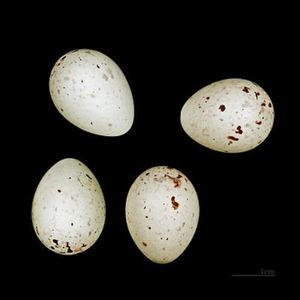
The period from February to March is considered the best time for crossbills due to the abundance of food. They usually begin laying eggs at this time, but sometimes they lay eggs in January. The birds prefer to nest mainly in the coldest regions. In winter, temperatures in such areas can drop to -35OWITHBirds are not afraid of the bitter cold and they build nests despite severe frosts.
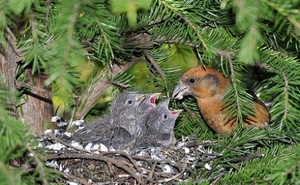 Birds have fairly thick and warm plumage, so they tolerate severe frosts well. Parents do everything to keep their chicks warm. As soon as the female lays her first egg, she immediately sits on it and warms it. The female sits on the eggs constantly and does not leave the nest to protect the future offspring. The male ensures food for the expectant mother. When the chicks hatch, he also continues to get food for the whole family.
Birds can travel long distances in search of a bountiful harvest of pine cones. Once they find one, the bountiful forest can serve as a new nesting site.