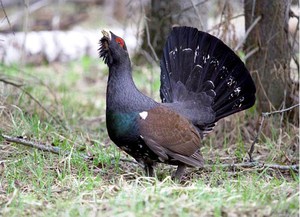
 The black grouse is a fairly large bird belonging to the pheasant family, with a vast habitat, including forests, forest-steppes, and parts of the Eurasian steppe. It can be found throughout the Russian Federation. It is usually sedentary, but sometimes migrates in search of food. It prefers to live at the edges of forests and in large river valleys.
These birds have several species:
- meadow;
- sharp-tailed;
- black grouse;
- blue;
- Caucasian black grouse;
- wormwood.
Some of them have been brought to the brink of extinction by humans and are now under protection.
Content
Habitat
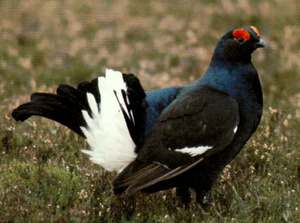 The black grouse is most widespread in the territory extending from the British Isles and the Alps to the Korean Peninsula and the Ussuri region.
In the west and central parts of Europe these birds live in forests and settle in the mountainsThey can also be found along the northern coasts of Denmark, Belgium, and the Netherlands. In Asia, these birds are often found in Kazakhstan, China, Mongolia, and North Korea. In some areas, the birds have been completely exterminated by humans (for example, black grouse are not found in the Eastern Sudetes).
Black grouse also have a very extensive range in Russia. In the north, they are found in the following areas:
- Kola Peninsula;
- Arkhangelsk region;
- Komi Republic;
- Tyumen Oblast.
In the south it lives in the following areas:
- Kursk;
- Volgograd;
- Voronezh;
- valleys of the Ural and Samara rivers.
In the east of Russia, black grouse can be seen here:
- in the north of Lake Baikal;
- in the valleys of the Gorin and Argun rivers,
- near the Ussuri River.
The black grouse is also common in the Baltics, Ukraine, Poland, and Germany. This bird can also be seen in Kazakhstan, especially in its northern regions, and in Mongolia.
It is obvious that the habitat of these birds is quite wide. Sometimes, in search of food, they make short-distance migrations, thus expanding the habitat.
The Caucasian black grouse, a larger representative of the grouse family, has a more limited range: Russia (the Caucasus), Azerbaijan, Armenia, Georgia, and Turkey. It prefers to settle and build nests at significant altitudes, more than two and a half kilometers above sea level, and feed even higher – at altitudes exceeding 3 kilometers!
These birds are also found in North America, and the sage grouse prefers this continent. In winter, they live near farms, feeding on them, and during mating season, they move to grassy areas.
The sage-grouse prefers to nest in the immediate vicinity of the Rocky Mountains in Turkmenistan, in sagebrush thickets. The wood grouse inhabits coniferous forests.
Habitats
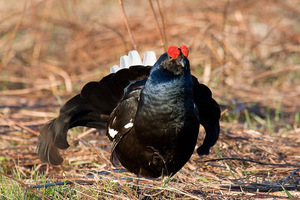 Black grouse prefer to live in forests where there are open areasTypically, they live in small groves and sparse forests. They often nest along the edges of agricultural fields or floodplains, in burned-out areas, or in clearings. They avoid dense, gloomy forests. They prefer birch groves, and less commonly, moorlands and marshes. The black grouse's favorite habitat is a birch forest; it's no wonder that in Germany, these birds are nicknamed "birch grouse" for this preference.
Previously, birds also settled in the steppes, but as agriculture developed, these lands passed to humans, who displaced the winged giants.
These birds prefer to nest on the ground, specifically choosing a safe spot in dense bushes or thickets. Sometimes, a a small depression in the groundNest building is the female's responsibility; the male will not participate in this process. The completed "dwelling" is insulated with feathers and dry grass.
The black grouse lays approximately 6-8 eggs and incubates them herself. The chicks hatch after about a month, sometimes three weeks. During the first few days of life, they feed on larvae and insects. However, adult birds prefer plant foods: buds, leaves, berries, juniper cones, flowers, and seeds.
Caucasian black grouse prefer to settle in rhododendron and rosehip thickets, populate small juniper groves, and nest among low-growing birches. Nests are located in shrubs or on meadow slopes, and the female incubates the eggs and cares for the young. Typically, the nest size is no more than six.
Like common black grouse, Caucasian representatives prefer to stay in flocksIn winter, females tend to stick with males. In the spring, the birds climb trees to sample fresh buds or shoots. Clinging to the trunk with their strong feet, they can hang upside down for extended periods. These birds are reluctant to change their habitat, which led to their near-extinction: hunters easily found the nests of these large beauties.
Appearance
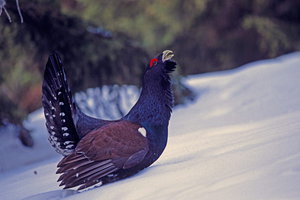 These are fairly large birds, about 45 cm in length and weighing about a kilogram. Males are handsome, with iridescent black feathers and red stripes above their eyes, like eyebrows. The bill is black, and the legs are dark. The undertail and underwing feathers are white, and the belly is brown. Flight feathers are dark brown with white specks, called speculums. The tail feathers are black. The bird looks very beautiful due to the smooth curve of the outer tail feathers.
Females are less attractive. They are smaller in size and feature mottled yellow-brown or gray-yellow hues with transverse stripes. Their tails are not as beautiful as those of males and are significantly shorter.
The chicks are also colorful, their coloring includes brown, white, brown, yellow stripes and spots.
Interesting facts
- Black grouse have clearly defined sexual characteristics: even an inexperienced observer can't confuse males and females. Females are mottled brown-gray, or less commonly dark yellow, and produce a clucking sound, while males are black, with a green or purple tint, and have a resonant voice.
- Black grouse have excellent hearing and keen eyesight, so they can sense danger from afar.
- Males play virtually no role in raising the chicks. Females take care of both the nest and the young. They feed the chicks and carefully hide them from danger. If females see a predator approaching, they will divert attention to themselves by running away from the nest to save the chicks.
Lifestyle
Leads a terrestrial existence, moving into trees only to search for food. However, it is a skilled flyer, able to cover tens of kilometers without pausing. It prefers to live in flocks, which can reach quite impressive sizes—up to 300 birds of both sexes.
The time of special activity is early morning or late evening.
Nutrition
The Caucasian black grouse prefers seeds, berries, leaves and grass in the summer, and in the winter cold it will happily eat birch catkins, buds, and dig berries and seeds from under the snow.
Black grouse are also herbivores, happily feeding on buds (of both birch and other trees such as aspen, willow, and alder), berries (blueberries, rose hips, bird cherry, and bilberry), and seeds. They sometimes eat insects, but this is more common among chicks. In autumn, the birds move closer to the fields to feast on the grain left over from harvesting. In unfavorable years, they feed on pine cones, pine needles, and juniper berries.
In winter time
The black grouse doesn't migrate to warmer climates, preferring to winter in its natural habitat. This bird has adapted to the harsh season in a remarkable way: living near birch trees, it feasts on their kidneysAnd in the coldest weather, it basks in the snow: diving from a tree into a snowdrift, creating a veritable canal, ending in a "room" where the black grouse survives the storm. However, upon hearing the crunch of snow under the paws of an approaching predator, the sensitive birds instantly take flight and fly away.
A little about reproduction
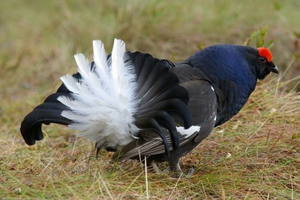 Black grouse nesting begins in the spring. Males settle at the edge of a forest or in a clearing and begin their mating display—emitting strange, melodic sounds to attract female grouse. During this time, they are very active: they move around the clearing, chasing each other, eager to present themselves in all their glory.
After the females arrive at the clearing, the fighting beginsThey are practically harmless to birds, but they look simply amazing! Black grouse do not form pairs; one male can give birth to several females. After mating, the female takes full responsibility for the nest, eggs, and chicks.
The black grouse's habitat is quite extensive, but human intervention has largely reduced its range. This has particularly affected steppe species, which have been virtually wiped out by agricultural operations. Forest birds continue to thrive, occupying a significant portion of the forests and forest-steppes of Europe and Asia.
 Hunter
1 comment