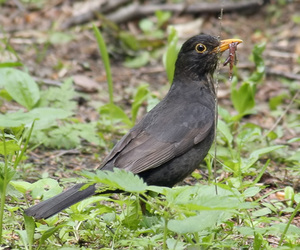
 Birds are warm-blooded creatures. Their average body temperature is 41OC, which means they can be active in cold weather, provided they have enough food. Due to food shortages, many birds abandon their nests and fly to warmer climates when the cold weather arrives. There, they will have ample food. One such migratory bird is the thrush, which we will discuss in this article.
Brief characteristics of thrushes
Thrushes are passerines. Thrushes are called more than a dozen species of birdsThey all differ from each other in appearance, size, and habitat. Thrushes are renowned singers and are considered forest dwellers. Nowadays, this bird species has become more sociable, therefore settling in urban green spaces. In the evening and morning hours, city residents have the opportunity to enjoy the songs of these birds. In early summer or spring, the birds even sing at night.
These birds are distinguished by their slender build and strong, thin beak. They have strong claws, and their body length can range from 17 to 28 cm. Their weight varies depending on the species, and can be ranging from 85 to 110 gramsAppearance and coloration can also vary depending on the species. Most species have brown and tan spots in their plumage. The black thrush has the most subdued feather coloration, while the rock thrush has brighter plumage. They have a very active tail; twitching of the tail signals alarm and danger. There are two species of thrush that can be kept in a cage at home:
- singer;
- black.
There are about 20 species found in Russia, but The most common are:
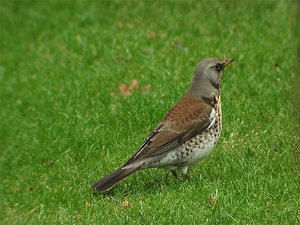
- rowan,
- black;
- singer;
- white-browed;
- mistle thrush.
There are 62 species of thrushes worldwide, many of which live in Asia, America, and Europe. These birds move in a fascinating way, hopping and squatting simultaneously. These singers are shy, active, and intelligent. Their lifespan is up to 17 years.
Habitat
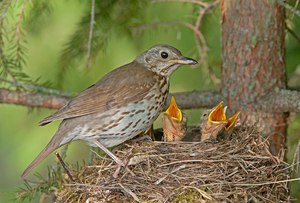 Thrushes inhabit almost the entire planetThey are absent only from the Arctic and Antarctic, as well as from oceanic islands. Whether thrushes are migratory or not is a definitive question. Thrushes are migratory in temperate latitudes, but in other latitudes they rarely leave their nesting sites.
There are many migratory thrushes, and most arrive at their nesting sites very early. They also leave late, migrating to warmer climates. They inhabit primarily deciduous and coniferous forests, but some species can also live on plains. Thrushes build nests in shrubs and trees. The birds settle primarily in forests, mountains, and plains, and have also become common in suburbs.
Nutrition
In the summer, birds feed on insects, but they can also eat various invertebrates. When berries ripen, most thrush species prefer berries and fruiting plants. In rural areas, these birds are a real scourge, as they can destroy large crops. When birds flock together, they can destroy:
- strawberry fields;
- pear and apple trees;
- other berry crops.
Despite such problems with crops, thrushes are still beneficial, destroying many agricultural pests.
Many people keep thrushes in their homes, but before doing so, it's important to know that these birds are very wary and timid. If you want to keep this species in your home, you'll need to create a spacious aviary for it. If an aviary isn't possible, you'll need to choose a cage. with minimum dimensions of 70x30x40 cmThe aviary or cage should be equipped with hanging feeders, as thrushes prefer to eat food this way. They enjoy sunlight and bathing. During the warmer months, it is recommended to keep thrushes indoors in a well-ventilated area with partial shade.
Thrushes are voracious eaters, but they are easier to care for than other insectivorous birds. They require a large amount of food to feed them. They generally prefer soft foods. In addition to many types of berries, thrushes readily feed on slugs, earthworms, and naked caterpillars.
Are thrushes wintering or migratory birds?
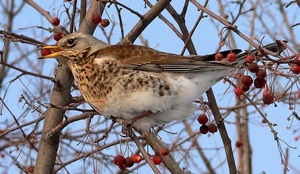
These birds are considered migratory, but their departure for the winter is spread out over a period of time. This phenomenon occurs unnoticed. In the spring, they return in small flocks or alone. With the arrival of September, the thrushes begin to fly away to warmer climes. In years with abundant berry production, the birds may depart significantly later. Species such as the fieldfare may remain over the winter if there are plenty of berries in its habitat. Thrushes winter in Africa, in southern Asia and southern Europe. After wintering, they return in April.
They can even build nests on the ground, and they can also nest in stumps and trees. They often nest in tree hollows, brush piles, and the roots of fallen trees. They always try to build their nests in places inaccessible to predators.
Blackbirds can hatch chicks twice a year. The female incubates 3-7 eggs. Due to her coloring, the female is virtually invisible in the nest. While the mother is sitting on the clutch, the male may sometimes take over for a short time. The chicks hatch after two weeks, helpless and in dire need of parental care. Mother and father feed them berries and insectsThe chicks' daily food will depend on the male's luck. This may include:
 berries;
- mollusks;
- worms;
- ants;
- slugs;
- frogs;
- lizards.
 berries;
Thrushes migrate to warmer climates at night twice a year—in spring and fall. If you have a thrush in a cage at home, the birds are very restless at night during this period. They are constantly jumping from perch to perch, and also jump onto the floor. Their restlessness makes noise.
When birds are healthy and in good spirits, they are very active. Thrushes eat a lot, are active, readily bathe, and do not fluff up. Their feathers are not ruffled, and their beaks and eyes are clear.
 Dmitry
1 comment