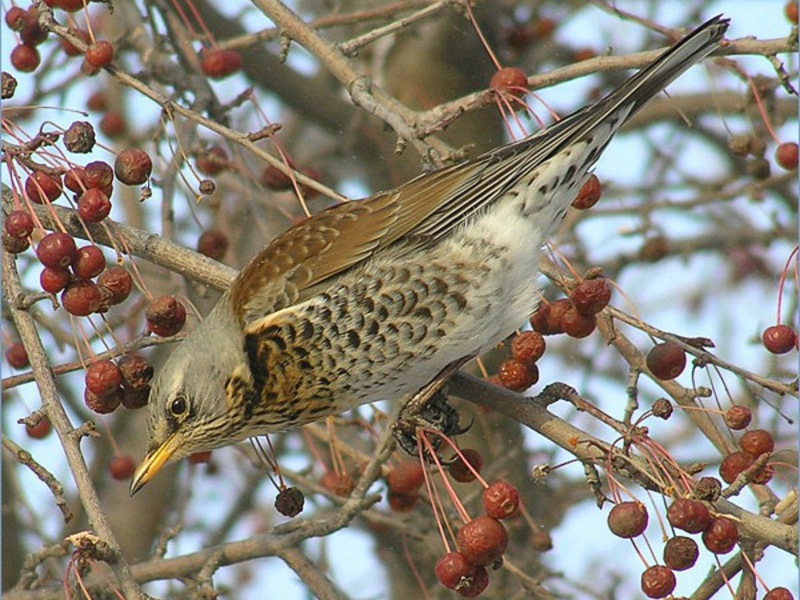
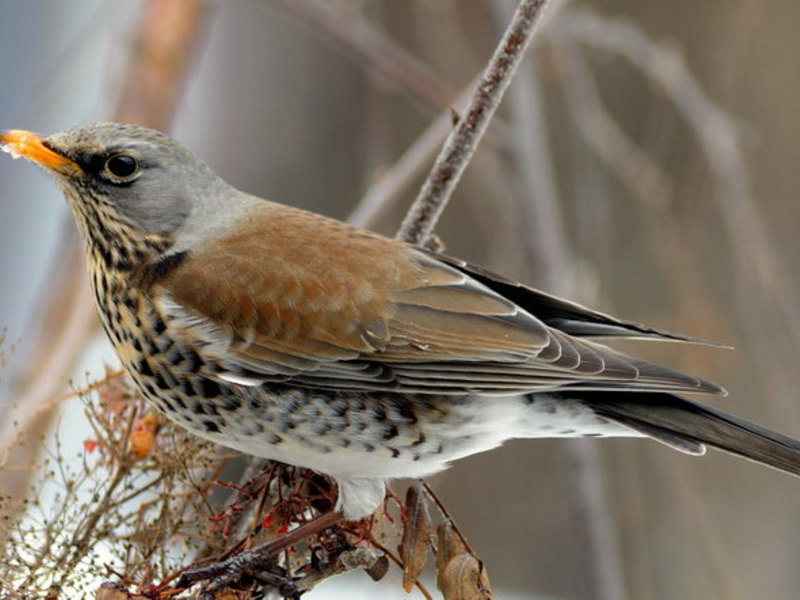
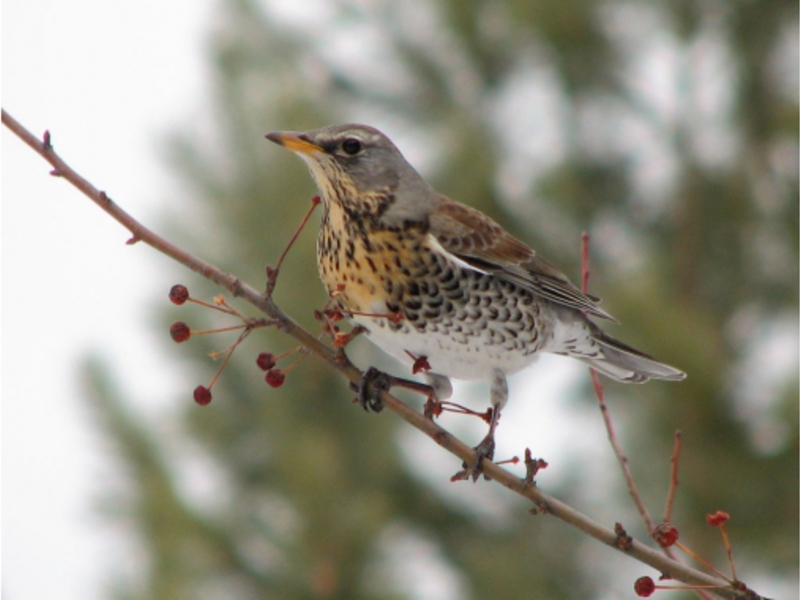
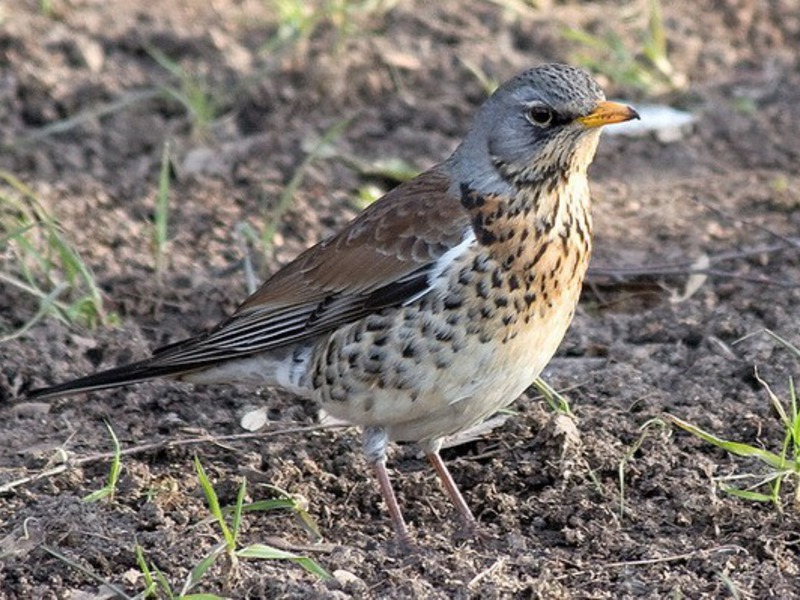
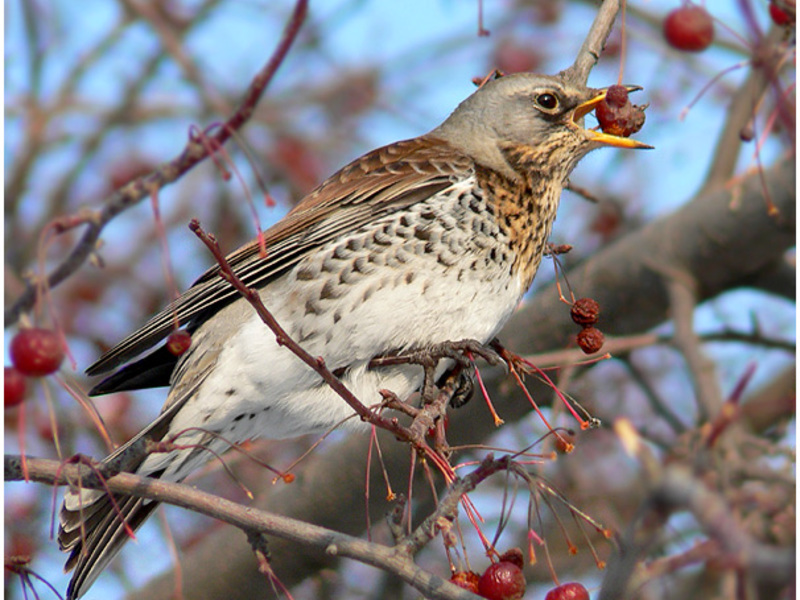
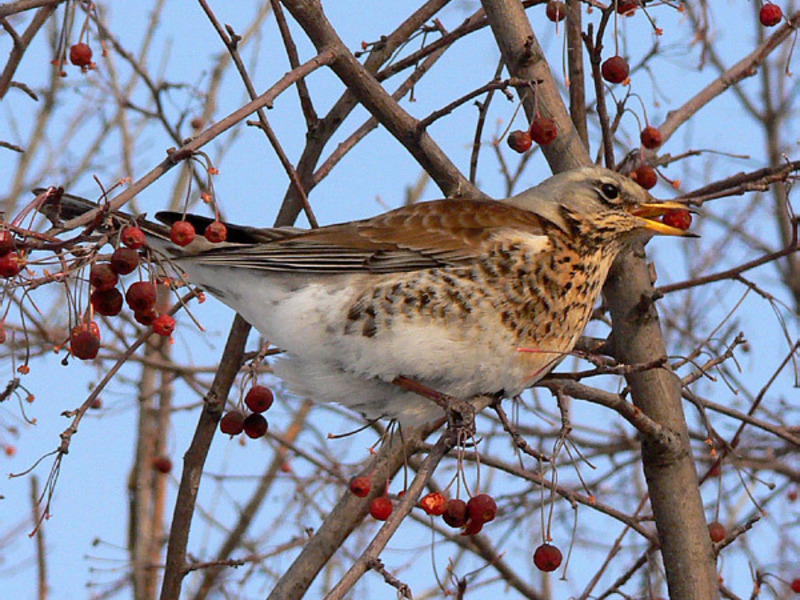
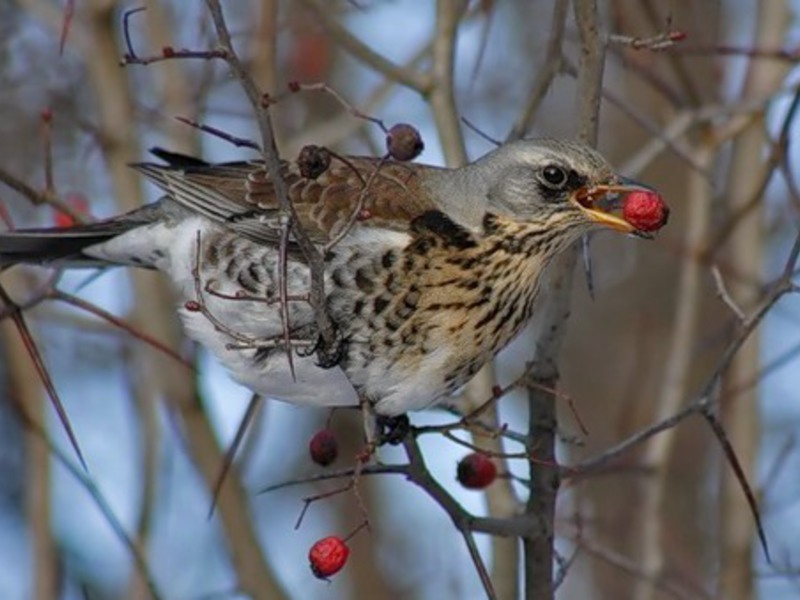
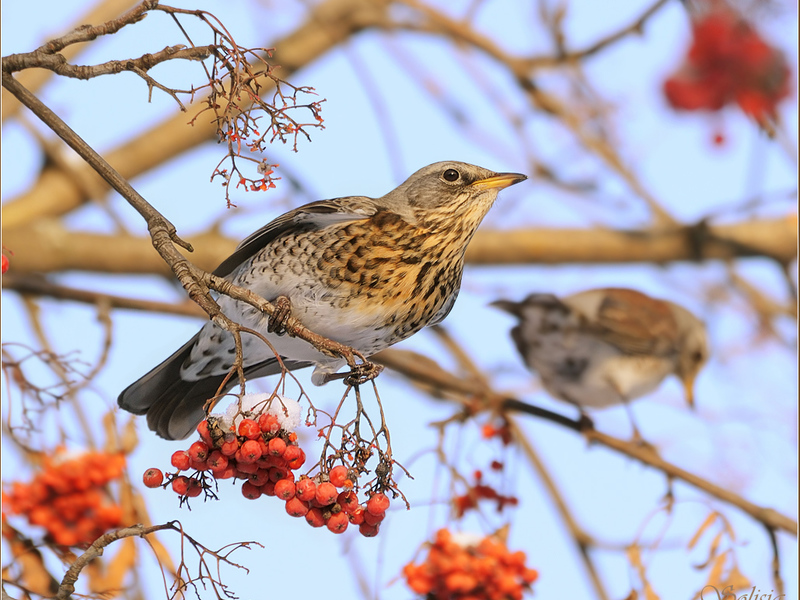
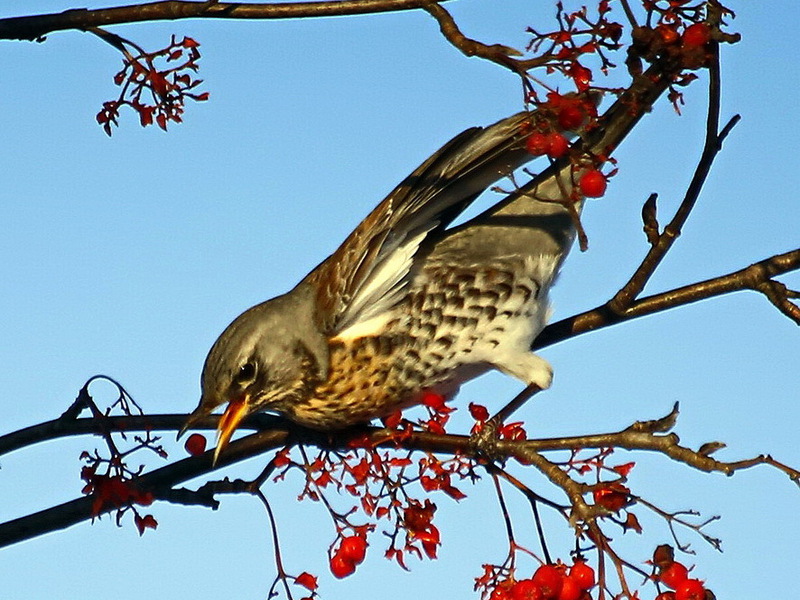
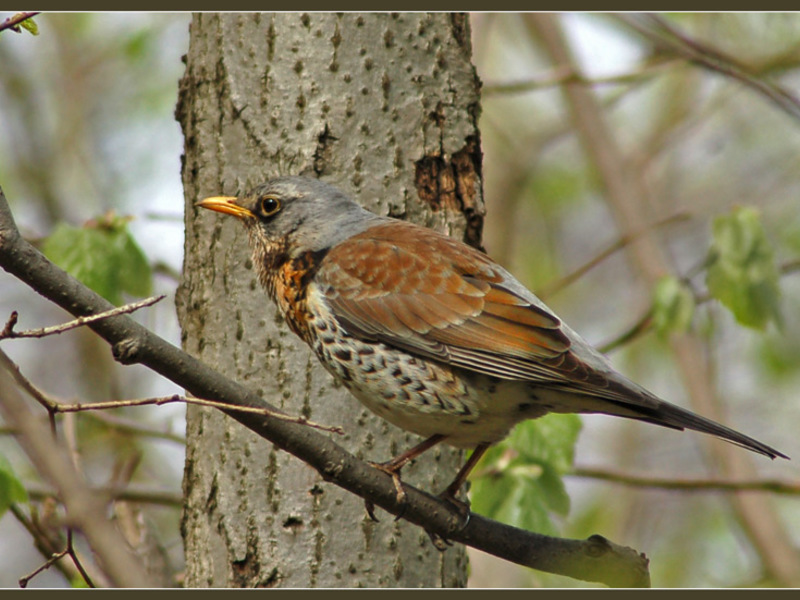
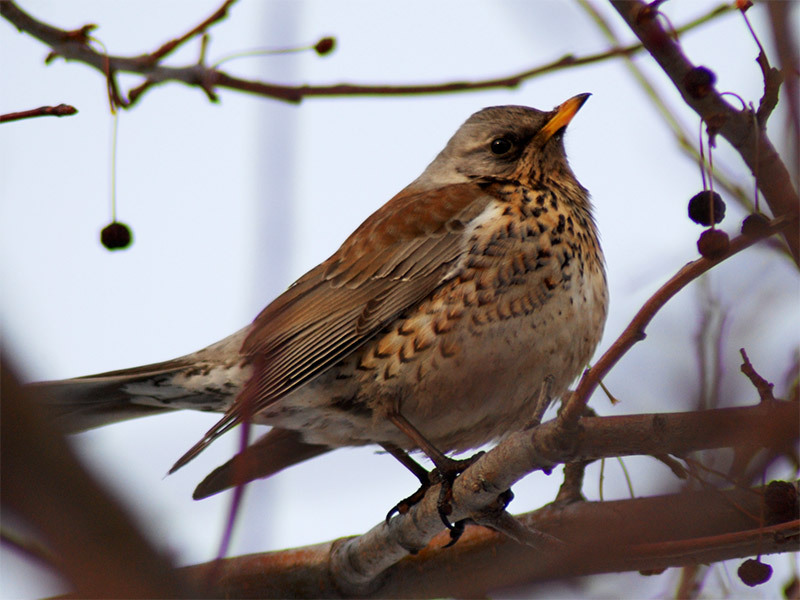
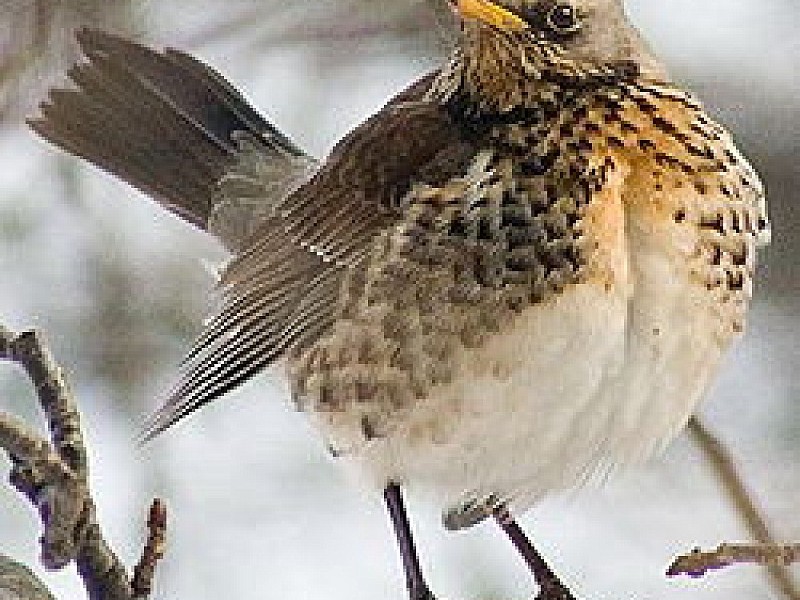
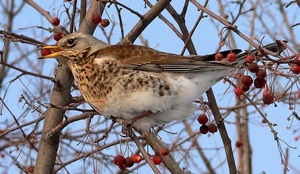
 The fieldfare belongs to the passerine order of the thrush family. It is a fairly large bird with a gray head, dark brown back, and gray uppertail coverts, which contrast sharply with the black plumage of its rather long tail. White axillaries can be seen on a flying thrush through binoculars.
A restless and very active bird, constantly making characteristic sounds of chak... chak... chak, when alarmed it begins to make a deafening chattering ra-ra-ra. It sings and chirps in a creaky voice, something similar to the song of the white-browed merganser, but mostly without the pure opening stanza characteristic of the latter.
Fieldfare: Description
The fieldfare has the following characteristics:
- the size of an adult bird is from 25 to 28 cm;
- weight reaches 75-130 grams;
- wingspan 39-43 cm.
The fieldfare differs from its other relatives primarily in its lifestyle. Most pairs nest next to each other, forming small colonies (about 30-40 pairs), however, some families prefer to build nests in isolation.
The nest of this bird species is built by the female. The male's job is to escort and protect the nesting site and his mate. The female gathers construction materials nearby, if possible. The nest is cup-shaped, quite massive, and lined with soft grass.
A clutch consists of 4 to 7 eggs. The eggs are greenish with brown spots. Incubation begins after the last egg is laid and lasts 12 days. Two clutches are laid during the summer.
While the female is incubating the eggs, the male's duties include guarding her, as well as defense of the colonyDuring incubation, the female is forced to find her own food, as the male does not feed her. The hatched offspring are fed by both parents for 12-13 days.
Where does the fieldfare live?
Fieldfares nest throughout almost all of northern Eurasia. They winter in North Africa, Asia Minor, and Central and Southern Europe. Some are nomadic, while others are sedentary. Fieldfares prefer to nest in copses and parklands, as well as at forest edges and in close proximity to wet meadows. These birds do not inhabit dense forests. The nesting season lasts from April to July.
Characteristics of the Field Thrush
Fieldfares are very active, courageous, and even warlike birds. They boldly attack predators as a colony and almost always win, driving them away from their nests. They can also attack animals., including people, flying low overhead and not forgetting to spray them with droppings. This is their method of defense, you must admit, quite effective.
Enemies of the Field Thrush
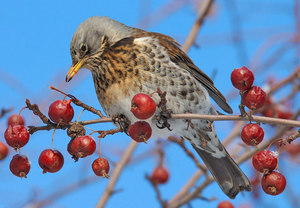 Among the fieldfare's many enemies, the crow deserves special mention, often building a nest near a thrush colony. However, upon spotting a crow near their nest, males, even solitary ones, boldly attack it and force it to flee.
But despite its belligerence, the fieldfare is a completely peaceful bird and is not capable of causing even the slightest trouble to its neighboring birds. On the contrary, it boldly stands up for the protection of smaller birds, whose nests are destroyed by predators in the hope of profiting from eggs or chicks.
Thrushes can easily chase away a squirrel from their territory, which never misses the opportunity to dispossess a flycatcher or a chaffinch. Magpies and crows themselves are reluctant to venture into the area from which the fieldfare's seemingly disgruntled cries can be heard. This vigorous defense of the colony's territory by thrushes attracts a huge number of small birds. Greenfinches, warblers, finches, and many other small birds often nest en masse within thrush colonies or on their outskirts.
However, despite such active defense, thrushes are not always successful in saving the colony. In some cases, crows that destroy fieldfare nests face no punishment. This occurs mainly when the thrushes' defense of their nest is hindered by human presence. Besides crows, squirrels, jays, woodpeckers, and sometimes nocturnal predators and dormice participate in the destruction of fieldfare nests and those of their immediate neighbors. Hawks also prey on fieldfares. Predators, as well as rain and summer and spring cold weather, also contribute to the destruction. capable of completely destroying a colony.
In such conditions, the high mobility and gregarious nature of fieldfares facilitates their active exploration of uncharted geographic areas. A mobile colony can not only travel long distances but also actively seek out and colonize new sites that are most favorable for nesting in a given season.
Nutrition
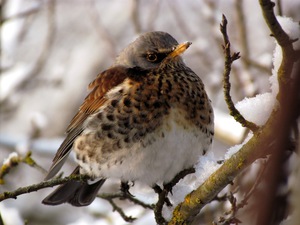 The fieldfare feeds on both plant and animal food.
During the nesting period, fieldfares collect food on the groundIn areas with sparse grass cover, they prefer damp fields or marshy, short-grass meadows, and in parks and forests, areas covered with rotting leaves and shaded by tree canopies. On the ground, the birds move jerkily, constantly turning their heads and scanning the ground, and with nimble movements of their beaks, scattering or even turning over leaves and ground litter.
Most wood thrushes feed on terrestrial mollusks and earthworms, and this diet is shared not only by adult birds but also by the chicks they raise. This penchant for earthworms can sometimes lead to serious consequences: birds begin to die en masse from nematode infestations. The rapid proliferation of these parasites contributes to the clogging of the digestive and respiratory tracts of both chicks and adults.
In addition to earthworms, rowanberries willingly feast on various insects, living in fields and meadows, as well as in the forest litter. These may include the following types of insects:
- woodlice;
- centipedes;
- butterflies and their pupae;
- caterpillars and their larvae;
- various beetles and other invertebrates.
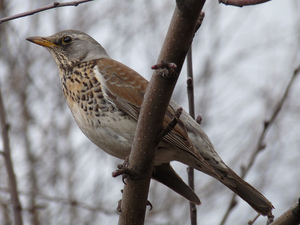 The fieldfare has a special affinity for sweets. As early as summer, it begins to seek out ripening berries and feast on them, despite the fact that there is plenty of bird food available everywhere. When there is no other choice, thrushes feed on tart rowan berries, the bitterness of which interrupts the taste of sugar.
However, if a single tree bearing sweet berries is discovered in the middle of a rowan alley, the fieldfare will pluck it first. Once it finds such a tree, the bird remembers its location and will lead all its fellows there the following autumn.
Until recently, the fieldfare was a rather rare guest in cities, which accidentally flew there during the protracted pre-winter period. However, after the rowan tree firmly established itself in city gardens, squares, and parks, thrushes, delighted by the abundance of food, began building nests right within the city limits. Today, rowans have become one of the most visible and numerous inhabitants of fields, meadows, and green spaces in Russia.