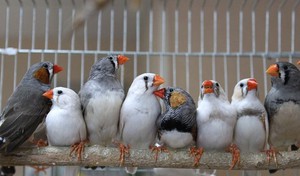
 Are you considering getting a cute little bird for your home, but can't decide which one to choose? Are the usual canaries and parakeets not your thing, and are you looking for a unique feathered friend?
Then you might want to consider the interesting and rather cute zebra finch, which will delight you with its bright plumage and melodic song. These birds are a bit shy and require some care, but that's nothing compared to the festive feeling they can bring to your home.
Content
What is a zebra finch?
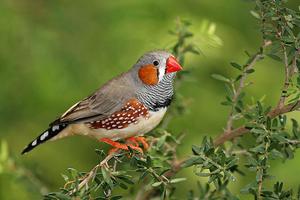 Finches are small, cheerful birds belonging to the weaverbird family. Their homeland is distant Australia. They appeared in Europe and other countries relatively recently (about two hundred years ago).
These birds breed easily and are completely unpretentious in their habits and food, very active, lively, and have a resonant voice. However, their popularity among bird lovers was primarily due to their unusually bright plumage.
If you decide to have these birds in your home, keep in mind that the finch, although small, is a completely independent bird and you will not be able to pick it up, as it does not become attached to people at all.
Based on their external characteristics, finches are divided into three groups:
- Australian herbivores. They are distinguished by their diverse coloration. Their bright plumage can have five or more colors. Males and females often have the same coloring.
- African (wax-billed) weavers. Their bills have a wax-like texture, hence the name.
- The third group has the least vibrant plumage. Birds can be coffee-colored, cream-colored, or brown.
Since finches are flock birds, it is better to keep them at home. contain several pieces, and if this is not possible, then at least a couple.
Varieties of finches
 There are about thirty species of these birds found in nature. Finch painting These are quite large birds (up to 20 cm in length). They are very vocal and active. They were domesticated several centuries ago. They have a quarrelsome nature, so they should not be housed in the same cage with smaller birds. They can be aggressive towards their smaller relatives and injure them.
Zebra finchesThese birds are active and quite noisy by nature. Care for them is almost the same as for their relatives, but there is one peculiarity: they reproduce very vigorously, so to avoid exhausting the females, the breeding process must be strictly monitored and the birds should not be allowed to nest frequently. Males of this species can be aggressive towards other birds.
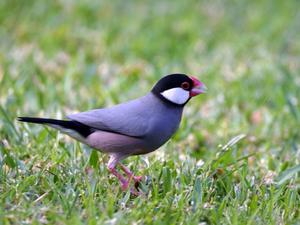
Japanese finchesThey look plain and inconspicuous and require little care. These birds have adapted to life in captivity, and in the wild, they are no longer able to build nests or forage for food. Their coloring ranges from cream to dark brown. Crested Japanese finches are occasionally encountered.
Other popular domesticated species of finches:
- parrots;
- diamond;
- red-throated.
How to keep finches at home
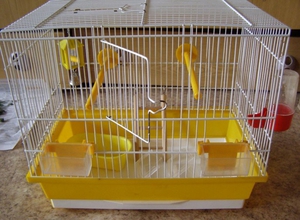 At home, weaver finches are kept in both aviaries and cages. Although weaver finches require flocks, building large houses for them is not necessary, as they are no larger than a sparrow.
In the city apartment of the finches it is more convenient to keep them in cagesThere are several types and designs. Some cages are wooden, made of hardwood (the frame and bars are entirely made of wood), others are all-metal, made of duralumin, aluminum, or steel, and others are a combination: their bars are made of steel wire and the frame is made of wood.
All of the above types of cages are suitable for keeping birds of this species, however, each of them has certain advantages and disadvantages.
So, all-metal cages They're hygienic, durable, and their bars let in plenty of light. And if the cage is rectangular with a flat top, it offers additional convenience: you can save space by stacking several cages on top of each other.
These structures are resistant to disinfectants, boiling water, and fire. However, they do have some drawbacks: every time a bird jumps onto the floor, the bars, or from one perch to another, the bars make noise.
Furthermore, making such a birdhouse yourself is quite difficult, as spot welding is required to connect the metal planks to the rods. You can, of course, try using a soldering iron, but it's not very reliable and takes a long time.
Wooden cages They are also suitable for keeping birds. They are graceful and beautiful, and the wood makes no noise when the bird jumps, only a soft spring. The rods, made of hard wood, protect the finch from injury even if thrown sharply or startled.
However, such a cage has its drawbacks: wood is sensitive to moisture and cannot be treated with hot disinfectant solutions. At the same time, the cracks are easy for bird parasites to settle and breed in. Such cages are unhygienic and short-lived.
Combined cells They have both the positive and negative qualities of the first two types. They are easy and quick to make, but they are not suitable for keeping finches, which are particularly skittish. Cages made of copper wire are completely unsuitable for keeping birds, as they oxidize when exposed to dirt, moisture, and air, gradually poisoning the birds.
Cells manufactured made of synthetic materials (Getinax, organic glass, etc.) are also very durable, beautiful, and hygienic, and are resistant to chemicals. However, they are adversely affected by high temperatures and hot water. Japanese and zebra finches can be kept in such houses year-round.
For keeping finches it is absolutely do not fit rectangular cells with a domed top (they hide the birds from people), as well as round ones, since the birds feel insecure in them, and in diamond-shaped and trapezoidal ones there is not enough space for them.
How to care for finches
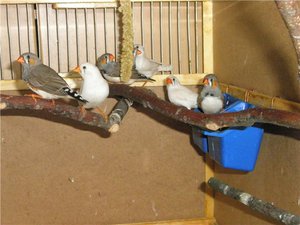 The zebra finch's habitat should be kept clean at all times. The cage needs to be disinfected At least once a month, otherwise it will become infested with parasites (bird mites, etc.). Before disinfecting, the cage should be cleaned of dirt and dust and rinsed with boiling or hot water.
Then, all the cracks and crevices are washed with a disinfectant solution, using a brush for this purpose. Once the cage is dry, it must be wash with hot water and soapWhen cleaning, be extremely careful and do not leave any traces of disinfectants on the surfaces of the cage.
During the work, the bird is removed from the house. If the bird's housing is not maintained in a timely manner or is neglected, it is possible the appearance of the feather mite, which reproduces quite actively and becomes a very serious problem for both the pet itself and its owner.
Equipment needed to maintain cleanliness and order in the cages:
- Glass dropper pipes.
- Scraper for cleaning window sills in cages.
- Syringe for powder and liquid disinfectants.
- Brushes for lubricating cracks and grooves with disinfectant solutions.
- A scoop for dosing sand and removing dirt and dust.
Among other disinfectants, Disinsectal has proven itself to be an excellent choice. It should be handled with extreme caution, as it is very potent.
Weekly disinfection during sand change is carried out using a two percent chloramine solution and carbolic water (2% carbolic acid solution). These preparations process walls and pallets cages, wooden feeders and perches.
A good remedy is powdered chamomile or pyrethrum, which should be poured onto a tray in a thin layer, covered with thick paper on top and covered with sand.
Necessary conditions for keeping finches
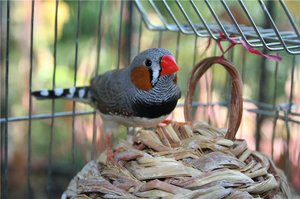 The cage must have water bowls, preferably closed ones, to prevent excrement from contaminating the water and to prevent the birds from bathing in them. Microscopic algae can form on the walls of water bowls over time, and the accumulation of these algae darkens the surface and makes it unsightly.
To clean the drinking bowls you can use a large table salt or millet, which are filled with water (up to half the volume). The container is then vigorously shaken, the spout of the drinking bowl is covered with a finger, and then thoroughly rinsed.
In open enclosures, where there is enough space for the birds to move around and a bath, it is possible install open drinking bowlsFor bathing, use settled (unboiled) water; its level in the drinking bowl should be no more than two centimeters.
To ensure that the food is less exposed to contamination, it is recommended to place the feeder between the perches, and the drinking bowls and baths wall-mounted ones are preferableThe height of the feeder walls should be no more than 2.5 cm. It is recommended to pour mineral fertilizer into hanging feeders near the perch.
Owners of finches also need to have in their inventory transport and quarantine cellsA newly acquired bird is first placed in a separate cage to prevent the introduction of possible infections. Quarantine cages are typically smaller than those in which the birds live permanently.
Sunlight plays a big role in maintaining the health of the finch, so it is recommended to place houses by the window along the wall, so that they receive 2-3 hours of sunlight per day. Birdhouses are best installed at a distance of 0.4-0.5 m from the floor.
When changing water and food daily, approach enclosures and cages carefully, avoid sudden movements, and keep your voice low when speaking to your pet. This will help your feathered friend become accustomed to humans more quickly.
When airing your apartment, be careful: finches - heat-loving birds and are afraid of sudden temperature changes. A sudden power outage, the unexpected appearance of a stranger near the cage, or a loud noise can frighten the bird and even cause its death.
In the room where the finches are kept no smoking, as tobacco smoke and other carbon monoxide emissions are detrimental to the birds' health. Keeping pets with hunting tendencies (e.g., cats) in the same room with a finch is also unacceptable.
How to feed and what
Zebra finches' diet consists of a grain mixture containing 6-8 ingredients. The main one is millet. For 1 kg of millet, take:
 250 g of meadow grass seeds (timothy grass, plantain, clover, dandelion, etc.).
- 100 grams each of hemp seeds, millet, mogar, lettuce and rapeseed.
- 50 g of flaxseed.
- 150 g of oatmeal.
- 300 g of canary seed.
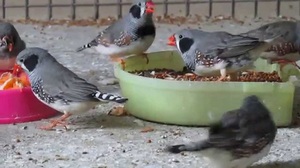 250 g of meadow grass seeds (timothy grass, plantain, clover, dandelion, etc.).
You should feed the bird once a day 1 teaspoon per head. Various cereals (buckwheat, millet, rice) can be added to the diet. Be sure to include fresh herbs (parsley, dill), berries, fruits, and vegetables.
In addition, birds should receive small amounts of hard-boiled eggs and cottage cheese. Live food (corethra, bloodworm, mealworms, gamarus) is also necessary for birds (especially during the breeding season).
In summer, it is useful to add finely chopped leaves to the feed. plantain, dandelion, lettuce and other plants, and in winter, sprouted grains of wheat, barley, oats and millet will serve as additives.
Before you decide to buy a finch, you should carefully consider whether you can provide the birds with comfortable living conditions, proper balanced nutrition, and care.
If you're ready, go ahead and buy these cute, cheerful birds with melodic voices at the pet store. But remember: only healthy birds will give you no trouble and will bring you many pleasant moments.
 yuryt
yuryt  Olga
Olga  Paul
Paul
3 comments