 Experienced poultry farmers know that a brooder is a box, crate, or part of a room where chicks are kept during their first days of life. This unique home for the chicks serves as their warming source, thus replacing the mother hen. The chicks' future development and productivity depend entirely on the quality of their care.
Brooders are sold in specialty stores, but to save money, you can make your own. To do this, you need to select high-quality materials, determine the dimensions to use for the drawings, and follow the instructions in our article and video.
Content
What should a brooder be like?
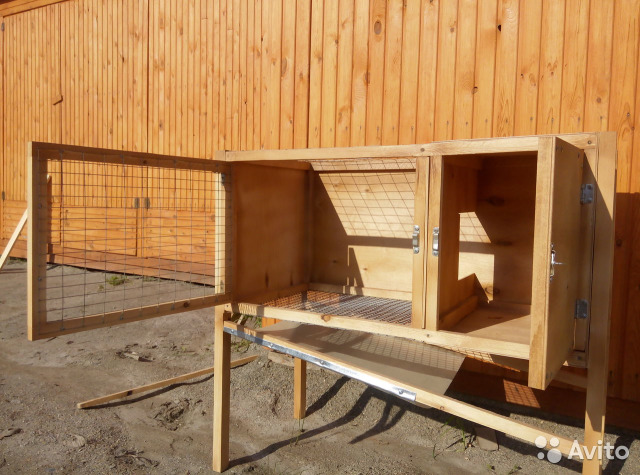
Brooder (nursery) for babies is a fairly simple deviceEssentially, it's a simple box equipped with lighting and a heating system to help the chicks develop and grow.
When making a brooder yourself, you need to consider the following requirements:
 Size. Since broilers grow quickly and become not only heavy but also quite large by the time they reach 50 days of age, the brooder cage must be spacious. If the cage is too small, the chicks will develop poorly, become weak, and become ill. A typical brooder size is 100 cm long, 50 cm high, and 50 cm wide. However, this depends on the number of chicks being raised in it.
- Floor. The surface the birds will walk on should not be slippery. Otherwise, their feet will constantly slip, which can lead to various injuries. A two-tier floor is best. The lower tier should be pull-out, making it easier to change the litter and clean the floors. Regular cleaning is essential in the chicken coop. A pull-out floor allows this to be done without disturbing the chicks.
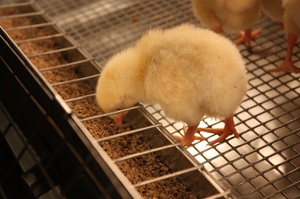
- Feeders and waterers. If possible, it's best to equip the nursery with automatic feeders and waterers. Chickens can knock over regular food and water bowls, which leads to constant contamination of their home. Furthermore, replacing the feeder requires reaching into the structure, which is stressful for the chicks.
- Heating system. If plastic containers or regular boxes were used to build the brooder, table lamps are suitable for lighting and heating. For more complex designs, infrared lighting fixtures are recommended.
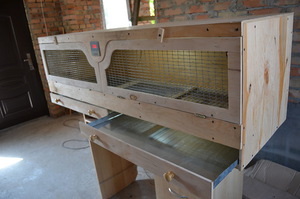 Size. Since broilers grow quickly and become not only heavy but also quite large by the time they reach 50 days of age, the brooder cage must be spacious. If the cage is too small, the chicks will develop poorly, become weak, and become ill. A typical brooder size is 100 cm long, 50 cm high, and 50 cm wide. However, this depends on the number of chicks being raised in it.
Preparation of materials and tools
Since a brooder can be made from many available materials, there is no exact list. To make you will need multi-layer cardboard sheets, wooden beams. Plastic containers, barrels, cabinets, wooden crates, and so on can also be useful.
The following tools should be prepared:
- roulette;
- pencil;
- nippers;
- pliers;
- screwdriver;
- hammer;
- jigsaw or hand saw.
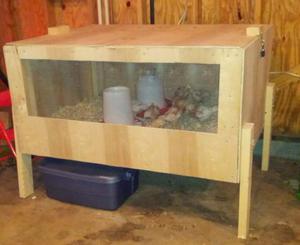 roulette;
Before beginning assembly, it's necessary to determine the dimensions used for the drawing. Then, based on the drawing, the necessary materials are selected.
Making brooders yourself
For fifty or more chicks you will need to do a structure measuring 100x50x50 cmIt can hold no more than fifty broilers, but many more quails.
Plywood nursery
For the construction of the above dimensions, the following materials will be needed:
- one sheet of plywood measuring 150x150 cm and 1 cm thick;
- loops – 4 pieces;
- a strip with a cross-section of 50x15 mm;
- self-tapping screws or nails;
- sheet metal, oilcloth or plastic panels for the pallet;
- plaster mesh for doors;
- fork – 1 piece;
- reflector;
- infrared lamp 40 or 60 W – 1 piece;
- dimmer;
- cartridge;
- cable of the required length.
Once you have prepared the materials and tools, you can begin making your own brooder for chickens.
Manufacturing stages:
- Cut a 50x150 cm piece from a sheet of plywood and saw it in half. These will be the side walls, which should be 50x50 cm.
- The remaining large piece is sawn into three equal parts, which will be the bottom, back wall, and top of the structure.
- All walls are fastened together.
- Now you can start making the excrement tray and the floor, for which two frames measuring 98x49 cm are made from the slats.
- The bottom of the pallet will be a 100x50 cm sheet of plywood, which is nailed to one of the frames.
- To make it easier to remove excrement, the bottom of the tray is lined with film.
- Rails are attached to the side walls above the installed tray. These will support the floor.
- The floor will be made of galvanized mesh, which is attached to the prepared frame. To keep the chicks warm in the brooder, the mesh is lined with newspaper.
- Doors measuring 45x31 cm are made from a slat, which is covered with plaster mesh.
- The slatted frame is hung on the front wall using door hinges.
- If necessary, latches are attached.
- A hole is cut in the ceiling, through which the cable is threaded, and a socket is installed.
- A plug and dimmer are installed on the outside.
- A thermometer is attached to the rear wall of the structure.
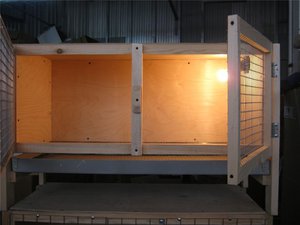
- A light bulb is screwed in, and a reflector is attached to it. This way, the chicks will have areas with higher and lower temperatures. If they get cold, they'll sit under the reflector, and when they get warm, they'll move to the other end of the brooder.
 Cut a 50x150 cm piece from a sheet of plywood and saw it in half. These will be the side walls, which should be 50x50 cm.
A self-built brooder is ready for babies to move in. If desired, it can be paintedBy making two more similar structures and stacking them one on top of the other, you can create a spacious and convenient battery. It can be used to house chickens of different ages.
Brooder with a glass lid
You can make your own structure with a glass lid that can be heated with hot water. This is best suited for summer, when the chicks can bask in the sun during the day and, during colder weather and at night, near the closed part of the manger.
Materials needed:
- standard materials for making a long box or a ready-made suitable container;
- organic glass;
- canister;
- self-tapping screws;
- mesh material;
- metal hinges;
- pieces of fabric.
 standard materials for making a long box or a ready-made suitable container;
Stages of work:
- Mark out two segments in the assembled box.
- Make double walls in the closed part 15 cm above the floor.
- Nail the canister holders to the wall.
- Make a frame of appropriate dimensions from the slats and insert glass into it.
- In the open part of the structure, install the frame holders, having chosen the angle of inclination in advance.
- Using hinges, attach the frame with glass to the slats located above the double wall.
- Attach the side door to the hinges.
- Make a ventilation hole with a mesh in one of the side walls.
- Fill the space between the walls with insulating material, such as rags and sawdust.
- Install the lid and hang the screen between the two segments.
- Attach a canister of water to the holders, line it with cotton wool on top and cover with a lid.
The homemade brooder is ready. You will need to use it regularly change cooled water to hot water.
Frame nursery
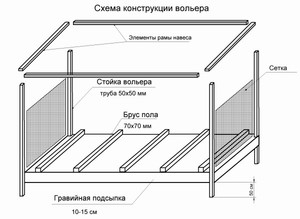
This simple design will be convenient for caring for chicks. The materials used for its construction are the same as for a plywood crate, but you'll need more slats or beams.
Manufacturing stages:
- A frame for the upper and lower parts of the structure is assembled from bars.
- Side rails are installed between the frames, resulting in a frame.
- The sides, back and floor are made from plywood sheets.
- The top and bottom of the structure are connected by a beam in the middle.
- The brooder is assembled using nails and screws.
- A mesh is attached to the front.
- The four bars installed on the sides will serve as legs.
- Doors are cut out of plywood and attached to the top using hinges.
- If necessary, valves are installed.
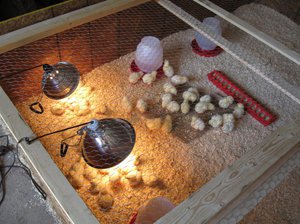 A frame for the upper and lower parts of the structure is assembled from bars.
The homemade structure is equipped with lighting, ventilation and a thermometer.
Setting up a brooder
In addition to lighting and heating, chickens need flooring, convenient feeders and drinkers.
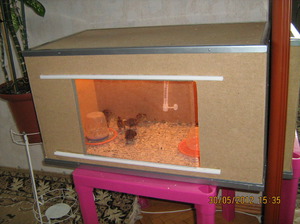 In summer, thin, lightweight bedding can be used. In winter, it should be warmer, so a deeper layer such as sand, dry peat, or sunflower seed husks is preferable. Corn husks, chaff, and straw, which mold quickly, are not recommended. Chickens eat sawdust, which often kills them, so its use is strictly prohibited.
Hopper-type feeders are best, as they keep the brooder clean because the birds won't scatter food. These feeders dispense food from the outside, preventing disturbance to the brooder's inhabitants.
Water containers should not be large. Children can drown in them. It is best to use a drinking bowl with a sensitive nipple, having first installed a drip catcher on it.
Making a brooder yourself is fairly easy. The key is to keep it warm, light, dry, and clean. This way, the chicks will grow up healthy and worry-free.