 Muscovy ducks, also known as Muscovy ducks, are quite common in Europe due to their excellent, lean meat. These large birds can be found in the wild in Mexico and some other South American countries. Their undemanding nature, lack of fussiness in food and care, and their ability to survive make these remarkable birds ideal for raising at home.
Content
The benefits of breeding Muscovy ducks at home
- Excellent meat - lean, tasty, dietary, without the specific taste typical of waterfowl meat.
- They don't need a pond. A regular drinking trough will do just fine: the birds can drink water there and teach their young chicks to swim.
- They do not require special conditions for breeding.
- They don't need any special food, so you can save a lot on food in the summer.
- Resistant to diseases.
- A fairly quiet bird, it will not cause discomfort to its owners (it is not for nothing that one of its names is “the dumb duck”).
- Remarkable growth rates: in 2 months the chick reaches sufficient weight to obtain the required amount of meat.
- An additional product is eggs, rich in protein and carotenoids.
Traits of Muscovy Ducks
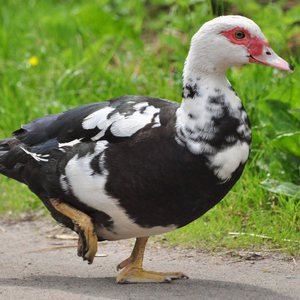
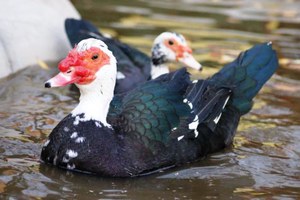
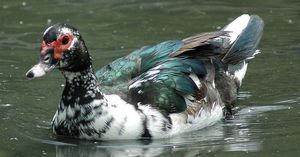
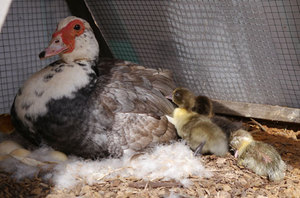 The Muscovy duck is characterized by broad chest and small neck, short legs, and powerful wings. A drake can weigh up to 6 kg (with a length of up to 90 cm), while a duck can weigh up to 3-3.5 kg (with a length of 60 cm). Their coloring varies depending on the breed. On the head, at eye level and under the beak, are distinctive red growths. In older birds, these growths emit a strong musky odor, hence the name. The video shows what these large representatives of the avian world look like.
Breeding Muscovy ducks
Preparing the premises
Despite its unpretentiousness, the Muscovy duck cannot get along with other representatives of the animal world, so it is advisable build a separate house for herThis bird is ideal for raising at home! Choosing a room for the duck house should be done carefully: it should be warm enough in winter, but not too hot in the summer heat. Ventilation and a low humidity area are essential. To prevent the birds from pecking each other, the lighting should be dim; it is recommended to paint the bulb orange or red.
If possible, the duck house can be placed in a summer cottage or in the yard of a private home. In this case, lightweight, collapsible structures are ideal. During the winter, the Muscovy duck house will need to be thoroughly reinforced.
The layout of the duck house depends on the size available to the beginning poultry farmer. If the room is large, most of it should be covered with fine-mesh netting, on top of which a thick layer of bedding (sawdust or straw) should be placed. It's crucial to thoroughly insulate the floor, as the Muscovy duck's feet are particularly sensitive to the weather. very sensitive to coldCalculating the required area for birds is simple: one bird requires 1.5 meters of living space.
If the home is small, a suitable option is to house the Muscovy ducks in cages placed one above the other. These can be homemade (from wood and wire mesh) or purchased ready-made. To keep the cage clean, the back wall should be slightly lower than the front to allow excrement to flow there. It's highly recommended to provide a yard for the Muscovy ducks to run around in; they love the sun and fresh air.
When the room itself is ready, it follows take care of its equipment.
 Feeders. For every five Muscovy ducks, one feeder, one meter long and 25 cm wide, is required;
- Drinking bowls. It's best to choose narrow options to prevent ducks from trying to bathe in the drinking water.
- Roost. Stacking several logs on top of each other makes a wonderful perch for ducks. It should be placed some distance from the wall and no more than 40 cm high.
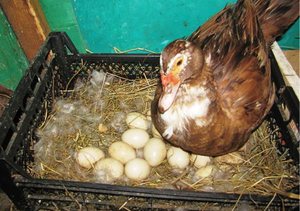
- Nests. For breeding Muscovy ducks, nests should be placed near the waterers; they can be made in a cardboard box or basin, lined with rags or straw at the bottom. The duck will find the nest, insulate it with down, and lay eggs. The number of nests depends on the size of the flock: each duck should have its own.
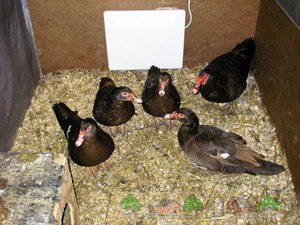
- Heating devices. These will be needed during the winter; supplemental heating should be used fairly early, as soon as the temperature reaches 5 degrees Celsius. Space heaters, potbelly stoves, and electric lamps are all suitable for this purpose.
 Feeders. For every five Muscovy ducks, one feeder, one meter long and 25 cm wide, is required;
Bird acquisitions
The best solution would be to purchase a young Muscovy duck in the year of the broodAfter some time, she will be able to please her owner with her first offspring.
The best time to acquire birds is the first half of autumn, when the young have already matured into drakes and ducks. Selecting a breed is an important step, and will greatly influence the success of breeding. The following Muscovy ducks are the most popular:
- white;
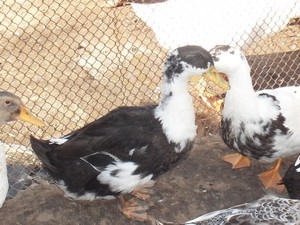
- black and white;
- brown and white;
- black;
- blue;
- white with a pattern.
All these breeds of ducks are characterized by rapid weight gain, making them ideal for meat production. Maintaining them requires little investment or experience.
Hatching in an incubator at home is easy!
Incubation mode is divided into three periods:
- First week: temperature 38 degrees, humidity 60%.
- Days 8-29: Temperature drops to 37 degrees, humidity – to 45%.
- Days 30-34: Temperature remains at the same level, humidity should be increased to 75%.
Placing the eggs horizontally will produce better hatching results, but placing them vertically will allow more ducklings to fit in the incubator.
Growing
 The best starting point for beginners is 30 birds, but if your home environment doesn't allow for such a large flock, you can reduce the number. For every five Muscovy hens, you should definitely buy one drake.
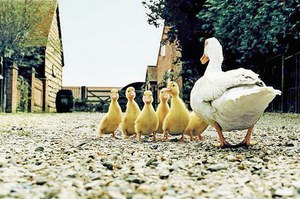
Muscovy ducks start laying eggs in April., the number of eggs is about twentyThe incubation period is over a month, and has often exceeded 40 days! The hatched chicks are covered in down, weigh up to 70 grams, and can stand on their own. Birds have a highly developed maternal instinct: they brood and care for their chicks very well. When the bird leaves the nest, mist the clutch, which improves gas exchange in the egg. Raising adult ducks from chicks is not particularly difficult; the main thing is to carefully care for the birds.
The time for slaughtering birds can be determined using the example of French farms: a drake – after 85 days and a duck – after 70 days.
Feeding
The Muscovy duck is quite unpretentious in food, but She should be fed a balanced dietFeeding birds warm or hot food is contraindicated; the mainstay of their diet is grains: corn, barley, wheat, and oats. Don't forget to provide them with vegetables, greens, and supplements such as yeast, bran, oilcake, and bone meal, and occasionally treat them to a favorite dish: porridge with greens. In summer, birds will happily feast on fresh grass. The daily requirement for an adult Muscovy duck is a liter of water and approximately 400 grams of feed. You can see how to prepare food for birds and feed them in the video.
To ensure strong egg shells, add chalk, crushed eggshells, and shells to the feed. A container of fine gravel should be placed in the duck house, as it is essential for digestion.
It is especially important to organize the correct feeding of chickens, so it is described in detail: day-old chicks should be treat yourself to a hard-boiled eggThe chicks can only eat food that moves, so the food is sprinkled on their backs. On the second or third day, they can be given a mixture of milk, bran, and boiled eggs. Next, the chicks are fed a mash of cottage cheese, chopped onion and spinach, and a small amount of crushed grain. From the fifth day, finely chopped cooked scraps of meat are added to this mixture. From the tenth day, boiled potatoes are included in the diet.
Care
Birds don't tolerate stale air, so ventilation should become a habit for any caring owner. In addition, the litter should be cleaned regularly. Maintenance also requires regular balanced feeding and access to clean water.
The duck loves to walk in the fresh air, so a walk should be organizedIn summer, Muscovy ducks can stroll on fresh grass, and in winter, a thick layer of straw should be laid on the snow to protect their delicate feet. The video shows successful examples of breeding and keeping these birds at home.
Important to know!
 If birds start plucking each other's feathers, it's a signal to the owner: they're trying to compensate for their meager diet. It's important to diversify their food with vitamins and greens.
Day-old chicks should definitely remove the wing tipsTo prevent the birds from flying, treat the cuts with potassium permanganate or hydrogen peroxide. If this is done to adult birds, they will stop laying eggs.
Birds can accidentally swallow small metal objects, such as rivets, nails, or broken wire, which can cause death. Care must be taken to prevent such objects from entering the flock's habitat.
Keeping ducks in winter has some specific requirements. Birds must be protected from hypothermia. While they can survive severe winter frosts without special care, their productivity will decline.
Keeping Muscovy ducks at home is not a particularly troublesome and exciting business, which allows you to get tasty dietary meat both for home consumption and for sale.