 Most homesteaders raise various types of livestock. Ducks are among the most popular birds. They have long been domesticated and can now be found in almost every home. They don't require any special conditions for their upkeep. This business is considered low-cost for a beginning farmer, making it very popular and profitable. Where do you start raising ducks at home, and how do you raise them properly?
Content
The purpose of keeping and breeding Pekin ducks
Poultry farming can be a lucrative business. It doesn't require huge investments, as keeping ducks, for example, costs little. For a profitable business, it's necessary choose the right breed of bird.
Domestic duck farming is a profitable business, as the meat is considered tasty and healthy. Ducks lay eggs and produce excellent down. Selling young ducklings can also bring in a good profit.
Many people raise ducks for their delicious meat. It's darker in color than chicken, has more fat, coarser fibers, and a richer flavor.
Ducks lay large eggs, but they are rarely used for home cooking. They are primarily used in the food industry, for example, as an ingredient in mayonnaise. They also make excellent incubation material.
Such a domestic bird valued for its fluffIt is used to produce various items of clothing and home textiles:
- down jackets;
- pillows;
- blankets.
Duck manure is also known for its beneficial fertilizing properties. It is considered the best among other poultry manures.
Selecting a breed for breeding
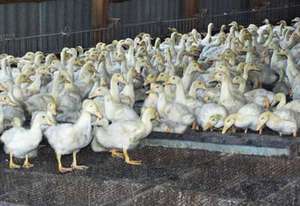 Before purchasing ducklings for raising, you should decide on the breed. Most people prefer leaner poultry, so they try to choose a variety with leaner meat.
This breed includes Muscovy duckThe bird has red skin growths under and above its beak. They are distinguished by their white or black and white plumage, which is why they are commonly called Muscovy ducks. An adult can weigh up to 2.5 kg, and a mature drake averages 5 kg. They are an excellent choice for beginning poultry farmers to raise at home.
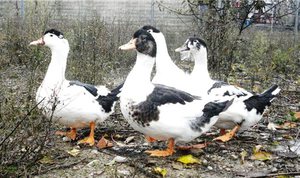
Moscow White The Pekin duck is considered a young breed. To create it, breeders had to cross the Pekin duck with the Huckie Campbell duck. Distinguishing features of this variety include:
- long head;
- wide beak;
- tasty and juicy meat.
A drake can weigh up to 4 kg, and an adult duck about 3.5 kg.
Ukrainian breed, quite common among poultry farmers. Their plumage can be:
- white;
- gray;
- clayey.
White-feathered ducks are most commonly bred. An adult drake weighs 3.5 kg, while a female duck weighs almost 2.5 kg. A single hen can produce up to 220 eggs per year.
The Pekin duck is a popular breed. Its distinctive feature is its fatty meat. Females can weigh up to 3.5 kg, and males can reach 4 kg. A hen can lay up to 150 eggs per year. Pekin ducks are considered easy to care for, making them a popular choice for raising. They gain weight quickly, and within a couple of months, good-quality meat can be produced.
Conditions of detention
To start raising ducks, you need to have an equipped poultry house, and a fairly spacious one at that. The barn can be:
- stone;
- wooden;
- frame.
It's best to make the floor of the poultry house stone or brick. If small rodents, such as mice or ferrets, get into the house, they can seriously harm the birds. The floor of the house should be covered with a mat. The following materials are commonly used for this:
- hay;
- straw;
- sawdust.
Floors are often covered with fine, dry sand. The room should be equipped with waterers and feeders for the birds.
Basic rules and features of content
Before considering duck breeding, it's important to learn as much as possible about duck care and maintenance. For this species, feeding is key to achieving high productivity. follow a special dietThe scheme is very simple, and many people use it in their gardens:
 In the morning the birds go to the pond and since the birds lay eggs in the morning, it is not recommended to let them out of the poultry house before 10 am;
- after 5-6 hours the ducks need to be driven into the pen for feeding;
- After this it's time for the pond;
- In the evening, the feeders should be filled with food so that the birds can eat.
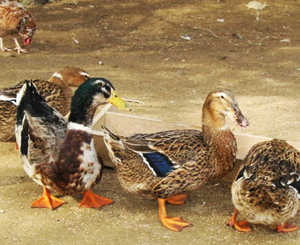 In the morning the birds go to the pond and since the birds lay eggs in the morning, it is not recommended to let them out of the poultry house before 10 am;
After feeding, the ducks can be brought into the coop to sleep. If the birds maintain a daily routine, they will soon get used to it. At the right time, they will approach the pond and feeders on their own, and enter the barn.
In the morning time for the ducks to eat give concentrated feed (crushed grain), and in the evening they feed a mash. The evening food consists mainly of plant products:
- roots;
- vegetables;
- fresh grass.
At home, owners often use it to feed ducks. various food waste and are always added to duck food:
- whey;
- bone meal from meat and fish;
- minerals.
Almost 80% of a duck's diet should consist of grains and starchy foods, and only 20% other additives.
Duckling breeding
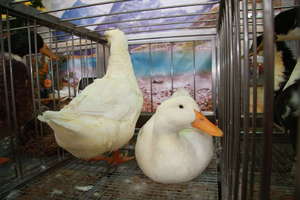 It is believed that ducks are not very good brood hens For hatching. Chickens are much better at this, so duck eggs are often pinned to brooding hens. However, there are cases where a duck allows the eggs to be laid under her and sits on them calmly. Young ducklings hatch a few days later than chicken chicks.
If a hen is brooding ducklings, she will become alarmed when the ducklings begin to readily approach the water for a short time after hatching. It is believed that they should not be released into the water until their down has fallen off and new feathers have emerged. During this period, they have not gained the necessary subcutaneous fat, which can lead to illness.
Ducklings can also be hatched using an incubator, but feeding and raising them without a broody hen is much more difficult. An incubator cannot produce a 100% hatch rate. Only 50% of the eggs set will hatch. This is because during the embryonic stage, the whites of duck eggs lack antibacterial substances.
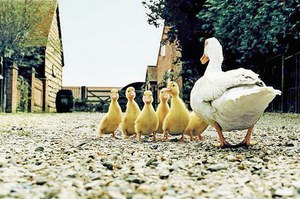
In the first period after birth ducklings need comfortable conditionsFor growing they need a warm and dry room with a temperature of 20-25OC, so they grow healthy and strong. It's best to create even better conditions for them by placing them in special cages with heating at a temperature of 30OC. You can also use regular cages, but you need to install incandescent light bulbs in them.
After three weeks they can be placed in spacious enclosures, with the temperature gradually reduced to 16-18OC. It is advisable to provide additional lighting for the young animals; it should be for 15-16 hours a day.
The ducklings' diet should include boiled and finely chopped eggs and crushed oatmeal. After three days, cottage cheese and finely chopped greens and aquatic plants can be added.
At the age of 10 days include potatoes in the menu and finely chopped root vegetables. Ducklings should be fed 6-8 times in the first days of life. After ten days, the number of feedings is reduced to 5-6 times. As the ducklings grow, they can be fed 2-4 times a day.
Winter maintenance and meat production
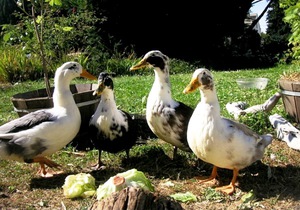 In private backyard farms, ducks are generally raised only during the warm season. Professional poultry farmers also raise them in the winter. This is done primarily for meat production. To ensure good carcasses, the birds should be fed three times a day. In the morning and afternoon, the ducks are fed mash, and in the evening, they are fed grain.
During the cold season, birds tolerate low air temperatures well, but special conditions must be created for them in the poultry house. Temperature should not fall below +5OWITHDucks are wary of drafts, so the room should be warm and well-protected from drafts. It's also important to keep the litter dry. This will determine the birds' productivity.
Supplemental lighting will help increase duck egg production during the cold season. The optimal number of hours of light per day should be at least 14.