 In recent years, Muscovy duck meat has become increasingly popular in many countries. Although native to South America, the bird is primarily raised in European countries. Interest in the Muscovy duck stems from its unique characteristics. Its meat is dietary, vaguely reminiscent of chicken in flavor, yet much juicier and more filling. A bird can weigh up to 4-5 kg, depending on the breed. Some farms raise Muscovy ducks solely for the popular delicacy—fatty Muscovy duck liver.
Today, our compatriots raise this bird in large numbers. Muscovy ducks can and should be bred at home.
Content
When Muscovy ducks lay eggs
The Muscovy duck is an unpretentious bird. It's easy to care for and, importantly, doesn't make any unnecessary noise. Muscovy ducks don't squawk or quack. The only sound they make is a hiss.
The bird itself grows up early and quickly gains weight. Adult drakes reach up to 5 kg, and adult Muscovy ducks - up to 2.5-3 kg respectivelyThese birds produce tasty and filling meat, which is why many farmers are interested in breeding them. Muscovy ducks are often raised at home. Although meat production is the primary reason for breeding ducks, the birds are also good egg layers.
Muscovy ducks lay their first eggs at six months of age. Typically, the first clutch occurs either in late February or early March. Muscovy ducks, like many birds, lay twice a year—in the spring and fall. Farmers claim that they lay a lot of eggs. Based on actual surveys, Muscovy ducks lay between 90 and 140 eggs per year. There are several methods for increasing egg production, but experienced breeders believe this is unnecessary, as the effort required does not yield the desired results.
It should be noted that the Muscovy duck mothers very good hensTherefore, there is no need to create special incubators for "maturing" eggs. Natural hatching yields good results and higher egg production. This fact may be of interest to those who want to raise poultry at home, without special equipment.
How and when does a Muscovy duck hatch eggs?
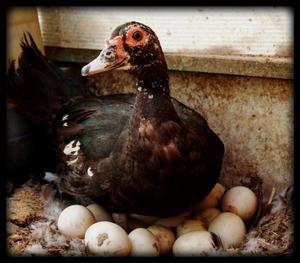 As mentioned earlier, the Muscovy duck is a good broody hen, but she's also a poor mother. Therefore, it's essential to monitor the hatched ducklings, and do so daily.
It is already known that Muscovy ducks produce quite a large number of offspring, and the eggs can also be used for consumption. The egg itself, on average, weighs 75-80 gramsIt has an oblong shape and is white, sometimes with a bluish tint. Note that a duck egg is always larger than a chicken egg. It is also more nutritious, and the yolk is larger.
How long does a Muscovy duck incubate eggs?
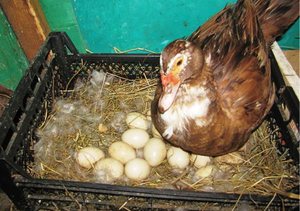
On average, an adult hen incubates her future ducklings for 25 to 35 days, though sometimes the process can be prolonged. To prevent the hen from sitting in a secluded spot where the farmer won't find her, it's necessary to prepare a special nest. The location should be warm, and there should be plenty of food and fresh water nearby. If these simple conditions are met, the hen will not leave her eggs unnecessarily, and they will hatch on time.
How many eggs can a Muscovy duck hatch?
Conventionally, a bird can incubate 15 to 20 eggsThis figure is considered approximate, as the number of eggs in a nest depends directly on the bird's weight. The offspring, which is being incubated by a broody hen, should be completely under the mother hen. A slight "peeking" of an egg from under the broody hen is acceptable. Any eggs that are significantly visible are likely defective.
How to set a Muscovy duck on eggs
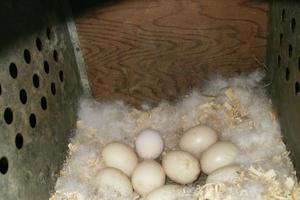 Once a hen begins laying eggs, it's important to time her first sitting on them. Many factors influence her desire to hatch future ducklings, though the most important factor, of course, is the emergence of a natural instinct.
The nest may not be warm enough, it may be improperly equipped, and the number of eggs also plays a special role.
For a Muscovy duck to develop the instinct to brood, there should be about 15 eggs in the nest. However, the product must not be left unattendedIf the individual does not start hatching them soon, they may simply spoil.
To prevent eggs from being lost and to encourage the Muscovy duck to start brooding them more quickly, a "false egg" method is used. An egg is placed in the future nest, followed shortly by the first clutch. The clutch is camouflaged, and after two or three days, the eggs are replaced with fresher ones. This way, the Muscovy duck gets used to the presence of future ducklings in the nest and understands that they need to be brooded.
When discussing the process of egg placement, it's important to know that you can use eggs that have been removed. They must be no older than 10 days and stored at a temperature of 10ºC (50ºF).
In cases where fresh eggs appear under the mother hen, they also need to be removed. It should be noted that checking should be daily, such a check is carried out in the absence of the bird.
Separately, it is necessary to say about eggs: the Muscovy duck should hatch only fresh product, and the shell shape should be correct and whole (without the slightest cracks).
Waiting for the first ducklings
After 25 days, the Muscovy duck begins to call, signaling the hatching of her offspring. Experienced farmers advise checking the clutch after 30 days. If the ducklings have hatched, they should be removed from the mother hen. If the ducklings are not removed from the mother, she may simply crush them. Typically, the ducklings hatch all at once, but it is still recommended to remove the first batch to avoid confusing the mother.
It's recommended to take the hatched ducklings into a warm, comfortable home. Water and food should be readily available in the ducklings' home.
Features of equipping a place for eggs and a mother duck
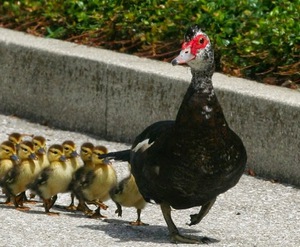 As mentioned earlier, the Muscovy duck is a very good broody hen, but a poor mother. It's important to remember that the Muscovy duck doesn't protect her eggs, so the nesting site for the future ducklings should be set up in a separate area, away from outside noise and other young ducklings. If other birds are nearby, the duck will frequently abandon the nest.
To build a nest you can use any materials at handThese can be ordinary cardboard or wooden boxes, in which fresh hay and grass must be placed, and it is also necessary to ensure that the nest will be ventilated.
It's recommended to place necessary food and water near the nest. It's also recommended to build an artificial pond nearby for the bird to bathe.
A pond is essential for a Muscovy duck, as she needs to bathe daily. If the mother hen doesn't, the eggs will be permanently coated in a film of fat.
Experienced farmers say that nests with hens should be located separately from other birds so that young individuals do not intersect with mature Muscovy duck hens.
Another point: the nests of hens should be located at a sufficient distance from each other. If a hen sees the early hatching of offspring in a neighboring clutch, she will may stop hatching her eggsShe will not return to the incubation process again.
Problems of breeding Muscovy ducks
Although Muscovy ducks are generally unpretentious birds, some difficulties arise during their breeding process. These can be especially challenging for new breeders raising Muscovy ducks at home. The most fundamental problem for any farmer is refusal of an individual to incubate eggsHere are the main reasons:
 The bird may be too young to brood or too old.
- Parasites have appeared in the area where the future ducklings are located, and the mother hen cannot remove them from the nest on her own.
- There are rodents near the nest that scare the bird and take the eggs.
- Poor nesting conditions: noisy, too cold, too hot, bright light, insufficient water. The coop is poorly ventilated, allowing stale air to accumulate.
- Incorrect or insufficient nutrition of the laying hen.
- A bird's protracted molting process (lasting about two months).
- There are too few eggs in the clutch; the hen will not sit on the clutch if there are less than 12-15 eggs.
- The Muscovy duck noticed that the farmer was constantly taking away the product.
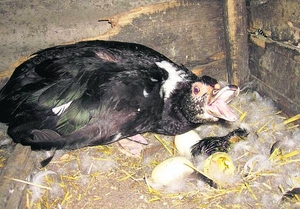 The bird may be too young to brood or too old.
If the causes of the bird's anxiety are eliminated as soon as possible, the hen can continue to hatch eggs.
Conclusion
Growing Muscovy ducks at home - a very profitable enterprise.
- Firstly, the bird is unpretentious in terms of food and care.
- Secondly, it lays eggs very well; you can get up to 140-150 eggs per year.
The Muscovy duck is excellent at brooding foods that are both natural for breeding future offspring and for daily consumption. Moreover, the bird can brood the offspring of other birds, such as chickens.
Muscovy duck eggs, in turn, are more filling and larger than chicken eggs, with the average weight of one product being 70-80 grams.
Speaking of poultry, it's highly nutritious and dietary. An adult can weigh, on average, up to 5 kg.
Caring for laying hens is simple, it is enough to provide her with a quiet, calm place and the Muscovy duck will begin to lay eggs; the hatched ducklings, in turn, are quite strong and grow quickly.
If all the conditions for breeding poultry are met, a farmer can hatch up to 20 young, strong ducklings per season, suitable for subsequent breeding.