 Turkeys are considered the king of birds. People are drawn not only to their dietary and tasty meat, rich in high-quality protein, but also to their unique coloring. For those who want to breed them or simply enjoy their beauty, it's enough to know the basic rules for keeping them.
Content
Where to start breeding turkeys
If you have a desire to breed these birds, then first of all you need to decide on the breedIf you're interested in the mountain turkey, which resembles a partridge, this isn't the right choice, as its habitat is mountainous areas in specific locations and attracts more interested hunters. Among the many types of poultry, turkeys have a limited number of breeds suitable for home farming. Here are some examples of turkey breeds popular with private farmers and suitable for home farming:
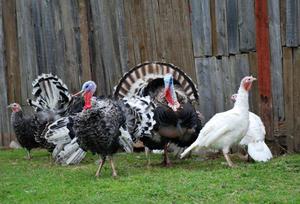
North Caucasian bronze turkey
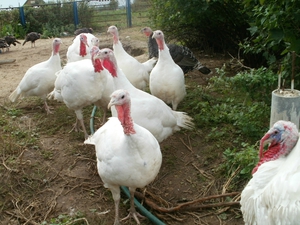 This long-known breed is suitable for pasture keeping.
Appearance: Bronze shades with a green sheen, with a bronze stripe running through the feathers of the lower back, back, and tail. The turkey's breast is gray, visible through the white edge of the feathers. Female turkeys are smaller than male turkeys.
Weight: turkeys about 14 kg, turkey hens up to 7 kg.
Egg-laying: begins at 9 months of age and lasts 6 months.
Egg production: one laying period produces about 80 eggs
Egg color: light fawn with speckles.
White North Caucasian breed
Resulting from crossing a white broad-breasted chicken with a bronze breed, its egg production reaches 160 eggs per season.
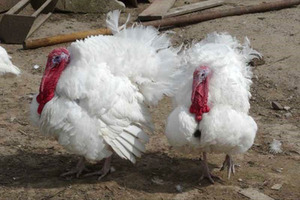
White broad-breasted breed
Due to their good meat properties, rapid growth and ability to adapt to any climatic conditions, they are very attractive for breeding.
Appearance: Medium-length legs set wide apart, an oval body with a broad chest, and tightly set white plumage. After three months, their height remains almost the same.
This breed has 3 varieties:
- Heavy (turkey about 35 kg, turkey hen – 10 kg).
- Medium (turkey - 15 kg, turkey hen - 7 kg).
- Light (turkey - 8 kg, turkey hen - 5 kg).
Egg laying: begins at 9 months of age and continues for 7 months.
Egg production: about 120 eggs per season.
Egg color: yellow-brown with brown speckles.
Bronze Broad-Breasted Turkey
Appearance: Similar to the North Caucasian bronze turkey, but with more robust, developed chest muscles. The turkey's feathers are black with a greenish-bronze sheen.
Weight: male up to 14.5 kg, female up to 8 kg.
One of the distinctive features of this breed is high fertility of eggs, good hatchability of turkey poults and increased viability of young animals.
Egg laying: from 10 months of age
Egg production: about 100 eggs per year
Bronze turkey and Moscow white
Moscow turkey is popular among domestic farmers due to its excellent taste and easy acclimatization.
Data for both breeds: egg production and reproduction have good indicators.
- Bronze turkey. Appearance: black plumage with a bronze sheen, wings and tail covered with light stripes of black and white edging.
- Moscow White. Appearance: white plumage, pink legs and beak, and a more compact body.
Weight for both breeds: males about 13 kg, females about 7 kg.
Egg-laying: if the light is adjusted constantly, then from 6 months, under other circumstances from 9 months.
Egg production: about 100 eggs per year.
Egg color: pink with light brown speckles.
Breeding turkeys at home, in detail
How to choose turkey poults
To start breeding turkeys, you need to purchase them. Take a close look at the turkey poults, for this you need to look at:
 Correct responses to stimuli and general well-being.
- The presence of fluff without bald spots, thick.
- The eyes should be healthy and bulging and shiny.
- The umbilical cord should not bleed and should be dry.
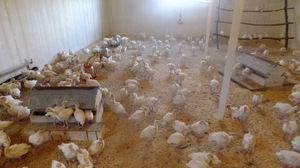 Correct responses to stimuli and general well-being.
You can always choose which turkeys to raise, either buying them from a poultry farm or hatching them yourself from eggs. To determine whether an egg is fertile, there's one way: drop it in a glass of water. If it floats to the bottom, it's safe to hatch. If it floats, it's discarded.
Turkeys require more care than broiler chickens, and only at 6-8 weeks they become more independentBirds that are being prepared for slaughter must be raised for 5-6 months.
How to keep turkeys on a farm
First of all, you need to properly plan their living conditions. Each turkey requires 2 square meters of walking space, perches, and large nests. Some use old chicken coops. In summer, the birds are walked early in the morning or in the evening when the heat subsides. You can also build a canopy over the walking area, which is then sown with clover and green grass. Sometimes, turkeys are walked on pastures.
Setting up a turkey house at home
Turkeys should be raised in a dry, damp-free, and especially draft-free, spacious room. Provide ventilation by installing vents, which are necessary both in summer and winter. In summer, the maximum temperature in the barn is 20°C (68°F), and in winter, no lower than -5°C (21°F). In the brooding area, the temperature should not drop below 10°C (50°F), which will allow for early hatching and early hatching.
The floor for the turkey house should be 25 cm above ground level, and be insulated. Use sawdust or straw for the floor to quickly absorb moisture. In winter, the flooring should be 10 cm thick.
The perch where the bird spends the night is made of 7 cm wide, 7-10 cm high perches. The perch should be positioned approximately 60-80 cm above the floor. The distance between each bird should be at least 30 cm, and preferably 1 meter.
Building turkey nests at home
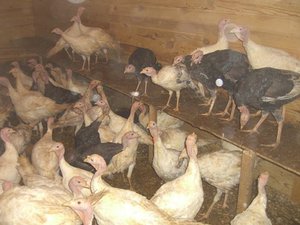 Building a nest properly is essential for a bird to be able to raise its young. Several nests are built in the darkest corner, 60 cm above the floor. The nest should be 50 x 70 cm, with high partitions. One nest per 5 hens.
The nest is laid in layers, a little soil on the bottom, then branches and hay. Another option is to make a circle out of bent branches and vines, and lay straw or hay inside.
It's important to consider the female's need for peace and quiet, as she will later incubate her chicks there. A turkey can lay her eggs anywhere she finds secluded, even in the undergrowth of a garden, and later raise her brood on her own.
Incubation of offspring
The turkey lays eggs from March to June. A turkey hatches 17-19 eggs, and you can also put chicken or duck eggs inShe'll hatch them too. Furthermore, the hatched chicks will be raised as if they were her own. If you have the choice between an incubator and a live turkey, she's the best choice for motherhood.
A turkey hen incubates her eggs for 27-28 days, sometimes up to 32 days. During this period, no one except the owner should approach the nest. It's important to ensure the bird receives the necessary care, takes it for a walk every three days, and leaves the nest to eat and drink. Sometimes, you may need to manually remove the bird from the nest to feed it, check for loose eggs, and remove any cracked ones.
What to do with hatchery turkey poults?
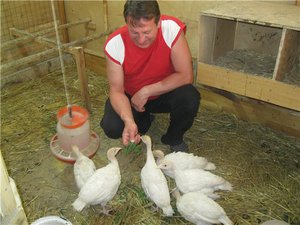
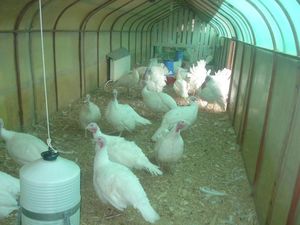 Chicks hatched in an incubator require a room with specific living conditions. To begin, use a large box with bedding, hanging waterers, a temperature of 37°C (98°F), and 24-hour lighting.
In the first 3 days the chickens are given dry food, 8 times a day. Boil millet mixed with egg yolk. This feed is placed on a cotton, non-staining cloth and served to the bird. This is necessary to prevent the turkey's soft beak from being damaged by the hard surface while eating. On the fifth day, return to the regular feeder. Instead of water, give a weak solution of potassium permanganate twice a week for two days. This is necessary for raising healthy birds.
Next, finely chopped greens (nettles, lettuce, alfalfa, green onions, cabbage leaves) are added to the feeding process. Compound feed and vitamins are also included. At 10 days of age, the chicks are introduced to a mash (ground oats, corn, and wheat soaked in whey or sour milk, with the addition of greens). Cheese is also introduced. The feed is made by soaking barley groats in sour milk and adding beets, cabbage, and rutabaga.
A turkey chick is considered mature when the comb begins to break through. Regular grazing is essential for growing it. food is given 2-3 times a day, but grazing must take place all day. When this is not possible, they are fed with green tops, chopped vegetables, sprouted and ground (wheat, oats, barley).
To prevent mortality and ensure the growth of the turkey chick, you need to:
- The room where the young animals are kept must be kept clean and the bedding dry.
- There should be a constant t of 37C.
- Feeding occurs 8 times a day with fresh food, just prepared.
- Give solutions of potassium permanganate to drink (every two days add water with a very small solution of potassium permanganate instead of water to the drinking bowl).
- Constant 60-watt lighting is required to allow the chicks to easily find food and water. From the sixth week, an eight-hour light schedule is required, with the light on at 7 a.m. and 2 p.m. for four hours.
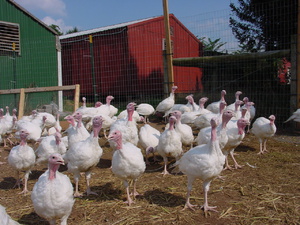 The room where the young animals are kept must be kept clean and the bedding dry.
When you first decided to take chicks from the incubator, It's better to take a 2-3 week old turkey chickDuring this time, they have become stronger and do not require much attention.
How to raise adult turkeys on a private farm
Turkeys that are already grown up, if kept properly, do not cause much trouble, it is enough to maintain the necessary growing conditions and adhere to certain rules:
- Only fresh food is provided (the feeders are positioned at the level of the bird's back, and the feed is poured to ¾ of the volume of the trough or trough; gravel, chalk, and shells are poured into a separate feeder;).
- Clean water in a drinking bowl (the drinking bowl is located at the level of the bird’s neck).
- A draft-free room
- The bedding is warm and dry, the floor is periodically cleaned and disinfected (the hay is scalded with boiling water and dried, and then laid out).
- 1 male for 5-10 females.
- Cozy, dark places for nests (they should be raised 25 cm above the floor).
- A proper, comfortable perch.
- The temperature in winter, where turkeys live, is no lower than -15°C. At other times, it ranges from 10°C to 18°C. Humidity is 65%.
- Walks (a couple of hours in winter, free range at other times). If they don't exercise enough, like chickens, they become obese and stop laying eggs. Therefore, their diet should be more plant-based and less grain-based.
How to Raise White Broad-Breasted Turkey Poults
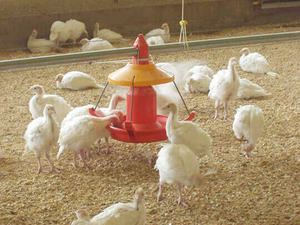 The White Broad-Breasted turkey is native to Canada and is a broiler breed. They are clean, warm-loving, and, despite their small size, gain weight well.
Breeders are faced with the peculiarity of reproduction of this breed; sometimes artificial insemination is necessary due to the weight difference between the male and female. Males reach 30 kg, and the turkey is half as big, 93% of the eggs are viable.
To achieve good results in breeding this breed, you will have to adhere to certain growing conditions:
- The temperature in the turkey house for both young and grown birds must be maintained at a constant temperature of 22-25°C, otherwise runny noses will develop.
- Good lighting
- For young animals, it is better to make an enclosure on the grass where they can walk.
- This breed is fed dry (compound feed) and wet feed (softened grains), as well as carrots. Turkey poults are also given cottage cheese, meat and bone meal, and buckwheat.
- Feed the grown chicks 4-5 times a day. In winter, they are given hay, and in summer, grass.
- It is best to give them water from a bucket; this type of container is more suitable for them and they do not tip it over.
- The food is given in the amount sufficient for 30 minutes of eating at a time.
- The area where they are kept must be disinfected to remove insects and rodents, as they can contribute to the development of infectious diseases. Solutions (chlorophos is also suitable) are used. If this breed was slaughtered, the area must be treated first. The next day, the coop must be cleaned and disinfected again.
Otherwise, they require the same care and attention to grow as other turkey breeds.