 Turkey breeding is very popular today on poultry farms and in private households. This is due to the high-quality meat of these birds and their dietary properties. In the 1960s, a new turkey breed was developed in the United States, which quickly became popular among poultry farmers.
The White Broad-Breasted turkey's parents were White Broad-Breasted and White Holland turkeys. This new breed is noteworthy for its excellent adaptability to all weather conditions, rapid weight gain, abundant egg production, and low maintenance.
Content
Characteristics of White Broad-Breasted Turkeys
The main feature of the bird is rapid growth, which is completed by the hundredth day of their life. These turkeys are divided into three groups:
 The first light group includes birds with the lightest weight. Males average 9 kg, and females 6 kg. They are excellent for commercial breeding and management. This group includes such popular breeds as the Small Bestville, Norfolk, and White Dutch.
- The middle group includes birds weighing between 7 and 15 kg. These include the North Caucasian White, North Caucasian Bronze, Moscow Fawn, Moscow White, and Moscow Bronze breeds. All are distinguished by their high productivity.
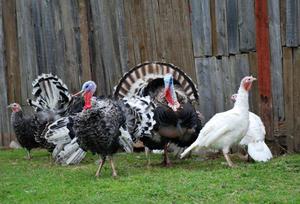
- The Heavy Group consists of birds with significant weight gains. Females weigh from 10 kg, while males can reach 24 kg. This group includes bronze and white broad-breasted birds, Canadian broad-breasted broilers, and the Big 6 cross.
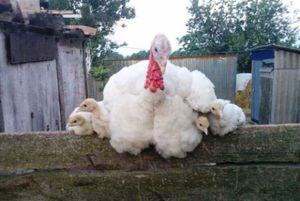 The first light group includes birds with the lightest weight. Males average 9 kg, and females 6 kg. They are excellent for commercial breeding and management. This group includes such popular breeds as the Small Bestville, Norfolk, and White Dutch.
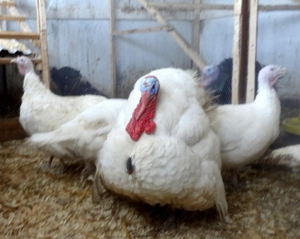
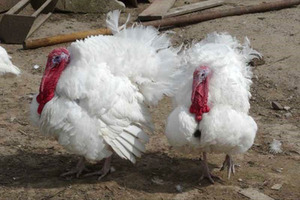
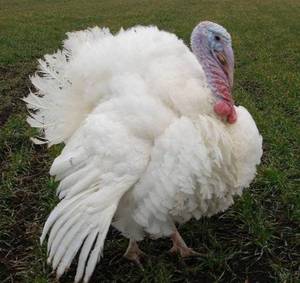
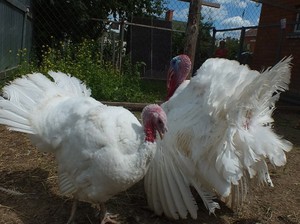
Appearance of white broad-breasted turkeys of any group has its own distinctive featuresTheir peculiarity is:
- broad and massive chest;
- an oval body covered with thick plumage;
- white plumage;
- tufts of dark feathers on the chest;
- Widely spaced, medium-sized, dark pink legs.
Conditions for keeping young animals
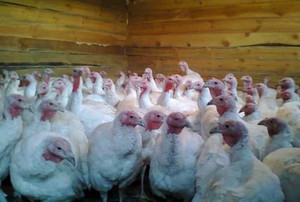 Before purchasing turkeys, the first thing you need to consider is where they will be kept. To do this, you need to build and equip a poultry house suitable for the breed.
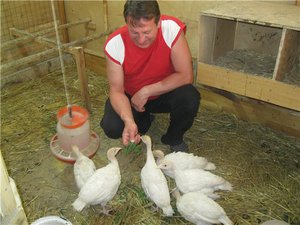
Small cages or an enclosure in the corner of a warm room will suffice for young turkeys. Cages are relatively easy to care for, as they're easier to maintain sanitary conditions and cleanliness. Building a run requires minimal investment.
When choosing a cage, it is recommended to ensure that the cage side is at least 2.5 cm. This is necessary for the safety of the young birds. The area of the pen is calculated based on the number of birds it will house. Per square meter accommodates 5 chicksOnce the turkeys reach four months of age, the area of the pen is doubled.
To better retain heat and make cleaning easier, it's recommended to use wood flooring in the room. For the first week of life, poults should be provided with sand as bedding. This should then gradually be replaced with traditional turkey bedding, which can be made from:
- hay;
- wood sawdust;
- corn stalks;
- chopped straw.
Before laying the bedding, the floor is first disinfected with slaked lime. For this, 500 to 800 grams of lime is applied per square meter. The bedding is laid in an even layer. at least 12-15 cm thick.
Temperature and light conditions
When housing young birds, it's essential to strictly maintain the correct temperature. Failure to do so often results in the death of the chicks. While other poultry species tolerate cold weather relatively well, turkey poults require a warm environment. Therefore, before placing the young birds in the house, ensure the temperature in the house is at least 34-37 degrees Celsius. The temperature should be measured at the bird's height, approximately 10 cm above the floor. Broad-breasted turkeys adapt to cooler temperatures as they age.
Caring for small turkeys in the first 10 days of life consists of in providing them with bright lightingIt helps them find water and food more easily. As the birds age, the light intensity gradually decreases.
Six-week-old birds require eight hours of daylight. It's recommended to turn the lights on and off at approximately the same time each day. If the birds spend time outdoors in the summer, they'll be well-suited for daylight hours.
Caring for turkey poults
 Maintaining a clean pen is the most important rule when caring for young animals. During the first week of life, young animals are susceptible to various bacteria and diseases, so bedding must be changed regularly. Intestinal infections and infections can spread quickly in dirty sawdust, straw, or hay. pathogenic bacteria multiplyIf droppings are removed daily and the bird's housing standards are met, then the litter can be changed every five to seven days.
Walking turkeys
Fresh air walks are essential when caring for young birds. They benefit from sunlight and the nutrients they gain from fresh grass, worms, and various insects they've caught.
The young, raised with the mother hen, are let out for a walk at two weeks of age. Dry weather is chosen for this purpose. air temperature not less than +20CWithout a mother turkey, the young feel vulnerable outdoors, so it's recommended to wait until they gain weight and become stronger. In good weather, you don't have to worry about the young's health once they reach nine weeks of age.
Turkey poults are gradually acclimated to the outdoors. The run should be dry and protected from predators. The run should be free of harmful and poisonous plants.
The turkey pen must be equipped with a wooden shelter and decking. This will provide shelter from the rain and scorching sun. In good weather, the birds are let outside early in the morning and left there until dark. Feeders and water bowls with fresh water are placed in the shade under the shelter.
Care and maintenance of adult birds
Since turkeys are larger than chickens, they require a large amount of space to keep them. more space is neededIf the flock is small, a chicken coop can be adapted for its housing. For the birds to thrive, there should be at least a meter of space per individual.
The poultry house must be warm and dry. Dampness is the main enemy of white broad-breasted turkeys. The house is equipped with clean, dry, and warm bedding and a sleeping platform. Since turkeys are much larger and heavier than chickens, the sleeping platform must be of a corresponding size. The perch is installed at a height of 80 cm. The sleeping platforms are positioned so that each bird has at least 60 cm of sleeping space. The bedding should be changed at least twice a year, usually in the fall and spring.
The poultry house must be sufficiently bright, so when building it, windows are placed on the south or southwest side. During the winter, the room is equipped with lighting fixtures. If the lighting will last more than 14 hours, the turkey will start laying eggs.
The room is equipped with feeders and waterers. The sides of the feeders should be higher than the bird's chest, otherwise the feed will spill. Any container that can be placed on a stand or hung up is suitable for feeding. It's best to place the waterers on a table to prevent sawdust, straw, or droppings from getting into them.
To prevent turkeys from becoming obese, they need daily exercise, even in winter. Adult turkeys should be allowed at least an hour's exercise in winter. Since turkeys are large, their exercise area should be large. In the spring, it's recommended to sow clover and alfalfa, which are a favorite food for white, broad-breasted turkeys.
Features of feeding young animals
 The first feeding of turkey poults should occur 12-15 hours after hatching. In the first hours, the chicks are not yet fully dry and are very weak, so there is no point in feeding themBut if you delay feeding them, they'll start pecking at their bedding. Therefore, you need to be attentive and begin caring for your turkey poults from the first hours of their life.
The most practical feed for young turkeys is a compound feed designed for young poultry of any type. Its balanced composition, small granules, and easy dosing will make feeding and caring for the poults easier. If suitable compound feed is unavailable, you can make your own.
During the first few days, a mixture of boiled eggs and dry fine grains is used as food. Later, a grain meal mixture is fed, the main component of which should be nutritious cornmeal.
The following are added to wet mash for young animals:
- small or crushed cereal grains;
- fish oil;
- ground bones;
- fresh milk, sour milk or skim milk;
- eggs;
- cottage cheese;
- fresh herbs.
Grown-up white broad-breasted turkey poults should be given mineral supplements in the form of shells, gravel or chalk in a separate bowl.
To prevent disease, it's crucial to feed young birds wormwood, nettles, and green onions. Fresh grass is also beneficial. dandelions, yarrow, clover, etc..
Newly hatched turkeys are given water heated to 24°C (75°F). From day one, they can be given room-temperature water. The waterer should be cleaned several times a day, refilling it with fresh water afterward.
Feeding adults
 Turkeys should be fed three times a day. A combination diet is optimal for this.
The main diet should be compound feed and grain. Turkeys love corn, barley, and wheat. Dry grain is recommended to be fed in the evening, as it is more nutritious and will keep the birds full until the morning. Adults readily eat wet and dry mash, which It is recommended to feed the bird in the morning and at lunchtime.
During the summer, turkeys will get vitamins from greens while they're outside. However, dandelions, green onions, and carrot tops should be added to their feed.
In winter, birds especially need vitamins, so don't forget about vegetables when feeding them. Turkeys will happily eat cabbage, beets, and carrots, which can be added to their mash. In the summer, you can stock up on hay and feed it soaked in the winter.
To obtain tender and juicy meat, poultry should be provided with a large amount of succulent feed.
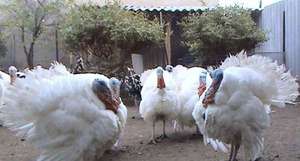
White broad-breasted turkeys are one of the most profitable breeds for farms and small farms. By 20 weeks of age, the birds have already reached a healthy weight, and the costs of its maintenance pay for themselvesHowever, poultry farmers should be aware that feeding and caring for domestic turkeys requires a fair amount of physical effort.