 Poultry farming is a typical and interesting activity in our latitudes. And the goose is a traditional Russian bird. These birds have been kept as pets since time immemorial, and they are still bred today. Geese are relatively easy to maintain, and the benefits of raising them are obvious. How to breed geese at home or in a summer cottage for beginners—we'll discuss this in our review.
Content
Features of cultivation
Raising geese at home For beginners, it promises the following benefits:
 An adult produces 6 kg of meat and 2.5 kg of fat,
- Goose liver has an extraordinary taste and is considered a delicacy,
- Goose feathers and down are widely used in everyday life, as they have water-repellent and thermal properties.
- These birds grow very quickly, in two months you can reach 4 kg of live weight.
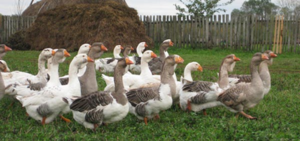 An adult produces 6 kg of meat and 2.5 kg of fat,
Raising geese at home requires raising a high-quality breeding flock capable of producing healthy offspring. They reach sexual maturity at 8-10 months, which is relatively late compared to other domesticated animals. However, eggs from a good hen can produce offspring. over the course of 3-4 yearsThe breeding flock is formed from strong and healthy individuals. Gander are selected to be 10% heavier than the average flock weight.
A goose's weight should be within the average range; anything less is undesirable. The offspring's progeny and conformation traits are also taken into account. When forming a breeding flock, remember that males should be three times fewer than females. Experienced breeders match males with a pair or several females. A flock of several families can be raised in a single location.
If geese exhibit a fiery temperament and become territorial, they are separated and each housed in a small pen. This prevents squabbles within the goose families, and the breeding stock maintains high egg production and fertility. To understand how geese are raised at home, you need to know decide on a method of breeding themTo hatch goslings, you can use an incubator, or the old traditional method, which involves a mother goose, will work. We present a video showing how goslings are hatched using an incubator.
Egg culling
If eggs are selected correctly, goslings will hatch after just four weeks of incubation. For this reason, it's important to discard any defective eggs before placing them in the incubator or under a broody hen. These are the eggs that might turn out to be:
- Irregular shape,
- With blood clots that are visible when transilluminated,
- With damage to the shell, for example, with a crack,
- Large with one very mobile yolk or two yolks,
- With an incorrectly positioned or very large air chamber that can be seen when held up to the light.
Content Rules
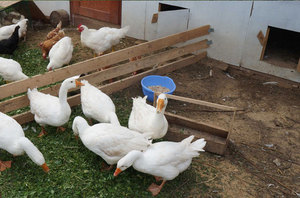 Beginners will find it easy to keep geese at home, as they don't require any special knowledge or conditions. These birds are disease-resistant and undemanding. Therefore, raising geese at your dacha or on your own farm is common practice. The main requirement for breeding these feathered pets is good bedding, which is constructed from hay, straw, or peat. These birds are frost-resistant, as their subcutaneous fat provides good warmth, but their beaks and feet are sensitive to cold, so bedding is necessary.
If you decide to breed several breeds of geese, it's best to house them separately. Keep in mind that geese spend most of their time outdoors, so keeping them indoors all the time isn't practical, as they can obtain the lion's share of their diet on their own.
Premises: what should it be like?
Breeding birds requires a building that is clean, dry, and bright. Each bird requires approximately 1 square meter of space to feel comfortable. If the room chosen for keeping the birds is damp and dark, it can lead to frequent colds. Another thing to consider is that geese experience water evaporation, from about 10 heads - 2 litersThis means good ventilation is essential. The floor of the room can be lined with wood or filled with clay, but dryness is essential, as geese sleep on the floor.
In winter, the room temperature should be maintained at 0 degrees Celsius. The walls and ceiling of the goose house are insulated with mineral wool, or other sealed materials will do; in this case, additional insulation is not required. The optimal temperature will be maintained by the heat emitted by the birds' bodies. Ventilate the house periodically during winter to avoid stale air, which can cause illness. To do this, briefly release the geese outside.
Features of the inventory
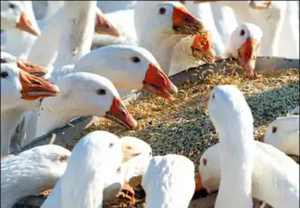 It's important to properly arrange the equipment in the room. This will save space and make cleaning easier. For example, it's best to use a feeder with a high edge to ensure efficient feeding. For this purpose, you can use wooden or plywood troughs, sized 15 cm per goose. This will prevent squabbling and crowding. put out several feedersFor mineral feed, use a separate container 20 cm above the floor; geese prefer to eat green feed from a manger installed in the wall.
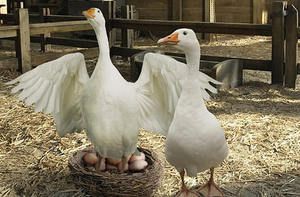
Buckets, troughs, and other containers serve as drinking bowls. You can also make your own from large pipes placed on special trays. In winter, heated water is added to the drinking bowl to prevent freezing. Nests are installed indoors a month before the egg-laying season. The dimensions are as follows: width - 40 cm, length - 60 cm, height - 30 cm.
Feeding the geese
Successfully raising geese at home depends on the quality of their feed. If the area for running is large enough, they won't go hungry. These birds are herbivores, and one goose can eat a lot in a day. pluck about 2 kg of grassClover, dandelion, wheatgrass, and alfalfa are especially preferred, as they grow abundantly in any area. Grass greens are also used, but geese prefer them before they bloom.
Breeding in winter is different in that the green diet is replaced with hay, bran, or grass meal. Of course, grass alone won't satisfy all a goose's needs. A complete diet consists of grain, with these birds preferring oats, wheat, barley, rye, and corn. They also enjoy root vegetables such as potatoes, carrots, and beets. Geese's stomachs can handle fiber, while other captive birds find it difficult to digest.
Due to the fact that feeds containing a significant amount of fiber are cheaper than others, Keeping geese is economically profitableThe advantage is that geese utilize the energy they eat better than other captive birds. Chickens utilize 65% of the energy they consume, while geese utilize 70-80%. This allows goslings to grow quickly and easily. Keep in mind that geese also feed at night, so it's important to provide them with feeders at night.
Generally, feeding geese is not a problem, especially in the summer, when they return home from their free-range foraging only in the evening. Many backyard geese breeders release their pets into their gardens after the harvest, as they are good at cleaning the garden, eating leftover root vegetables and greens. This video for beginners shows in detail how geese live at home and what they eat.
Care
The goose is one of those birds that can feed itself and provide minimal living conditions. That's why they they are readily bred at homeHowever, they still require some care.
- To avoid conflicts among birds, ensure you have the necessary equipment, such as waterers, feeders, and nests.
- When choosing a clearing for geese to graze, choose a spot with low vegetation. A site with tall grass is unsuitable—the geese will go hungry.
- During the summer, keep your geese in shaded areas near bodies of water. If there's no river nearby, provide a spacious container filled with water for the honking birds to bathe in.
- When raising poultry, it's helpful to occasionally bathe them therapeutically in a mixture of sand, ash, and feed sulfur. The latter is an excellent preventative against parasites that eat feathers and down, which are valuable materials. Furthermore, parasite bites can cause skin inflammation and lead to illness. If a bird is already infested with feather lice, simply rub the sulfur into the feathers.
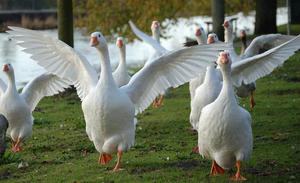 To avoid conflicts among birds, ensure you have the necessary equipment, such as waterers, feeders, and nests.
With proper care of geese, even in a small area you can raise a great flock. To ensure the birds gain weight well, don't skimp on food, you also need to pay attention to the living conditions. This way, by slaughter season, you'll receive a generous reward of tasty meat, fatty liver, and down.