 Breeding geese in a backyard is quite profitable, making it a widespread practice. These birds mature quickly, requiring 1.3 kg of grass and 2.5 kg of concentrates per kilogram of live weight. Breed selection plays a significant role in maximizing profits with minimal investment. Currently, there are approximately 20 different breeds successfully kept in backyard farms.
They are raised primarily for meat and down. Beginning goose breeders are interested in learning about the different breeds of geese and their distinctive characteristics. A description of the most popular breeds can be found in our article.
Content
Kholmogory geese
This the most ancient breed, which has been mentioned since 1885. Kholmogory geese are very large. Males weigh up to 12 kg, while females weigh around 8 kg. These plump birds are characterized by:
 Large head with a bump on the forehead.
- With a wide, convex chest.
- Characteristic folds on the abdomen.
- Low egg production, which is only 40 eggs per year.
- Calm character.
- Endurance and unpretentiousness.
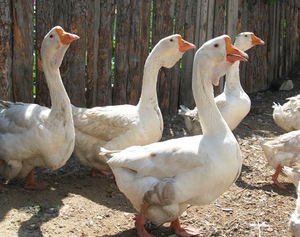 Large head with a bump on the forehead.
Their tasty and healthy dietary meat has an excellent flavor. Despite all their advantages, Kholmogory geese have one drawback: they don't reach sexual maturity until they're three years old. However, a breeding flock can live up to 20 years, so frequent replacements aren't necessary.
This breed is widespread in central Russia. Keeping them requires a goose house, which must have warm bedding. The birds need a draft-free environment and free range. Access to a pond is especially beneficial. Even in winter, Kholmogory geese will happily walk and swim in icy water.
When breeding the breed There should be no more than four females per maleEach goose must have its own nest. Eggs intended for incubation are stored for no more than 15 days. If all recommendations are followed, the flock will increase by 15-20 birds annually.
Lindovskie geese
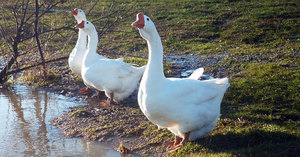 The breed is the result of crossing Chinese and Gorky geese. To produce a large breed with high egg production, the best representatives of both breeds were selected. The resulting offspring were crossed with Adler geese to improve the quality of their feathers and down. But the development of the world's best breed didn't stop there. To obtain excellent meat and liver quality, the resulting breed was crossed with Arzamas geese.
The result of such complex work was large breed, which differs:
- early maturity;
- average weight of 7-8 kg;
- thick, white plumage;
- high quality down;
- egg production up to 50 eggs per year.
Linda geese reach full sexual maturity at 8 months.
One of the main conditions of the breed is providing birds with a large number of drinking bowlsWithout water, they can become ill. Poultry houses should be equipped with secluded, poorly lit nooks where geese can retreat.
Lindov geese begin laying eggs in late winter. It's important to remember that the hens leave their clutch for about half an hour each day, which requires maintaining the proper temperature. To achieve this, the eggs can be sprayed with warm water.
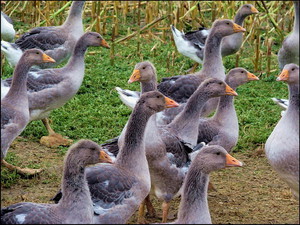
Large grey geese
The breed is loved by many farmers, as the birds do not require additional care and can do well without a pond. The distinctive features of grey geese are:
- the weight of the male is 9 kg, geese – about 6 kg;
- wide body;
- thick beak of orange color with a pink tip;
- middle neck;
- white belly;
- gray color of feathers.
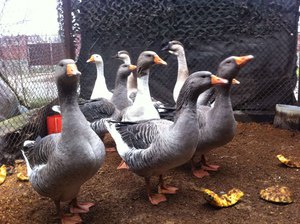 The breed's maturation time is astonishing. In just two months, the bird gains weight up to 5 kg. Over the course of a year, the goose lays approximately 60 eggs, each weighing 200 g.
Large greylag geese should be kept in a room with underfloor heating. The bedding should be changed regularly, otherwise the birds may become ill.
The breed is not suitable for beginning farmers due to its low survival rate at an early age. This is due to the special care required for young goslings. Goslings are not transitioned to a regular diet until they are one month old.
Demidov geese
The breed is most common in the northern and some central regions of Russia. Adults reach maturity in 8 months. capable of gaining 7-8 kg in weightThey differ:
- large wingspan;
- massive legs;
- white plumage;
- characteristic bend of the frontal part of the tail.
Fertilized in the spring, geese produce up to 68 eggs per year, each weighing up to 200 g. Demidov geese are very profitable for raising in industrial conditions, since they do not require special care and nutrition, and develop according to the usual pattern.
Danish Legart
Bred in Denmark the breed is one of the best in the worldIts features include:
- average build;
- the weight of males is 7.5-8 kg, and females – from 5.5 to 7 kg;
- deep and long body;
- medium length neck;
- small beak;
- a small fold of fat on the abdomen;
- orange paws and beak;
- white plumage.
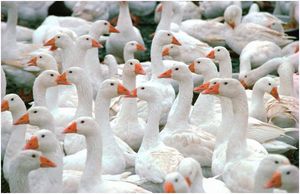 Goslings become very elegant and beautiful when their white down changes to feathers. Their plumage is pure white, without any speckles.
The Danish Legart is known for its low maintenance and high gosling survival rate. A female lays 30 to 40 eggs per year, weighing up to 200 g. The goslings gain weight quickly and can weigh up to 7 kg by three months.
The breed is famous for its fluffBirds can be plucked starting at one year of age, every six weeks. As a result, each bird can produce up to 500 grams of down per year.
Danish Legarts are very sensitive to temperature fluctuations, so they require warm housing during the winter. In the summer, they gain weight on pastures, producing marketable carcasses when slaughtered in November and December. Males reach sexual maturity three weeks later than females. Geese enter egg-laying season in April.
Tula fighting geese
One of a kind the breed was bred for goose fightingThat's why they differ:
- endurance and mobility;
- original appearance;
- well-developed muscles;
- compact body;
- strong constitution;
- broad-browed, rounded head;
- massive, short beak;
- bluish-gray or black eyes;
- well-developed wings that fit tightly to the body;
- with grey, white or clay-coloured feathers.
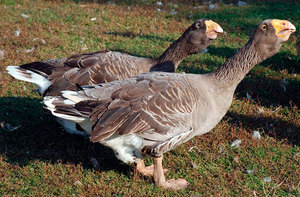 endurance and mobility;
Tula geese are divided into three types, which differ in the shape of the beak.
This breed is very resilient and can withstand even the lowest temperatures, but its economic utility is low. Adult males weigh 5-6.5 kg, while females weigh between 5.2-5.5 kg. Geese lay up to 25 eggs per year and are excellent brood hens. By two months of age, the young reach a live weight of approximately 4 kg.
Goose fighting has survived to this day. Tula goose fights are regularly held in several Russian cities. Geese fight with their wings; the use of beaks and feet is prohibited. The battle continues until one of the geese flees from the battlefield..
Toulouse geese
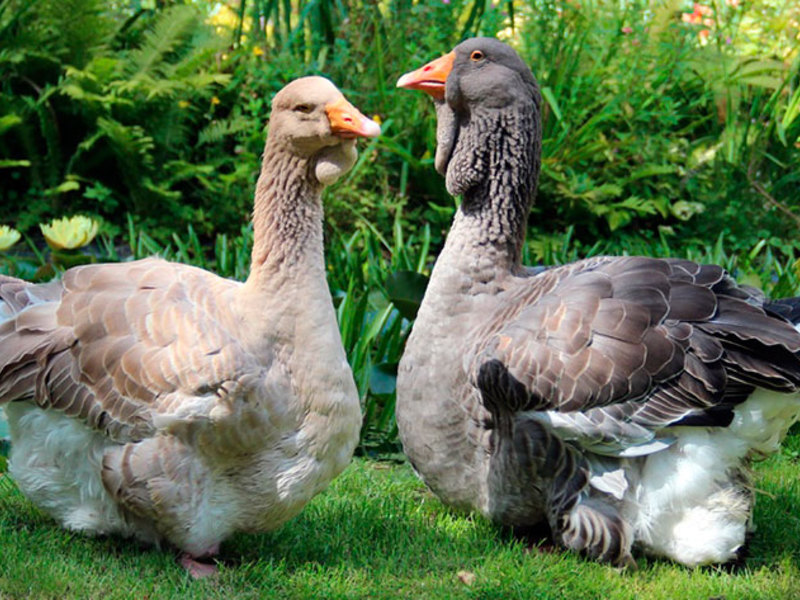
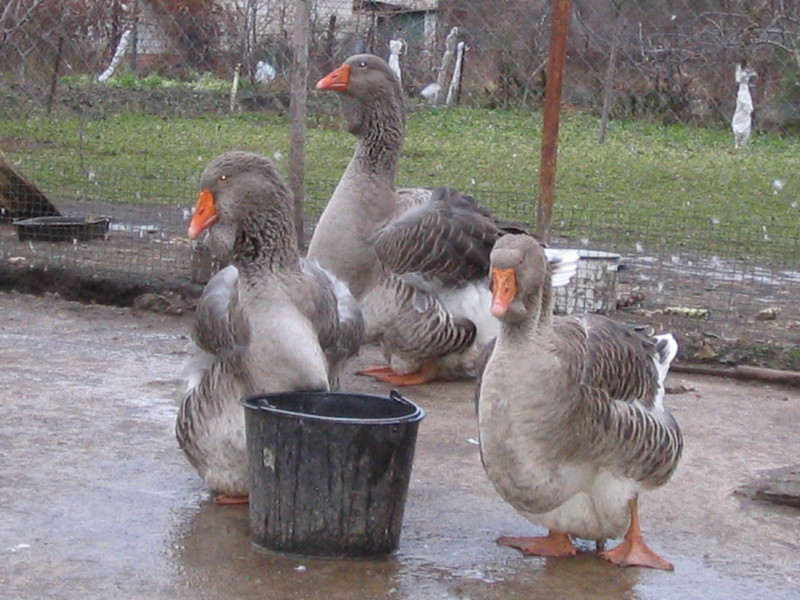
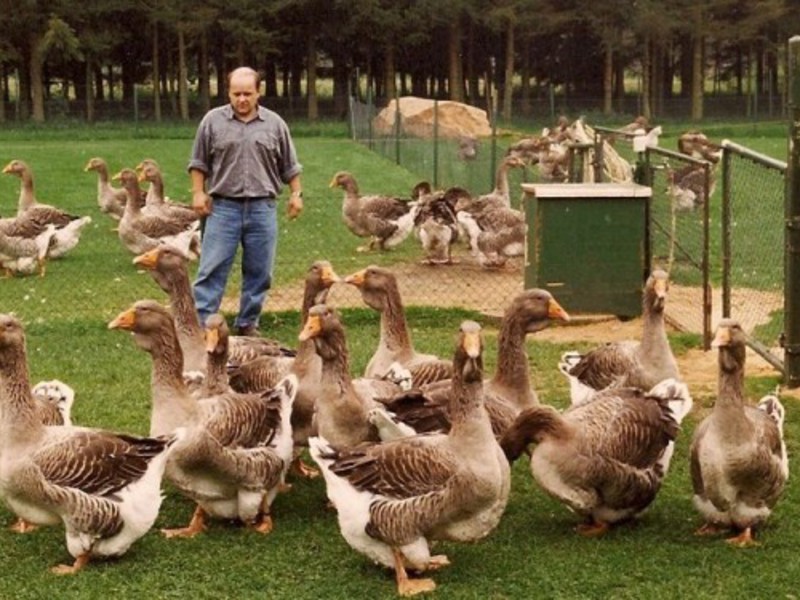
The breed was developed by selecting birds from the area around Toulouse, France. The result is large domestic geese distinguished by:
- impressive dimensions;
- wide, large chest;
- massive and short legs;
- a kind of "pocket" under the beak;
- skin folds;
- The live weight of a gander is 8-8.5 kg, and that of a goose is up to 7 kg.
These impressively sized and heavy birds are very calm and sedentary. With proper care and feeding, each individual can produce a liver weighing up to 400 g.
This species of goose is very heat-loving and therefore requires a warm coop. Drafts must also be avoided and humidity levels must be controlled. Failure to meet these conditions poses a risk to the birds.
Geese lay between 25 and 40 eggs per year. Furthermore, a small percentage of the offspring survives, as the females are not particularly fond of incubating eggs. Therefore, to successfully breed this breed, it is necessary to purchase an incubator or to introduce the eggs to geese of other breeds.
Emden geese
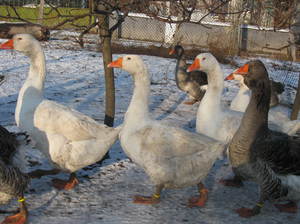 These large, snow-white beauties are named after the city where they were bred. The German breed turned out to be large and fleshy. Males weigh up to 9-11 kg, and females – from 8 to 9 kgEmden geese are distinguished by:
- large and wide head;
- wide and thick beak;
- long body with a fold on the stomach;
- very massive short legs.
The birds are well-fed and have good quality meat and fat. Geese produce 25 to 30 eggs per year. By two months of age, the young weigh about 4 kg.
Unlike other goose species, Emden geese change plumage color. Goslings hatch with gray down. Adults can be white, mottled, or completely gray. The birds become pure white after molting.
Italian geese
Relatively A small breed of geese was brought to Russia in 1975The average weight of male geese is 6 to 7 kg, while females can weigh 5-6 kg. Distinguishing features of Italian geese include:
- snow-white plumage;
- hard and dense feathers;
- a small amount of fluff;
- compact, small head;
- small neck;
- quite a wide chest;
- skin folds on the abdomen.
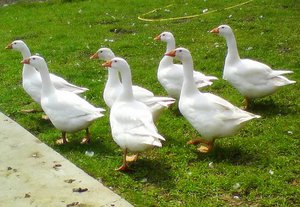 snow-white plumage;
When properly cared for and fed, the main characteristic of these birds is their liver weight, which can reach 7% of their total weight. The liver's flavor is also highly prized, and is used to make the famous goose pâté.
Geese are quite prolific egg layers. They lay up to 40-50 eggs per year, each weighing 150 grams. Females are good brooders. By two months of age, the young can weigh up to 3 kg. They reach sexual maturity at 240 days.
Italian geese are relatively easy to keep. They tolerate Russian frosts quite well, even though they were bred in sunny Italy.
Egyptian geese
Egyptian or Nile geese are often called IndogusiTheir closest relatives are ducks, but they look more like geese. They are wild birds, but their meat is very tasty, so they are hunted.
Egyptian geese are distinguished by:
- slender build;
- luxurious plumage;
- wide wings;
- high legs;
- thin neck.
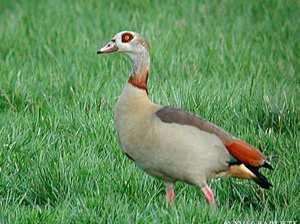 Nile geese They swim and dive well and run quickly on landTheir flight is fast, easy, but noisy.
Indogeese are common in tropical Africa and the Nile Valley. They live along the shores of lakes and rivers that are overgrown with forest. They build nests in trees, swamps, or dry ground. They breed year-round, incubating a clutch of eight to nine eggs for 28 days. The female does not sit on the clutch until she lays the last egg, so the young hatch at the same time.
During the mating season, ganders They are very aggressive and fights often occur between them.When courting a female, they display their white feathers, which are located on the underside of their wings.
When kept as a pet, the Egyptian goose will need to be provided with a large area with nests, otherwise the bird will attack nearby nesting birds.
The ancient Egyptians considered Nile geese to be sacred birds and often depicted them in frescoes and reliefs.
The most important criteria when choosing a goose breed are size and precocity. These two factors should be given special consideration, as they play a decisive role in the profitability of a farming business. When choosing geese, it's also important to consider the climate in which they will be kept. After all, each breed was bred for a specific climate, meaning it will thrive in those regions.