 In ancient times, raising chicks from eggs was reserved exclusively for priests, but now anyone can do it. There are numerous articles and videos online that can help poultry farmers understand the process of goose incubation.
Content
Incubation of geese
Incubation of goose eggs at home is a difficult and thorny path. To navigate it, you need stock up on patience and enduranceBefore you begin practicing, you need to deepen your knowledge of the theory: study the necessary literature and watch videos. The reward for your efforts will be the hatching of little goslings from the eggs.
To raise a brood of geese at home, you need an incubator – a specialized chamber with adjustable, artificial heating and a control mode.
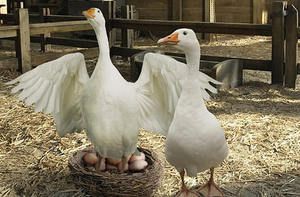
Geese can take care of their young themselves. Hatching is possible with a goose brooding the eggs. This is cost-effective, but the offspring will be far fewer than with an incubator.
The incubator should be loaded with eggs carefully selected eggs.
Goose egg selection criteria
The selection of eggs from which little geese will hatch in an incubator must be approached with great responsibility.
- The best breeding stock for healthy chicks comes from birds between two and four years old. Typically, there are three to four females per male.
- The most important criterion is to select eggs from healthy animals, as sick geese cannot be expected to produce healthy goslings. This is because infections from the parents are always transmitted to the eggs.
- Their weight should be average and vary between 130-160 grams.
- The shell must be intact, without cracks or chips. And most importantly, it must not be contaminated with anything, especially excrement.
- Birds must be kept clean and well fed – this directly affects the offspring.
For a more thorough and detailed review of the criteria for selecting material for goose incubation, you can watch a video online.
Is there an embryo?
The selection of eggs has been completed, now it’s time to determine the presence of an embryo in themTo get a guaranteed result, how do you do this? You'll need a special device called an ovoscope. If you don't have one, you can shine a powerful light on them with a regular lamp.
Signs indicating the presence of an embryo:
 the shell is clean and smooth
- the air gap is located in the area of the blunt end
- the yolk is not clearly defined, located in the middle or closer to the blunt end
- When you turn the egg from side to side, the yolk rotates with it without changing its position
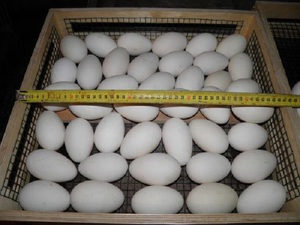 the shell is clean and smooth
Immediately after selection it is necessary disinfect the material, which will be placed in the incubator if its surface is more than half contaminated.
Warm solutions, ranging from 37 to 40 degrees Celsius, are used for this purpose. The material must be placed in the solution and left for 5-7 minutes. Then, remove it, rinse with warm water, and dry. This must be done very carefully, as there is a risk of damaging the protective coating. Weak solutions of potassium permanganate or hydrogen peroxide are best for this purpose.
Before incubation, eggs should not be stored for more than two weeks, as this affects the hatching of the goslings. Geese hatched from such eggs may be unproductive. The storage temperature of the material should be within +13-16 degrees.
Bookmarking the incubation material
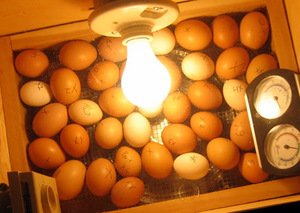 The prepared material from which the little geese will hatch should be laid horizontally. If you plan to turn it over manually, mark the sides with different colored markers. For example, one side would be red and the other green. The expected hatching date should also be recorded.
The efficiency of incubating goose eggs will be significantly increased if the material is manually turned 180 degrees over a period of two weeks.
You can learn more about laying the incubation material for geese by watching special videos.
How many days does goose incubation last?
The average incubation period is 30 days. During this time, the same incubation regimen as used at home must be strictly followed. The young geese begin to hatch after 29 days, but can sometimes take up to 32 days. Any eggs that remain intact after this time can be safely removed, as hatching is not expected.
The process of incubation of geese
The key to successful incubation of eggs and the hatching of goslings is a properly selected temperature regime.
First, warm the incubator to 39°C (102°F), closing the ventilation windows. Once the chamber has warmed up, you can begin adding the eggs. This is important, as the eggs must be heated to 38°C (100°F), a temperature that must be maintained for the first three to five hours.
In the future, the temperature inside the incubator should be lowered to +37.7-38 degreesThe humidity level should be 60-70%.
By the third day, humidity is reduced to 25-35%, and the temperature should be approximately 37.6 degrees Celsius. From this point on, the material should be ventilated until the temperature drops to 32-33 degrees Celsius. This is done to prevent overheating and improve oxygen diffusion to the embryo, as the eggshells from which the young geese will hatch are very strong. The material should be ventilated for at least 10-15 minutes per day.
Hatching eggs, which are expected to hatch goslings, must be turned 180 degrees twice daily. This ensures even heat distribution and oxygen diffusion across their entire surface.
On the fifth day, additional cooling methods should be introduced, such as spraying the material with a weak solution of potassium permanganate. To ensure proper and harmonious embryo development, the eggs should now be turned at least once every two to three hours.
How many times during incubation should you examine eggs with an ovoscope?
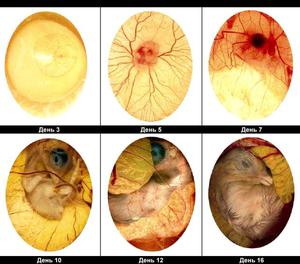 During the incubation period, the eggs should be examined twice with an ovoscope or under a lamp. The first time should be on the eighth day – this period is significant because the beginnings of the circulatory system can be seen.
The second examination should be carried out on the fourteenth day - at this time the embryo can already be clearly seen.
Eggs that have not changed during their time in the incubator should be discarded - small geese will not hatch from them.
From the 11th day, the material should be irrigated with potassium permanganate twice a day, reducing the temperature inside the incubator up to 37.4 degreesIt is also necessary to ventilate the room for 20-30 minutes per day.
On the 20th day, cooling sprays are applied at least three times per day, and on the 23rd day, the eggs are sprayed four to six times per day. Regarding ventilation, the trays containing the material should be removed from the incubator chamber and left outdoors for an hour. During this time, the eggs will reach a temperature of approximately 29°C (84°F) and should be returned to the incubator.
On the 27th day, the humidity in the incubator should be increased to 75%, and the material should be sprayed with warm water every three to four hours. You can cover the incubator contents with gauze pads, moistening them with water every two to three hours.
Airing and turning are completed at this stage.
The process of hatching little geese
Goslings hatch from their eggs without assistance. Before removing them from the incubator, make sure they are sufficiently dry. You can learn more about this process by watching this video.
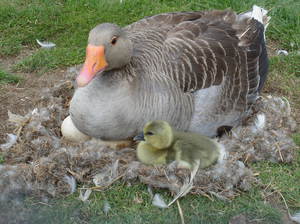 Maintaining an optimal temperature is crucial for their continued growth and development. Humidity, in this case, doesn't play a particularly significant role.
A few days later, the goslings gain strength and begin to feed independentlyFrom now on, you can gradually accustom them to independent walks. Start with thirty to forty minutes a day, gradually increasing the duration.
During the warmer months, month-old chicks can be gradually acclimated to open water. If you have a large farm, keep a close eye on the young geese to prevent injury or harm from other geese. Due to their activity and curiosity, they can easily fall prey to dogs or cats.
Incubation of geese, though labor-intensive, is quite a fascinating process. By taking the plunge, you'll gain not only valuable experience but also long-awaited goose offspring.