 A dacha isn't just a great place to relax, it's also a place to grow your own food. This includes vegetables, fruits, meat, and eggs. Raising chickens at home isn't as difficult as it seems, and even novice farmers can handle it.
At your summer cottage, you can keep laying hens, which will provide your entire family with fresh eggs, or poultry for meat production. The main goal is to ensure they are well-off and properly fed.
Content
What breed is suitable for breeding in the country?
To begin with we need to decideWhat do you want from your chickens—a lot of meat or a lot of eggs? If you choose the former, you should get broilers; if the latter, you should get layers.
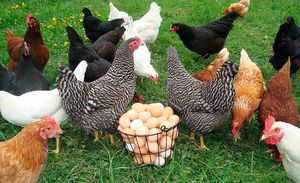
To obtain eggs, choose the following breeds of laying hens:
- Minorca,
- Leghorns,
- Hisex,
- Italian partridges,
- Loman Brown,
- Livensky calico (meat and egg breed).
The above-mentioned breeds perform their tasks well, are disease-resistant, undemanding, and have proven themselves to be successful in our latitudes.
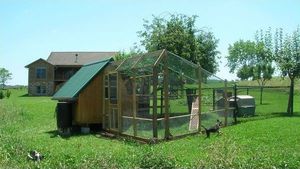 Buy pullets at the age of 4-6 months, at this time the hens begin the process of egg layingThe first eggs are small, but they gradually become larger, reaching their usual size. If you don't plan to breed chickens, you can do without a rooster. Since hens are capable of laying eggs without male intervention, he is only necessary for fertilization and production. However, a rooster can delight you with his morning crowing and also serve a decorative purpose. If you decide to buy small chickens, the question of sexing them will arise; of course, it's better to buy more hens.
Advice! How can I determine the sex of baby chicks? proven folk remedy, which can easily distinguish a hen from a rooster. To do this, grab the chicken by its feet and turn it upside down. If it's a rooster, it will try to lift its head up, while the hen's will hang freely.
Meat breeds in our latitudes are represented by the following breeds:
- Broilers,
- Brama,
- Cornish,
- Cochinchinas.
Meat chickens It's best to buy chickens at 60–70 days of age. Meat breeds don't lay eggs well, but they have no problem gaining weight. For meat breeds, the choice of sex isn't critical. However, males are naturally larger than females, so it's best to have a majority of them. On the other hand, females don't expend much energy on egg production due to their low laying rate, so they also gain weight well.
Raising chickens in the country: features
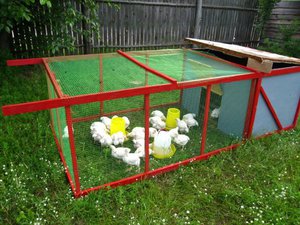 Where should I start raising chickens in my dacha? First we need to take care of housing and a place for the birds to roost. An open area that's well-lit and shaded, so the birds can escape the scorching sun on hot days, is ideal. If you plan to raise chickens only during the warmer months, you don't need to build a permanent coop. Simply construct a structure consisting of three walls and a roof, where the birds can find shelter from the elements and roost at night.
With such an improvised poultry house all your care for poultry It's just a matter of adding food and collecting eggs. You just need to purchase feeders and waterers from a specialty store and place them in designated areas. You can make your own or use household items, such as old bowls, basins, or boxes.
Also you can do without an aviary, release them directly into the open air. However, this may cause some inconveniences:
- Your garden beds and flower beds will be constantly being torn apart by the chickens' paws. They can't be trained, and they're unlikely to understand that here, housekeeping is prohibited, while here, they can roam.
- Be prepared to discover your chickens' freedom-loving nature. Your neighbors probably won't be thrilled to see your chickens acting like they belong in their garden. You'll have to trim their feathers and check for any holes in the fence.
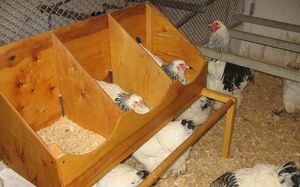
- The hen will lay eggs in the wrong place. It will be very difficult to find the egg in thickets, weeds, a shed, or near garden tools.
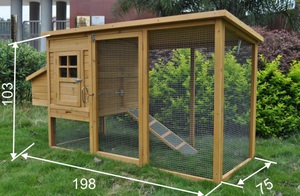
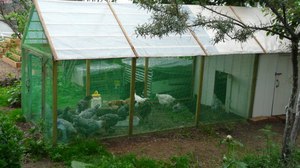 That's why It's better to limit the birds' freedomTo avoid any trouble, there are many chicken coop models available today, specifically designed for summer cottages. If you consider this an expensive endeavor, you can build one yourself.
Before you get started, you need to consider the following features:
- One chicken requires a pen with a space of 1 square meter.
- The length of the perch should be calculated at 30 cm per chicken.
It is important to remember that the more space, the lower the risk of developing diseases, stress and aggression in chickens.
How to feed laying hens?
Birds should receive fresh grass regularly, as it contains many vitamins and microelements. Therefore, it's best to install a portable aviary to provide the hens with sufficient weeds. However, constantly rearranging the aviary requires a lot of space, which is not ideal for a small garden with plantings. However, there is a solution: when weeding the garden beds, throw the weeds into the aviary; they will have enough vitamins.
To ensure good egg production, special feed will help your chickens. You won't need to supplement with additional nutrients, as it contains the ideal balance of nutrients.
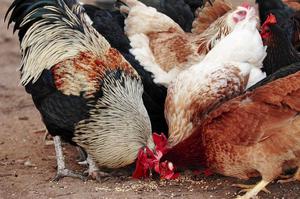
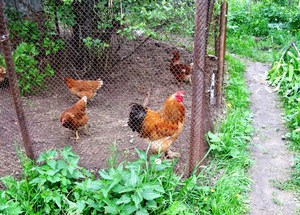 For laying hens cereal crops will be needed, such as barley, oats, and wheat. They are fed both together and separately. Sometimes, increased vitamin and mineral content is required in the feed, but generally, grain alone is sufficient for proper growth and good egg production.
Anyway you should constantly monitor your body condition and the hens' condition. Both underweight and overweight can lead to illness and decreased egg production. Each laying hen requires no more than 150 g of feed per day. Remember to provide fresh water, which must be changed daily.
Young chicks will require special feed. Its composition should be as follows:
- Finely chopped boiled chicken eggs,
- Semolina,
- Ground corn,
- Millet,
- Chopped carrots.
- Finely chopped greens: lettuce, cabbage, dandelion, etc.
Chickens aged 1 month and older can be fed grain, compound feed, potato peelings, and food scraps with the addition of crushed chalk, which serves as a source of calcium.
Growing meat breeds in the country
Before purchasing meat-grade chickens, carefully examine their appearance. A bird is healthy if it exhibits:
- Soft belly,
- Activity,
- Invisible umbilical cord
- Fluffy, shiny fluff.
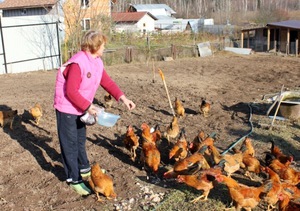 With good nutrition and favorable conditions, chickens reach 3 kg by the age of two months.
Chicken coop for meat breed chickens The bird's nesting area should be well ventilated and well-lit. The area should be fenced off to protect the bird from cats and rodents. A strong net stretched around the entire perimeter will keep cats out. To protect the bird from rodents, the area should be thoroughly treated before bringing the bird in.
Before placing the chicks, the floor of the room is sprinkled with lime At a rate of 0.5 kg per square meter, topped with wood shavings. In summer, this layer should be about 10 cm thick, in winter – 20 cm. Initially, chickens need an air temperature of 28–30 degrees Celsius, gradually decreasing it by a couple of degrees every week.
If the room with the chickens is quite large, then install a heater, so that he gathers all the birds around him. Meat breeds of poultry also require constant lighting during the early stages of growth. Over time, lighting is reduced to areas with waterers and feed. Once the chicks are one month old, they have gained strength and confidence, and can be released into the fresh air.
Important! For meat-producing chickens cleanliness is necessary, especially in nutritionThey tend to trample on their food, so it's important to ensure they eat carefully. Special feeders and waterers are available, but you can also make your own. To do this, pour food into a jar, cover it with a flat saucer, and turn it upside down. The required amount of food will spill out when you lift the jar.
To help your chickens grow quickly, use special feed:
- The first 4 days are pre-launch,
- From 4 days to 1 month - starting,
- From 1 month - final.
Features of the feed
 The feed for the first four days consists of a concentrated mixture containing ground barley, wheat, corn, dried skim milk, and sunflower meal.
- The starter feed contains the same thing, but with the addition of fish and grass meal, feed yeast, feed fat, minerals and crushed chalk.
- The finished feed provides the chicks with the nutrients they need for intensive growth. Chopped vegetables and grass can be added to it.
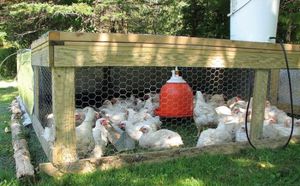 The feed for the first four days consists of a concentrated mixture containing ground barley, wheat, corn, dried skim milk, and sunflower meal.
So that the chickens-the broilers grew strong During the first weeks of life, feed them crushed wheat, barley, and corn grains. Thoroughly mix the grains with cottage cheese and boiled eggs to prevent choking.
Later, transition broilers to a simpler feed consisting of dry mixes. Gradually, the chickens can eat grass, grain, and vegetable peelings.
To raise chickens, you may need medications and vitaminsTo do this, visit your nearest veterinary pharmacy. The medications may vary for each breed, as well as depending on the living conditions and health of the entire brood or each individual chick.
So, raise chickens Cooking at the dacha isn't all that difficult and even a beginner can handle it. The main thing is to follow certain rules, and then you'll always have delicious fresh meat and eggs on your table.