 It's the 21st century, and the Russian Federation is entering a period of rapid agricultural development. As a result, many farmers are once again finding hope for demand and reasonable prices, while city dwellers are moving to rural areas and switching to subsistence farming.
Introduction
Farmers typically begin with small gardens and summer cottages. They spend 3-5 months in their gardens and then head back to the city. These people are the ones who most often opt for subsistence farming, as they are already familiar with many principles and are willing to learn more. After moving permanently into a house, they consider the many animals that can be beneficial to the property: cats, dogs, chickens, geese, ducks, and turkeys. However, beginners most often focus on chickens.
Breeds of domestic chickens
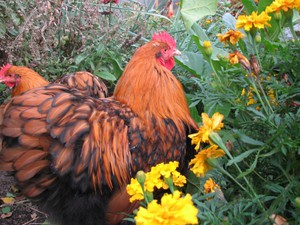
There is in the world more than seven hundred breeds of domestic chickens, and a novice poultry farmer needs to choose the right one to avoid losing the entire flock in the first month and achieve the desired results without significant expense. There are five main types of domestic chicken breeds:
- Ornamental chicken breeds;
- Meat breeds of chickens;
- Meat and egg breeds of chickens;
- Egg-laying chicken breeds;
- Fighting chicken breeds;
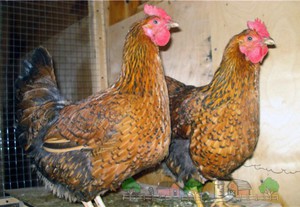
Beginners in this matter should pay attention to the third point: meat and egg breeds of chickensThese hens begin laying eggs very early, quickly gaining a lot of weight—up to three kilograms. They are also relatively easy to care for and require fewer vitamins.
Choosing the Right Chickens
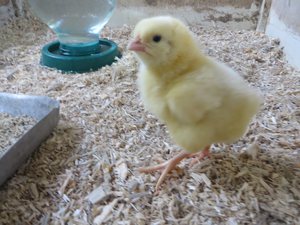
It's best to buy chicks between early April and mid-May, preferably at day-old age. However, it's important to keep in mind that caring for these chicks is more difficult. They also require a variety of vitamins for growth, so it's important to ensure their diet is varied. For this information, it's best to contact a poultry farm: the birds there are usually cheaper and have a certain level of protection against infections. Avoid buying chicks. whose age is more than a dayWhen choosing chicks, it's also important to pay close attention to their behavior and appearance. Here are a few tips that will greatly increase your chances of selecting healthy, strong birds from a shared incubator:
 The main requirement is that the chick must be active. It should be attentive to its surroundings, make vocalizations to its fellows, move around actively, and respond to unfamiliar sounds (to do this, place the chicks in a box and tap the bottom of it from the back. Only those chicks that are alert to the unfamiliar sound should be purchased).
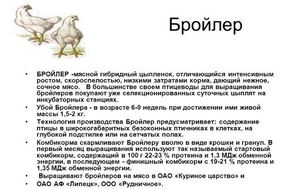
- The chickens' bellies should be soft and tucked in (in broiler breeds they are slightly rounded), and there should be no traces of blood on the umbilical cord;
- Another important condition is that the chick should not have problems with coordination: it should stand firmly on its feet, not wobble or fall, and move actively and easily among its own kind;
- The chick's eyes should not have any clouding or visible defects;
- The wings should be pressed tightly to the body;
- The fluff should be uniformly soft and shiny, there should be no areas on the body where there is no fluff and the skin is visible or the fluff is stuck together;
- Also an important condition is the condition of the chick’s beak: the beak should be short and thick, without new growths and pigment spots;
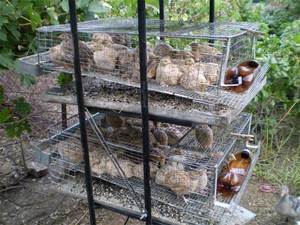 The main requirement is that the chick must be active. It should be attentive to its surroundings, make vocalizations to its fellows, move around actively, and respond to unfamiliar sounds (to do this, place the chicks in a box and tap the bottom of it from the back. Only those chicks that are alert to the unfamiliar sound should be purchased).
The first days in a new house
After a tiring journey from the poultry farm, the chicks will most likely be restless or, on the contrary, in a too frightened stateAt first, they should be kept outside or in an incubator, and covered with netting to prevent them from escaping. Ensure the enclosure has both light and shade to prevent the birds from freezing and overheating, and provide them with access to fresh water, which should be changed daily. In the following days, the chicks should be provided with ample care and feeding, but do not give them vitamin supplements at first.
What to feed chickens
If you've purchased newly hatched chicks, you should begin feeding them within 10 hours of hatching. To do this, you need to know what and how to feed them.
Imitation of the natural diet
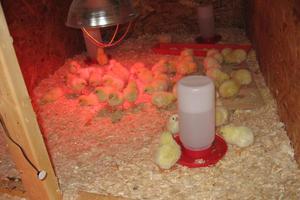 In nature, 4–6 hours after hatching, the entire brood follows mom for a walk, where they find their first food: various insects, plant seeds, sand, small stones (which eventually accumulate in the gizzard and help grind solid food), and young plant shoots. It is this food that should be imitated as much as possible when caring for day-old chicks in an incubator.
Instead of insects, a hard-boiled egg, divided into small pieces, will do. Plant seeds can easily be replaced with a variety of cereals, and young plant shoots can be replaced with finely chopped green onions or fresh nettle shoots (fresh ones, as stale plants produce hydrocyanic acid, which is dangerous for birds).
The first day
If you've purchased day-old chicks, then from day 1 to day 5 of incubation, you should feed them a mixture of hard-boiled egg yolk mixed with a small amount of flour and chopped chives. During the first day of hatching, need to feed every 2 hours, including at night. Low-fat kefir or yogurt should be added to the yolk. This will help improve digestion in young birds, populate their intestines with beneficial microflora, and facilitate subsequent feeding.
However, it's important to note that for the first 2-3 days, chicks can't peck at kefir, so it must be fed manually using a pipette or syringe. On average, for a dozen chicks, you'll need a handful of flour (fine cornmeal or millet can also be used), 4-5 spring onions, and one hard-boiled egg yolk.
Third fourth day
Kefir can be given in a separate water bottle from the third to fourth day, when the chicks can drink it on their own. At this time, hard-boiled egg whites can be added to the boiled yolk. It's also important to ensure that the chicks always have access to fresh, clean, boiled water from the first days of life.
Fifth day
Closer to the fifth day, the chicks' body needs more green food, so the proportion of kefir should be gradually reduced and slowly replace it with skim milk or low-fat cottage cheese, and add finely chopped clover and alfalfa to the finely chopped chives. During this period, you can also add sand to the diet (simply place a small box of sifted sand in the enclosure) and liquid fish oil at a rate of 0.1–0.2 grams per bird.
Days six to ten
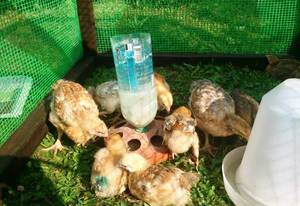 On the sixth day, you can increase the amount of mineral supplements, consisting of crushed shells, eggshells, or wood ash. Remove pure kefir from the chicks' diet, reserving it only for soaking stale bread (the bread should then be squeezed out, crumbled, and fed to the chicks).
The amount of egg whites is gradually reduced and replaced with low-fat meat broth and well-cooked meat scraps. By the tenth day, the number of daily feedings can be reduced: completely eliminate nighttime feedings, and during the day feed approximately every 3-4 hoursFurther care of the birds will only become easier.
If chicks are raised without access to a range, but only on food, they must be given courses of vitamins and trivitamins from veterinary clinics or specialty stores and given water with a weak solution of potassium permanganate once or twice a week (this does not replace the need for regular clean water in the enclosure).
Over the next few days, the chicks are gradually (over the course of two to three weeks) transitioned to adult food and fed less and less frequently, down to two to three times a day. Throughout their lives, it's important to ensure the birds have constant access to clean, fresh water.