 Many homes are home to beautiful, lively birds with colorful plumage—budgies. They captivate hearts with their cheerful nature, restlessness, and energy. You'll never be bored or bored in the company of such a bird. Since budgies are known to be amazing at imitating speech and sounds, almost every owner tries to teach their bird to talk. Not everyone succeeds, as to achieve results, you need to know a few rules, which you can learn in this article and watch in the video.
Which parrot should I choose for training?
Among all the birds, mockingbirds have the ability to talk more pronounced in males than in femalesFemales can also be taught human speech, but they will only be able to remember 10-20 words. Therefore, those who decide to train a budgie are advised to choose a male.
You should buy a bird when it's 35-50 days old. At this age, the parrots are already leaving the nest and feeding themselves. Many bird lovers who have been breeding and training budgerigars for a long time believe that training results can be even better if the chick is taken a few days before it leaves the nest. However, it will need to be feed the baby with a spoon on your own, which requires certain knowledge and experience.
Conditions for keeping a trained bird
Before starting training, the parrot needs to be provided with comfortable living conditions where it will need to adapt for some time.
It is advisable to choose and equip a cage for a budgie in accordance with the following recommendations:
 First, the bird should be placed in a separate cage, located in a separate room away from other birds. Failure to do so will make it difficult to teach your parrot human speech. This is because your bird will begin to imitate other birds, as their sounds are simpler than human speech.
- The approximate dimensions of the cage should be 40 x 30 x 25 cm. A larger cage is not advisable for a feathered pet, as it may hide in the far corner of the cage if it doesn't want to interact with people. A smaller birdhouse will allow the parrot to bond with people more quickly.
- During the first two months after purchasing a budgie, avoid equipping the cage with swings, mirrors, toys, or other unnecessary items. At a young age, birds don't respond to these toys. However, they hinder the budgie's mobility and can even cause injury. Hanging and securing various objects is possible once the budgie reaches four months of age.
- It's not recommended to let a newly acquired parrot out of its cage for a month. In a spacious room, the bird will have trouble navigating and measuring its flight speed, which can lead to a serious impact with the ceiling, wall, or window. Parrots begin to navigate well indoors at three months of age. Only window glass can pose a danger to young birds. Therefore, it's best to let birds out of their cage when it's dark outside and the curtains are closed.
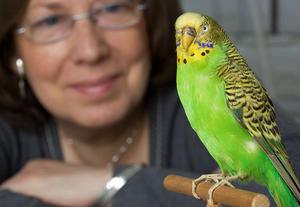 First, the bird should be placed in a separate cage, located in a separate room away from other birds. Failure to do so will make it difficult to teach your parrot human speech. This is because your bird will begin to imitate other birds, as their sounds are simpler than human speech.
In the first days, so as not to frighten the parrot, It is not recommended to pet or pick him upTo help your budgie get used to its new surroundings and people more quickly, approach its cage as often as possible and speak to it in a calm voice. If the bird becomes restless when you're around it, avoid disturbing it for the first few days.
Typically, within a few days, your feathered pet fully adapts, stops fluttering around the cage, and begins to observe people and their surroundings with interest. During this period, you can begin approaching the cage and speaking to the parrot in a calm voice. While doing so, you should most often mention the parrot's name.
How to teach a budgie to talk?
Teaching a parrot to talk is an interesting and engaging process, but it's quite time-consuming. Teaching a bird to talk won't happen in 5 minutes. Patience is required. constant presence and attentiveness.
Once your budgie has become accustomed to its new surroundings, you can begin training it, while following a few rules:
- Feed your feathered pet a few minutes before class. Talk to them while they eat.
- It's best to accustom your bird to lessons at specific times. For example, approach it at 10 a.m. and speak calmly for half an hour. The second lesson takes place in the evening, around 6 or 7 p.m. This way, the parrot will get used to the lessons starting at a specific time and will wait for its owner to interact.
- With the onset of darkness, the bird responds reluctantly to training, therefore in winter evening classes should be carried out at earlier hours.
- During the first few days, you should speak to your budgie using familiar sounds, such as cooing and whistling. You can even mimic the bird. Then, move on to monosyllabic words (like "chur," "shar," "chas," "rice," and "sir"). It's especially helpful if your budgie's name is easy to pronounce.
- Words must be pronounced clearly, each word pronounced with a distinct intonation. Teaching should not be conducted in a disinterested, monotone manner. Each word should be repeated many times (forty times or more).
- You need to talk to the bird calmly and kindly, without anger or threats in your voice.
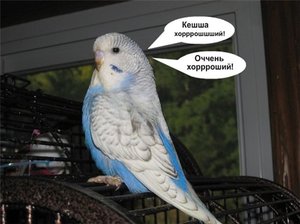
- Once your parrot starts saying simple words, you can start teaching it to say expressions like "Beautiful bird" or "Kesha is good."
- Parrots perceive a high-pitched voice better, so it is recommended that a child or a woman speak to him.
- During training, the same person should always speak to the parrot. They don't adapt well to changes in voice and may refuse training altogether.
- If a budgie becomes anxious or reacts differently to a certain word, it's likely a signal. It's best not to use it during training.
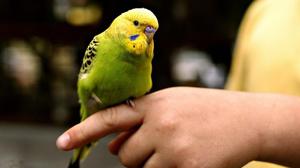 Feed your feathered pet a few minutes before class. Talk to them while they eat.
To avoid wasting time on training a parrot, the cage with the bird can be put it in a room or in the kitchen, and tell him the words he is learning while cooking, cleaning, or doing other household chores.
Is it possible to teach a parrot to talk in a day?
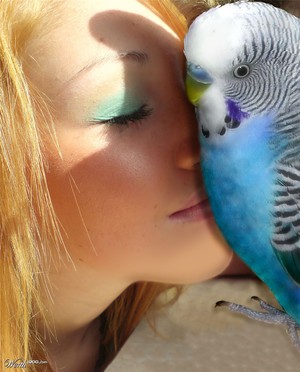 The training time for budgies depends on the individual characteristics of the bird. Your feathered pet may be slow or, conversely, quick. It's a good sign that within the first day, the parrot will begin to listen to your words, simply open its beak, or even respond to your conversation with a sound. If the bird is already trying to make sounds on the first day, it's a sign of talent, and you can safely continue training.
Parrots are the ones who talk most often. start 3-5 months after the start of trainingOnly after 2-3 months will your feathered pet utter its first word. After that, learning will proceed much more quickly.
How do you know if the training is being done correctly?
Since teaching a parrot to talk is a long process, it's sometimes impossible to know if the owner is doing everything right and whether the bird will talk soon. You're definitely doing the right thing if your pet behaves as follows:
- During class he looks at you attentively.
- Listens to you attentively, fluffing up his feathers and closing his eyes.
- Starts biting his lips as soon as you stop talking.
- He flies up, sits on your finger and starts looking into your mouth.
- He begins to pronounce new sounds that are unusual for him.
It is possible to teach a budgie to talk, however, it's a long process, which requires time and affection for your feathered pet. And the number of words your bird will speak in the future directly depends on your diligence and patience.