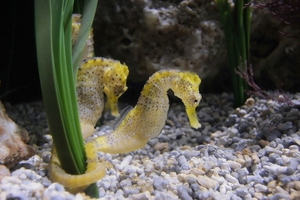
 Seahorses have always amazed people with their unusual appearance. These amazing fish are among the most ancient inhabitants of the seas and oceans. The first representatives of this fish species appeared approximately forty million years ago. They got their name from their resemblance to a knight chess piece.
The structure of seahorses
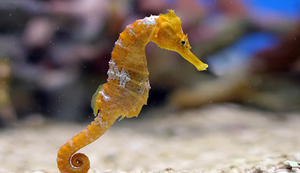 The fish are small in size. The largest representative of this species has a body length of 30 centimeters and is still considered a giant. Most seahorses are modest in size. dimensions of 10–12 centimeters.
There are also very miniature representatives of this species—dwarf fish. They measure only 13 millimeters. Individuals smaller than 3 millimeters are also found.
As mentioned above, the name of these fish is determined by their appearance. Generally, it's difficult to tell at first glance that you're looking at a fish and not an animal, as the seahorse bears little resemblance to other sea creatures.
While the vast majority of fish have their main body parts arranged in a straight line in a horizontal plane, seahorses are the opposite. located in a vertical plane, and the head is located at a right angle to the body.
To date, scientists have described 32 species of these fish. All seahorses prefer to live in shallow waters of warm seas. Since these fish are relatively slow-moving, they value their food most. coral reefs and coastal bottom, overgrown with algae, because you can hide from enemies there.
Characteristics of seahorses
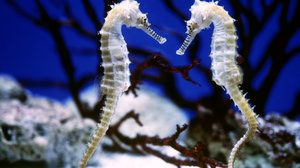 Seahorses swim in a very unusual way. Their bodies float vertically in the water while swimming. This position is maintained by two swim bladders. The first runs along the entire body, and the second is located in the head.
Moreover, the second bladder is significantly lighter than the abdominal one, which is what provides the fish with vertical position in water When moving. Fish move through the water using wave-like movements of their dorsal and pectoral fins. The fins vibrate at a rate of seventy beats per minute.
Seahorses also differ from most fish in that they have no scales. Their body cover the bone plates, connected into belts. This type of protection is quite heavy, but this weight does not interfere with the fish's free floating in the water.
Moreover, the bony plates covered with spines provide excellent protection. Their strength is so great that it is very difficult for a human to break even a dried seahorse shell.
Despite the seahorse's head being positioned at a 90° angle to its body, the fish can only move it vertically. Horizontal head movement is impossible. However, this doesn't interfere with visibility.
The fact is that this fish's eyes are not connected to each other. The seahorse can look in different directions with its eyes at the same time, so it is always aware of changes in its surroundings.
The tail of the seahorse is very unusual. twisted and very flexibleWith its help, the fish clings to corals and algae when hiding.
At first glance, it seems that seahorses should not have survived in the harsh sea conditions: they slow and defenselessIn fact, fish thrived for a time. Their ability to mimicry helped them do so.
Evolutionary processes have led to the fact that seahorses can easily blend into the surrounding areaThey can also change their body color completely or partially. This is enough to prevent sea predators from noticing them if they're hiding.
Incidentally, these marine creatures use their ability to change their body color in mating displays. Males attract females with their body's "color music."
What do seahorses eat?
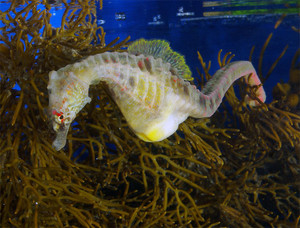 Most people believe that these fish feed on vegetation. This is a misconception. In fact, these marine fish, despite their apparent harmlessness and sedentary nature, are notorious predators. Their diet consists primarily of plankton. Artemia and shrimp - their favorite delicacy.
If you look closely at the skate's elongated snout, you'll notice that it ends in a mouth that functions like a pipette. As soon as the fish spots prey, it turns its mouth toward it and puffs out its cheeks. Essentially, the fish sucks in its prey.
It's worth noting that these marine fish are quite voracious. They can hunt for 10 hours straight, during which time they consume up to 3,500 crustaceans. And this is with a snout no more than 1 millimeter long.
Reproduction of skates
Seahorses are monogamous. Once a pair forms, it will not break up until one partner dies, which is not uncommon in the living world. But what's truly surprising is birth of offspring by males, and not females.
It happens like this: During mating, the female uses a special papilla to inject eggs into the male's brood pouch. Fertilization occurs there. The males then carry the offspring for 20, sometimes 40 days.
After this period, the now-grown fry are born. The offspring are very similar to their parents, but the fry's body transparent and colorless.
It is noteworthy that males continue to care for their offspring for some time after birth, which, however, very quickly becomes independent.
Keeping seahorses in an aquarium
It's important to know that these fish shouldn't be kept in a regular aquarium. They require special conditions to survive:
 You will have to buy an aquarium that is 3 times taller than the adult specimens.
- The water in it must be running.
- The water flow should be of such intensity that it does not sweep the fish away from the algae.
- The water temperature should be appropriate for the type of seahorse.
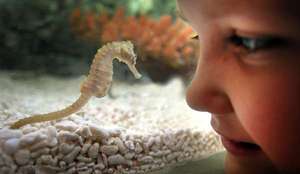 You will have to buy an aquarium that is 3 times taller than the adult specimens.
Keep in mind that these fish are quite dirty, so the water in the aquarium should be filtered well.
As you may recall, seahorses in the wild like to hide from predators in algae and coral reefs. Therefore, it's important to create similar conditions for them in the aquarium. The following elements can be used for this:
- Artificial corals.
- Seaweed.
- Artificial grottoes.
- Various stones.
An important requirement is that all elements must not have sharp edges that could damage the skates.
Feeding requirements
Since these fish feed on crustaceans and shrimp in the wild, you'll need to buy frozen Mysis shrimp for your pets. Feed your skates in an aquarium at least twice a day. You can treat them to live food once a week:
- krill;
- Artemia;
- live shrimp.
Seahorses can't compete for food with aggressive fish, so their choice of companions is limited. These are mainly snails of different types: asterea, turbo, nerite, trochus, etc. You can also add a blue hermit crab to them.
In conclusion, we will give one piece of advice: get all the information you can about these marine inhabitants before you start your first school.