Just mention the cherry fruit fly to an experienced gardener, and they'll sigh and frown with annoyance, recalling how many fruits have been lost to it—and not just cherries. Is there a cure for this pesky pest? Let's turn to the advice of villagers and experienced gardeners to answer this question.
Content
Meet the cherry fly
There's no doubt that you need to know your enemy. So, what exactly is a cherry fruit fly? The front part of the insect's head isn't much different from other fruit flies: the same shape, the same compound eyes. And the size is the same—3–5 mm. But its distinctive features are worth remembering right away: black-transparent striped wings, a bright yellow transverse shield-like stripe on the back, and the same legs.
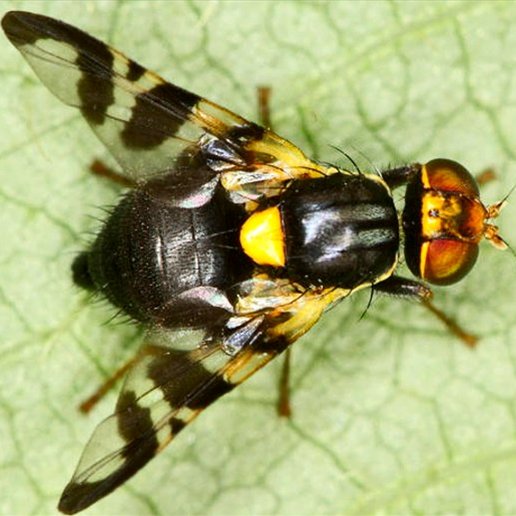
A cute striped fly is a dangerous pest!
Representatives of this species can be found throughout almost the entire territory of Russia: from the Caucasus to Siberia. The cherry fly's lifespan is short: it emerges in the spring, lays eggs in the summer, which grow throughout the season and burrow into the ground by autumn. More precisely, the adults, having grown over the winter, begin to emerge from the ground when the soil warms up sufficiently (approximately in the second half of May). A couple of weeks before mating, the flies feed on the sap of leaves and early fruits, as well as the sugary secretions of aphids. The flies lay eggs in the green fruits of cherries, sweet cherries, apricots, and other trees, and then die. The larvae continue to live inside the fruit, eating away the ripening flesh, and by autumn, they chew their way out, where they burrow into the ground to pupate and survive until spring.
Despite its name, the cherry fruit fly isn't particularly picky about its food. Its larvae can feed on cherries, apricots, honeysuckle, snowberries, and even such unique berries as bird cherry and barberry. Most often, gardeners notice the pest when it's essentially too late—that is, right inside the berry. Yes, it's hard to miss the white larva in the cherry's flesh.
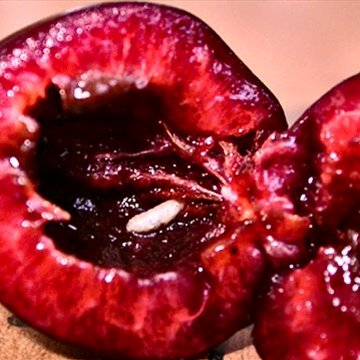
The larva may leave the berry before harvest, but it will already be soft and begin to rot.
Black spots on unripe fruits are harder to spot. These indicate that the cherry fruit fly has laid its eggs there. Later, a pit will appear in the same spot, and the berry itself will become soft and matte.
It seems futile to fight the cherry fruit fly—how can you resist it if you find not the fruit fly itself, but a damaged crop? However, don't despair: in fact, the pest can be identified even before it lays eggs. In the spring, it's a good idea to hang sticky traps on fruit trees to determine if there's a threat. They're easy to make: paint pieces of plywood yellow and coat them with ALT glue.
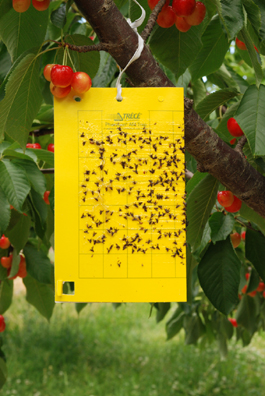
A bright yellow sticky trap attracts fruit flies.
If you manage to catch more than two flies, they've already emerged from their cocoons somewhere nearby, and it's worth trying to kill them at this stage with pesticides. However, when the number of flies that have stuck to you in a day exceeds ten, it's time to launch a mass outbreak of fruit pests. Then it's time to launch a counterattack. As you know, if you don’t fight cherry flies, their number will increase every year. In this case, the cherry harvest, and not only it, can be put to rest.
Reasons for the appearance of pests in the garden
So where do cherry fruit flies come from in your garden, and why did your trees suffer such an unenviable fate? There's no particular reason, as it's perfectly natural for these insects to lay eggs in the fruit of trees; that's their very purpose. They unerringly locate their "victims" by the sweet scent of their sap (incidentally, this is the basis for many methods of repelling cherry fruit flies). And if several trees grow close together (as is often the case in our gardens), it's a real paradise for these pests.
Moreover, even if you've managed to defeat the cherry fruit fly, you should still be on guard in subsequent years: firstly, the insects can sneak into your garden from your neighbors. Secondly, the pupae can remain in the ground for 2-3 years and emerge when you least expect it.
How to achieve a decisive victory
How can you solve the problem of these pesky pests damaging your crop once and for all? First, you need to do some reconnaissance. If cherry fruit flies are caught in a trap, it's time to take action. And then there are options.
Chemicals against cherry fruit flies
The first thing that comes to mind is turning to insecticides. Cherry fruit flies are quite susceptible to the effects of general-purpose garden pesticides.
Despite its logicality, this method can hardly be called truly effective. After all, our fly attacks not the tree or the foliage, but the fruit itself, which we plan to eat. Poisons are hardly a good addition to your jam or compote. There are a number of chemicals that experienced gardeners categorically avoid.
If you do decide to go to a gardening store to buy cherry fruit fly poison, be sure to follow the recommendations provided by professionals or the packaging when choosing a product. These should detail when and how to treat the berries to prevent them from becoming dangerous to you.
Do not spray early maturing varieties under any circumstances.
Photo Gallery: The Most Popular Insecticides for Pest Control
-

- The manufacturers of Iskra guarantee a double effect and a long period of protection.
-

- The insecticide Lightning has a pronounced knockdown effect, due to which the death of insects, including cherry flies, occurs within 30 minutes.
-

- The drug Karate Zeon is highly effective against flying pests and is intended to protect various groups of crop plants, including fruit trees.
Reviews of chemical use
I treat from the full bloom stage until the petals begin to fall. I can't always get to the site on a specific day, and the weather isn't always ideal. The treatments are most effective during the timeframe I've specified. I also treated a little later, when almost all the petals had fallen, but some of the fruit were already worm-infested. The products I use are Calypso and Horus, or Signum. If Signum is available, I prefer to use it twice in a row. But no more than twice in a row. Resistance is still a factor.
Fufanon contains oil and xelol. Decis is insoluble in water, but soluble in oils, and when combined, it dramatically increases its toxicity. Poison yourself. Decis (deltamethrin) is an old but rather unique product. There are contact and systemic versions. This one is neither. It's lipophilic (even though they say it's contact), sort of a third option. The microgranules are insoluble in water, forming an emulsion (suspension). When they land on a leaf or fruit, they partially embed themselves in the waxy coating and, after an hour, are no longer washed off by rain. When exposed to oxygen and ultraviolet light, the microgranules "gas" for two weeks, enveloping the tree in a toxic cloud. The cherry blossom fly examines the fruit before laying its eggs and either dies or flies away. But it's very toxic to bees, and the fly's flight time is precisely... well, Decis is an acquired taste. There are more advanced options, such as Calypso, Mospilan, Biskaya, and Euphoria. If it is possible to find non-counterfeit drugs, then you should gradually switch to them.
To prevent my cherries and plums from getting worms, I spray them several times with any pest control product: the first time when the “green cone” appears, the second time during the period of mass flowering, the third time 7-10 days after flowering, and the fourth time in the fall.
Folk remedies against cherry flies
Fortunately, fruit trees have been cultivated in Russia for a long time, and during this time, gardeners have developed and refined many effective methods for controlling the cherry fruit fly. The most popular are various types of traps:
- Sweet traps. As you already know, cherry fruit flies rely on smell rather than sight, so gardeners make unique insect baits out of jars and cut-down plastic bottles. They fill the traps with something sweet (beer, non-sour kvass, water with sugar or honey dissolved in it, sweet compote, or jam), then hang the traps at regular intervals on the branches of a fruit tree. Three to five traps are usually sufficient (depending on the size of the tree's crown). Sometimes the liquid needs to be changed, and the captured pests discarded. These traps should be set up immediately after the trees have finished blooming to catch the flies themselves.
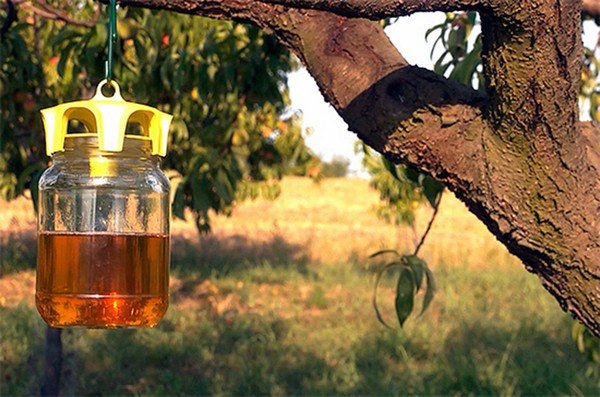
A trap with a sweet solution attracts cherry flies.
- Sticky traps. We mentioned them above in the context of pest detection, but many will be caught and neutralized. You can also hang sticky tape designed for catching common flies—they'll work just as well against cherry flies.
- Herbal infusions. You can appeal to flies' sense of smell in another way—overpowering the cherry scent with another, more powerful one. Strong-smelling herbal infusions have been prepared for this purpose since ancient times. Particularly popular are spruce and pine branches, wormwood, onions, garlic, and tobacco. In addition to leaves or needles, soap is also added to the solution to create a protective film. Naturally, if it has rained, the layer of mixture on the tree should be renewed. Furthermore, the soil also needs to be treated, as this is where harmful pupae hide.
- Fragrant plants. To continue the fight against the berry scent that attracts cherry flies, you can go even further than infusions and plant fragrant plants and flowers under and around the tree. Marigolds, calendula, tansy, and lemon balm are the most repulsive to pests.
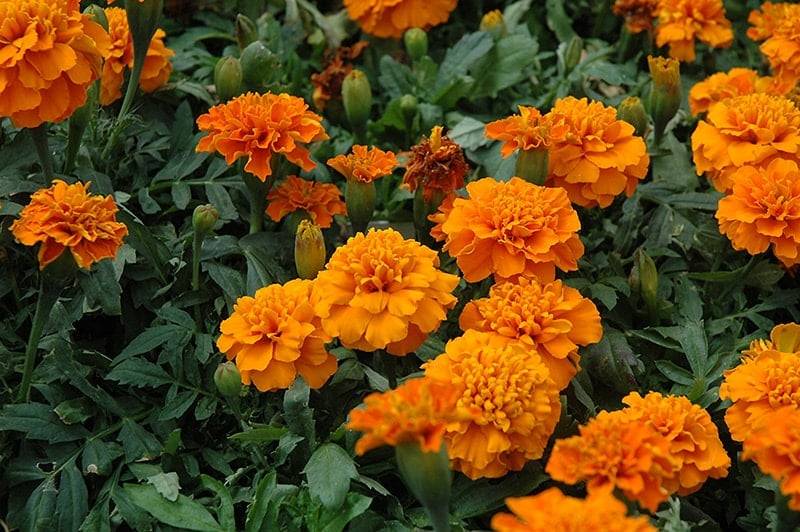
Marigolds planted under a cherry tree in spring will repel the annoying pest.
Reviews of home remedies for insect control
We've tried everything, but the worms still appear, as soon as the cherries become slightly sweet. We've dug up the soil, collected the cherries, and thrown them away (some even say they should be burned, but I don't know how). They recommended treating them with an infusion of onion peels—I'll try that this year.
How can I fight them when the entire street is covered in cherries, and I'm the only one trying to kill the cherry blossom fly? I tried putting netting over one young tree, but it didn't help. I soak the fruit in salt water before eating—that's all I can do, more or less.
You can try setting traps for cherry blossom flies. Make a paste, add cherry syrup for flavor, and be sure to add red food coloring.
Pest prevention
As you can see, the cherry fruit fly isn't a particularly powerful or indestructible pest, but it's still best to prevent it from appearing. It's not that difficult. Several methods, best combined, can help:
- Careful harvesting. Berries must be picked immediately and quickly, and secondly, all of them. Not a single cherry should be left on the tree—the fruit could contain fly larvae.
- Destruction of fallen berries. All berries that fall prematurely must be promptly collected and disposed of outside the plot or burned. They can be buried in the ground, but to a depth of at least half a meter.
- Cherry aphid control. Herbal solutions and chemicals will help kill aphids in the spring, significantly reducing their food supply. Incidentally, fragrant plants will also help here—aphids don't tolerate them either.
- Digging the soil. This is best done in early spring and late fall. The soil under the tree should be thoroughly dug to a depth of 30–40 cm to physically destroy the pupae or bring them to the surface, where frost and birds will do their work.
- Soil treatment. If you decide to spray your tree with insecticides, don't forget about the soil underneath—this will significantly increase your chances of defeating the cherry fruit fly and its offspring.
- Natural enemies. Some gardeners, especially those with livestock and poultry, recommend releasing chickens under trees in the fall to help eliminate the larvae.
Dealing with garden pests, and cherry fruit flies in particular, is no easy task. Moreover, it requires ongoing intervention: either direct pest control or preventative measures. However, the key is to never give up: the methods described above have been used by thousands of gardeners, so their experience will certainly help you save and increase your harvest.