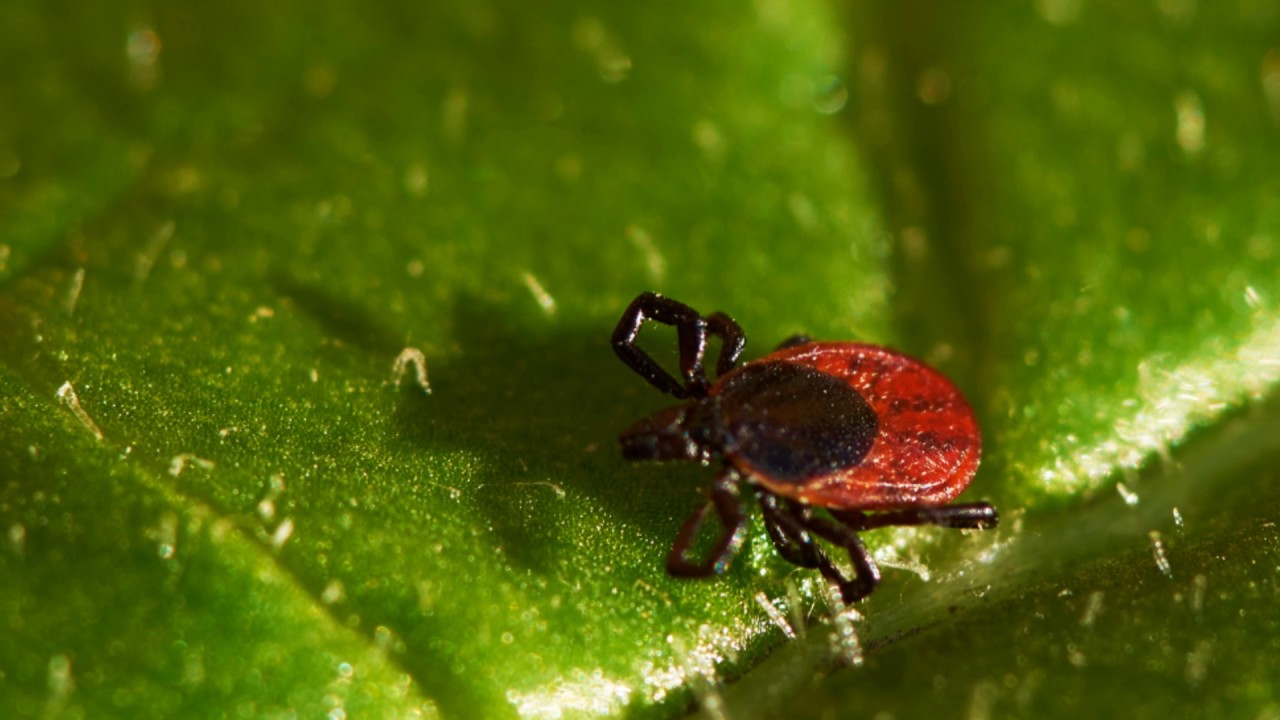
Taiga ticks are small arthropods. Their name comes from the original habitat of this subspecies in the forests of Siberia. These parasites feed on the blood of humans and animals. They are found in forests, parks, and garden plots. They transmit dangerous diseases such as tick-borne encephalitis, Lyme disease, and others.
Content
Meet the taiga tick
The taiga tick is a small, spider-like arthropod with a slightly compacted body. It has eight black legs and a reddish-brown back. When unfed, the parasite is small, ranging from one to six millimeters. Its shape resembles a small seed. The taiga tick is closely related to its European relative.
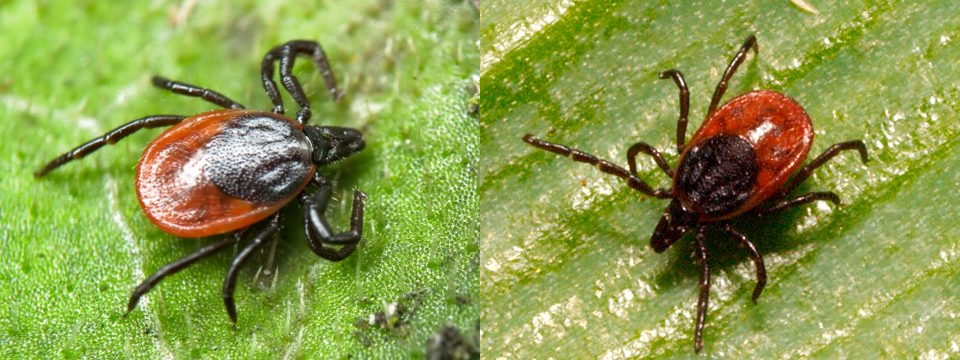
The taiga and European ticks are close relatives that even look very similar.
External features
The taiga tick has a number of distinctive features: its body is protected by a "shield," which can be reddish, brick-red, brown, or black. The larvae are beige before feeding, but darken as they become engorged. Ticks have no eyes; they navigate solely by smell and touch.
Habitats of taiga ticks
The taiga tick is a species of ixodid tick. The arachnid's name only hints at the former habitat of this subspecies. Today, they can be found in spruce and mixed forests (in the grass and undergrowth of trees). Taiga ticks are even found in parks and garden plots in cities, from the coast of the Gulf of Finland in the north to Belarus. The taiga tick has also retained its historical habitat in the Siberian forests. This parasitic species is also found in the forests of Altai, Tien Shan, and Primorye, and individuals can even live at altitudes of 3,000 meters above sea level. Taiga ticks can be encountered in China, the Kuril Islands, European countries, and the mountains of Asia.
It's a misconception that ticks live in trees. They can indeed live there, but they typically don't rise higher than one meter. In such places, they most easily find a host: wild forest animals or humans. Near forests, ticks stalk cattle (pasture ticks). Burrowing taiga parasites live in animal burrows and nests.

The taiga tick has colonized the territories of Southern Siberia, the Far East, and most of Europe.
Behavior of the taiga tick
Since ticks are parasites, their life cycle is closely tied to their host. Once satiated, arachnids never attack humans or animals. After feeding on blood, these arthropods transition from one growth stage to the next (from larva to adult). Only adult ticks pose a threat to humans. Larvae and nymphs feed primarily on small forest animals: dogs, squirrels, and cats. Owners of furry pets should take precautions in advance: purchase tablets, sprays, or drops against taiga pests.
Why are taiga ticks dangerous?
The taiga tick is dangerous because it can carry pathogens that cause fatal diseases. The most dangerous months for walking through parasite habitats are May and June: at this time, all the hungry ticks come out to hunt after hibernation. When a bloodsucker bites a person, the parasite's saliva can introduce pathogens causing tick-borne encephalitis, Lyme disease (borreliosis), babesiosis, and ehrlichiosis into the bloodstream.
Those planning outdoor activities should be vigilant from the first thaw until early fall. With the arrival of warm weather, adult ticks awaken from hibernation and await a new host in the grass along paths and even in trees. By late summer, a new generation of ticks—larvae and nymphs—emerges.

To protect yourself from taiga ticks, choose walking paths away from bushes, grass, and trees.
Development and growth of taiga ticks
The taiga tick develops from eggs, which the adult female lays in huge numbers (up to 3,000 at a time). The next stages of development are the larva and then the nymph. During this period, the tick is already active and feeds off its host. Over time, the parasite matures into an adult. The complete development cycle of the taiga tick takes from two to six to seven years.
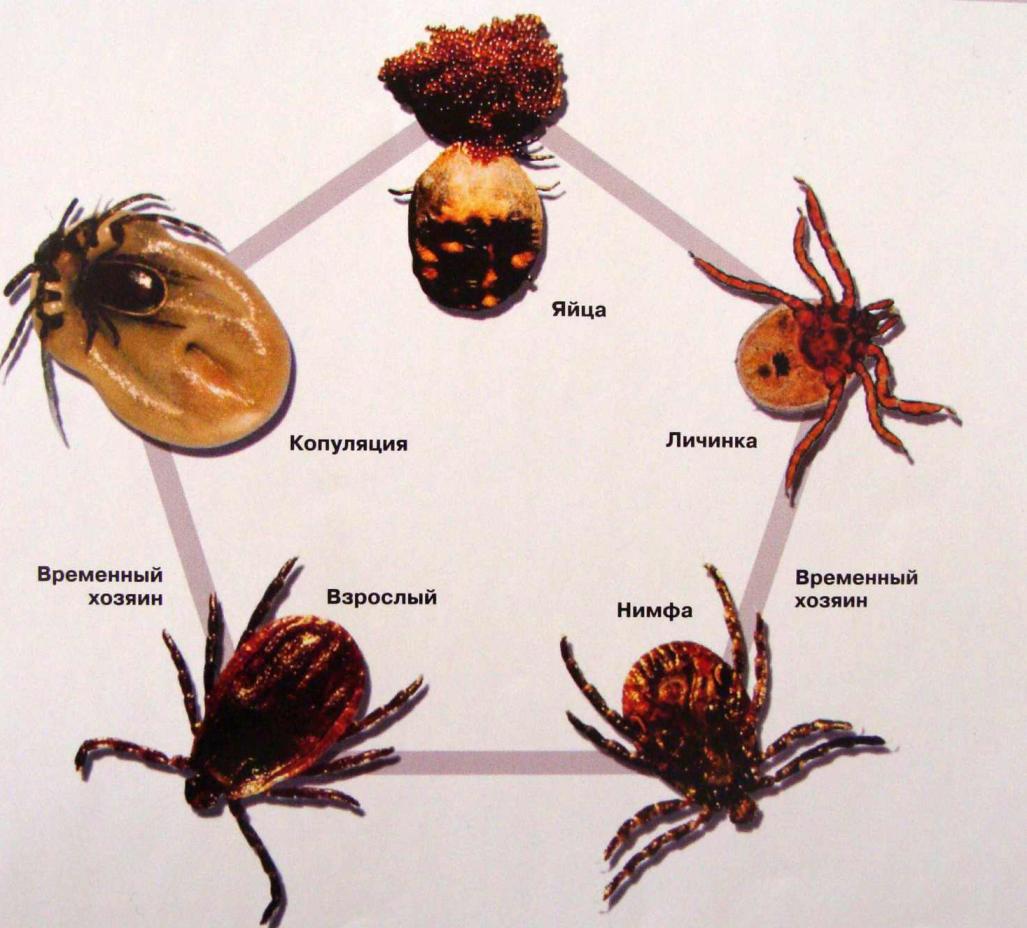
During its life, the taiga tick goes through 5 stages
How do taiga ticks reproduce?
The male waits for his mate in the grass or attached to his host. Having recharged, he breaks away from his victim and fertilizes a large number of females. After accomplishing this feat, the male taiga tick dies (by June, there are no adult males left, but larvae and nymphs begin to hunt). The fertilized female feeds on her host for another week, after which she lays eggs. At this time, her size can reach 1 centimeter.
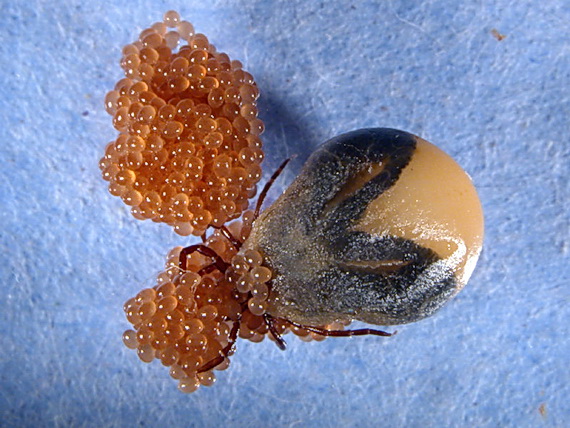
The female tick usually reaches a very large size, since during the period of laying eggs she eats more than usual.
What to do if you encounter a taiga tick
If you see this parasite on your clothes or skin, gently shake it off. You must not touch or crush the tick with your hands. This can increase the risk of infection. It's best not to attempt to remove the attached bloodsucker yourself, as doing so incorrectly can damage the parasite's body and lead to infection. The dangerous proboscis and head with its blood-sucking apparatus (and any disease-carrying organisms) will remain inside.
The best solution in this case is to go to the hospital immediately, without waiting for the tick to fall off. After removing the tick yourself, it should be tested to rule out infection.
How to remove a tick yourself
The taiga tick (like its relatives of other species) can be removed in several ways: with tweezers, thread, a syringe, or by applying oil. Grasp the tick with tweezers and pull it toward you using a rocking, circular motion. Alternatively, you can use a thread instead of tweezers. Place the loop close to the bite site, where the proboscis is, and pull.
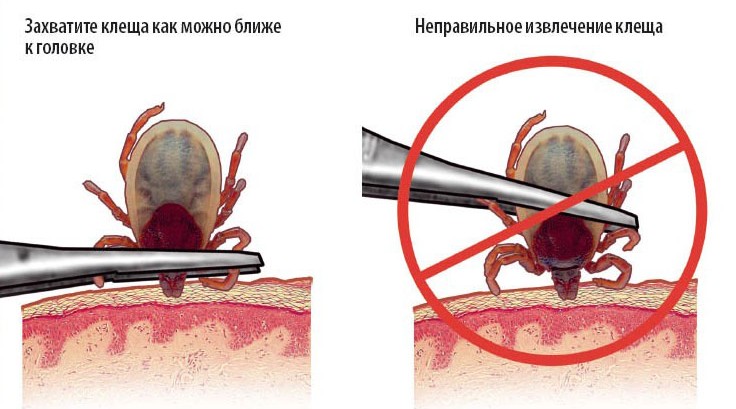
To remove a tick, you need to grasp it with tweezers as close to the head as possible.
Under no circumstances should you tilt the tweezers at an angle or pull them too hard. After removal, the tick should be placed in an airtight container (bag or jar) and submitted for testing within 48 hours. The bite site should be treated with a disinfectant (alcohol, brilliant green, antibiotic ointment). Make sure the tick is removed completely: its head and proboscis should be visible. If any remain, remove them with tweezers using the same twisting motion.
Video: First aid for a tick bite
The first symptoms of diseases
Symptoms of even the most dangerous diseases can remain latent for a long time (the so-called incubation period, when the disease is asymptomatic). Fatal illnesses can resemble the common cold.
Table: Diseases carried by the taiga tick
| Name | First symptoms |
| Lyme disease |
|
| Tick-borne encephalitis |
|
| Babesiosis |
|
| Ehrlichiosis |
|
How to protect yourself from the taiga tick
Choose light-colored clothing: dark-colored ticks are easier to spot against a contrasting background. Skin should be protected as much as possible with thick fabric. This will prevent the tick from reaching the skin and biting. For frequent and long trips, we recommend purchasing an anti-tick suit, and even better, getting vaccinated against encephalitis (44 days before the trip).

The tick suit reliably protects a person from parasites getting onto exposed areas of the body.
Apply tick repellent lotion or spray to exposed areas of the body. Sleeves should be tightly cinched with elastic to prevent ticks from crawling under your jacket. A tick repellent suit is a good solution, but you can do without one. Simply wear tight-fitting, thick clothing and treat it with a special spray (Reftamide Taiga). Here's how summer residents rate the product's effectiveness:
Our dacha is located in a tick-infested area. The road to the dacha runs through the forest. After rain, it's impossible to drive; we have to walk 3 km along an overgrown forest road. Every year, someone from our dacha gets bitten by a tick, and a good half of our neighbors have already contracted encephalitis and Lyme disease. Some in our family have also had the disease. We've tried many repellents, but we still manage to remove ticks. Now, for the second year, we've been using Reftamide Taiga (Antikleshch) from Sibiar (Novosibirsk). I don't know how it works—whether it repels ticks with odor or toxic fumes—but the fact remains: ticks don't want to cling to our clothes. Which is very encouraging.
Shoes should completely cover your feet and allow you to tuck your trousers in for added protection. Wear a hat (ideally, a net covering your entire face, head, and neck).
After visiting potentially dangerous areas, it's best to leave outerwear and bags outside. After walks in the forest or park, inspect your pets, comb them with a fine-tooth comb, or, even better, give them a special tick repellent. A single tablet (such as Comfortis, Bravecto, or Frontline) is sufficient to completely eliminate ticks. Avoid sitting on the grass in forests, and keep lawns near your home short. For walks, choose well-trodden paths free of bushes and tall grass—common tick habitats.
By following these simple rules, ticks won't be able to even get close to you, and you and your family will be reliably protected from danger. Remember that the tick-borne encephalitis vaccine only protects against one disease. For comprehensive protection, it is recommended to use repellents (such as Deta). There is no prevention for diseases transmitted by the taiga tick (except for vaccination against encephalitis).
I'd like to share my impressions of the Deta aerosol. I've used it in the past and will continue to use it this year. This is a Deta aerosol for midges and ticks. The undeniable advantage of this product is its effectiveness. It repels insects effectively. The stated effect is definitely achieved. The only downside is the strong odor. As they say, the end justifies the means.
Walking in the forest is one of the most enjoyable activities, especially in summer. When heading out into nature, remember simple safety precautions, and you won't give ticks a chance.