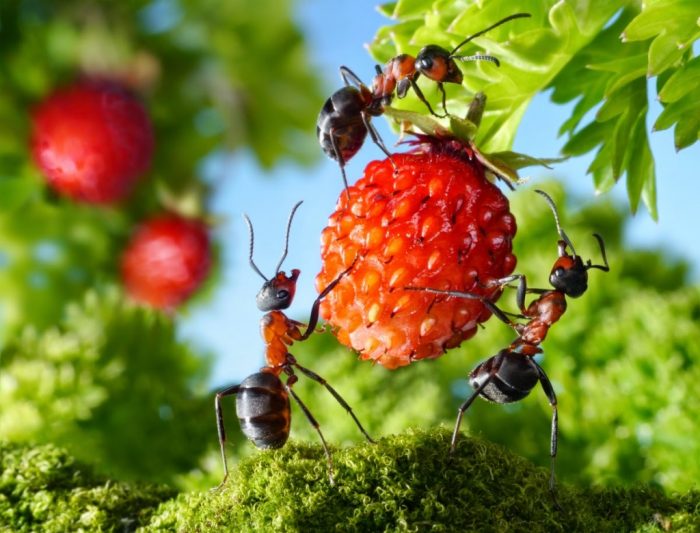
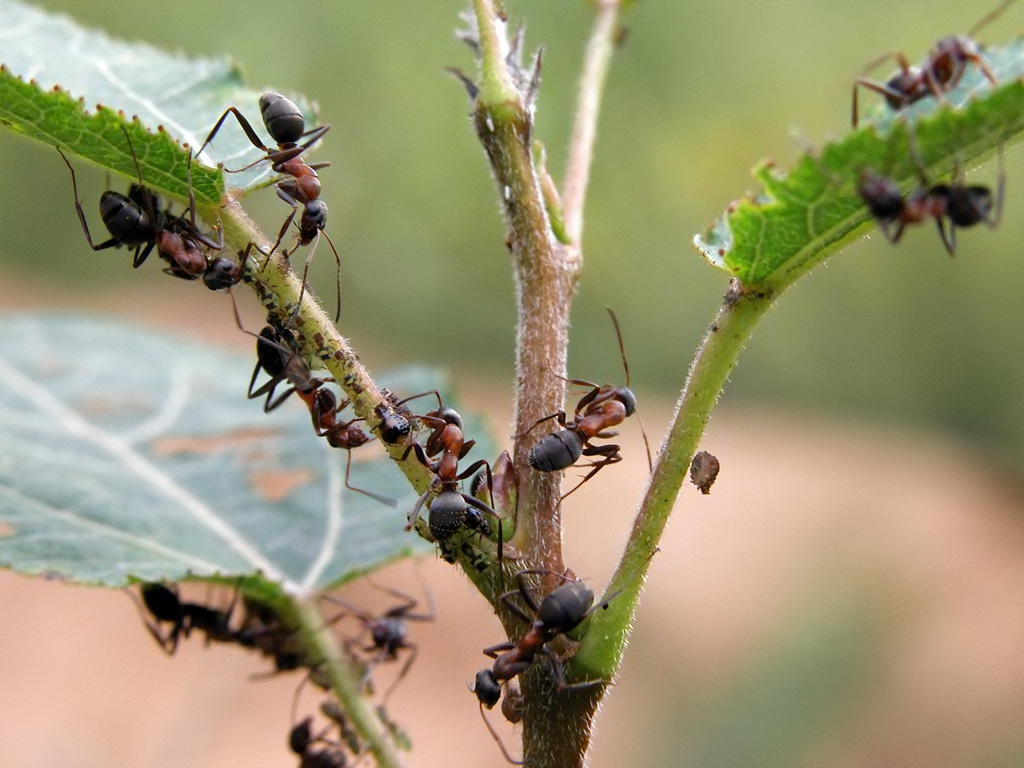
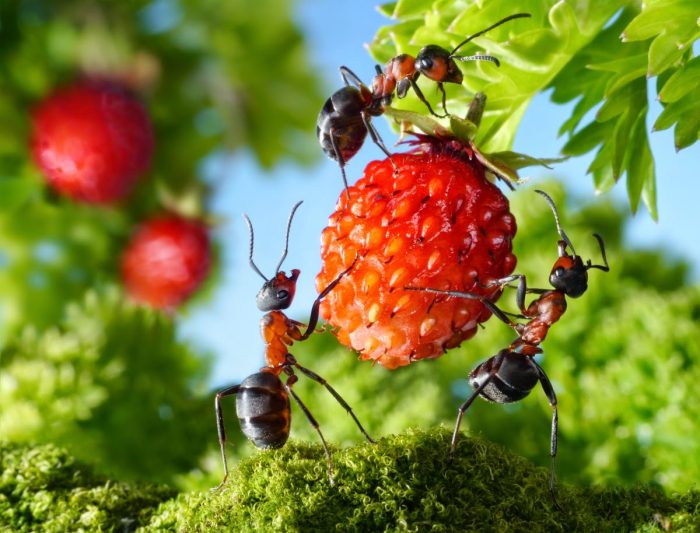
If you notice curled upper leaves on your blackcurrant berries, or swelling on your white and red currant berries, it means you've got aphids on your berry bushes, which will inevitably attract ants. To preserve your harvest, you need to begin combating these insects promptly.
Content
Where do aphids and ants come from on currants?
Aphids live on the undersides of leaves, overwintering under the bark of young shoots. In the spring, when the weather warms, their larvae emerge. They feed on the sap of young shoots. This causes the leaves to curl, wither, and die. The berries on the bushes become small, and the harvest declines. Around midsummer, when leaf growth stops, the aphids develop wings and fly to neighboring plants, where they feed until autumn. These insects reproduce rapidly. In the fall, the aphids return to the currant bushes and lay eggs. Where aphids appear, ants will surely appear soon.
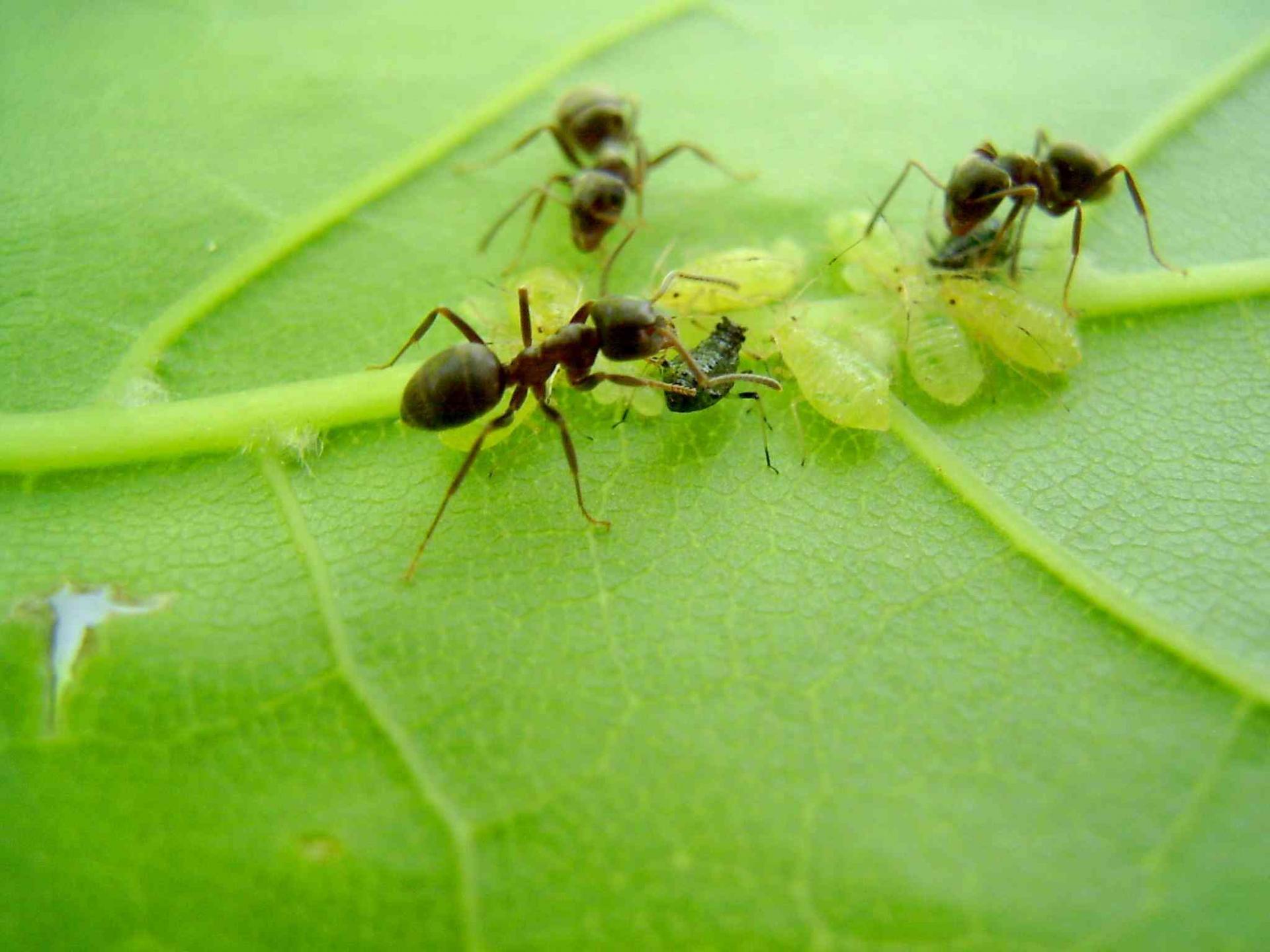
Aphids and ants do not live separately
Ants don't eat aphids; instead, they spread them among buds and twigs, providing themselves with food—the honeydew they produce. This sugary substance is their favorite delicacy. They build their nests near berry bushes. Anthills are easy to spot by mounds of earth and paths. Most often, these are:
- Brown ants are a common species of wood ant, black and gray in color. They build their nests under rocks or make mounds of earth.
- Black garden ants are tiny insects, only 3–5 mm long. They live in decaying trees or build nests in the ground. They are black in color.
- Turf ants are small, earthen ants up to 4 mm in size. Their color ranges from yellowish-brown to black. They build small nests in the ground.
All of them are carriers of aphids. Therefore, it is necessary to fight not each insect separately, but all of them in a comprehensive manner.
However, ants are beneficial in addition to their harmful effects. They destroy caterpillars, midges, and slugs, and improve the soil by enriching it with phosphorus and calcium.
Ways to control ants
Every gardener wants to grow organic berries and fruits in their garden. Chemical pesticides that affect not only the currant bush but also the soil beneath it should only be used when aphid and ant colonies are very large.
It's worth starting with folk remedies. They are quite effective and safe.
Traditional methods
- One of the easiest ways to get rid of ants is to treat their nesting area with boiling water. First, dig up the nest. This procedure is repeated several times.
- To repel uninvited guests from your property, use feeders baited with eggs and boric acid and sugar, mixed in a 1:1 ratio. The traps are placed under bushes. They are safe for humans and animals. Boric acid can also be mixed with jam, yeast, or honey. The result will be similar.
- Garlic repels ants with its scent. You can plant it nearby or scatter the cloves around the bushes.
- Insects dislike the scent of tansy, parsley, tomatoes, valerian, cloves, and anise. These plants can also be placed around seedlings.
- You can sprinkle the insects' nests with cinnamon, red pepper, tobacco, or ash. This will permanently repel ants from the area.
- Kerosene or diesel fuel can help get rid of insects if you pour it on anthills. To do this, dilute 10 tablespoons of kerosene or diesel fuel in 10 liters of water.
Photo Gallery: An Arsenal of Folk Pest Control Remedies
-
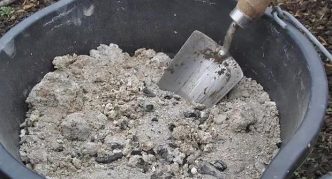
- Dusting currant bushes with wood ash helps get rid of ants.
-
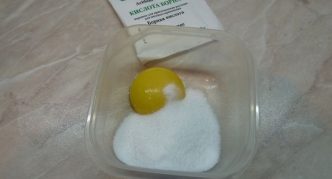
- You can make poisoned ant bait from boric acid, eggs, and sugar.
-
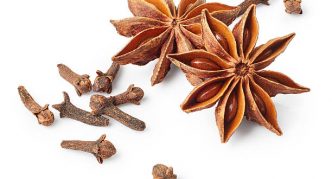
- The spicy smells of cloves and anise repel ants.
-
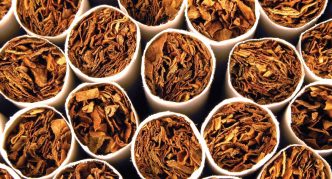
- You can drive away ants by sprinkling their homes with tobacco
Chemical ant control
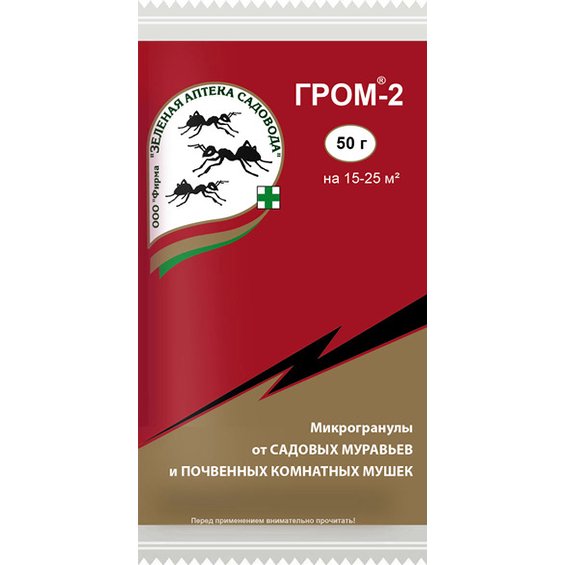
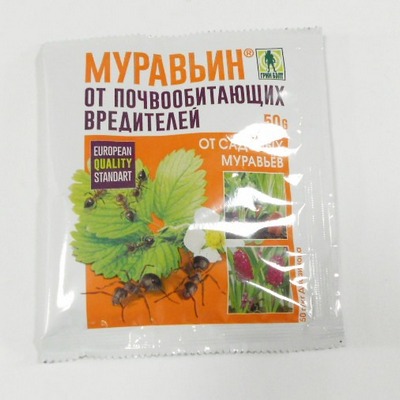
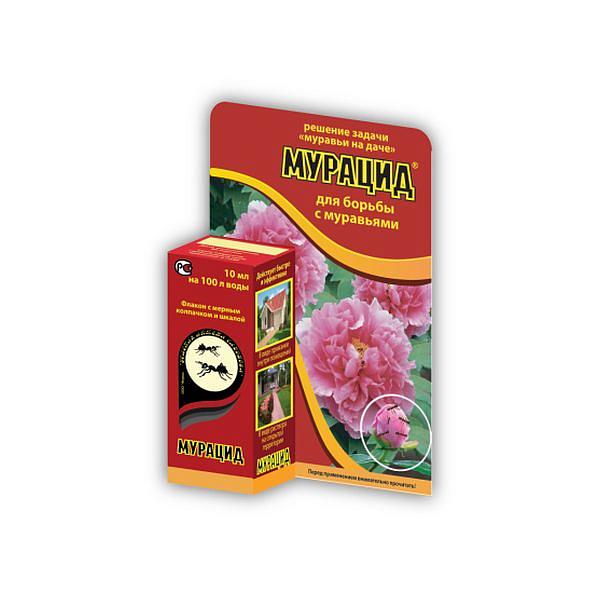
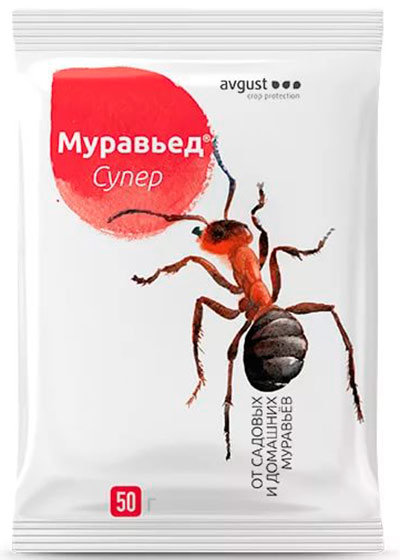
If you decide to fight ants using chemicals, the most effective will be those based on diazinon. This is a potent poison with contact and intestinal effects. It is absorbed through the skin, causing paralysis. The ants die within 2–3 days. The protective period after treatment lasts 3 weeks. Diazinon-based products include Muravyin, Muravyed, Grom-2, and Muratsid.
- Thunder-2 - It is produced in granular form and contains diazonin. It belongs to hazard group 2. When treating plants, personal protective equipment (PPE) is required: a respirator, goggles, and gloves. To destroy an anthill, remove the top 2-3 cm of soil, sprinkle the poison on top, and cover with soil. The insects usually disappear within 3-4 days.

Thunder-2 is a pellet that needs to be buried in an anthill.
- Muravin is a granular product that helps eliminate ants in your garden. It's safe for animals and plants. Sold in 10g sachets, it's a food bait and shouldn't be diluted with water. The product is buried 2 cm deep around the anthill. One sachet is enough to treat 5 m2.2It belongs to the 2nd hazard group, and it is better to work with it using protective equipment.
Ant is safe for animals and plants
- Muracid is used to control garden and house ants. It comes as a liquid and is diluted in water: 1 milliliter of the product per 10 liters of water. The insects die 2-4 days after treatment. The insecticide is used as bait and placed in small containers around bushes. To do this, dissolve 100 grams of sugar, 20 grams of honey, and one drop of the product in 100 grams of water.
Muracid is used to make poisoned baits for ants.
- Anteater is used to control garden ants. It is sold in ampoules containing liquid. To prepare a solution, dilute 1 ml of the product in 10 liters of water. This volume can treat 7-10 anthills.
One ampoule of Muravyed is enough to treat 7-10 anthills
Fighting aphids
Mechanical, biological and chemical methods of protection will help protect seedlings from these pests.
Mechanical methods
Control of aphids on currant bushes begins in early spring and ends in late fall. One of the main methods is seasonal pruning.
- In the spring, before the buds open, currants should be watered with hot water heated to 80 OTo kill pests that have overwintered on plants, it's also necessary to prune and remove diseased shoots.
- In summer, remove and burn infected branches. This should only be done if the bush is only slightly affected. Prevention requires weeding and controlling ant nests. Beneficial insects, such as ladybugs, destroy aphids. To attract them to the area, plant alyssum and marigolds near the currant bushes.
- In the fall, old and diseased branches are pruned and burned along with fallen leaves. Healthy shoots are sprayed with protective agents. The soil under the bushes is dug over.
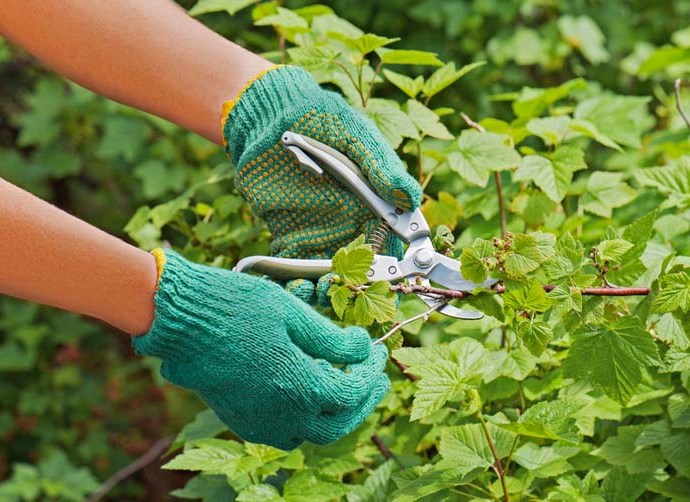
Seasonal pruning is an effective mechanical method for controlling aphids on currants.
Folk remedies
Folk remedies are used to combat aphids and are harmless to bees and ladybugs. Infusions and decoctions of plants grown in garden beds and flower beds are used to repel them:
- marigolds,
- garlic,
- tomatoes,
- celandine,
- red pepper.
Aphids live on the back of the leaf, so it is necessary to spray and treat each branch along its entire length. Young shoots are bent over, dipped into a container with the solution, and washed thoroughly. This work is best done in the evening, in dry and windless weather. The bushes and everything growing beneath them are treated.
- Marigold infusion is made from dried flowers. Take half a ten-liter bucket of crushed flowers and top up with warm water until the bucket is full. Let it steep for three days, then strain. Add 50 grams of soap before spraying.
- A red hot pepper decoction is prepared from fresh pods. One kilogram of hot peppers is chopped and poured into 10 liters of cold water, boiling for one hour. The prepared solution is stored in a dark place for 3-4 days. The resulting concentrated decoction is filtered and stored in a cool place. For spraying, one cup of the concentrated solution is diluted in ten liters of water. To prolong the effect on the leaves, soap is added.
- Garlic infusion: Chop 0.5 kg of garlic and add 5 liters of room-temperature water. Let it steep for 24 hours, strain, and use for spraying.
- Tomato top decoction. To make a concentrated solution, chop 2 kg of dried and 4 kg of fresh tomato tops and boil them for half an hour in 10 liters of water. Cool, strain, and store in a cool place. For spraying plants, dilute the concentrate with water in a ratio of 1:5. Soap can be added to the solution.
- A solution of washing soda is prepared from 1 liter of water and 1 tablespoon of baking soda. This solution also helps fight fungus.
- Ash and wormwood infusion. Grind 500 g of wormwood and pour 5 liters of water over it. Add 1 cup of ash and 50 g of laundry soap. Let it steep for 5 hours. To make the working mixture, combine one part of the solution with two parts of water.
- Celandine infusion. Steep 4 kg of fresh celandine in 10 liters of water for 24 hours. Spray the currants with the prepared solution. Celandine is a poisonous plant, so wear eye, hand, and respiratory protection when handling it.
Photo gallery: aphid control using traditional methods
-
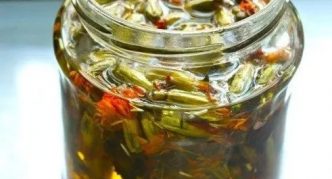
- To make the marigold infusion stick better to the branches, you need to add soap to the solution.
-
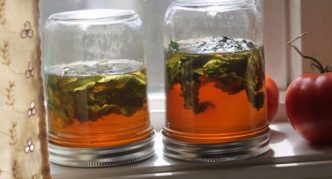
- A decoction of tomato tops against aphids is made from dried and fresh tomato greens
-

- A hot pepper decoction is an effective remedy for aphids in the garden.
-
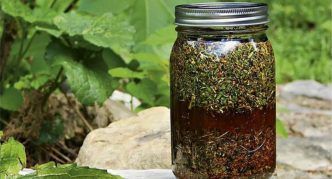
- Ash should be added to the wormwood infusion to enhance the effect against aphids.
-

- A solution of soda ash helps against aphids and fungi.
-
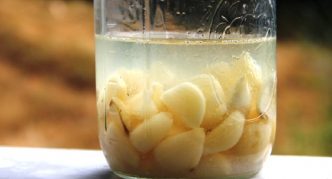
- Garlic infusion helps against aphids and other insect pests
Chemical preparations against aphids
When a garden plot is heavily infested and folk remedies are insufficient, chemical pest control agents are used. These agents have different effects on pests:
- contact - from the outside, in direct contact with insects;
- intestinal - from the inside, when they enter the aphid's body with food.
The first stage is carried out in early spring, when the buds begin to open, the second - during flowering, the third - after flowering, and the last time the bushes are treated after harvesting.
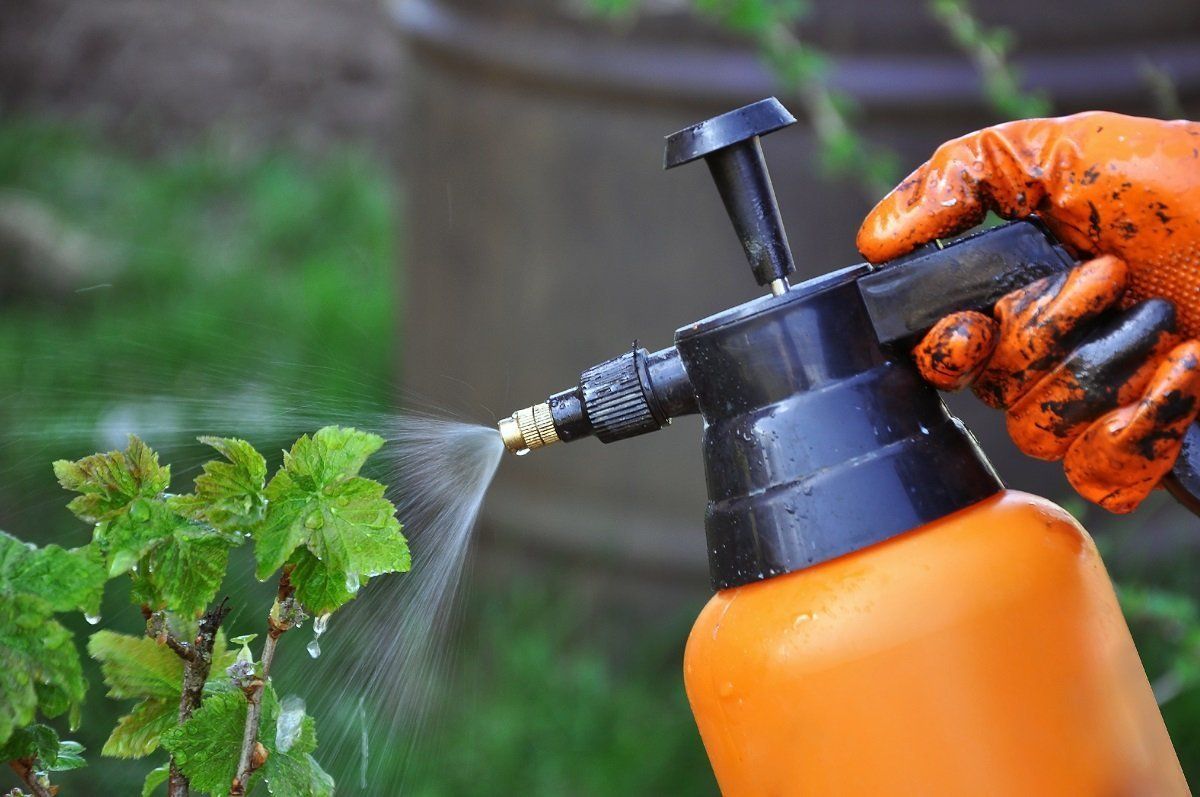
Currants need to be treated against pests several times per season.
The following preparations are effective in the fight against aphids:
- Aktara,
- Karbofos,
- Confidor,
- Fury,
- Inta-Vir.
When using them, it is necessary to strictly follow the instructions.
To get a good harvest, constant care and maintenance of plants is essential. Preventative measures take time, but they can eliminate aphids, eliminating the need to deal with pests.