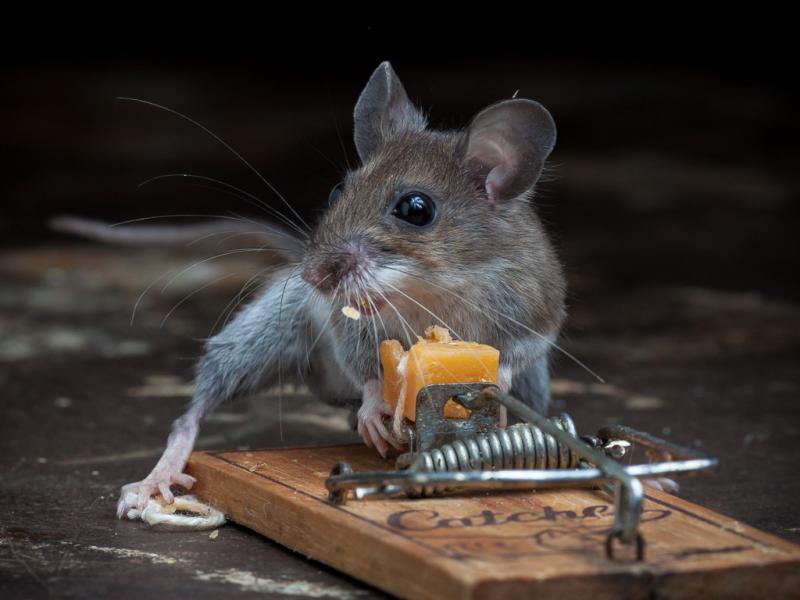
These cute little creatures may look harmless and fragile, but in reality, having mice in your home can be a major nuisance. They carry potentially dangerous diseases, destroy food supplies, and damage furniture and books. They're also so small that they can only fit through openings as small as six to seven millimeters. Catching mice typically involves setting traps in areas where the animals roam, but you can get rid of these annoying guests without the use of special means.
Content
How to catch a mouse
To check if mice are actually infesting your home, simply sprinkle a little flour in the suspected areas where the animals are found and see if any traces appear the next morning. Depending on your preference, you can choose from a variety of mouse trapping methods, from harmless to rather brutal. It should be kept in mind that these rodents rarely leave their nests during the day, so traps should be set at night.
Interesting fact: Mice's incisors grow throughout their lives, so the animals are forced to constantly wear them down by gnawing on everything in sight. Using their teeth, mice can destroy structures made of wood, concrete, and even metal.
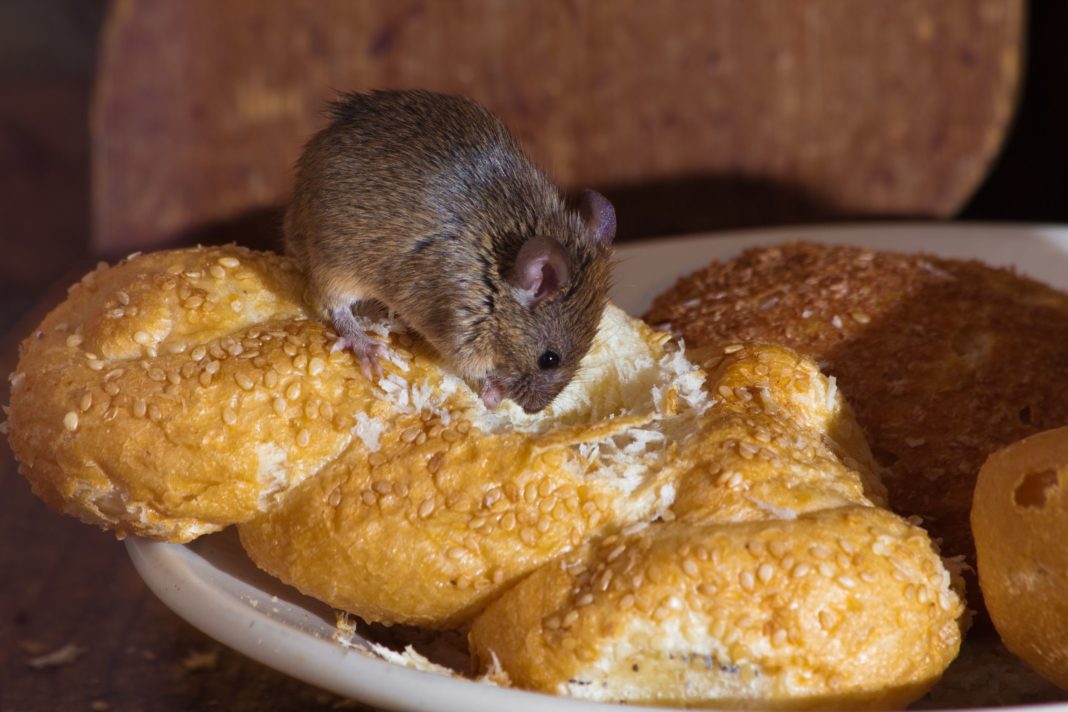
A mouse is dangerous for a person because it can cause a dangerous infection, especially if it gets into contact with food products.
The Killer Mousetrap
An old, tried and true, but not always effective, way to catch mice is to use a mousetrap. These can be industrially manufactured and come in a variety of designs. These traps work by luring the rodent and then killing or injuring it using a special mechanism.
Table: Rodent Killing Traps
| Traps made of steel and/or wood | A reliable and proven remedy that often kills the pest outright. Lard, raisins, peanut butter, and smoked meats can be used as bait. |
| Mouse traps | Better and more reliable than similar mechanisms made of wood and metal, due to greater efficiency, lower risk of injury to humans, simplified design, and versatility. |
| Noose mousetrap | A simple, but not very effective design. It works by luring the animal and strangling it with a steel loop. |
| Electric mousetrap | The principle of operation is based on luring and shocking the rodent with an electric shock. It's a relatively humane tool for killing mice. |
Photo gallery: types of mousetraps
-

- A classic mousetrap consists of a wooden board and a metal spring.
-
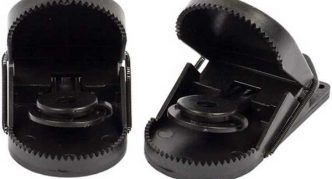
- An improved version of the classic mousetrap is available for sale.
-

- An electric mouse trap kills a mouse with electricity.
Humane traps
Not everyone enjoys killing or maiming a living creature, even a harmful one. Manufacturers specializing in rat and mouse traps have developed a wide variety of humane mousetraps that are harmless to animals. Typically, these traps work by luring the animal into a cage (box, container) with an automatically closing door using bait. The captured offender can then be released into the wild. It is recommended to do this at least one kilometer from home.
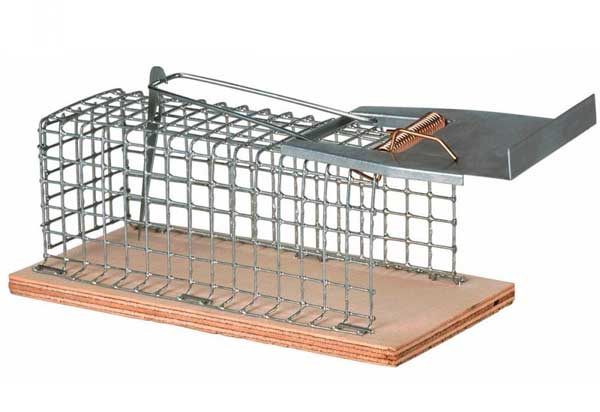
A mouse caught in a cage mousetrap remains alive.
Table: Traps that do not harm animals
| Live traps of various types | A very simple yet effective type of mouse trap that can be used multiple times. They are safe for both rodents and humans. Recommended bait includes chocolate, sunflower seeds, and bread with sunflower oil. |
| Mousetrap-cage | It's hygienic and humane, but less safe for people than modern live traps due to the trigger mechanism. False alarms can sometimes occur. |
How to make a mousetrap yourself
You can get rid of mice in your home by purchasing one (or several, for greater effectiveness) of the commercially made traps listed above. But what if the rodents catch you unawares late in the evening, or if the traps and live traps you buy at the store aren't working properly? Making a quick mousetrap from household items isn't as difficult as it seems; it just requires a little patience and ingenuity.
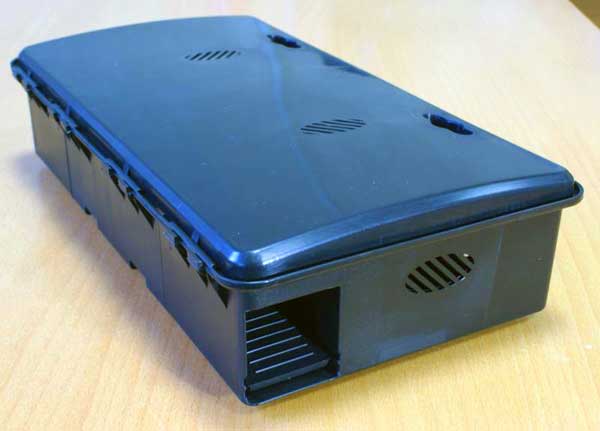
There is an improved version of the cage mousetrap: the so-called live trap
Making a mousetrap using a plastic bottle
There are many ways to catch mice using a plastic bottle. Depending on the layout of items in the house, the rodents' habitats, and other factors, you can modify and vary the methods for making and setting the traps—all it takes is a little imagination.
How to catch a mouse in a bottle
The easiest way:
- Take a plastic bottle.
- To be on the safe side, you can grease the inside walls of the container with vegetable oil.
- Place the bait.
- Mount the bottle at an angle so that the mouse can climb into it from the floor or another surface.
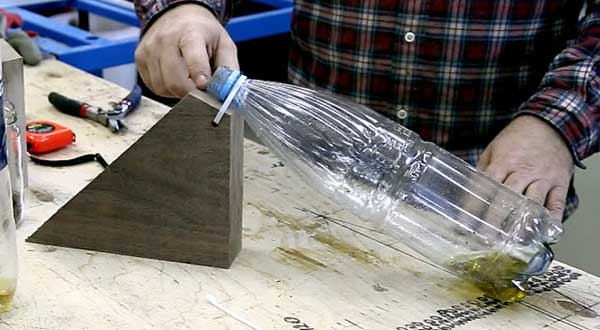
A simple and reliable mousetrap can be made from a plastic bottle.
Plastic construction for catching mice
The more complicated way:
- Take a bottle.
- Cut it in half.
- Grease both parts with oil on the inside.
- Place the bait.
- Place the top part inside the bottom part with the neck down, securing the structure with paper clips.
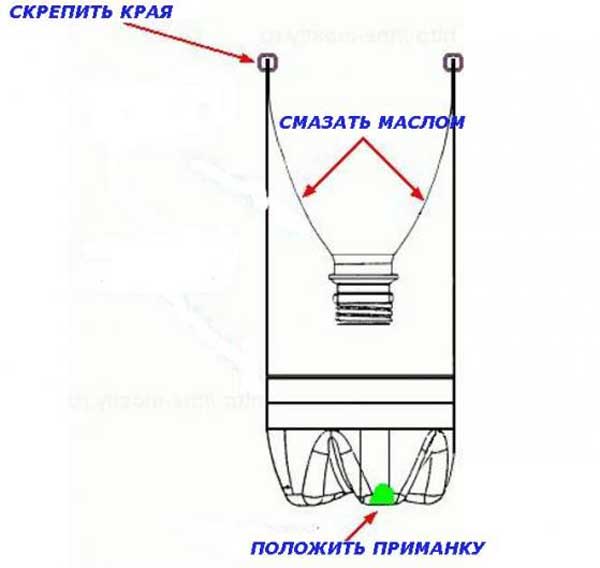
A mouse trap can be made from a cut plastic bottle.
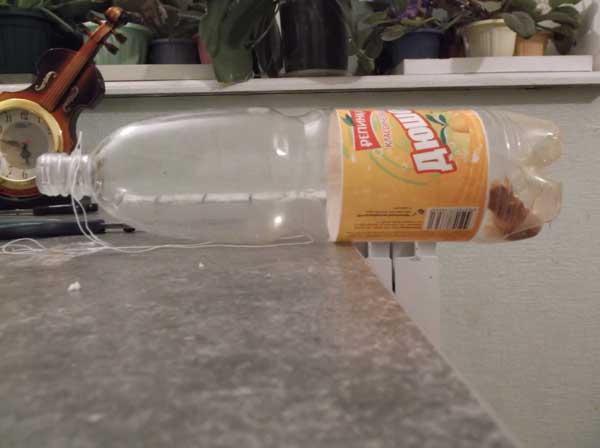
A trap made from a bottle and a rope
For this method you will need a thin but strong rope.
Algorithm of actions:
- Take a plastic bottle.
- Tie a rope up to 50 cm long to the neck.

The length of the rope should not exceed 50 cm.
- Place the bait in the container.
The bait is placed inside the bottle
- Attach the other end of the rope to the table with tape.
One end of the rope is attached to the table.
- Place the bottle on the edge of the table in a horizontal position, making sure it is properly balanced.
You need to position the bottle so that it doesn't roll away.
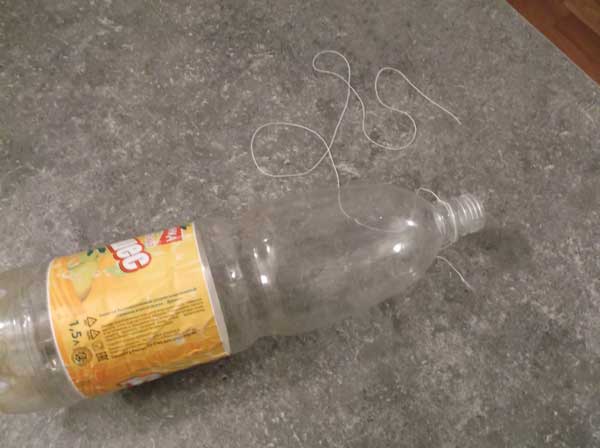
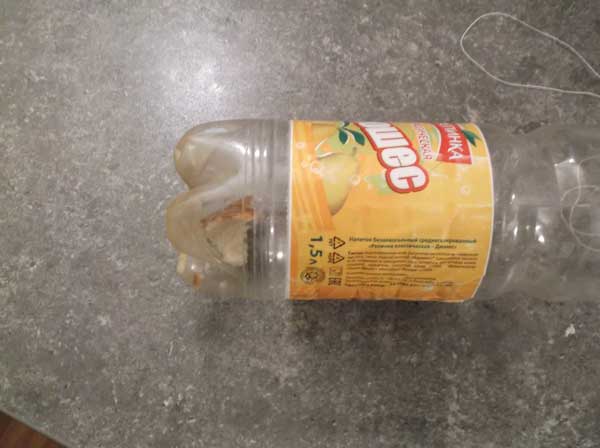
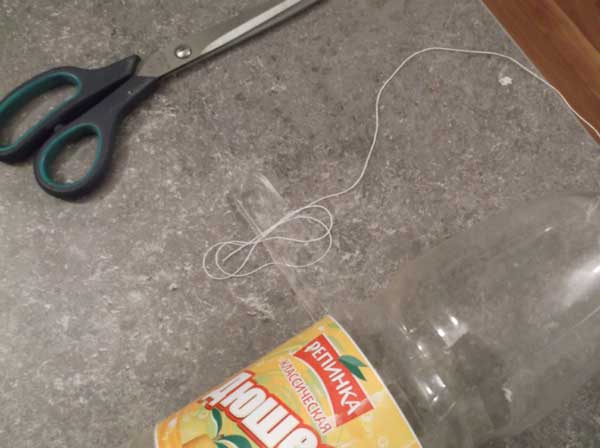
Mousetrap made from a bucket and a plastic bottle
To make it you need to do the following:
- Take a small plastic bottle.
- Use an awl to make holes in the lid and at the end.
- Insert a knitting needle or a straight piece of wire 1–2 mm in diameter into the holes.
- Attach the bait to the bottle.
- Grease the bucket with oil or fill it halfway with water.
- Place the bottle on top of the spoke (wire).
- Place a piece of board against the bucket.
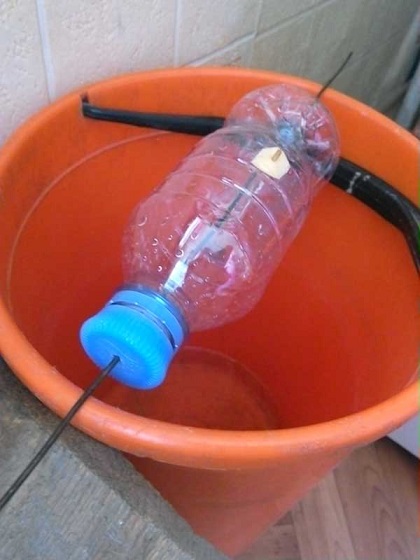
When a mouse gets caught in the trap, it ends up in a bucket of water.
A trap made from a cut bottle
Another option for making a trap yourself:
- Take a bottle.
- On the side where the bottom is, cut out strips 3 cm wide and half the length of its circumference.
- Sharpen them and bend them into the bottle. This way, any animal that gets inside won't be able to escape.
- Place a piece of chocolate or a loaf of bread soaked in sunflower oil into the trap.
Video: How to make a trap from a plastic bottle
An easy way to catch a mouse in a bucket
A very simple but effective "trap" can be made from an ordinary bucket:
- Fill it halfway with water.
- Place at the edge of a table or chair.
- Place a school ruler with bait on the edge of the surface above the container, maintaining balance so that the structure does not fall into the bucket.
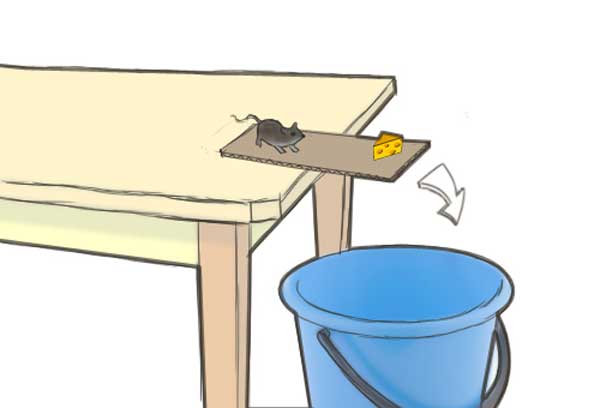
Before the mouse reaches the bait, it will fall into a bucket of water
How to Catch a Mouse with a Jar
The structure is very unstable, but it can nevertheless be quite effective. Here's what you need to do:
- Take a jar and a five-ruble coin.
- Attach the bait to the inside of the container using a piece of double-sided tape.
- Place the jar upside down on the edge of the coin.
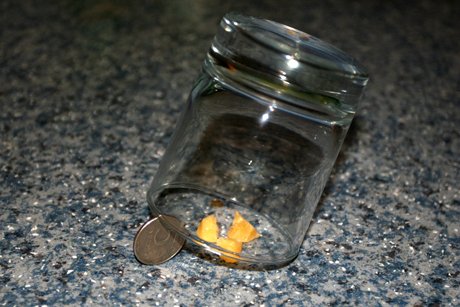
Instead of a jar, you can use a wide glass or any other container with smooth edges.
Glue trap
To make one, you'll need to purchase a store-bought glue specifically designed for catching rodents. You can make a mousetrap as follows:
- Take a piece of cardboard.
- Apply glue to the surface.
- Place a piece of fish, chocolate or bread with vegetable oil in the center.
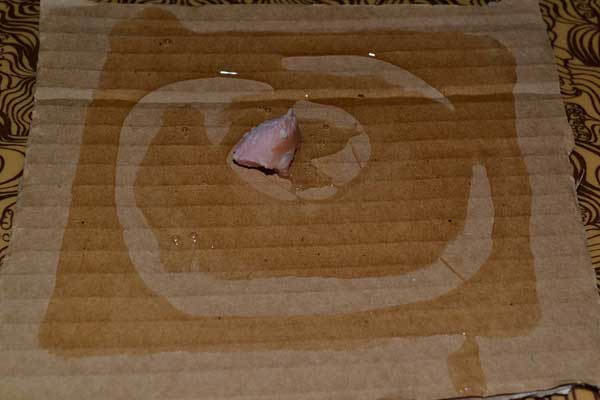
The trap is made with glue specifically designed for catching mice.
What is the best bait to use?
Contrary to popular belief, mice are not particularly attracted to cheese. Given a choice, they will most likely choose other favorite products.
Table: TOP 10 treats for mice
| Smoked lard | A very small piece is enough, because you don’t need to feed the rodent, but rather catch it. |
| Sunflower oil | It is best to use unrefined oil, which is more aromatic. |
| White bread | To enhance the effect, you can drop a little sunflower oil onto the piece. |
| Roasted seeds, especially pumpkin seeds | Three or four seeds are enough to attract rodents. It's best to peel them for a stronger scent. Mice generally enjoy almost all types of seeds and nuts, but some are more attractive to rodents than others. Pumpkin seeds fall into the first category. |
| Peanut | It's also best to use it fried. A couple of pieces is enough. |
| Smoked sausage | A small piece can drive a mouse crazy and make it forget its caution. The best results are achieved with a product prepared naturally, without the use of dyes, preservatives, or flavor enhancers. |
| Cold smoked fish | Smoked fish is a magnet for many animals, including mice. It's important to remember that the product must be fresh and natural. |
| Cookie | You can use flavored ones, for example, with vanilla scent. |
| Salted bacon with garlic | Salted lard itself attracts mice, and the aroma of garlic enhances the effect. |
Reviews
We were catching a mouse in a felt boot once, but we saw it while we were doing it, so we put the boot in its path, and it hid in it like a hole. Then we closed the boot and carried the mouse outside, releasing it at a construction site.
We were also catching mice at work once. One got caught with glue... We cried over it for an hour afterwards.
Plastic mousetraps are very simple and safe for humans. They're small, trap-shaped boxes. The halves are held together by a spring, and inside is a tongue with spikes to which a piece of bread is attached. You press the bread into the tongue, the mouse touches the tongue, and that's it. It won't escape, no matter how hard you try.
Our cat didn't catch mice at all (we lived in a private wooden house in the countryside). We used to put him in the basement, and he'd sleep there, with mice running all over him! Then we stopped feeding him, and he caught all the mice and piled them up near the porch.
A mousetrap is best. Use chocolate or nut butter as bait. Don't touch the trap with bare hands when setting it—wear gloves. If the mouse smells human scent, a fig will do.
There are many and varied methods for controlling mice in a private home or apartment. The most effective are setting traps, pitfalls, and repellents. Homemade mousetraps are just as effective, and sometimes even better, than store-bought ones. Don't forget about cats, natural-born mouse hunters.