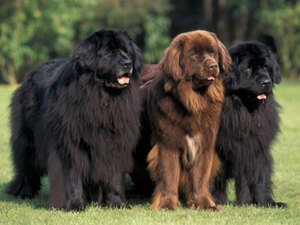
 The Newfoundland is a giant-sized dog breed. It makes an excellent assistant and rescue dog. It loves to swim and is very fond of water. It has unique abilities, being highly sensitive to human fear, and is therefore widely used to rescue drowning people. It can retrieve game for its owner, become an excellent companion and friend for all family members, and is also a loyal and devoted companion for fishermen.
Legends have even been told about the breed's origins. One of them says that God, admiring the world he had created, suddenly noticed a storm-battered island inhabited by a small fishing tribe. The people were constantly and arduously struggling with the forces of nature, struggling to survive. God felt sorry for these unfortunates and began to ponder how to help them and ease their suffering. He searched among all the living creatures he had created for a suitable animal, but finding none, he decided to create one.
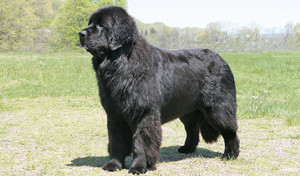 God took the body of the master of the forest—the bear, whose strong bones could bear a heavy load, and whose thick hide would protect it from any cold. He complemented the heavy body with the sleekness of a seal, so that the creature could move swiftly through the water like dolphins. God labored long over the creation of this new animal until he achieved its perfection.
In the end it worked out an amazing creature with a very gentle character, a strong and powerful body, kind eyes and shiny furThe animal was called upon to become a loyal friend to man, to live alongside him and to be ready to defend him at any moment.
To this end, the Lord placed a dog's heart into the animal's chest, and lo and behold (!) a Newfoundland appeared before the Almighty's gaze. He presented it as a gift to the people, promising that it would be a reliable helper and friend who would always help in difficult times.
Content
History and description of the breed
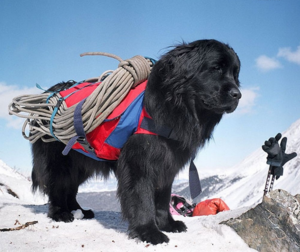 It's difficult to pinpoint exactly when this dog breed originated. However, it is known for certain that the birthplace of these giants is the island of the same name, with its constant Arctic winds and cold winters.
According to numerous sources, the Newf's ancestors were hunting dogs used to hunt bears, and they arrived in America with the Vikings. It is also mentioned here the black dog Olum, whose owner was the Viking Leif Eriksson.
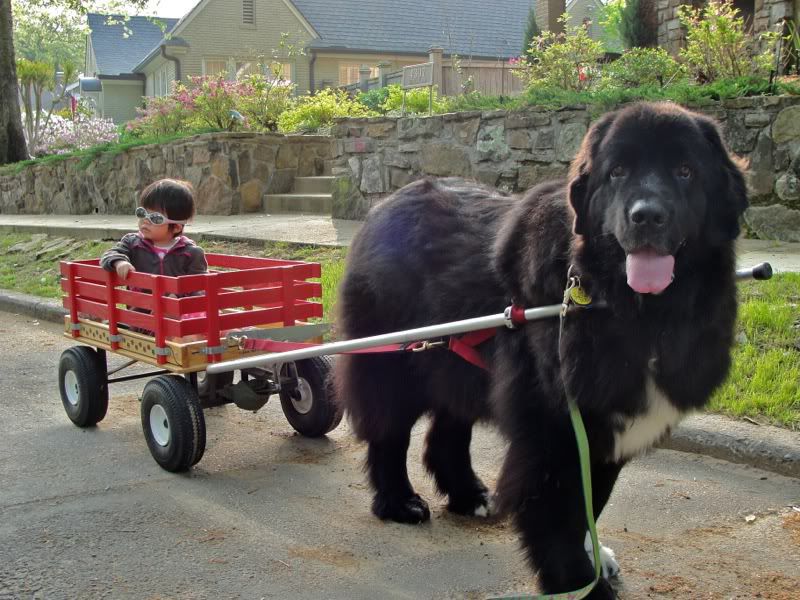
According to another theory, the ancestor of all guard dogs—the Tibetan Mastiff—came to the country with the ancestors of the American Indians. Therefore, the Newfoundland's ancestor could be the large black dog of the Apache Indian tribe. The dog helped them with fishing and hunting, babysitting children, guarding territory, and pulling wagons with heavy loads.
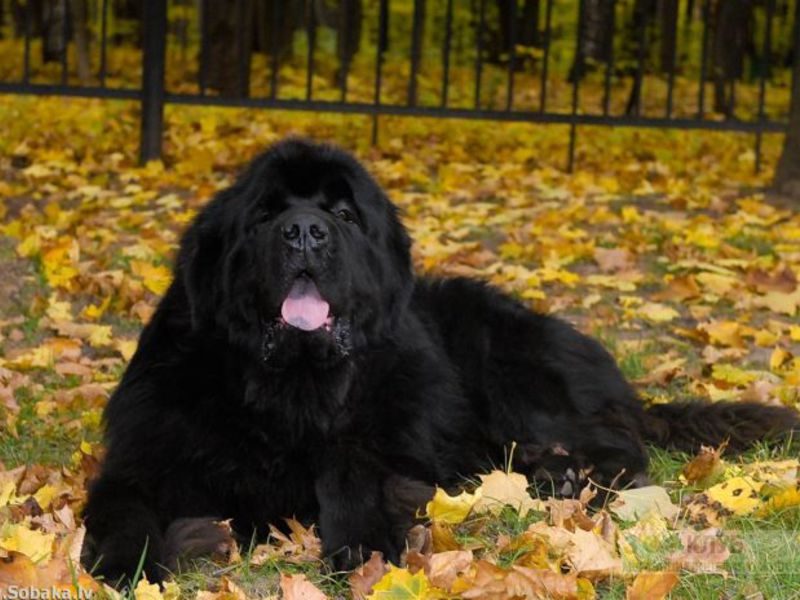
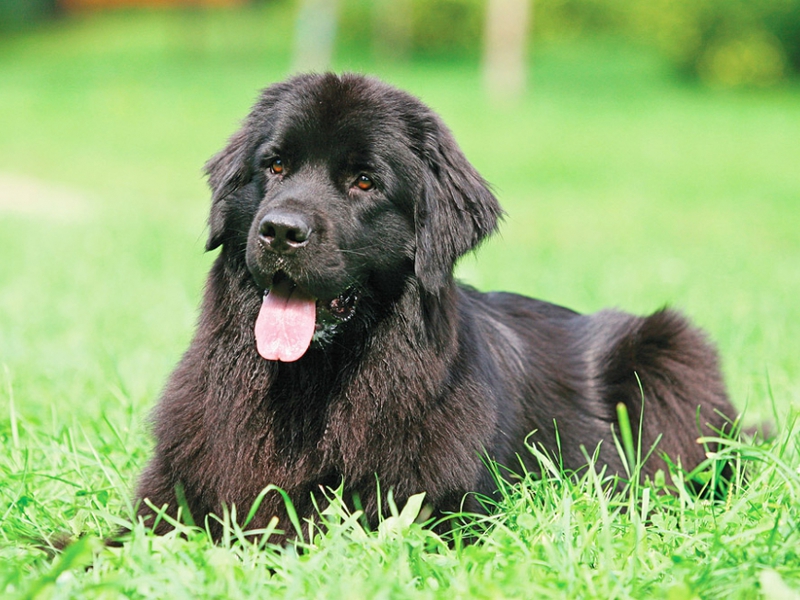
Newfoundland's structural features
Head Quite massive with a wide skull. The occipital protuberance is well developed.
Frame Muscular, powerful, compact, strong, and deep. Body movements are well coordinated. The distance from the ground to the withers should correspond to the length of the body from the withers to the tail. A male's body may be more massive and less elongated than a female's.
Dorsal line From the withers to the croup, strong and straight.
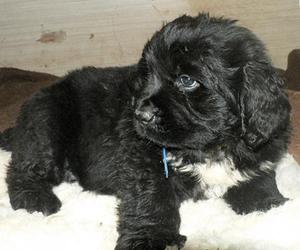 Mouth tightly covered by teeth, soft.
Muzzle Short, deep, and square in proportion to the head. Covered with fine hair. The lips are clearly defined and well defined. There are no folds.
Bite straight or scissor-shaped. The teeth are located at right angles to the jaw.
Nose Wide, large, with well-developed nostrils. The nose color is determined by the coat color: in brown individuals it is brown, while in black-and-white and black individuals it is black.
Cheeks soft.
Eyes Widely spaced and deep. Their color is also determined by the animal's coat and can be light or dark brown. The eyelids are not drooping.
Ears small, triangular in shape, with rounded tips.
Breast wide, low, rounded. The ribs are curved.
Cereals wide, with an angle of inclination of approximately 30°.
Small of the back muscular, short.
Back straight, wide.
Elbows are located low and fit tightly to the body.
Shoulders powerful ones are directed backwards at an angle of 45°.
Limbs The toes are round and large. The toes are wide apart, strong, and have well-developed webbing. The claws are light or black. The hind legs are close together, strong, and sturdy; the front legs are parallel and straight.
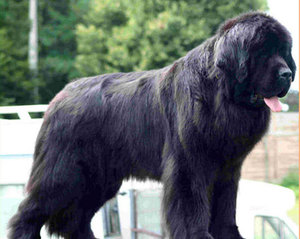 GaitWhen moving, the dog sways a little.
Tail The tail is wide at the base and strong, medium in size. It serves as a rudder for the dog when swimming. When at rest, the animal's tail is slightly curved at the end and hangs down. When the Newfoundland is excited or in motion, the tail is raised and tensely extended.
Wool The coat is thick, smooth, and water-repellent, with an undercoat. The outer coat is straight, fairly long, and free of curls, and abundantly oiled. The undercoat is thick and soft. The hair on the ears, muzzle, and head is short. The forelimbs have fringe. The tail is well-furred.
The color can be of the following shades:
- Silver;
- brown (bronze or chocolate);
- black and white;
- black.
Newfoundland character
Newfies are renowned for their incredible patience, intelligence, and kindness. Although they may look rather menacing, they are actually peaceful creatures with no aggressive tendencies. The Newfies are excellent family dogs, adoring children and devoted to their owners. They also get along well with other pets, including other dogs and cats.
Newfoundlands are very sensitive and have a hard time dealing with separation from their furry friends and family membersHowever, provided the dog is not deprived of attention the rest of the time, he can easily be left home alone for a short period.
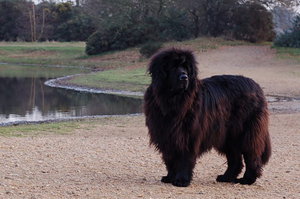 Newfies are very intelligent and easy to train. They always try to please their owner and anticipate their next command and desire. With such a sensitive nature, dogs of this breed do not tolerate rough handling, yelling, and especially physical force. When training your dog, try to remain calm and be gentle with your pet.
A patient water dog will make a great babysitter for your child and will happily participate in children's games while keeping an eye on their safety. Dogs of this breed are excellent swimmers and travelers.
Newfoundlands, like all dog breeds, require prompt socialization; otherwise, they may become aggressive toward guests and strangers and may develop a withdrawn personality. If you're unsure of your training skills, it's recommended to enroll your puppy in a specialized dog training class.
Like puppies of other breeds, Water Dogs love active play; however, due to their size, they can accidentally damage their owner's property, such as home furnishings and decor. This circumstance further confirms that Newfoundland puppies require early training and socialization, and, of course, special attention.
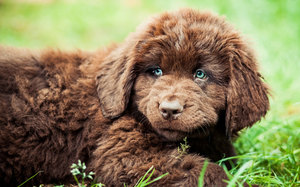 Dog training you need to start from the moment the baby appears in the houseAt this age, dogs are highly trainable and completely controllable. Water exercises should be performed under strict supervision, and it's best to seek professional help for this purpose.
If you keep a Newfoundland outside, be sure to provide a secure fence. However, this doesn't mean your pet should be confined to a crate all the time, as they need constant attention and interaction.
Remember! During the first two years of life, a diver especially needs regular physical activity. However, it shouldn't be strenuous, as the dog's skeleton is still developing, and excessive exercise will negatively impact the development of the musculoskeletal system and spine. In this case, walks in the fresh air and swimming lessons will suffice.
Newfoundland Care and Nutrition
Their large size and heavy body weight are perhaps the breed's only drawback, as a dog of this size requires space, which is quite difficult to provide in a small apartment. They are ideal for a country house, preferably with a small plot of land. Unlike other breeds, they don't require constant exercise and thrive on the sofa. However, if your pet decides to stretch their legs, don't interfere.
Newfoundland Care Guidelines
Caring for a pet of this breed The following rules must be observed:
- An animal of this size doesn't tolerate direct sunlight well, so in hot summer weather, it's important to provide it with ample shade. A Newfoundland should also have constant access to water, or better yet, a large basin nearby, which it can use as a bath, thus cooling its body. This will help prevent heatstroke.
 The animal's thick coat requires regular brushing, especially during shedding season. During this time, it is recommended to brush every three days using a special metal comb.
- Newfoundland should be bathed as often as it gets dirty.
- Claws should be trimmed with a special claw clipper for large breeds approximately once a month.
- Ears should be regularly inspected for excess wax and odor. If the inside of the ear becomes dirty, wipe it with a damp cloth.
- The eyes also need to be examined regularly and, if necessary, wiped once a week with a clean cloth soaked in tea leaves.
- Every 18 to 21 days, Newfoundlands should be treated with a special antiparasitic agent (fleas, ticks). After each walk in the park or forest, carefully inspect the animal for ticks. If a tick is found, it should be carefully removed and the bite treated with iodine. Over the next two to three days, closely monitor the dog's condition, behavior, and body temperature. Failure to detect the parasite promptly can lead to serious consequences, including death.
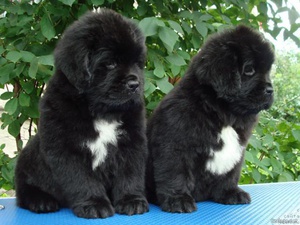 The animal's thick coat requires regular brushing, especially during shedding season. During this time, it is recommended to brush every three days using a special metal comb.
One of the most dangerous diseases caused by a tick bite is piroplasmosis.
Symptoms of the disease:
- A sharp jump in temperature (up to 40–41 °C);
- refusal to drink and eat;
- lethargy.
A timely visit to the doctor, accurate diagnosis of the disease, and immediate treatment give your dog a chance for recovery.
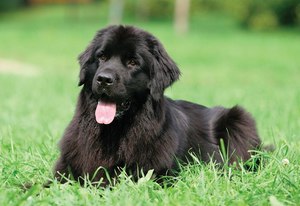 You can feed a Newfoundland natural food or high-quality dry food, at least twice a day. A specialist can advise you on the appropriate diet for your pet.
The Newfoundland dog breed evokes associations of extraordinary kindness, intelligence, strength, and power. It is a loyal friend and fearless rescuer. This dog's unique working abilities are complemented by a truly golden character. So, if you need a reliable and devoted companion, the Newfoundland is the breed for you.