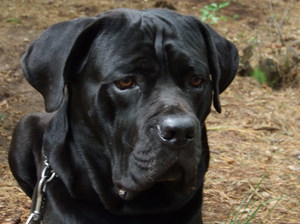
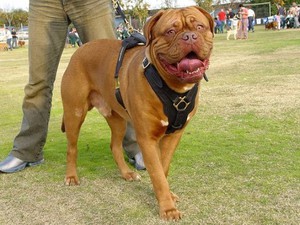
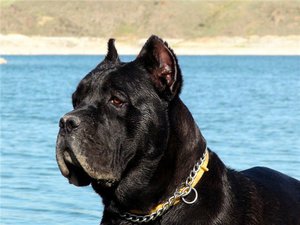
 A combination of primal strength and a strong character, love for their owner and a dislike of strangers—this is the character of the ancient Italian dog breed, the Cane Corso. These animals are the well-deserved pride of Italian dog breeders, and are among the most disciplined and obedient of the mastiff breeds.
History of the breed
The ancestors of modern Cane Corso are considered to be Molossian dogs, and their homeland - Ancient RomeAt that time, representatives of this breed not only served as guard dogs but were often used in military operations. These powerful creatures were also frequently used in gladiatorial arenas to fight against tigers, lions, and even humans.
Over time, the breed took hold and became very popular in rural areas. There, the dogs guarded property, herded livestock, and helped hunt bears. The widespread popularity of the versatile Cane Corso is evidenced by its frequent mention in folklore.
With the fall of the Roman Empire, the love for the breed also waned, so much so that it practically disappeared, mixing with other breeds. The reason was that it did not please the new aristocracy, who considered these huge creatures too “plebeian.”
Interest in the Cane Corso was revived by Italian researcher and dog enthusiast Paolo Breber. He initiated the creation of the first club, which greatly contributed to increasing the number and improving the quality of the dogs. Thanks to the efforts of the club's members, the Cane Corso was fully recognized by the Fédération Cynologique Internationale in the 1990s and spread throughout the world.
Appearance of Cane Corso dogs
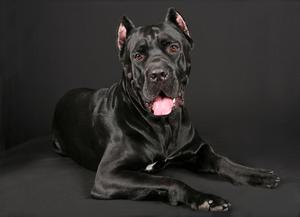
The Cane Corso is a large, long animal with well-defined muscles. The dog's body length exceeds its height at the withers. Here are the main External features of the breed:
 Height 60-68 cm, depending on the type.
- Weight – 40-50 kg.
- These animals have a broad skull and a massive head. The skull is longer than the muzzle in an approximate 2:1 ratio.
- The lips hang down and cover the lower jaw. The jaws are wide.
- The nose is black, with wide nostrils.
- The eyes are slightly protruding, oval, and dark. The standard allows for lighter eye colors, provided the eyes are light in color, but dark eye rims are mandatory.
- The ears are set high, triangular, and drooping. Some owners prefer to crop their dogs' ears to create a triangle shape.
- The dog's body is strong, with a muscular neck and a well-developed chest.
- The tail is fairly thick at the base and set high. It is usually docked after the fourth vertebra. When the dog is excited, the tail is raised slightly, but not curled or erect.
- The Cane Corso's legs are muscular and long, and its movements are sweeping.
- The coat is shiny, short, with virtually no undercoat.
- Coat color: black, red, brindle, fawn, and shades of gray. White markings on the paws and chest are possible.
 Height 60-68 cm, depending on the type.
Cane Corso character and training
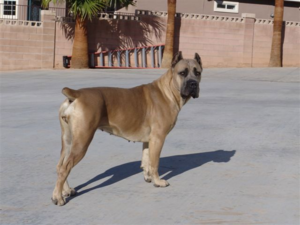 The very appearance of the Cane Corso breed is attractive to many inspires timidity and respectA large, strong body and a serious face—this is clearly not a dog that strangers will pester with cooing. And that's a good thing, because Corsos clearly differentiate their surroundings into "friends" and "strangers," and treat them accordingly.
These animals' devotion to their families is almost legendary. If they grow up in a large family from puppyhood, they will give their lives for every member. They can even be trained to be quite tolerant of other cats in the family.
Cane Corsos are very sensitive to children. Unlike many other dogs, they have a keen sense of their own strength and, therefore, can play with small children without any problems As much as necessary, without causing harm. The crying of a child it's entrusted to protect is the worst punishment for a dog, so it always behaves cautiously, doesn't rush to knock them down, and doesn't bite accidentally. But children should also be immediately explained that this is a living creature, not a stuffed animal.
The Cane Corso's primary role is as a protector and guardian. Their behavior toward strangers reflects this role. If the dog notices sudden movements or believes that strangers or dogs are encroaching on its territory or its owner, it can easily attack without waiting for a command. Its strength and high pain threshold leave the attacker virtually no chance.
To avoid such danger, the dog requires strict upbringing and training. The Cane Corso is smarter and more obedient than most mastiffs, and It's not difficult to train them at allThey love to follow commands and quickly learn them. In skilled and experienced hands, these animals will become well-balanced and obedient, but if left untrained, they can grow into aggressive monsters that will attack anyone they don't like.
There are several points to pay attention to when raising and training a Cane Corso:
- This breed has a very dominant personality. If a person doesn't immediately assume a dominant position, the dog will, becoming completely uncontrollable, and living with it will be downright dangerous.
- The hunting instinct of their ancestors is so strong that Cane Corsos should not be allowed to go for walks alone; there is a high risk of receiving a “gift” in the form of the carcass of a neighbor’s cat or another small animal.
Care and life with a Cane Corso
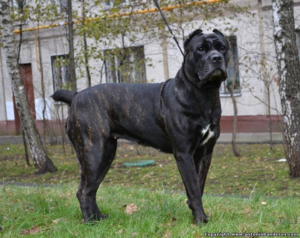 Grooming a dog of this breed, despite its impressive size, is not at all difficult, but there are a number of features that are best not neglected. The first thing you need to clearly determine is the location. where will the puppy liveCane Corsos are historically accustomed to living in a fenced-in country yard, and they consider any enclosed area their domain. If they're trained from puppyhood to run all over the apartment, they could run into trouble in the future with guests and repairmen, whom they'll jealously guard.
If the owners live in a private home, the animal can be kept in the yard, in a pen, or in a kennel. However, this is only possible in areas with a mild climate. Frosty winters can be very harmful to the heat-loving Italians.
Grooming – another important point. In principle, this isn't difficult at all. The dog sheds little, and occasional brushing with a stiff brush is sufficient. Also, regularly treat for fleas and ticks, as the lack of an undercoat can cause a lot of trouble for your pet.
Ears, especially cropped ones, are cleaned regularly with a special solution. They are bathed 3-4 times a year.
A dog needs a varied diet, including vegetables, dairy products, and grains. Naturally, this guard dog's favorite food is meat. They can even eat it raw, and this won't be a problem if they are regularly treated for parasites.
Heavy and regular physical activity – is a key element of an animal's physical and psychological health. Having had their fill of running, this breed will be calmer and less likely to damage furniture or hunt other pets. However, there's one important point: immediately after eating, the dog should not be forced to move, as this can cause a volvulus. This volvulus must be removed immediately, at a veterinary clinic, otherwise the animal may die.
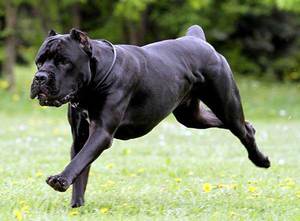 Many people wonder how long this breed typically lives, as large dogs often have weak immune systems. Cane Corso lifespan about 11 yearsThis is one of the healthiest large dog breeds. And with proper care, its lifespan can even be extended.
Despite its easy care, health, and naturally balanced nature, the Cane Corso is not a dog for beginners. Its strong, dominant nature requires regular training and discipline, which only experienced dog owners can master. The result of all this effort will be a powerful, intelligent dog and a most devoted companion. However, if the owner shows laziness or weakness, they will be forced to live side by side with an aggressive and unstable animal that doesn't respect any authority, and how many people and animals will suffer!