A new pet in the family is always a joy, and a purebred dog is now considered a source of special pride for owners. A pet often makes an excellent guard dog, and its protective qualities can also be useful in the workplace. But before bringing a dog into your home, you should thoroughly research the breed's history, personality traits, trainability, and, importantly, inquire about its relationship with children and other pets. The Beauceron French Shepherd is an excellent choice for those who value endurance, firmness, and devotion to their owner in a four-legged companion.
Content
History of the Beauceron breed
The Beauceron is a purebred French shepherd dog that has never been crossed with other breeds throughout its existence. The exact origin of this dog cannot be determined today, but many experts are inclined to believe that its ancestor is the French peat dog. Others argue that the Beauceron breed originated from wild wolves and acquired its modern characteristics through the process of evolution.
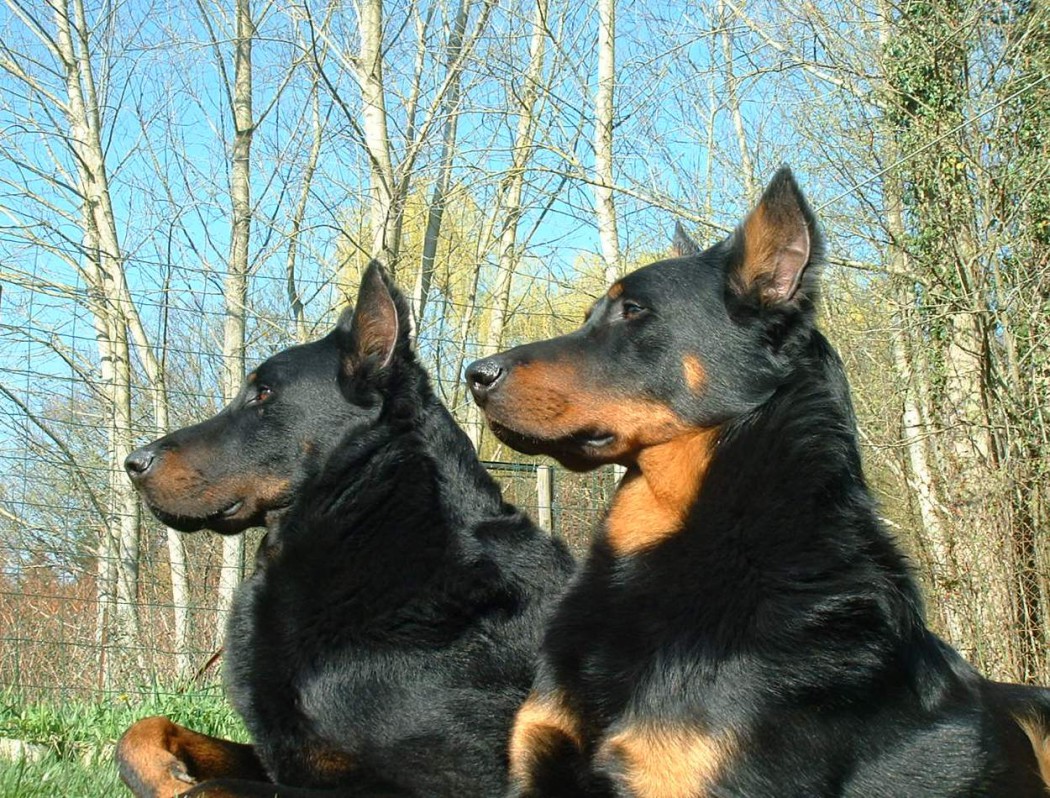
French Beauceron Shepherds have never been crossed with other breeds, so they are a purebred dog breed.
However, the first mention of the dog dates back to 1578. Later, in the 18th-19th centuries, when French agriculture was experiencing a boom in sheep farming, the Beauceron gained popularity as an excellent guard dog.
Two dogs could guard a flock of 200–300 sheep. Their endurance allowed them to accompany the flock all day, covering distances of 70–80 km. In his book on army dogs, the French professor of zoology and veterinarian Jean-Pierre Menin first nicknamed this breed "Beauce shepherds" (from the French "berger de Beauce," the region of Beauce in France where the breed originated) for its guarding role.
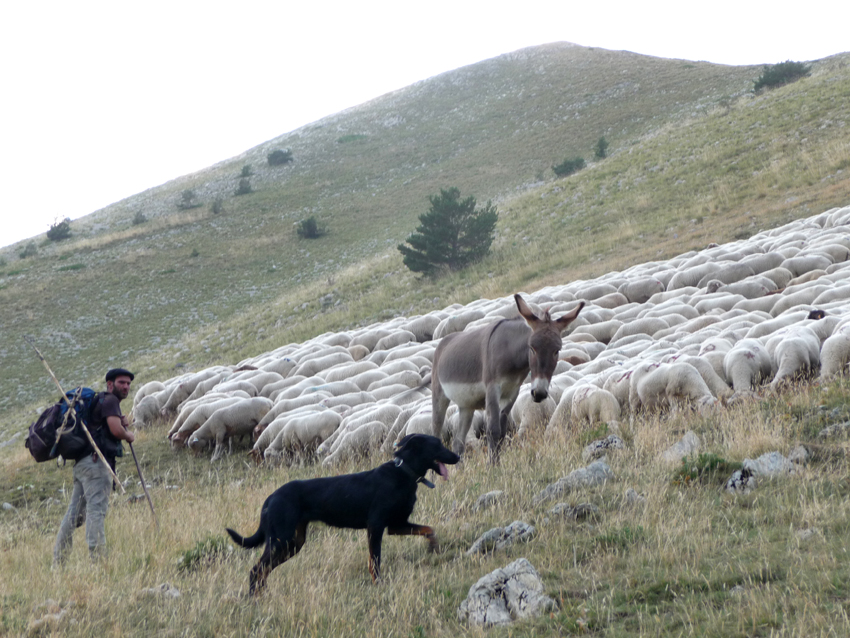
The Beauceron is a guard breed capable of protecting flocks of several hundred sheep.
In 1863, the first dog show was held in Paris. A previously unknown dog, the Beauceron, was on display, and of rural origin. Despite its proud posture and stern, direct gaze, this breed failed to attract the attention of showgoers, which is unsurprising: miniature dogs or hunting hounds were far more popular at the time. However, the "Beauceron" was finally officially recognized in 1863. Their other name, still retained in some places today—"little red stockings" (French: bas rouge), derived from the reddish-brown coloring of the undersides of their legs—was more memorable at the time.
In 1896, the already familiar to us Jean-Pierre Menin, the farmer and owner of shepherd dogs Emmanuel Boulet and the French Minister of Agriculture Ernest Menin met in the village of Villette to establish the standards of the Bosco shepherd breed. Then the main division of one breed into two was made: long-haired shepherd dogs began to be called Briard shepherds (berger de Brie - Brie shepherd, where Brie is a region in France), and the smooth-haired ones were finally given the name Beauceron.
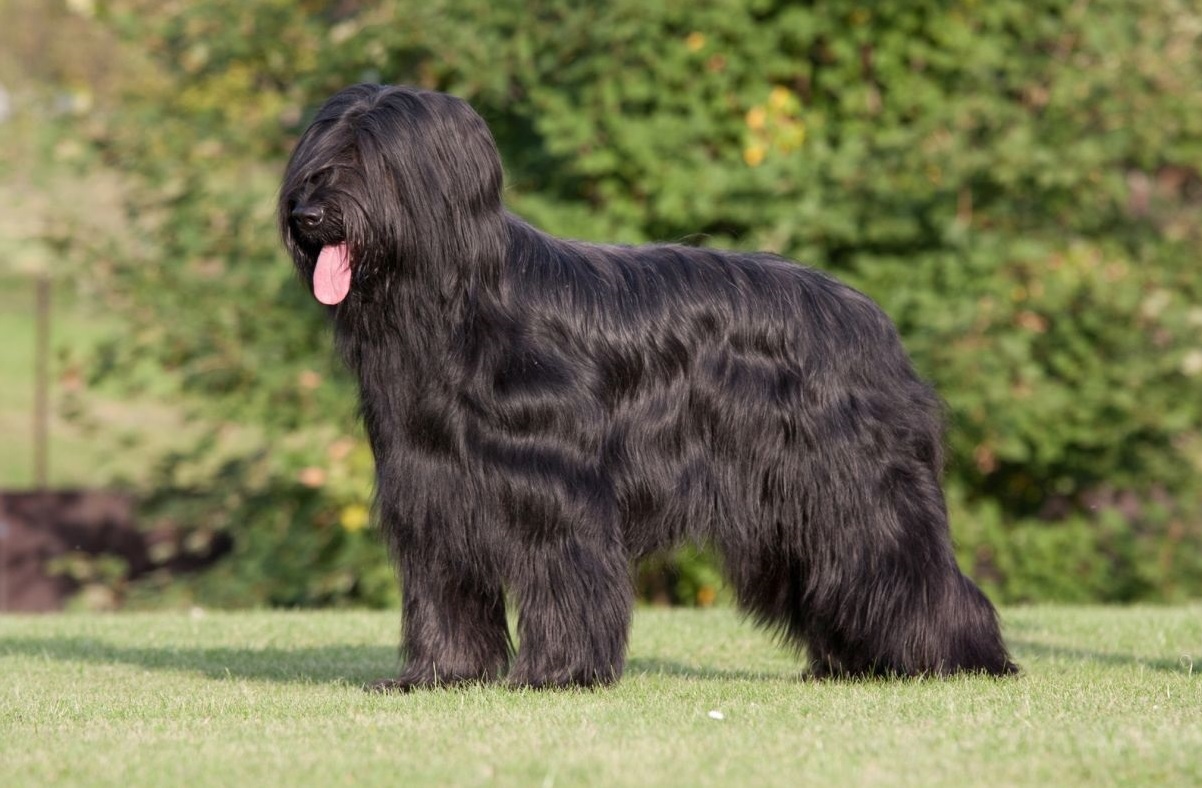
The French Briard is a long-haired version of the Beauceron.
Later, the French Shepherd Club was formed in France, and in 1911, Jean-Pierre Menin founded the French Club of Friends of the Beauceron (Club les Amis du Beauceron), which was dedicated to maintaining the breed's characteristics and promoting it among dog lovers. However, over time, sheep farming ceased to be a popular branch of agriculture, and the Beauceron's primary occupation began to disappear. Concerned about preserving the breed, the Club of Friends of the Beauceron began promoting these shepherds as guard dogs, protecting homes and people.
During World War II, French Shepherds were frequently used by the military to relay information, detect mines, and track saboteurs. Afterward, only 50 of these dogs remained in the world. However, thanks to breeders, the breed's popularity began to grow in the second half of the last century, and today they are widely used as companions, service dogs, military dogs, and, as before, guard dogs. There are now over 7,000 of them worldwide.
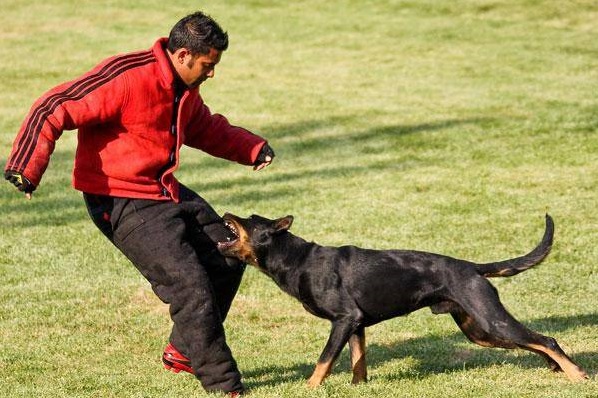
The Beauceron is a breed that excels at being a guard dog and companion, capable of protecting the home and family members from attack by intruders.
It wasn't until the early 2000s that Beaucerons first appeared outside of France. In 2003, the Beauceron Club of America was founded in the United States. However, unfortunately, the breed never gained widespread popularity overseas.
Characteristics of breed standards
In the century since the registration of the Club of Friends of the Beauceron in France, the main characteristics of the breed have been re-evaluated only six times. The last amendment was made in 2001, so the appearance of the Shepherd Dog has remained virtually unchanged since its first mention in the 16th century. The main difference in the standards was that ear cropping was previously considered necessary, whereas today most veterinarians recommend abandoning this procedure, as it serves no purpose.
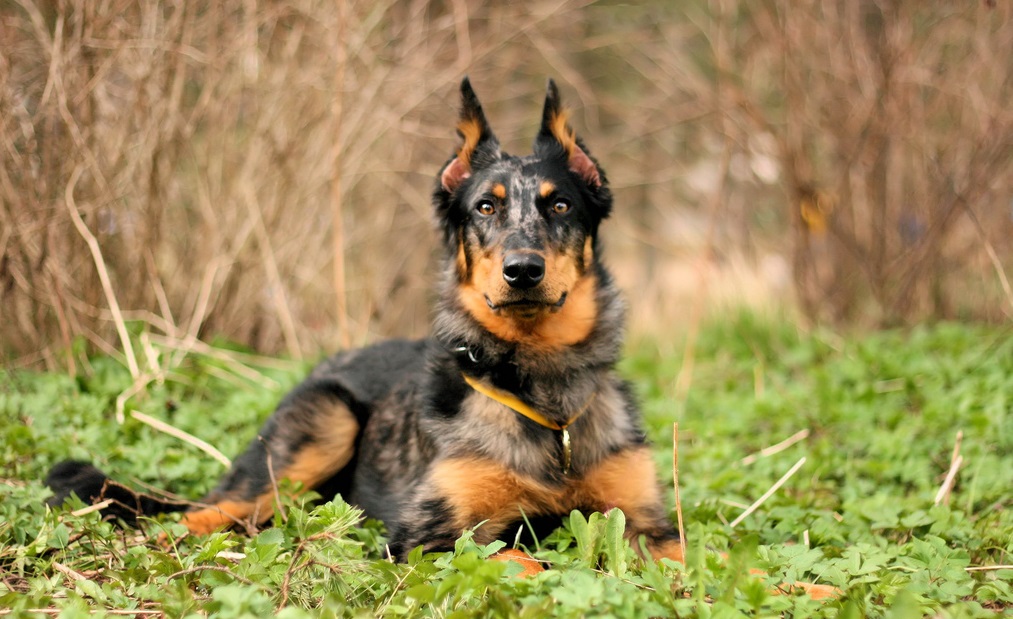
While ear cropping was once considered necessary in the Beauceron breed, today it is quite rare to see a French Shepherd with cropped ears.
Ear cropping in fighting and hunting breeds was once done to make this part of the body less susceptible to wounds and lacerations during fights with other dogs and wild animals. Today, this procedure is no longer necessary unless the owner wishes to make the dog appear more aggressive and aristocratic.
The Beauceron breed is reminiscent of the Doberman, but these dogs are slightly larger in stature, have more fur, and appear more gentle. Many believe that French herding dogs were used in the development of the Doberman breed.
Table: Basic standards of the Beauceron breed, approved in 2001
| Characteristic | Description |
| Appearance | A large dog with well-developed muscles, a direct, bold look, strong and hardy. |
| Dimensions | Males – 65–70 cm at the withers, females – 61–68 cm. |
| Weight | The weight of an adult male is 40–50 kg, a female weighs from 36 to 40 kg. |
| Behavior | Calm, bold, open. |
| Wool | The hair on the body is short (3–4 cm), longer and thicker on the inner thighs, tail, and neck, thick and hard to the touch, and smooth on the head. The undercoat is dense, thick, soft, fluffy, short, and dark gray. |
| Eyes | Oval, horizontally set. The iris is brown, even if the tan markings are light. Heterochromia is permitted only in harlequin coats. The expression is intelligent. |
| Teeth | White, healthy, strong. Scissor bite. |
| Head | Elongated, its dimensions are 0.4 times the dog's length at the withers. The transition from the forehead to the muzzle is smooth and sloping. The muzzle is elongated, but not narrowed or pointed. The hump at the back of the head is clearly visible. The nose is black, without a cleft. |
| Ears | Not erect, but not too drooping, and should not be pressed against the cheeks. The length of the ears is equal to half the length of the head. |
| Neck | Thick, strong, flowing smoothly into the shoulders. |
| Frame | The chest is long and broad, reaching to the elbow. The back is level, the croup is slightly sloping. The length of the body slightly exceeds the height at the withers. |
| Tail | Thick, long, reaching to the hocks. Often shaped like the letter "J." When at rest, it hangs low, but when moving, it can rise horizontally to the level of the back. |
| Paws | The forearms and thighs are large and muscular. The paws are strong and rounded, the toes are tight, and the nails are black. The hind legs have dewclaws (a characteristic feature of the breed) that are clearly separated from each other. The closer they are to the main toes, the better. The hind legs are straight, turning slightly inward. |
| Color | A solid black, glossy coat with tan markings on the chest, inside the tail, thighs, and paws. The harlequin pattern features black coats interspersed with marbled gray, with tan markings in the same places as the black and tan Beauceron. The markings are clearly distinguishable. |
A true professional can always determine how accurately a dog matches its breed. Any deviations are considered a fault, and such pets are not suitable for show. Breed faults include:
- excessive inward rotation of the hind limbs;
- light eyes (lighter than dark hazel) and heterochromia in black and red Beaucerons;
- cleft nose;
- ears that are too erect;
- non-standard color (for example, when there is more marbled gray than black);
- non-specific behavior (shyness, excessive aggression).
Photo gallery: the main external characteristics of the Beauceron breed
-
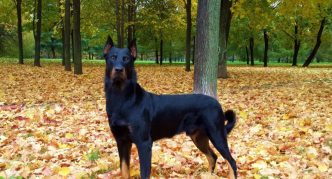
- The croup of the Beauceron is slightly sloping.
-
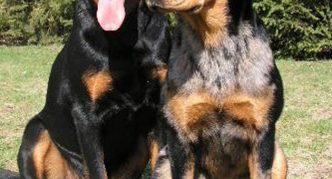
- The dogs' coat can be either black and red (black with tan markings) or harlequin-type - black and gray (sometimes marbled) with red markings.
-
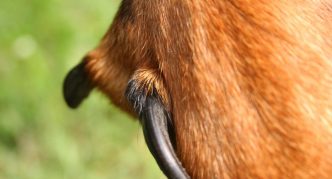
- Double dewclaws on the paws are a characteristic feature of the Beauceron
-
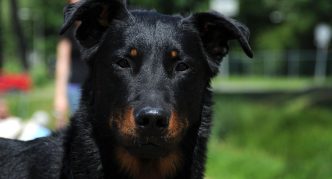
- The Beauceron's gaze is always direct, open and very intelligent.
-
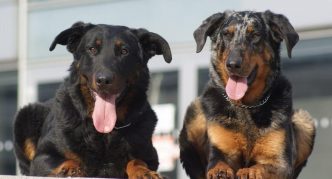
- The ears of Beauceron dogs should be semi-erect or hanging.
-
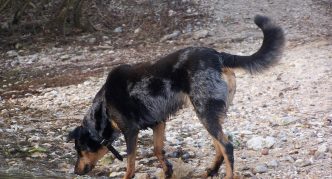
- When the dog is at rest, its tail is usually lowered; when moving, it can rise horizontally to the level of the croup.
Beauceron character
Beaucerons are quite proud and willful, it is difficult to make them do something if they do not want to, but with proper training their character becomes more flexible. These dogs are always loyal to their owners and the family in which they were raised, but the servility often seen in mongrels is not their characteristic trait. Beaucerons are even-tempered and not hysterical. They are quite sociable dogs, capable of companionship. However, it's important to remember their origins and historical occupation—guarding dogs required them to nip sheep to direct them in the right direction. Without training, these innate instincts can negatively impact their attitude toward people. Furthermore, Beaucerons possess leadership qualities, and if they don't prioritize their dog from the start, this can backfire on their owner.
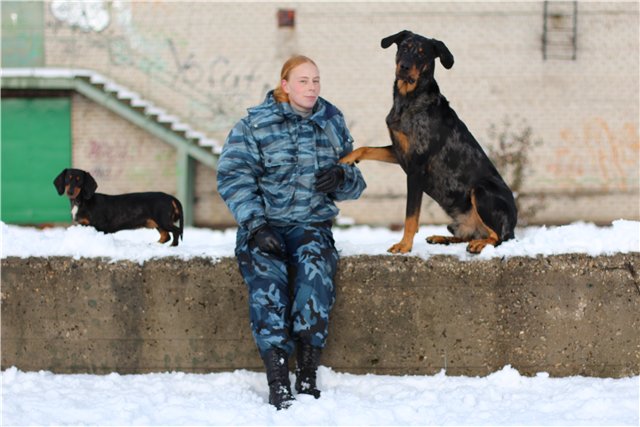
Beaucerons are good companions and also excel in military service and guard duties.
These dogs are highly intelligent but cautious and always wary of strangers. If a person, especially someone they're meeting for the first time, shows aggression, they may pay a price. Beaucerons do not tolerate cruelty.
The French Shepherd loves children, but again, it's important to remember their innate instincts. Introducing a child to the dog should be gradual, so their friendship will be strong. However, it's better to introduce a Beauceron puppy to children rather than an adult one. The puppy should also be taught to always treat the dog with caution, not to pull its fur, and not to hit. It's best not to leave a small child alone with the dog.
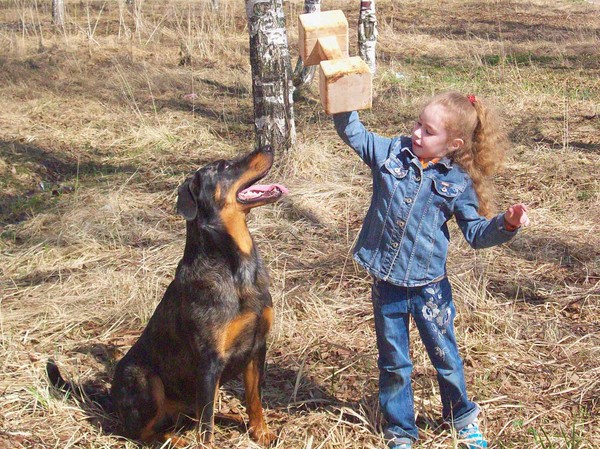
Beaucerons get along well with children, but it is better not to leave the dog alone with very young children.
The Beauceron is a very energetic and active breed. Lack of training, a favorite activity - running on rough terrain, the required number of walks - can make a dog disobedient and aggressive. Only the release of energy makes this shepherd a devoted dog.
Video: Beauceron Breed Characteristics
How to choose a puppy
If you're looking for a purebred pet, it's best to choose a puppy. Firstly, the dog will get used to its owners more quickly, and secondly, if you have small children in the house, it'll be easier to acclimate your four-legged friend to the presence of a small person, and there's a better chance they'll become great friends.
Before choosing a Beauceron puppy, you need to decide exactly whether this breed is right for you.
The French Shepherd is a fairly large dog. However, she doesn't belong outside - a regular kennel won't do for a Beauceron mongrel. Your house or apartment should have enough space for this pet. The dog's size also determines how much it will eat (keep in mind that cheap food will be very detrimental to your pet's health, so supplementing with meat and other natural foods is essential). Additionally, your dog should be given vitamins and minerals regularly. You'll also need to invest in veterinary care, a bed, a collar and muzzle, bowls and water bottles, toys, and even clothing.
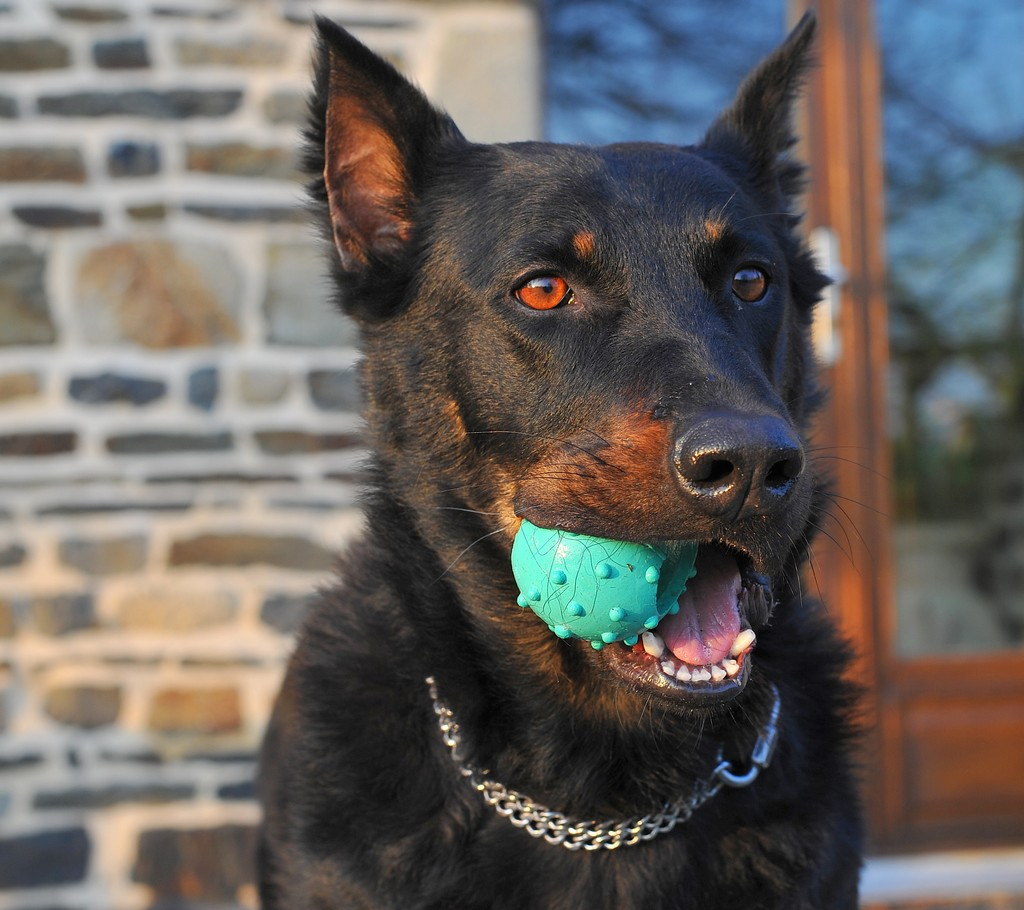
If you are planning to buy a Beauceron puppy, remember that you will also need to buy toys, collars, change the water bottle and bedding: the costs will be multiple.
If the owners are often away from home, it's important to check with friends in advance if they'd be willing to take in a large dog. Unfortunately, such people are few and far between, so it's often necessary to resort to boarding or a special dog boarding facility.
It is important to know that a Beauceron will not grow and be trained on its own: this dog constantly requires training and walking, and it requires a lot of time. In addition, the French Shepherd may not get along with an insecure or overly cruel person.
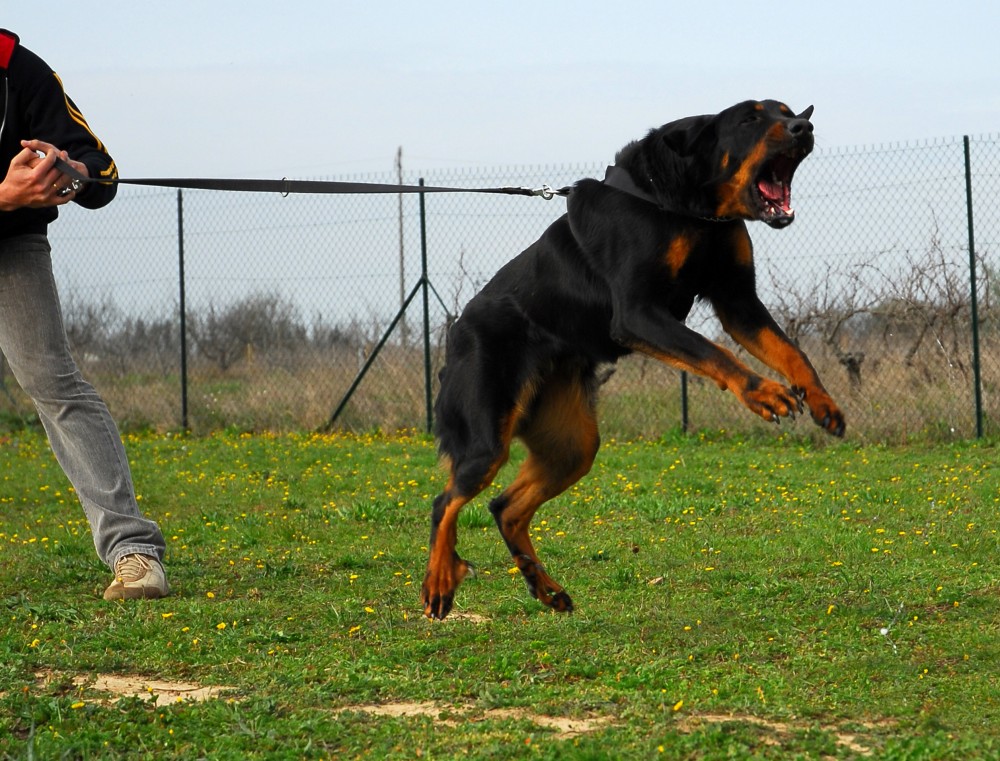
The Beauceron will always need frequent walks and constant training, so expect that a lot of your free time will be spent on training the dog.
If you have finally decided that you need a dog of this particular breed, and you have all the conditions for keeping it, decide what purpose it will serve: companionship and home protection (pet class), breeding (breed class), or participation in exhibitions and competitions for the continuation of the lineage (show class). In the first case, a Beauceron puppy that doesn't meet all the breed requirements (has flaws) would be suitable. Breed-class puppies must meet the Beauceron breed criteria, but their external characteristics may not allow them to compete in shows. Show-class dogs must look impeccable, not to mention conform to the breed's characteristics. They often become champions, and puppies of such pets are very expensive.
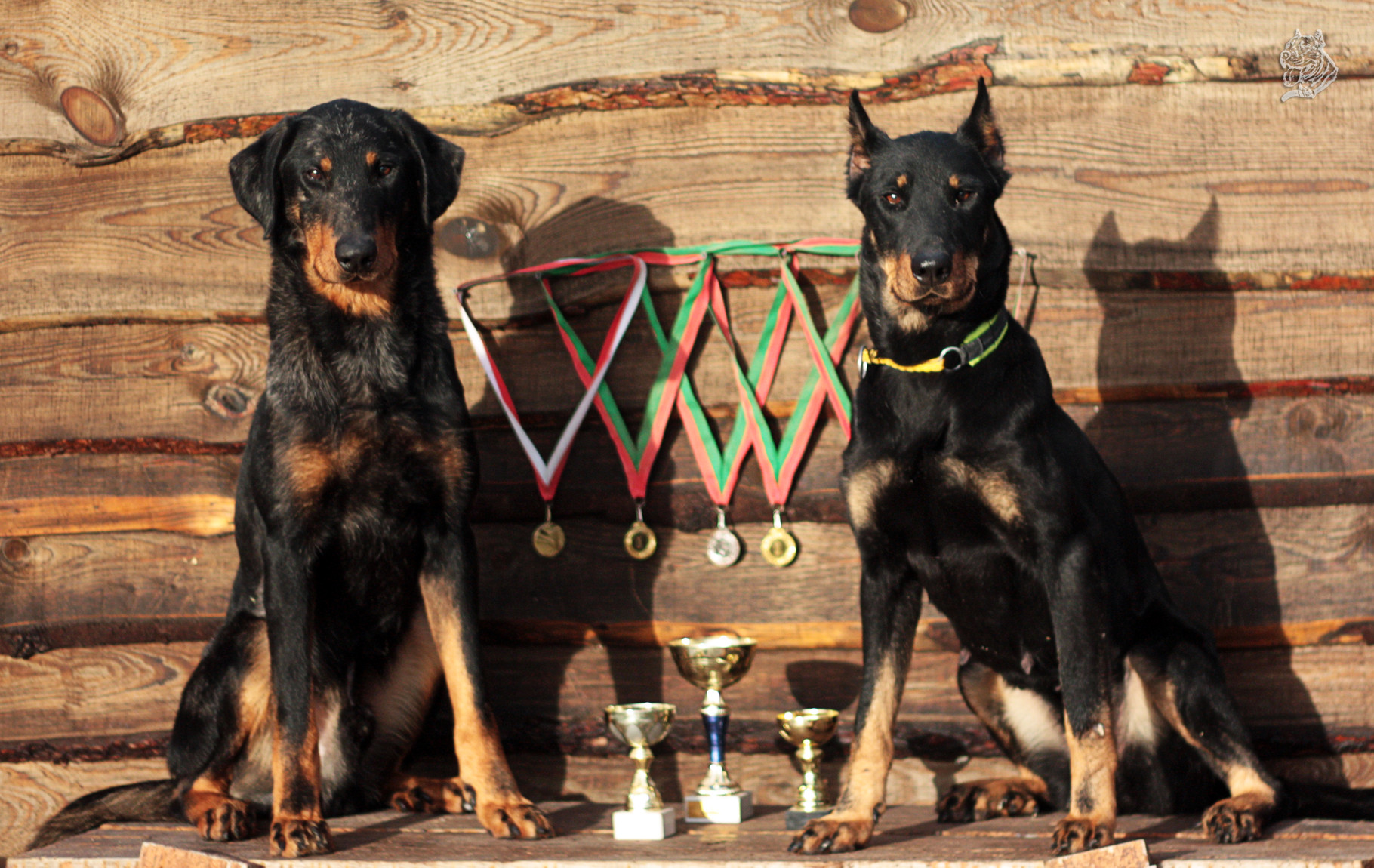
The most expensive Beauceron puppies are those that belong to the show class: in the future, they will win many competitions and conquer dog shows.
Decide for yourself what gender you want. It's important to remember that males are more valuable at shows. They don't go into heat and will never produce offspring. At the same time, there is an opinion that males are harder to train, they are more aggressive, and in search of a female, they can run far from home if they are not properly supervised. Beauceron females are more devoted to humans, bond more quickly, are easily trained, and are easier to handle. However, females often go into heat, and they can also produce offspring, which can be a headache for some owners. Beauceron females are inferior to males at various dog shows.
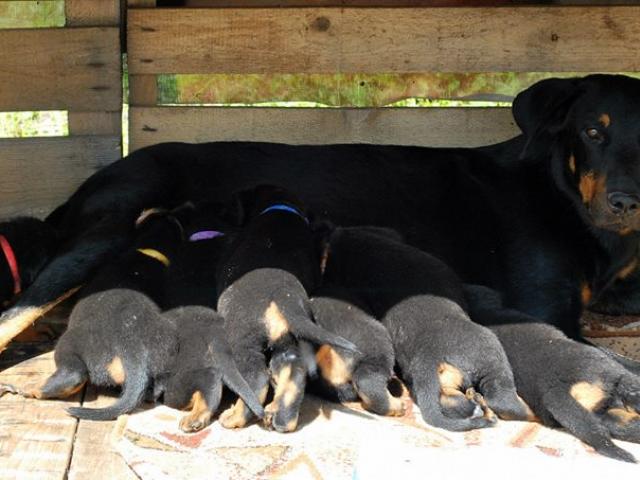
When choosing a Beauceron puppy, consider whether it is worth getting a female: although they are more loyal and trainable, frequent heats and litters can become a headache for you.
Next, decide on a kennel where you'll get your dog. Ideally, they should specialize in this breed and have exceptionally good reviews. Ask the breeder in detail about the puppy's parents, the presence of genetic diseases, vaccinations, how often and what exactly the puppy eats.
A good breeder will be happy to answer your questions. Their irritation is not a good sign; try choosing other breeders. It would be a good idea to talk to other Beauceron owners.
Carefully study the puppy's pedigree, and it's a good idea to meet its parents and their grown puppies from another litter. Clarify the relationship between the female and male: close inbreeding can negatively impact genetics. Inspect the area where the puppy is growing: it should be clean, the floor should be hard and non-slip. An unpleasant odor in the room is a bad sign: either the room isn't cleaned properly, or one of the dogs is sick. The water bowl, food dish, and sleeping area should also be kept clean. Puppies should have enough space to roam freely.
Get to know the puppy: he should be playful, active, and open to communication. A healthy puppy's nose, eyes, and ears are always clean. A small Beauceron's body is ideally firm, but its belly is not bloated (which could indicate illness), and the puppy has a good appetite.
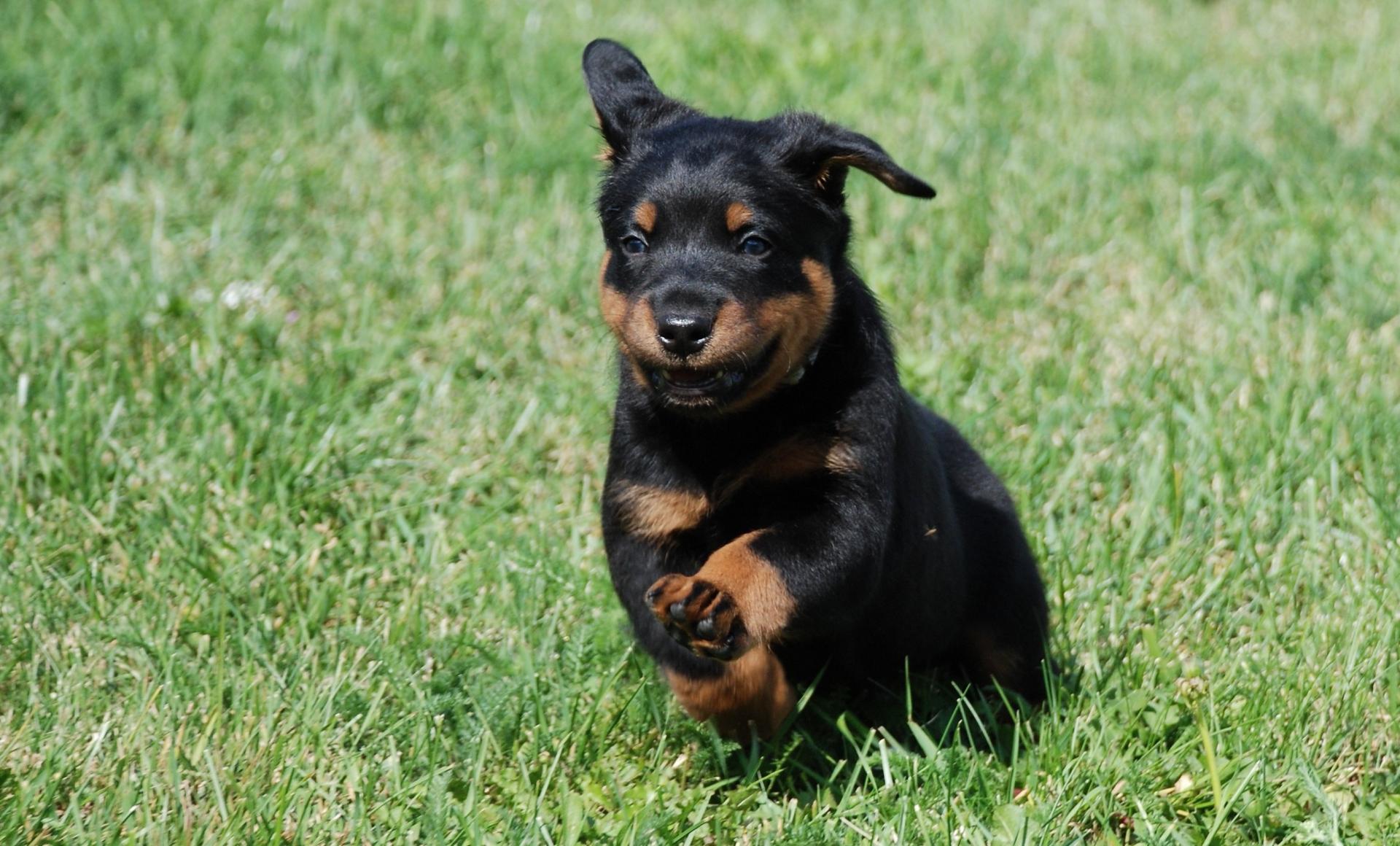
When choosing a puppy, observe it: the dog should be playful and healthy in appearance.
Ask the breeder about the puppy's personality. A good kennel owner will definitely know these key characteristics. Observe how the little Beauceron interacts with its siblings—this can reveal a lot about its personality.
It's best to get a puppy between 2 and 6 months of age, no younger or older: this is the age when it will be easiest for it to adapt to people, especially children.
To assess a puppy's courage, you can throw something on the floor: the loud sound will cause timid puppies to run away, while the brave ones will approach the fallen object with interest. Fearlessness is a trait of true Beaucerons. Otherwise, a puppy should be chosen according to the established breed standards described above.
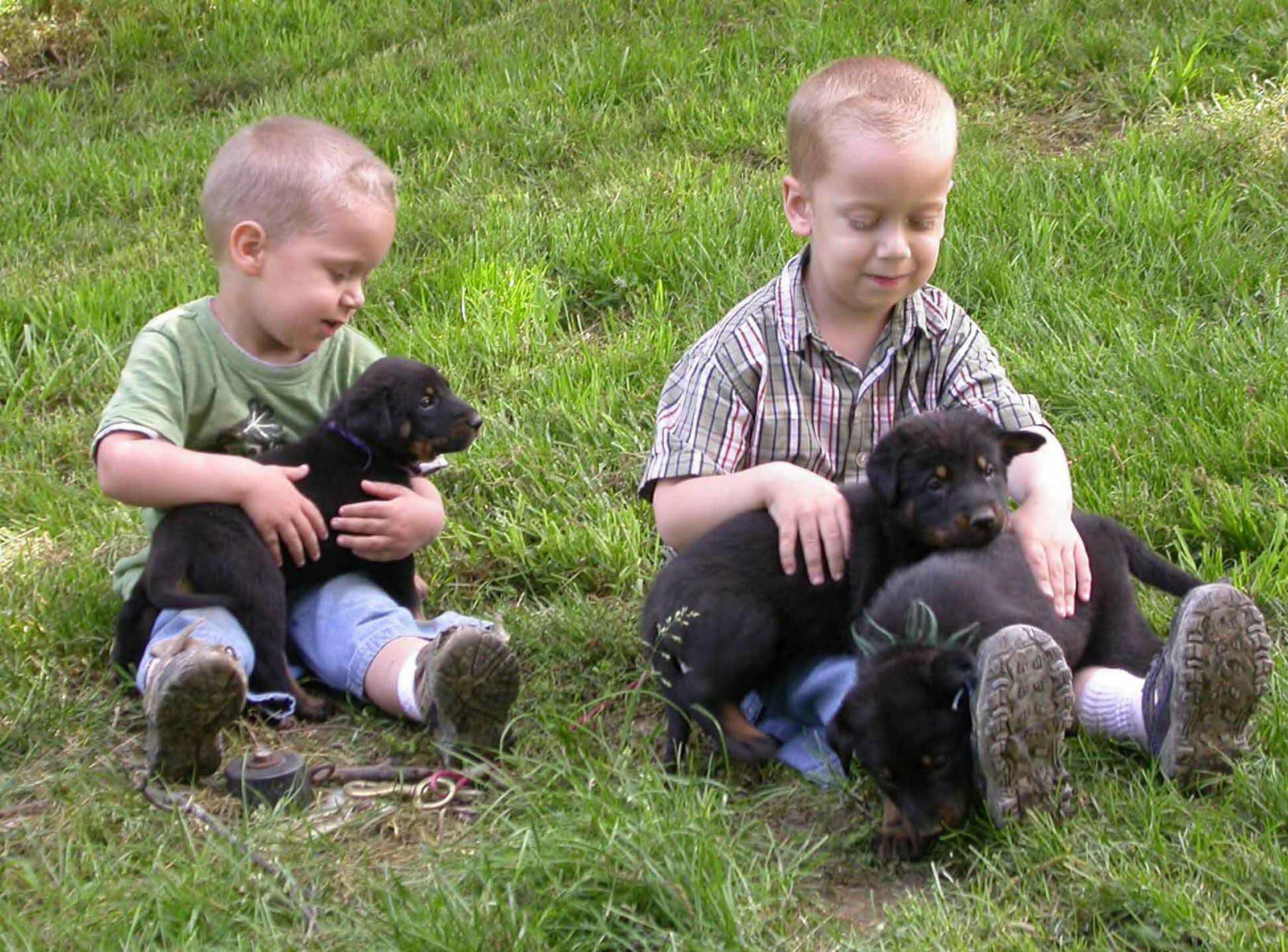
It is best to get a puppy between 2 and 6 months of age: this will make it easier for them to adapt to a family, and especially to children.
Caring for a Beauceron
A purebred dog always requires special care, and the Beauceron is no exception. Caring for a dog requires careful attention, from its hygiene and habitat to the delivery of the puppy.
Features of apartment living
A large dog like the Beauceron requires plenty of space. Make sure your apartment is large enough for this pet. While he won't be running around the room, he should have enough room to lie down on the floor, wander around, play with his favorite toy, and finally, get a good night's sleep, stretched out on his bed. If you live in a two-story house, it's best to keep your dog on the ground floor to avoid the risk of injuring his paws while going down the stairs. Floors shouldn't be slippery to prevent a Beauceron from twisting his paw while playing.
The Beauceron is a freedom-loving shepherd who spends most of its time outdoors. Keeping it indoors or chained in the yard for long periods of time can lead to mental problems, which can also be dangerous for humans.
Hygiene
The Beauceron's living area must be kept clean. Beds and bedding should be changed periodically. Make sure the dog's food dish and water bowl are also clean. Frequent cleaning of the apartment is encouraged.
A dog's body hygiene is also important. But despite the fact that the Beauceron, like many shepherds, loves to rinse in water, it is not advisable to wash dogs of this breed too often: it is advisable to carry out the procedure no more than twice a month.
Naturally, washing is best done in warm water using special dog shampoos. Human shampoos should never be used, as they can cause unpredictable reactions. A shepherd can be showered either in the bathroom or outside using a hose.
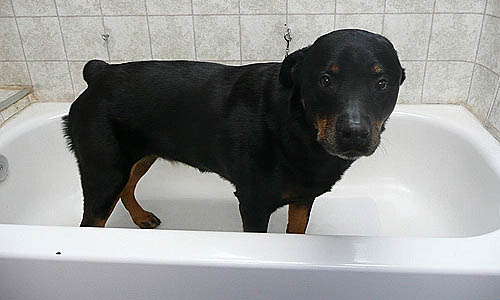
The Beauceron can be washed in the bathtub or hosed down with warm water outside.
After each walk, it is advisable to rinse the Beauceron's paws and the tip of its tail under running warm water.
The dog's ears are cleaned with a cotton swab and a special product once a week.
Nutrition
Since Beaucerons are an expensive and purebred breed, their diet must be appropriate. If you want your dog to be healthy and energetic, win competitions, and produce good litters, cheap food is a no-no. It's best to consider dry canned food, although natural foods are more nutritious. It's best to choose premium and super-premium dry foods: this way, you can be sure your pet is getting the required daily nutritional intake. Although the French Shepherd is undemanding, its diet should be balanced. Supplementing with natural lean meat and cooked seafood is a good idea. You can give your pet porridge cooked in water or broth, boiled or fried vegetablesDairy products should always be given separately from meat products, preferably at different meals.
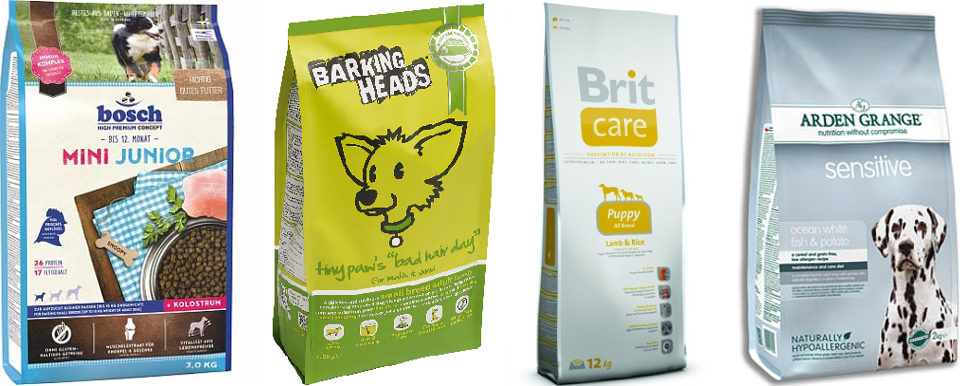
The Best Super-Premium Dog Foods of 2017
Periodically, once every 3-4 months, the dog needs to be given a vitamin and mineral complex. This is especially important for puppies. At three months, their teeth begin to grow, and at this age, it's important to supplement them with calcium, phosphorus, and vitamin D supplements, which support bone formation and the overall musculoskeletal system. By six months of age, dogs no longer need such mineral supplements on a regular basis.
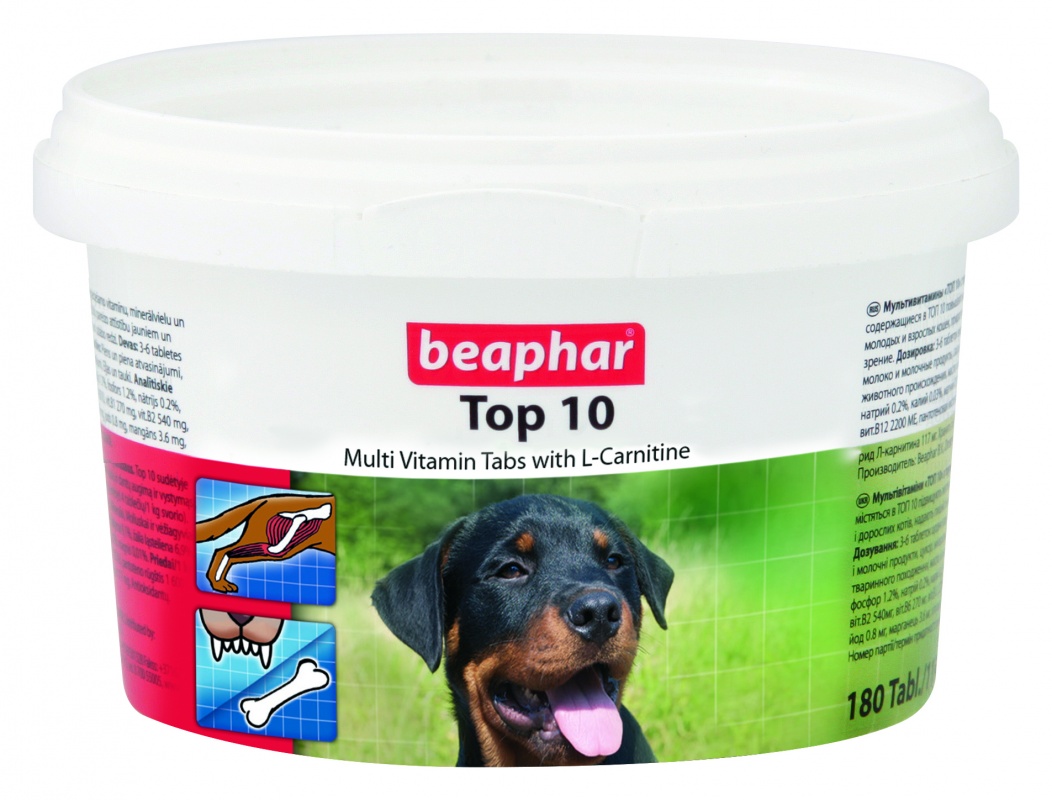
A vitamin and mineral complex for large purebred dogs is especially necessary for puppies
An adult dog should be fed twice a day—that's enough, while a puppy should be fed 3-4 times a day. If a meal is missed for any reason, the next one will still be on schedule and the same amount, not doubled.
It's easy to tell if your dog is getting enough food and whether the portion needs to be increased: watch how it acts immediately after eating, whether it licks the plate or calmly walks away from it. If the former, it's clear the Beauceron isn't getting enough food, and you need to serve more next time. However, overeating is also a bad idea, as it can lead to excess weight gain and make the dog lazy and lethargic. It takes 20 minutes for a Beauceron to be satisfied. Even if the dog hasn't touched the food, the plate should be removed after that time: a schedule is a schedule.
The food plate should be at the height of the dog's chest so that it does not have to bend over to eat. For this purpose, you can purchase a special stand at a pet store.
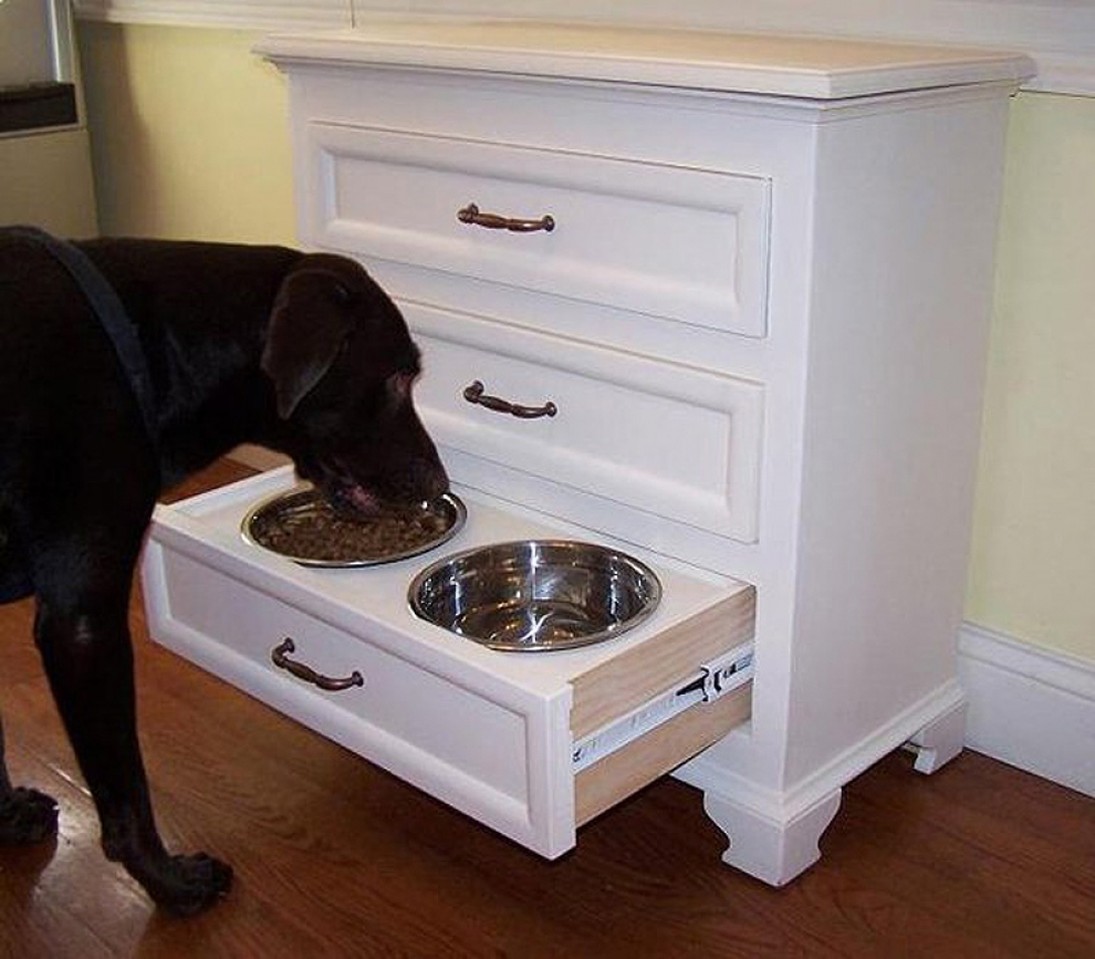
The plate and drinking bowl should be at the level of the dog's chest; there are special devices and stands for this purpose.
Make sure the water bowl is filled with clean water. Replace it daily with fresh, preferably filtered, water. The water bowl, like the plate, should be placed on a stand.
Any meal should take place no later than 2 hours before training and no earlier than an hour after: only then will the food eaten not negatively affect the dog's health.
Walking
Raised in the French foothills, the Beauceron requires frequent walks, and a sedate stroll through the park is not suitable for this dog. Cross-country running is essential for maintaining the dog's physical and mental health. This pet needs to release its energy to the fullest extent, otherwise it will negatively affect its quality of life. A Beauceron needs to be walked for at least 1 hour.
Long runs and agility are ideal for the Beauceron. However, the latter requires you to also invest time, energy, and patience: the game requires active participation from both dog and owner.
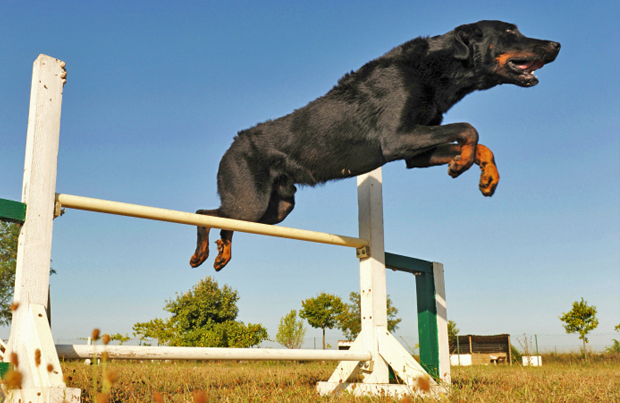
Agility running is the best walking option for a Beauceron.
Pregnancy and childbirth
If you choose a Beauceron female when purchasing a puppy, there is a chance that she will give birth to offspring twice a year.
The first heat in a dog begins between the ages of six months and a year, and this period lasts from 1 to 3 weeks. A so-called false heat may occur—a scanty discharge in pets approaching puberty. Even if mated with a male dog during this period, conception will not occur. However, a true heat may occur after 1–2 months, and during this time, the Beauceron owner should be especially vigilant.
Behavior of a dog during estrus:
- playfulness and some disregard for the owner;
- licking the perineum;
- attracting the attention of male dogs;
- frequent urination, which is actually marking territory.
The owner should clearly record the time between the first and second heat cycles. It is during the third phase of the cycle that mating is most favorable.
Despite a strong sexual desire, female dogs may be aggressive toward male dogs for the first time and avoid them. One and a half to two weeks after the onset of estrus, the bloody discharge turns to a yellowish color. At this time, the Beauceron shepherd's behavior changes significantly, and when they see male dogs, they assume a mating posture, moving their tails back. The vulva becomes greatly enlarged, indicating intense arousal. This arousal can last up to a week. This is when female dogs are most ready for mating.
If a dog is not mated, she may experience a false pregnancy. During this period, she may seek out a secluded spot, surround herself with toys, and even experience false labor. The owner should prevent this behavior by taking away toys and distracting the bitch. Protein in the diet should be reduced. Sometimes a false pregnancy can indicate liver disease.
Cynologists recommend allowing a female Beauceron to mate at the age of one and a half years, but some owners insist that the bitch be at least two years old.
If the mating was successful, the French Shepherd may show the following symptoms in the second month:
- poor appetite and toxicosis;
- lethargy, drowsiness;
- abdominal enlargement;
- swelling and lightening of the nipples.
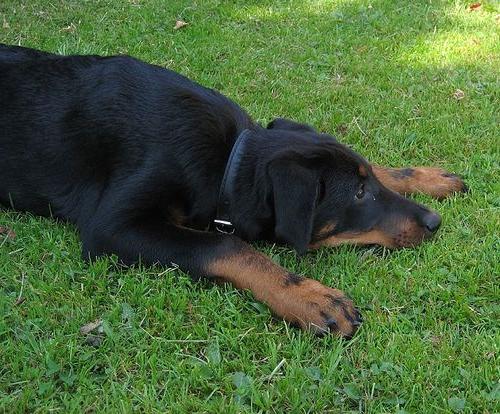
Some of the symptoms of pregnancy in Beauceron are lethargy and drowsiness.
If pregnancy is confirmed, the dog's activity should be sharply restricted to prevent harm to the unborn puppies. Increase her diet by approximately 10% each week, gradually reducing the amount of protein (meat, eggs). A week before the birth, feed the dog dairy and fermented milk products—milk, cottage cheese, cheese—as well as cooked vegetables. During this period, choose a whelping area, keep it clean, and change the sheets on the bed frequently.
The necessity of pregnancy and birth for a dog's health is practically a myth. This condition places enormous stress on the bitch's body, which can lead to a variety of illnesses. Only perfectly healthy dogs should be allowed to mate.
Two to three days before the expected birth, it's a good idea to start taking the dog's temperature. A drop to 37–37.5°C indicates the impending birth. Decide for yourself whether you are ready to deliver the kitten yourself or whether you should consult a veterinarian. Even if you're confident in your abilities, always have the breeder's or veterinarian's number handy: the whelping process may not go as planned, and complications are possible that will require the advice of an experienced person.
Prepare the following items:
- scissors;
- alcohol;
- sterile wipes;
- oilcloth;
- heating pad.
Before giving birth, a Beauceron bitch will begin whining and scratching the wallpaper, urinating frequently. Rapid breathing and shivering are also observed. Contractions soon begin, which can last from 1.5 to 24 hours. Then, pushing begins, accompanied by the dog sitting up. She may also lie down. Whelping occurs within 2.5 to 3 hours, and the puppies may be born head-first or pelvic-first. Each puppy should be followed by an afterbirth. If this does not happen, call your veterinarian and the breeder.
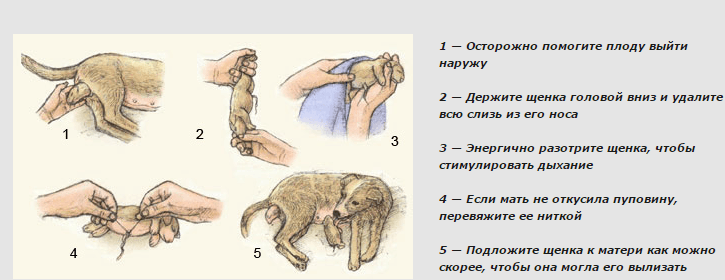
The sequence of actions when assisting a dog in giving birth
As soon as the puppy is born, remove any mucus from the nose and begin wiping the little Beauceron's body with a napkin. Do this gently but quickly. Apply pressure to the umbilical cord so that the blood flows toward the puppy, and cut it 2–2.5 cm from the belly. If it starts bleeding, you can tie it with a piece of string. Give the puppy to the mother, who will begin licking it, stimulating its circulation. When the second puppy is about to be born, place the first one in a box so that it won't be injured. Immediately after birth, the mother will begin nursing the newborns.
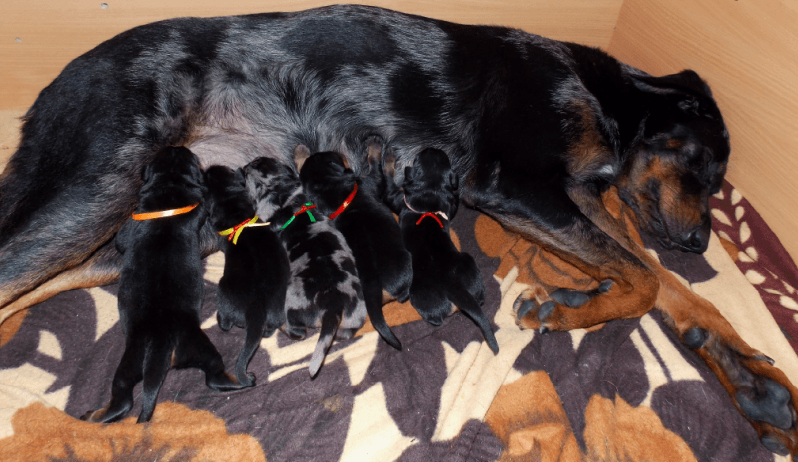
Immediately after birth, the Beauceron begins feeding the puppies.
After the birth, contact your veterinarian and ask him or her for answers to any questions you may have.
Education and training
A Beauceron needs to be trained from puppyhood. Only then will the dog become obedient and accustomed to following its owner's commands.
The most important thing here is to establish contact between the dog and the person (one of the family members). A Beauceron must trust its handler, otherwise the pet will ignore him and behave aloofly or even aggressively. During training, you should demonstrate leadership qualities and firmness of character, otherwise the dog will assume the role of master and boss in the house. The Beauceron is an independent dog, and its training should be strict. However, the use of a whip to discipline is discouraged, as it can lead to aggression and destructive behavior in the French Shepherd. It's important to teach the dog from puppyhood where its resting area is, what it shouldn't do indoors, and how to properly ask to go outside. Train your Beauceron to avoid displays of impudence: it shouldn't beg for an extra treat.
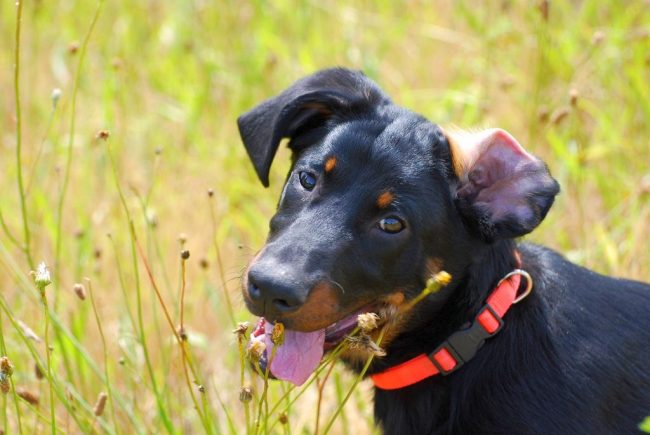
Beauceron training should be started from puppyhood, only then the dog will be obedient and trained to follow the owner’s commands.
Training this breed requires a great deal of patience. The key is to never allow unfairness or hostility toward the dog. This will permanently distrust the Beauceron's owner, and any further training will be in vain.
Training should be started as a game from an early age (around 3 months), once you've earned your puppy's complete trust: this will make the dog more responsive to commands. Each success should be followed by a reward in the form of a treat, which will encourage further achievements.
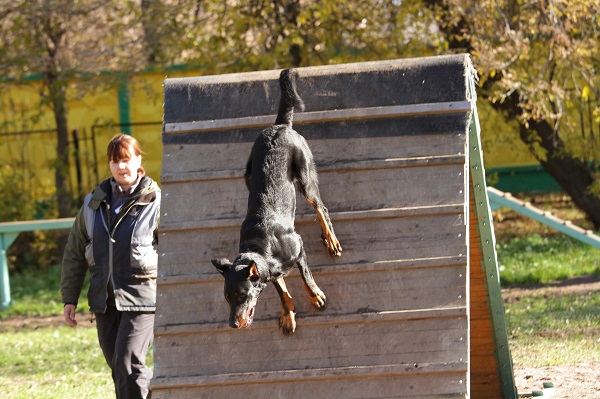
Beauceron training should be done in a playful manner, starting from an early age.
Initially, Beauceron training should take place in a quiet, preferably secluded area, so the dog isn't distracted by outside noise. As the dog matures, you can move on to training in a designated area. However, remember: your pet may react unpredictably to a large number of strange dogs. Teach your Beauceron new commands, get him running and working off his energy. But don't overtire your pet, otherwise all his interest in the training process may disappear.
French Shepherd Diseases and Vaccinations
Despite its appearance, which suggests a strong and healthy dog, the Beauceron is susceptible to various health problems. The most common of these are:
- bloating and volvulus;
- retinal atrophy;
- retinopathy;
- hip dysplasia.
Bloating, while a minor problem, can be uncomfortable for your dog. It can be resolved by following a strict feeding schedule. Meals should be separated, with meat and fish dishes served separately from dairy and fermented milk products. Overfeeding a Beauceron is one of the causes of bloat.
When a Beauceron develops bloat, it stops eating and becomes lethargic. It barely defecates and appears very ill. If veterinary attention is not sought promptly, death is inevitable—the disease does not resolve on its own.
Retinal atrophy is a very serious and virtually incurable disease. Initially, a Beauceron begins to see poorly or even completely in the dark, eventually becoming blind during the day. The pupil becomes more shiny and enlarged. The disease develops over the course of just a year, and if left untreated, the consequences can be dire: in advanced cases, the eyeball may need to be removed. Today, veterinarians have medications that can slow retinal atrophy.
Hip dysplasia is a very common problem in the Beauceron. Initially, the dog begins to limp, and pain appears when walking or running. Without proper treatment, the condition can lead to immobility.
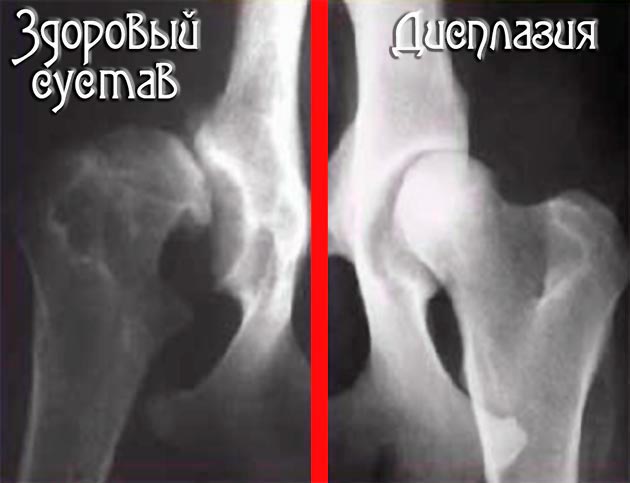
An x-ray shows signs of hip dysplasia in a Beauceron.
All Beauceron diseases must be treated promptly, and this should only be done with the help of an experienced specialist.
To prevent certain diseases (distemper, parvovirus enteritis, leptospirosis and parainfluenza), Beauceron puppies are given a comprehensive vaccination twice: at the age of 8 and 12 weeks. Typically, drugs such as Multakan, Eurikan and Nobivac are used for vaccinations.
Before vaccination, the dog must be dewormed and parasites (fleas and lice) must be eliminated.
Beauceron Owner Reviews
Strengths: Loyal, disciplined, patient breed.
Disadvantages: If you love your pet, then there are no disadvantages at all.
When training and establishing contact with your pet, clear consistency is essential. This will help your pet understand what is and isn't allowed. I wish you and your pet the best of luck in understanding and loving them. Remember, the Beauceron is a family dog breed that loves children and is ready to protect you!
This breed has a number of its own characteristics, due to which it is not as popular and widespread as other breeds, despite its beautiful appearance.
"The breed has its challenges, particularly in the noisy city they require early socialization to thrive. In their native land, the Beauceron is still largely a rural dog. The breed only began to adapt to city life relatively recently. This is something to keep in mind. It's also worth noting that after three years, the Beauceron finally begins to resemble an adult dog and stops being a 'big boy,' but childhood can indeed drag on."
Beaucerons are very different from Rottweilers. Not only are they more gentle, they're also predictable. If a Beauceron has a pure nature, they'll never attack without warning. They'll let you know with a growl, a look, or even their actions that they don't like what you're doing. As for family behavior, mine, for example, has built completely different relationships with each family member. I'm the unconditional boss, my husband is the secondary boss. Only we can bring strangers onto the property (my dog is a stray). With my father and eldest son, we're neutral—there's no particular affection; the dog doesn't bother them, and they don't bother the dog. They pet and cuddle, but nothing more. With my youngest son, they're like best friends, with all that entails. With my mother, he's like a grandson and a grandmother :)). Mom spoils him, he cuddles and almost obeys :).
The Beauceron is a highly intelligent and independent dog that requires a lot of time and attention, making it not a good fit for everyone. However, with the right approach to training and upbringing, it will become a best friend for you and your family.
 Leonid Kapitanaki
1 comment