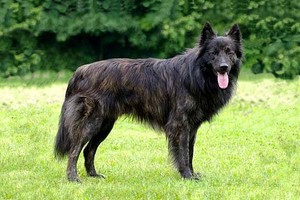
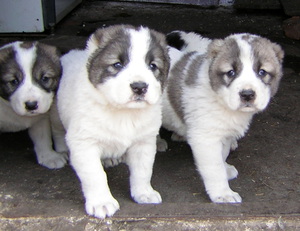
The Australian Shepherd is one of the most loyal and reliable dogs in the world. They are hardworking, active, intelligent, friendly, responsible, and possess excellent physical potential, making them an ideal herding breed.
Content
Breed characteristics
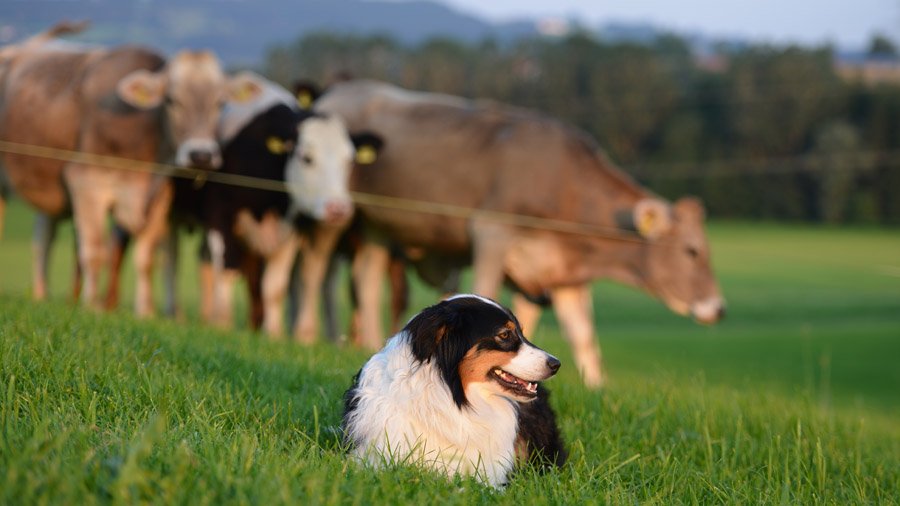
The Australian Shepherd was specifically bred to herd and guard livestock.
The Australian Shepherd, or Aussie, is a unique breed, specifically bred for herding. The breeders inbred the Collie, Bernese Mountain Dog, and Great Pyrenees, extracting only the best traits from each. The result is a remarkable breed, distinguished from others not only by its excellent working abilities but also by its unique appearance.
Historical background
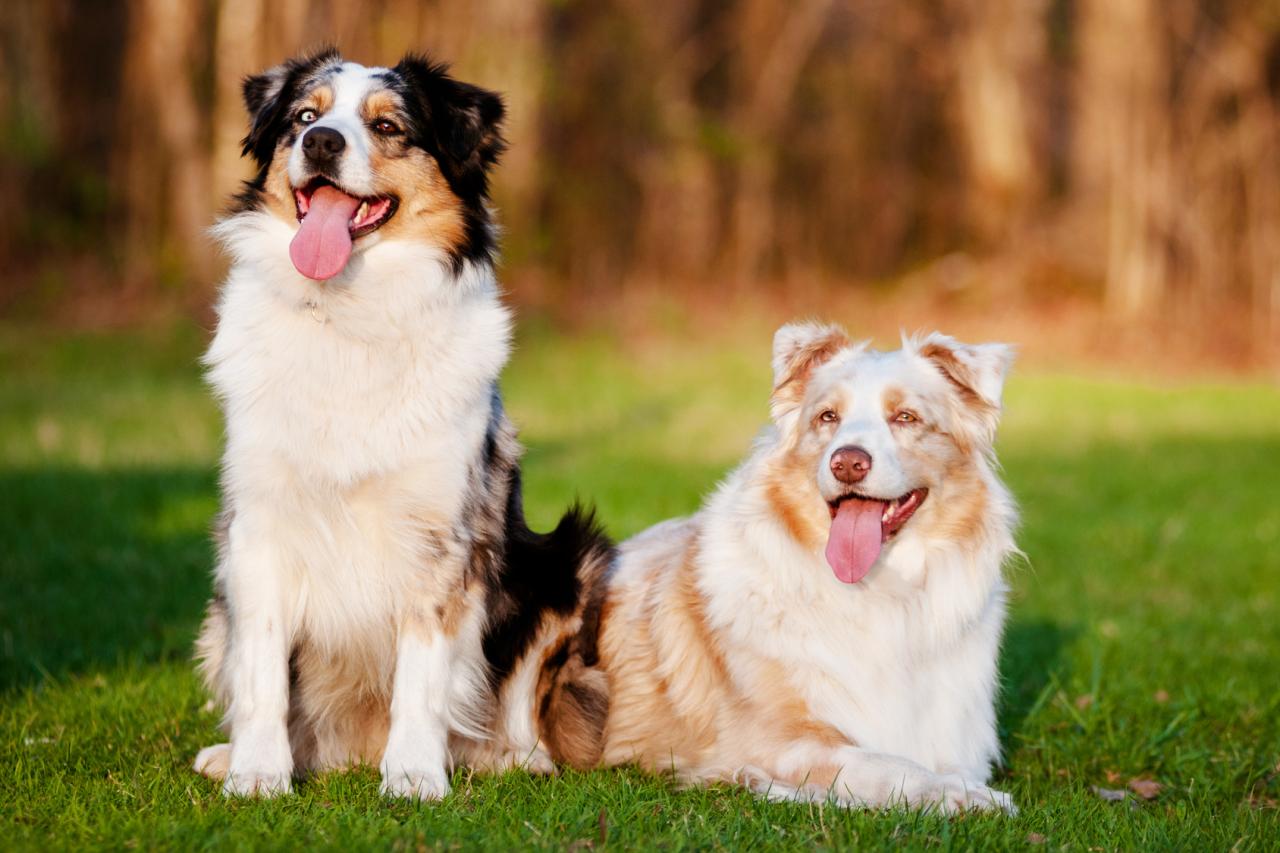
The Aussie is of Spanish-American descent and is not native to Australia.
Despite its name, the Aussie's homeland is not Australia, but the United States of America. There is no reliable information about the breed's origins, but the most common theory is that the Australian Shepherd's first ancestors were brought to the continent in the 16th and 17th centuries, when the Basques arrived to settle the American West.
Spanish farmers brought cattle, sheep, and horses to states like California and Texas, where the climate was most similar to that of the Iberian Peninsula. The animals adapted easily and quickly to their new habitat. The Basques also brought hardy and easily trained Pyrenean Shepherds as herding dogs. These short-tailed, unusually colored dogs became the ancestors of the modern Aussie. It is known that one of the breed's main progenitors was a female named Feo. However, the subsequent history has been difficult to trace precisely, as the Basques were not able to speak a written language.
Over time, American farmers appreciated the hardworking and resilient qualities of these shepherds, which sparked breeding efforts to develop a new breed in the 20th century. The Great Pyrenees was crossed with a Collie and a Bernese Mountain Dog, resulting in the Australian Shepherd. A breeding club opened in the United States in 1957, and by the early 1970s, there were more than 25 kennels. The FCI breed standard was officially approved in 1977.
The Aussie's popularity steadily grew thanks to its versatility, friendly nature, excellent herding instincts, keen intelligence, and ease of training. They quickly became an integral part of American ranches and farms. In 1979, the Australian Shepherd was recognized by the United Kennel Club (UKC). Today, it is a fashionable breed that has become an excellent companion and family pet.
FCI standard
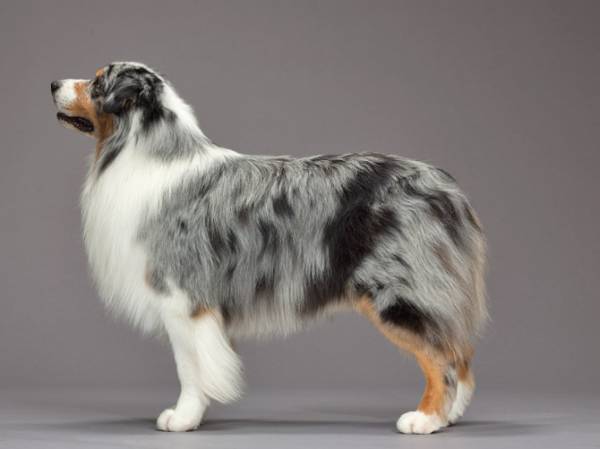
The Australian Shepherd is a large, well-proportioned dog with strong bones.
The Australian Shepherd is an active, strong, muscular, well-proportioned dog of medium size with a semi-long coat and a naturally short or docked tail. A distinctive feature of the breed is its individual coloring - very rich and almost always different. It is also noteworthy that the Aussie has excellent agility and is able to instantly change direction even when running fast.
The FCI standard defines the following provisions:
- The skull is slightly rounded. The stop is well defined. The occipital protuberance is small.
- The head is strong, clearly defined, and dry. The overall size is proportionate to the body.
- The muzzle tapers from the base to the bridge of the nose, forming a cone-shaped form. The length is equal to or slightly shorter than the length of the back of the skull.
- The nose leather can have different pigmentation depending on the dog's coat color:
- in blue merle and black cats - black color;
- in red-marbled (red merle) and red - brown;
- In merles, small pink specks are permitted, not exceeding 25% of the total pigmentation of the nose in dogs over 1 year old.
- The eyes are almond-shaped. They can be amber, deep blue, or a combination of the two. They are neither protruding nor indented. The eyelid pigmentation is light brown in red and red-merle Aussies, and dark in black Aussies. The expression conveys intelligence, alertness, and energy.
- The ears are set high, triangular in shape, and not cropped. They are raised when alert.
- The bite is scissor- or pincer-like.
- The croup is moderately sloping, the back is strong and straight.
- The neck is muscular, with a slight arch at the withers, and of moderate length.
- The belly is tucked up from the chest to the groin, the ribs are well sprung.
- The chest is deep, not wide, the lowest point is at the level of the elbow joints.
- The tail is naturally short and straight.
- The forelegs are strong, the shoulder blades are flat and well laid back. They are set close to the withers. The pasterns are of medium length. The toes are well-knit.
- The hindquarters are strong, with well-defined stifles. The hocks are slightly arched. The metatarsus is short, and the hind dewclaws are absent. The feet are oval, with the toes tightly closed.
Male animals should have two testicles, properly developed and descended into the scrotum.
The disadvantages of the breed are as follows:
- atypical wool;
- erect or hanging ears.
Disqualifying faults of the Australian Shepherd:
- overbite or underbite;
- large white spots on the body between the withers and the tail, between the elbows and the hind limbs (for all types of color).
Coat type and possible colors
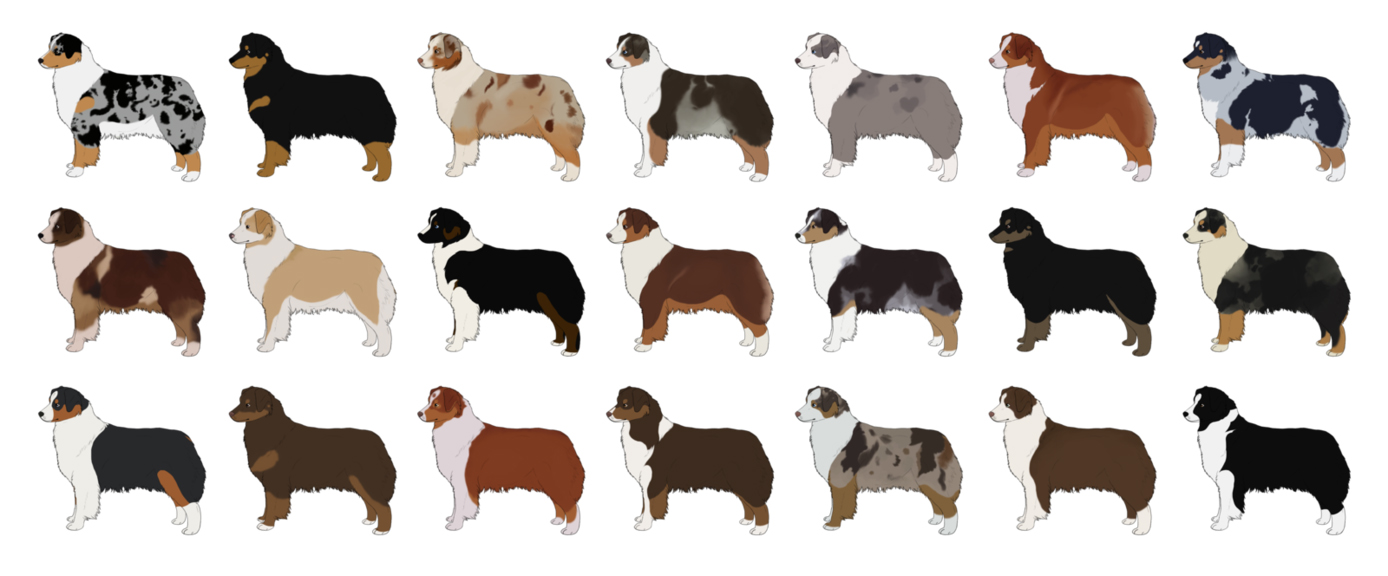
The Australian Shepherd can have a wide variety of colors - this is its unique feature.
The Aussie is renowned for its distinctive coat. This breed is characterized by a medium-length coat with a dense undercoat. Both straight and wavy hair are acceptable. The hair on the ears, head, and front of the paws is smooth and slightly shorter than the main coat.
You can find Australian Shepherds in a wide variety of colors, but the official standard recognizes four color types:
- black;
- marble-blue (blue merle);
- red or brown;
- marbled red (red merle).
All colors must have a white collar on the neck, chest, bridge of the nose, lower body, and partially on the paws. Unrecognized colors include graphite, gold, sable, and brindle.
Interesting! Aussie puppies are born with short tails, which eventually become completely invisible under their fur.
Character and working qualities of the dog
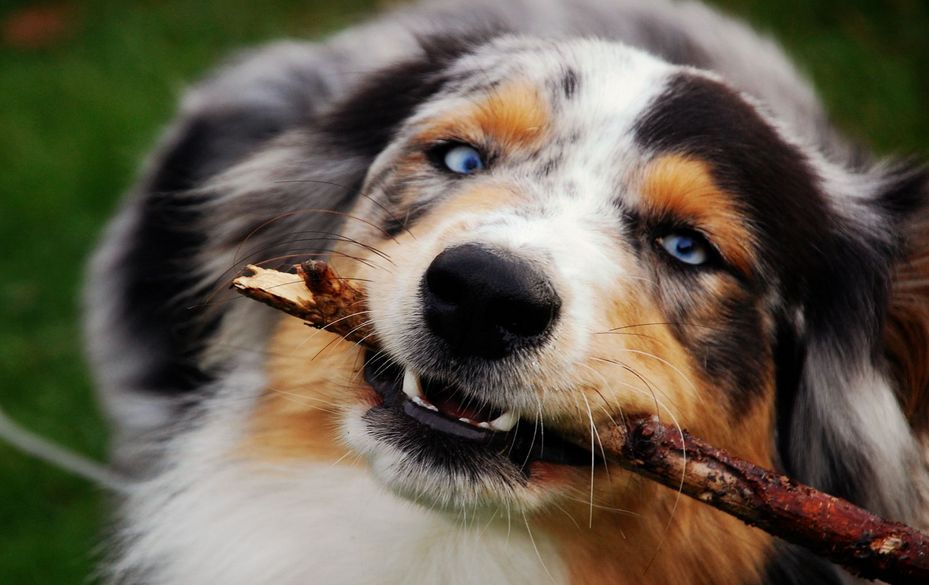
The Australian Shepherd is a hardy herder and an excellent athlete.
A properly trained Australian Shepherd is a friendly, intelligent, active, and cheerful dog who treats all family members with boundless love. Of course, as a true watchdog, Aussies are always wary of strangers, though usually without aggression or fear. These dogs get along well with other pets, and are even tolerant of rodents. Breeders note that Aussies are very devoted to their owners and love to be in their company.
Representatives of this breed are characterized by a keen intelligence, excellent obedience, affection, and curiosity. They rarely show malice toward people or animals and are also highly trainable.
Important! Australian Shepherds are considered one of the most physically developed dogs in the world.
Aussies are tireless. They can stand guard for hours in one place, alerting their owner to the approach of guests with a resounding bark. These dogs are territorial and therefore ideal for guarding the yard. However, they should not be chained up and completely deprived of your attention. Aussies desperately need human companionship and do not tolerate loneliness well. Some, especially those of working breeds, become so attached to their owners that they will follow them everywhere, never letting them out of sight.
The Australian Shepherd is the ideal companion and loyal friend for those who enjoy an active lifestyle. This dog is not recommended for homebodies—they will only suffer with it.
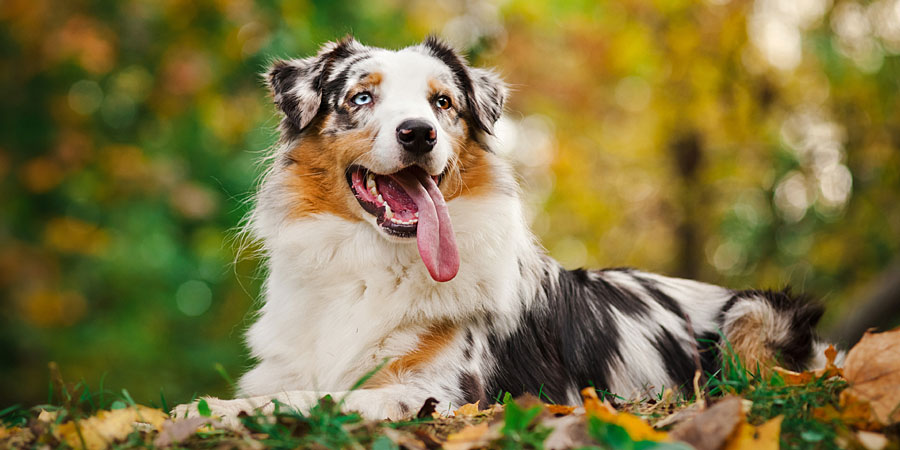
The Australian Shepherd is a great choice for people with active lifestyles.
When it comes to working qualities, Aussies are ideal for farms raising sheep, cattle, or even chickens. These dogs are diligent, hardworking, and easy to maintain, possessing qualities such as alertness, responsibility, and endurance—all essential for protecting the farm. The Australian Shepherd perfectly combines the qualities of a herder and a good-natured companion.
Important! Aussies are a breed that thrives on affection. They thrive on physical contact with their owners: they'll sit snuggled up to your feet or even climb onto your lap.
However, it should also be noted that the herding instinct, developed intelligence and desire to control everything can have a downside if the dog does not work on a farm. Aussies can be obsessive with other pets, pressuring them to do what they deem appropriate. Not everyone can tolerate such control, which can lead to conflicts. Therefore, breeders recommend taking their dogs through obedience training from an early age to channel their energy. Australian Shepherds learn very quickly.
In general, the Aussie is a wonderful nanny for children; he is a protector of the family, who will devote all his free time to playing with the household members.
Video: Breed overview
How to choose a puppy?
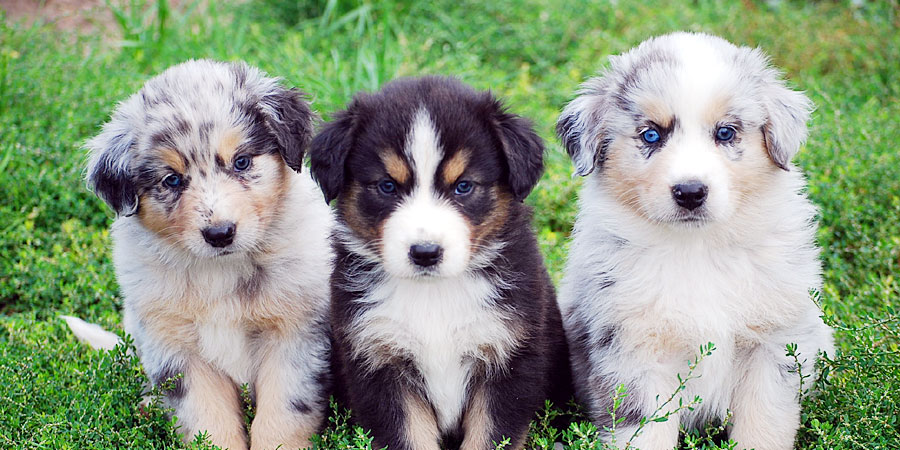
It is advisable to purchase a puppy from a reputable kennel.
In Russia, there's a National Breed Club that provides information on kennels, breeders, and shows. Purchasing an Australian Shepherd puppy isn't difficult, but be prepared to pay between $1,000 and $1,500.
Even at a very young age, an Aussie puppy has a distinct coloring. While it's possible this will change slightly with age, the coloring is immediately clear. This way, you can determine if your pet has any breed defects. Also, inspect the puppy before purchasing. It should be inquisitive, active, and unafraid of loud noises or sudden gestures. Otherwise, cruelty to pets, which can cause psychological damage, can occur.
Pay attention to the dog's appearance: the ears and eyes should be clean, free of discharge and unpleasant odors. A small Aussie's coat resembles a thick cloud. Bald spots and a lack of shine are signs of poor health.
Ask the seller for the puppy's vaccination record, pedigree, documents for the parents, and photos of them. A reputable breeder will provide all the necessary information without question. If they tell you they don't have any documentation because it "costs a fortune," walk away—you're being lied to.
Many clubs sell Australian Shepherd puppies with breed defects, but at a significantly lower price. These defects are most often related to color. So, if you're looking for a companion dog and don't intend for it to be a show dog, don't hesitate to purchase one.
Care
The Aussie is perhaps one of the most low-maintenance dog breeds. Your attention and care are more important to them than the living conditions. However, to maintain their good health and comfort, simple grooming procedures are necessary.
Features of apartment living
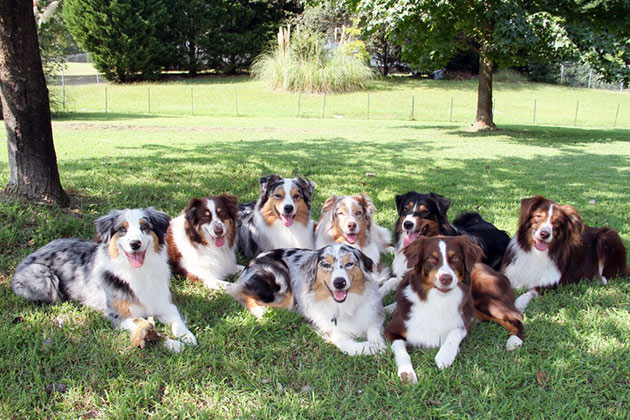
An Australian Shepherd can live in an apartment, but it is better to keep it in a country house.
An Australian Shepherd is not a couch potato. This is something you should understand even when purchasing a puppy. While they can certainly thrive in an apartment, they require regular, long walks and exercise. Otherwise, they'll become moody and destructive, damaging your furniture, shoes, textiles, and anything else they can get their teeth on. It is best to keep an Aussie in a country house, where it will have space and freedom of movement.
Important! Keeping an Australian Shepherd chained is not recommended, as it can negatively impact their mental state.
Provide your pet with a separate area that's just theirs. Provide a warm bed, clean water, and a few toys. Make sure there are no drafts or direct contact with heating devices.
As mentioned earlier, Aussies need exercise, long walks, and active outdoor play. Take your dog out two to three times a day for 1.5–2 hours. During hot weather, you can shorten the walks slightly to avoid exhausting your dog. Try to keep your Aussie busy with interesting, active games: frisbee, flyball, and agility are the best forms of exercise for an apartment-dwelling Aussie.
Pet hygiene
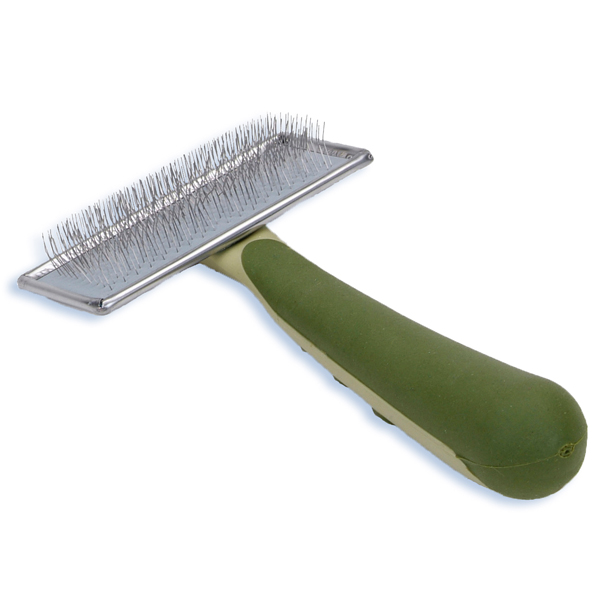
The Australian Shepherd requires regular grooming.
The Australian Shepherd has a semi-long, wavy coat with a thick undercoat, requiring owners to brush their pet regularly two to three times a week. During shedding season, brushing is done daily. Otherwise, the dog's skin becomes irritated and dermatitis develops. A wide-toothed metal brush or a slicker brush are best for brushing. Bathing is recommended no more than once every two months.
An Australian Shepherd's nails need to be trimmed if they walk on soft ground or grass and don't wear down naturally. Using a special nail clipper, remove 1–2 mm at a time to avoid damaging the nerve. If this does happen, treat the affected area with brilliant green.
An Aussie's eyes should be cleaned with a damp cotton ball as needed. Their ears should also be cleaned every two weeks. Cotton pads soaked in baby oil are best for this. According to the breed standard, Australian Shepherds have perfectly white and strong teeth. Traditional grooming methods, such as protective toys or feeding soft bones and cartilage, are good.
Principles of healthy eating
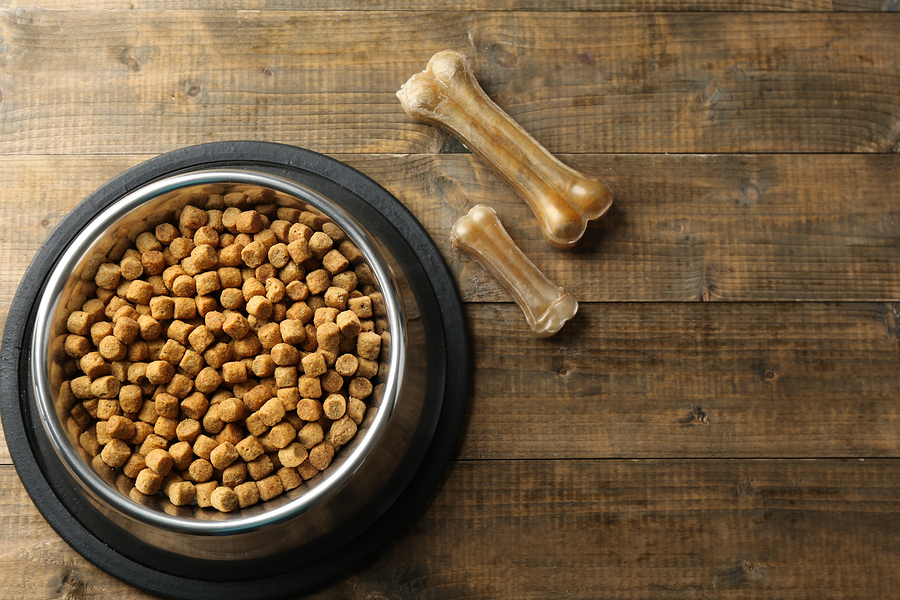
Aussies need a balanced diet designed for active dogs.
To maintain good health, a dog requires a proper and balanced diet. Australian Shepherds respond equally well to both natural and commercial foods. It's important to choose super-premium products designed for active dogs. For example, Dog Chow Active, Bosch Active, Royal Canin AGILITY 4100, Royal Canin ENERGY, or Purina Pro Plan Performance.
A natural diet should include the following foods:
- meat (poultry, veal, beef, rabbit) – 2/3 of the total food volume;
- boiled boneless sea fish;
- offal;
- milk;
- cottage cheese;
- boiled eggs;
- porridges (buckwheat, rice, wheat);
- vegetables (beets, zucchini, carrots);
- fruits (except citrus fruits).
Eliminate the following foods from your diet:
- corn;
- potato;
- pork;
- sausages;
- tubular bones;
- legumes and legumes;
- confectionery;
- spicy, fried, salty foods.
The feeding schedule is determined by the dog's age. Pets up to 3 months old are fed 4 times a day, 3 to 7 months old – 3 times a day, and after 7 months – 2 times a day.
Photo Gallery: Foods Suitable for Aussies
-
- Bosch Active – food for active dogs
-

- Dog Chow Active is a balanced food for active adult dogs.
-

- Pro Plan Performance is ideal for all ages.
-

- Royal Canin AGILITY 4100 is designed for highly active dogs.
-

- Royal Canin ENERGY gives your pet extra strength and energy
Features of mating, pregnancy and childbirth
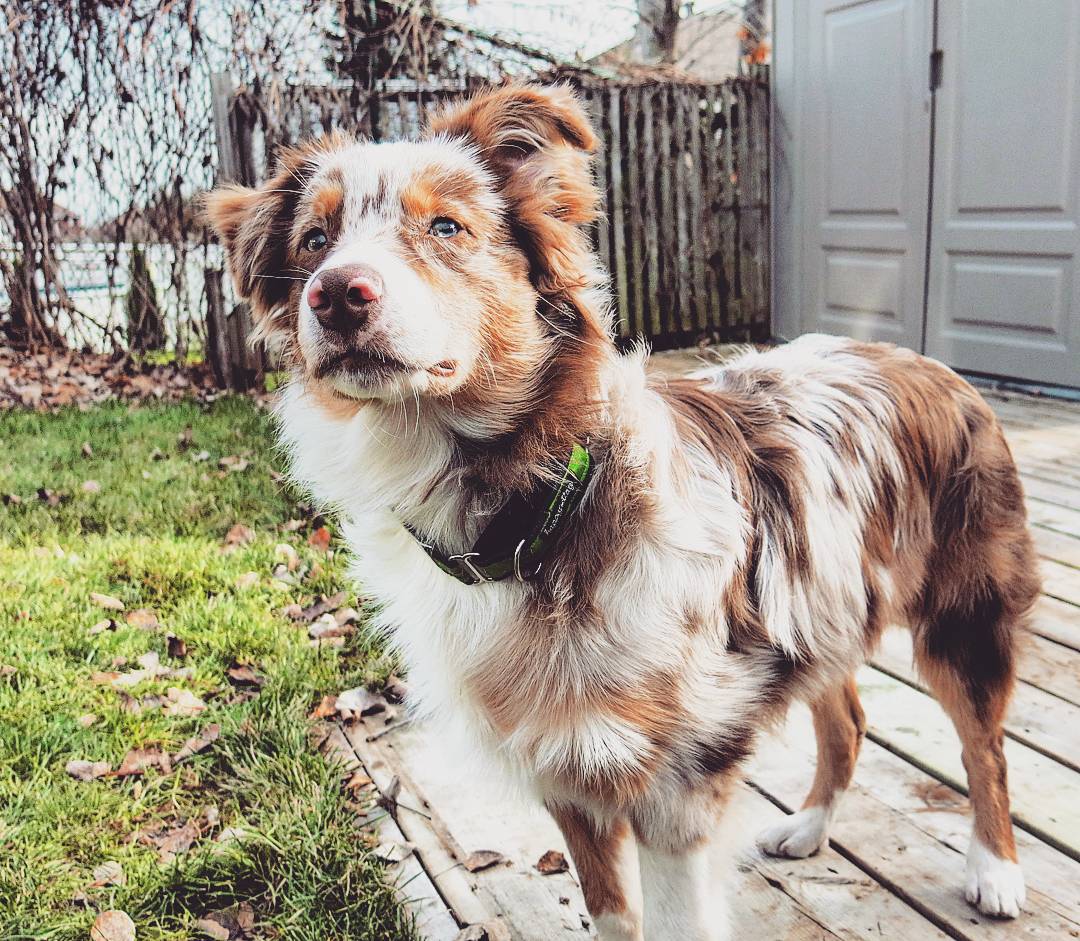
Australian Shepherds typically have 6-8 puppies in a litter.
The optimal age for mating an Australian Shepherd is at least 1.5 to 2 years. Before this age, owners wishing to breed their dog or female should undergo several mandatory tests to confirm or rule out genetic diseases or infections (mycoplasmosis, chlamydia, and herpes). Hand mating is typically practiced with Aussies, with the partners held on leashes.
Important! The maximum age for a female Aussie to produce a puppy is 9 years.
When creating a breeding pair, it is necessary to take into account the exterior of both partners, their health, character, and adaptability to work. Cowardly, weak-nerved dogs, as well as animals that have suffered from serious illnesses, are not suitable for breeding. Naturally, this applies to puppies for sale, not for home breeding. Therefore, pay attention to your Aussie partner. A healthy individual should have a cheerful disposition, excellent blood tests, a good coat, clear eyes, and a reputable pedigree.
An Australian Shepherd's pregnancy lasts 58-68 days. You won't notice the first signs until after a month: the bitch becomes calmer, eats and sleeps more, and is somewhat clumsy. Starting from the 30th day of pregnancy, the dog should be limited in physical activity. Don't allow her to jump high, and protect her from blows to the stomach, sudden movements, or overexertion. Naturally, avoid agility training, playing Frisbee, and other activities during the walk.
A week before the birth, prepare a place for your pet where she will stay during and after whelping. This can be a deep box or crate, at least 120 x 100 x 60 cm in size. Place it in an isolated, quiet area. Line the bottom of the box with clean diapers or sheets, and nail wooden slats around the perimeter. These will prevent the babies from accidentally squashing against the walls. Also, install an infrared lamp nearby to maintain the temperature in the maternity ward at 28°C (reduce it to 26°C after two weeks).
Important! Before giving birth, it is advisable to trim the hair in the genital area and nipples.
It's best not to disturb the bitch during whelping. She usually handles the task herself and everything goes well. However, you need to keep an eye on her and be ready to provide assistance if necessary. Whelping occurs in two stages: preparatory (contractions) and expulsion of the fetus (pushing).
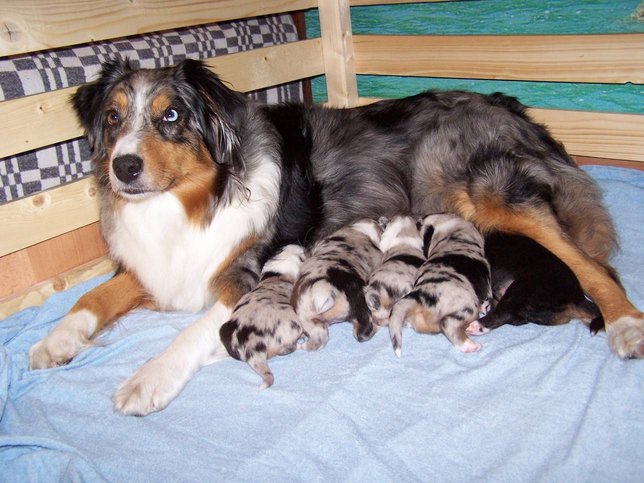
During labor, you need to be prepared to assist your dog.
A few hours before the birth, you'll notice changes in your Aussie's behavior: she'll be restless, scratching, following you around, whining, licking her nipples, or latching on to her side. These are signs that she's going into labor, meaning the puppies are about to be born.
You'd better prepare the following essentials in advance:
- sterile scissors;
- threads, cotton wool, brilliant green;
- clean diapers;
- terry towel;
- basin for collecting placenta.
During labor, the mother lies on her side. Puppies begin to emerge at intervals ranging from 15 minutes to 2 hours. If this continues for longer than 6-8 hours, a veterinarian should be called. Typically, with each new puppy being born, the mother bites the umbilical cord, eats the membranes, and nudges the baby with her muzzle to reach the nipples.
But if the bitch cannot cope with this task, she needs help:
- With your hands well washed beforehand, take the puppy and rupture the amniotic sac.
- If there are no signs of breathing, rub the baby with a terry towel.
- Tie the umbilical cord with a strong thread in two places (at a distance of 2 cm and 4 cm from the tummy), cut it with sterilized scissors and treat the cut with brilliant green.
- Wipe the puppy with a clean diaper and place it next to its mother.
- Make sure he starts sucking colostrum, as this will stimulate uterine contractions.
Repeat the same procedure for each puppy. At the end of labor, count the placenta. The number should match the number of newborns. If not, call a veterinarian, as the fetus may have died inside.
Important! Do not allow the bitch to eat all of the placenta, as this can cause severe stomach upset.
In the first few days after whelping, a mother produces colostrum, not milk—a thick, yellowish liquid with a distinctive odor. Don't worry, this is completely normal. Colostrum contains many trace elements that boost the puppies' immunity.
Also, don't be alarmed if you notice bloody discharge from your dog's vulva. During the first 20 to 30 days after birth, she will ooze blood, which is also a natural occurrence. However, if the discharge becomes thick, has an unpleasant odor, or if heavy bleeding is observed, consult a doctor immediately.
Education and training of Aussies
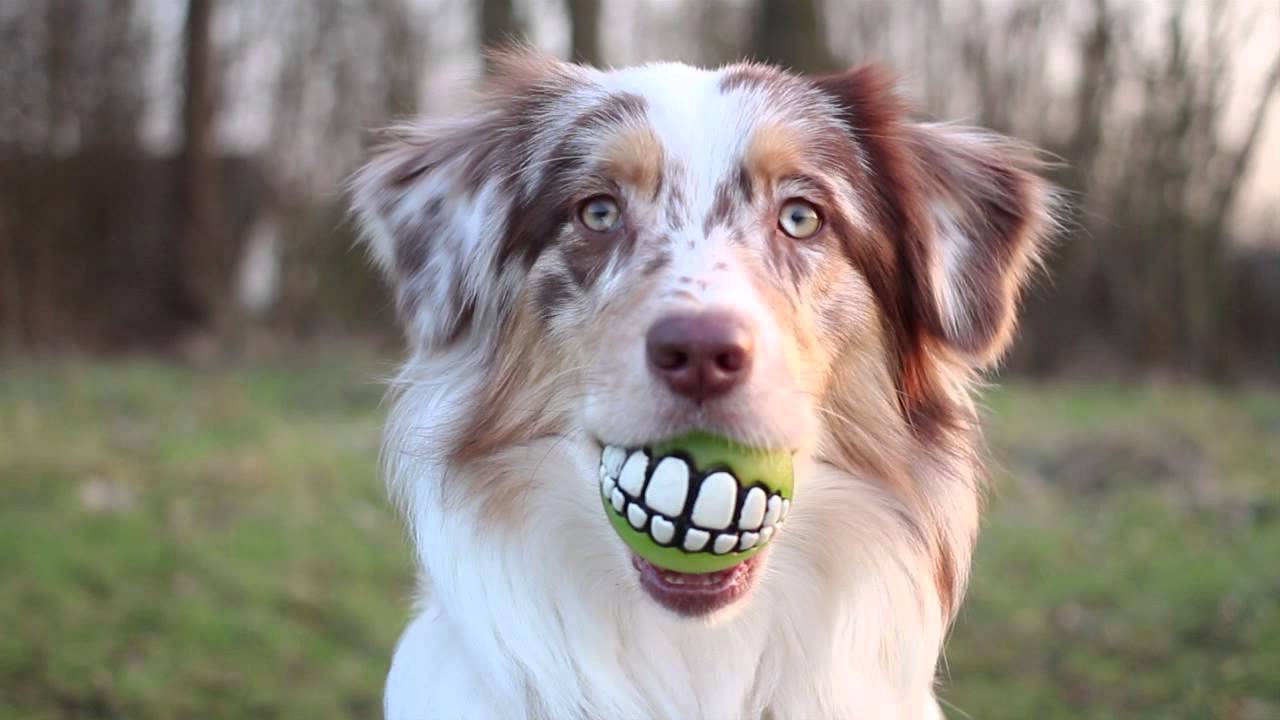
The Australian Shepherd is easy to train and enjoys participating in sports games.
Training with an Australian Shepherd is a joy. These dogs are outgoing, intelligent, and quick to grasp information, and the entire training process is like a game to them. They learn very quickly and don't try to take over. Breeders note that Aussies require not only physical training, but also mental training.
Puppies begin training at 1.5 months. At this time, they need to learn to walk beside you, respond to your name, and understand the command "No!" Starting at 2-3 months, dogs are gradually taught standard commands: "Sit!", "Down!", "Come!", and "Speak!"
If you're getting an Australian Shepherd to work on a farm, it will need to undergo herding training. This involves developing skills such as patrolling, tracking, guarding the farm, gathering and aligning the flock in a corral or at watering, and herding stragglers. Naturally, it's best to entrust this type of training to a professional trainer.
However, if an Aussie was purchased as a companion, it only needs to complete a basic obedience course (OKD) and be given plenty of time to participate in the sports this breed enjoys. Australian Shepherds excel in agility (high-speed obstacle course), flyball, frisbee, and diving. Aussies will also happily run alongside you on a bike ride.
Video: Aussie tricks
Dog breeders note that this breed fully memorizes a command after 25-35 repetitions. Some owners use clicker training. It's important for an Aussie to fully master and practice the first command before teaching it another.
Video: Australian Shepherd Training
https://youtube.com/watch?v=33D4RET4kKk
Pet health
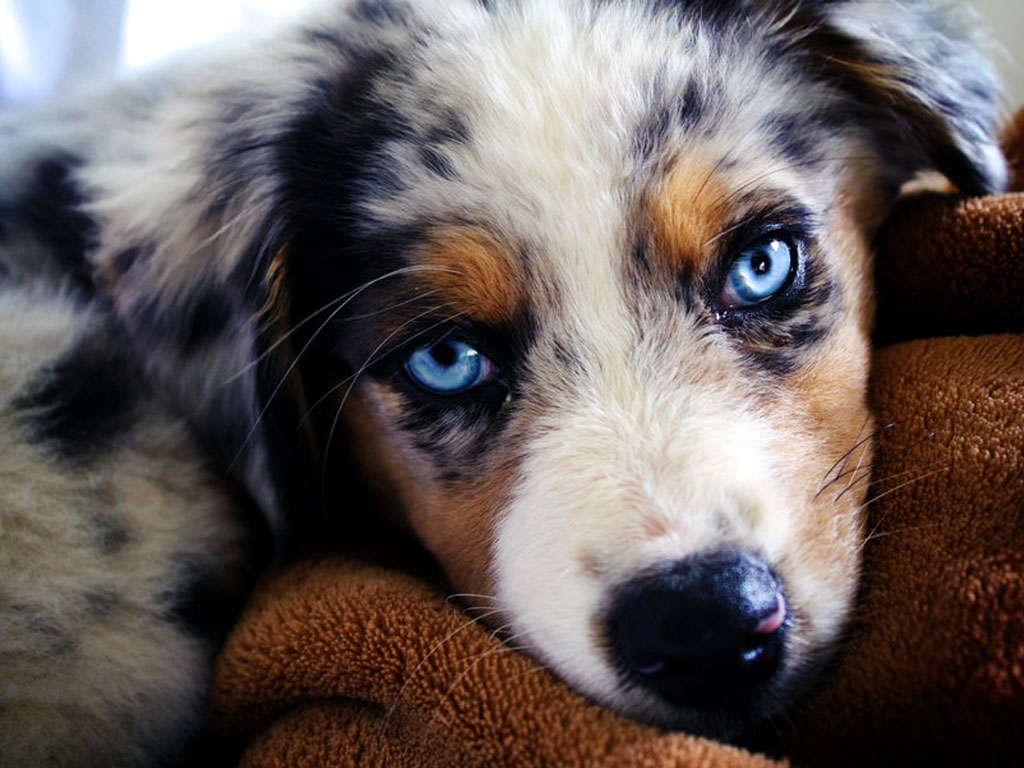
Australian Shepherds often have vision problems.
With proper care and exercise, Australian Shepherds rarely get sick and live an average of 12-14 years. However, like all herding breeds, Aussies are genetically predisposed to juvenile cataracts. Other ailments common to this breed include:
- optic nerve dystrophy;
- retinal dysplasia;
- demodicosis;
- oncological diseases;
- epilepsy;
- thyroiditis (pathology of the thyroid gland);
- hip dysplasia.
Timely vaccination helps prevent dogs from contracting diseases such as rabies, canine distemper, parvovirus enteritis, adenovirus hepatitis, rhinotracheitis, and Lyme disease.
Vaccinations are carried out according to the following schedule:
- at 1.5–2 months;
- 2 weeks after the first vaccination;
- at six months;
- annually throughout the pet's life.
Remember that two weeks before vaccination, your dog should be given a deworming medication (such as Milbemax), the dosage of which will be determined by your veterinarian. After vaccination, do not take your Aussie outside for 10-14 days and limit its contact with other animals as much as possible.
Choosing a nickname
The Australian Shepherd is an active, friendly and intelligent dog, so the nickname should be appropriate. For a male dog you can choose one of the following names: Agate, August, Adis, Alan, Cupid, Aston, Byron, Boston, Bruno, Bradley, Brook, Weiss, Valet, Viron, Walter, Volt, Guy, Hertz, Heron, Gray, Gross, Jean, Jimmy, Danko, Dantes, Julien, Jardon, Eli, Icarus, Colt, Klaus, Kraft, Kite, Corvette, Casper, Carter, Cooper, Lockie, Lars, Legart, Leroy, Lotus, Madeley, Mark, Maris, Marcus, Marcel, Mitchell, Newton, Noris, Norman, Augie, Oliver, Orpheus, Oscar, Olen, Oxford, Richard, Remus, Rit, Red, Sketch, Simon, Sutton, Singer, Tanner, Taylor, Timber, Toby, Phlox, Phillip, Ford, Falcon.
The following nicknames are suitable for an Aussie girl: Abigail, Adele, Iris, Aya, Bona, Barbara, Beatrice, Beata, Blanca, Veysi, Viola, Violet, Gerda, Hella, Gloria, Goldie, Hermione, Grace, Daisy, Darkly, Gema, Julia, Diana, Dixie, Eva, Jasmine, Jacqueline, Jeanne, Iris, Inga, Kaya, Kara, Quinta, Christy, Leila, Lana, Lixie, Lilith, Lorda, Malta, Maya, Marisa, Monica, Mara, Mary, Nora, Nikki, Nicole, Nera, Olenna, Obbie, Audrey, Rada, Rihanna, Rhonda, Sandra, Sansa, Susie, Summer, Timona, Tammy, Taisa, Thelma, Flora, Fiona.
Reviews from dog breeders
Australian Shepherds are very intelligent and love their owners. They're incredibly soft and cuddly. He's always with me, both on walks and in the car. He's a natural herder; it's in his blood. He's an excellent herder, even though he hasn't been trained. He just tries to help me. He can also be protective of the house. He's very affectionate with children and loves to be petted, especially by them. He's very jealous; you can't pet other pets in his presence; he gets very nervous and starts whining.
Yes, I have a breeding bitch, one... I doubt I'll get another. I've had two litters and the puppies were of varying degrees of gestation. I can say they come in all shapes and sizes. You can choose one to suit your personality, but these are very fidgety creatures. Their brains settle down around age two. If you get a non-dominant dog, you won't have any problems with smaller dogs. But they're so jumpy that they can injure you even reluctantly. When alone, they behave like many others; out of boredom, they can even destroy things. A crate helps if you train them from puppyhood. They're loyal and fixated on their owner. They have obvious herding and guarding instincts. They're easy to train and will go out of their way for their owner. They have many advantages, but they also have disadvantages. Like any dog.
It's much easier to work with males than females. They're more honest and outspoken. In sport or show competitions, it's better to use a male. Females are more resourceful and can be cunning. And these beautiful girls are also incredibly stubborn, even more so.
The Australian Shepherd is a loyal, obedient, cheerful, and good-natured dog with excellent herding skills. It's a natural-born childcare worker, a tireless companion, and a devoted friend. It's important for it to always be close to its owner, to be helpful, and to feel cared for. An Aussie makes an excellent guard dog for homeowners.