 The British devote much attention to various exhibitions celebrating their pets. It's therefore not surprising that they are credited with creating a new sport—dog agility. Today, many would consider them PR ploys, but back then, they weren't pursuing any mercenary goals; they simply wanted to slightly alter the dog show process.
Their desire led to the creation of a central ring, which featured obstacles reminiscent of those in horse show jumping. The difference was the addition of "dog rides"The dog presentation process involved the direct participation of trainers, who were required to demonstrate their pets' abilities. The very first events brought them unprecedented success. This led to similar obstacle courses being regularly established in other countries. Over time, this performance became known as agility.
Content
Basic rules
Many agility owners are attracted by the fact that no special documents or skills are required to participate. The main thing is appear before the audience with your four-legged pet and show what he is trained to doTrue, there are certified dog agility competitions where dogs are required to undergo inspection. But in most cases, these events, which often offer a specific prize fund, allow dogs of any breed to participate, including mongrels. Here, the emphasis is not on appearance, but on how quickly and accurately the trainer and their four-legged friend perform the actions.
The distinctive feature of this sport is that a trainer performs in front of the audience with his dog.
Based on the results of the obstacle course, each pair's performance is assessed individually. Each team has the opportunity to receive a small time bonus.
To participate in agility, you must meet a number of requirements:
 In these competitions Any dogs can participate regardless of gender, age, body type and breed.
- The handler assists the dog in performing necessary tasks using voice, gestures, or posture. The rules prohibit assisting the animal with deliberate touching, treats, or toys.
- Before choosing an obstacle course, judges evaluate the composition of the participants, each of the obstacles must be numberedThe end result should be a route that the dog cannot complete on its own.
- Each team is given only one attempt to complete the obstacle course. Their performance is then assessed, including the animal's characteristics, and the team is awarded a score at the end.
- Rules of the competition for the handler one attempt to complete the route is given to one personThis gives him the opportunity to choose the right tactics to reduce the time it takes to complete the route.
- Any physical punishment of an animal on the part of the handler will result in immediate disqualification of the team.
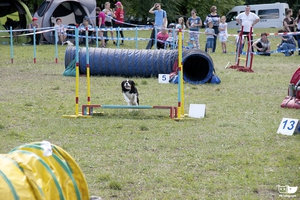 In these competitions Any dogs can participate regardless of gender, age, body type and breed.
For certain competitions, stricter or more lenient rules may be introduced. This depends on the difficulty of the course and the prize pool. For example, if the event offers no prizes or is held for charity, a single team may be made up of several pairs. Furthermore, not only adult dogs but also puppies, disabled dogs, trainers with congenital disabilities, and others may be allowed to participate.
<!—cke_bookmark_72E—>Agility equipment
For each such competition a standard set of obstacles is providedMoreover, in each case, they can have different heights, sizes, and distances between control points. Depending on the type of execution and the type of obstacle, agility obstacles are classified into several types.
To ensure that all animals, regardless of their personality type, are placed on equal footing, the course program includes not only obstacles for cholerics, but also obstacles that require the animal to demonstrate restraint and strict obedience:
- SlalomIt is constructed from 12 vertically fixed and flexible poles, which the animals must pass through in a serpentine pattern.
- PlatformIt consists of a podium with an inclined entry and exit bar. The dog is required to remain on the platform in a specific position for a period of time, determined by the judges.
- Zone or squareA section of the course with a tape around its perimeter. Once on it, the dog must assume a specific position—sit or lie down—and remain there for a period of time.
 SlalomIt is constructed from 12 vertically fixed and flexible poles, which the animals must pass through in a serpentine pattern.
Contact
- BoomA type of obstacle made from three 20-30 cm wide boards, resembling a bridge. Crossbars are added to the inclined sections, allowing the dog to navigate the obstacles more easily and also to comply with safety regulations. The main part of the obstacle is positioned 1 meter or higher from the ground. According to the rules, the handler is allowed to walk along the boom parallel to the dog and provide support should it fall. The contact zone is appropriately brightly colored and is located at the base of the raised sections. The dog is required to run onto the boom. If the dog attempts to jump onto it, it will be counted as a violation.
- SlideIt's made from two 80-100 cm wide boards, joined end to end. The resulting shape should be a triangle with isosceles sides, the apex of which should be 2.5 meters above the ground. The contact zone is the top of the obstacle. Once on it, the animal is required to touch the contact zone with its paw on either side.
- SwingThis obstacle is designed as a children's amusement ride. It is made from a plank 2-3 meters long and 30-40 cm wide, mounted on a triangular base. A weight is placed on the entry side and placed on the ground. The animal is required to run onto the plank above the middle, wait for the plank to lower, and then run back to the ground. The animal must touch each contact point on the entry and exit sides. When constructing this obstacle, the weight and dimensions must be carefully calculated: it must be easily passable even by small dogs, so that after running onto the obstacle, the plank can lower within 2-3 seconds.
- PipeIt is made as a hollow plastic structure with a large diameter. It can also be made closed, but this depends on the difficulty of the obstacle course. The obstacle can be of varying heights depending on whether the course requires running or crawling.
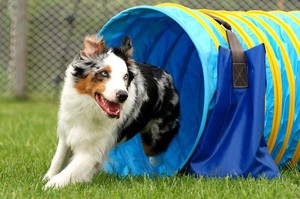
- TunnelIt consists of a corridor made of lightweight, durable fabric, with a rigid entrance made of large-diameter plastic pipe. The animal is required to run up to the obstacle, and from that point on, the trainer should vocally prompt the animal where to go. The obstacle will be scored if the animal completes the corridor without stopping.
- TransitionIt consists of a platform with several ramps, two of which are marked with contact zones. To navigate it, the animal follows the handler's voice. After climbing the obstacle, it must descend it along pre-installed inclined bars.
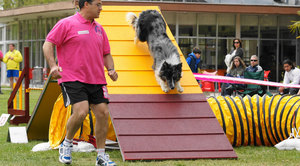 SlideIt's made from two 80-100 cm wide boards, joined end to end. The resulting shape should be a triangle with isosceles sides, the apex of which should be 2.5 meters above the ground. The contact zone is the top of the obstacle. Once on it, the animal is required to touch the contact zone with its paw on either side.
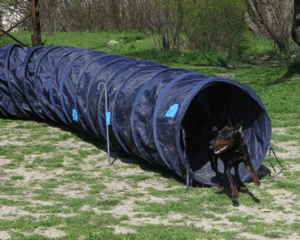 TunnelIt consists of a corridor made of lightweight, durable fabric, with a rigid entrance made of large-diameter plastic pipe. The animal is required to run up to the obstacle, and from that point on, the trainer should vocally prompt the animal where to go. The obstacle will be scored if the animal completes the corridor without stopping.
Contactless obstacles to jump over
- JumpingThese are obstacles taken from horse show jumping. They consist of two vertical bars with a crossbar mounted on them. The animal is required to jump over them without touching them. The obstacles are placed at a short distance and can be called double or triple jumps.
- FenceAn obstacle that a dog must jump over to pass. Instead of thin bars, these are made from shields or "hedges."
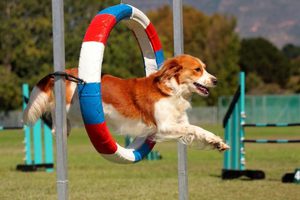
- TireIt consists of a square frame on which a circular barrier is installed using cables. Most often, the barrier is made of rubber from a car tire, wrapped in plastic or tape.
- Long jumpTo achieve this, a group of platforms of small height and width are installed close to each other. The animal is required to jump over them without touching. In some cases, a moat filled with water is used instead.
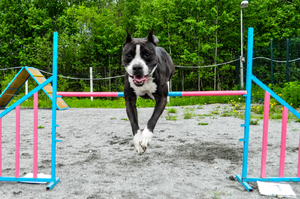 JumpingThese are obstacles taken from horse show jumping. They consist of two vertical bars with a crossbar mounted on them. The animal is required to jump over them without touching them. The obstacles are placed at a short distance and can be called double or triple jumps.
This new sport is gaining popularity every year, leading to its further development. Today, several types of agility can be distinguished depending on the animal's breed and skill level. Competitions for small breed dogs most often consist of contact obstacles. Due to their greater versatility, medium-sized dogs are trained on a course of mixed obstacles. As for agility for larger dogs, obstacles are included in the program to facilitate their navigation. For this purpose, equipment is used that allows the animals to climb without getting stuck.
<!—cke_bookmark_85E—>Is sport for everyone or are there exceptions?
It's worth noting that any dog can master this sport. The main thing is that its owner has the desire to do so. Agility can be practiced even if you don't plan to train your pet for high-level competition. Agility itself brings great benefits not only to animals, but also to their ownersAmong the wide variety of dogs, there are certain breeds that are ideal for such events:
- collie;
- Australian and Belgian Shepherds.
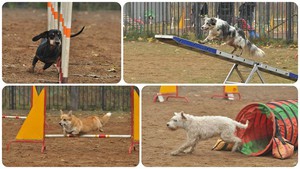 Owners of grumpy Pekingese shouldn't pass up the opportunity to get hands-on experience with agility. You can even start training in your apartment. Every pet is sure to love the exercises included in the agility program. But if you've noticed your four-legged friend mastering everything with relative ease, perhaps you should take this sport professionally and enroll your dog in an agility class. If desired, you can even build a full-fledged agility course:
- You will need an open, level clearing with an area of at least 30 x 30 m.
- Making the shells will also be easy; you can find the necessary diagrams on various websites.
- Finally, all that remains is to obtain consumables, which, with a certain amount of skill, will very soon turn into useful equipment for agility.
The only reason an owner wouldn't want to train their pet in agility is a lack of time or desire. Regardless of your four-legged friend's training, you shouldn't neglect agility training. They have many advantagesthat not only you but also your dog will appreciate:
- The ability to develop in your pet obedience, without resorting to physical force. Classes are held in a game-like format, so it's no surprise that this sport produces such excellent results.
- Regularity. The main drawback of many types of training is that the dog gets bored after completing it. However, this won't happen with agility, which offers a program with several levels of difficulty.
- Mutual understanding. You will be able to improve your relationship with your four-legged friend, if you do these exercises with him. Agility is especially useful for dogs who were adopted from a shelter or have recently suffered serious psychological trauma.
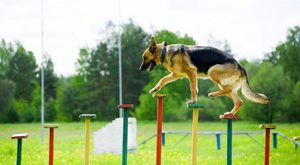 The ability to develop in your pet obedience, without resorting to physical force. Classes are held in a game-like format, so it's no surprise that this sport produces such excellent results.
Conclusion
Every dog owner at some point thinks about training their dog. But those familiar with standard programs are unlikely to be thrilled when their pet completes one. However, this isn't necessary; you can take a different approach and start agility. This is a sport that trains dogs for competitions. However, you can do agility even if you don't plan to participate. The main benefit of agility is that it will help you develop a closer relationship with your four-legged friend and keep your dog in good shape.