They were bred for hunting, but the result was an extremely sweet creature with such a cute appearance and charming character that very soon these dogs became man's domestic companion, sat at his feet, climbed into his soul and began to reign there.
The English Cocker Spaniel is capable of many things: being a model of excellent manners, eagerly chasing after birds, not even feeling the ground beneath him, making sweet eyes, begging for a tasty morsel, and devotedly loving and serving his master with all his heart, to the very bottom of his cheerful and positive soul.
Content
Origin
The name itself makes it clear where this breed originated. The word "cocker" translates from English as "woodcock"—a type of game bird, the hunting for which the breed was developed. The cocker dog was supposed to sniff out the bird, flush it, find it, and bring it back to its owner.
The meaning of the word "spaniel" is not so clear-cut, and there are various interpretations. One theory places the word's origins in the ancient Phoenician language, where "spani" meant rabbit or long-eared dog. This hypothesis seems quite plausible, especially because the ancient Phoenicians had dogs that they used for hunting birds, and later brought them to Western Europe and England.
The first cocker spaniels were larger than today's breeds until they were crossed with Japanese spaniels given to the Queen of England. This crossbreeding resulted in the development of small specimens with a distinctive coat—chestnut-red spots on a white background.
The English did much for this breed. They improved the spaniel's hunting abilities and taught it to use its voice to alert it to game. Cockers could navigate through dense thickets, tall grass, and thorny brambles, and were distinguished by their work ethic, balanced, friendly disposition, intelligence, and quick wit. This development took several decades of the 19th century.
The first English Cocker Spaniel Club was founded at the end of the 19th century, but the breed standard was not described until the beginning of the 20th century.
Until the breed was officially recognized, English cocker spaniels were called "field spaniels" at shows and "merry cockers" among themselves.
Description and breed standard
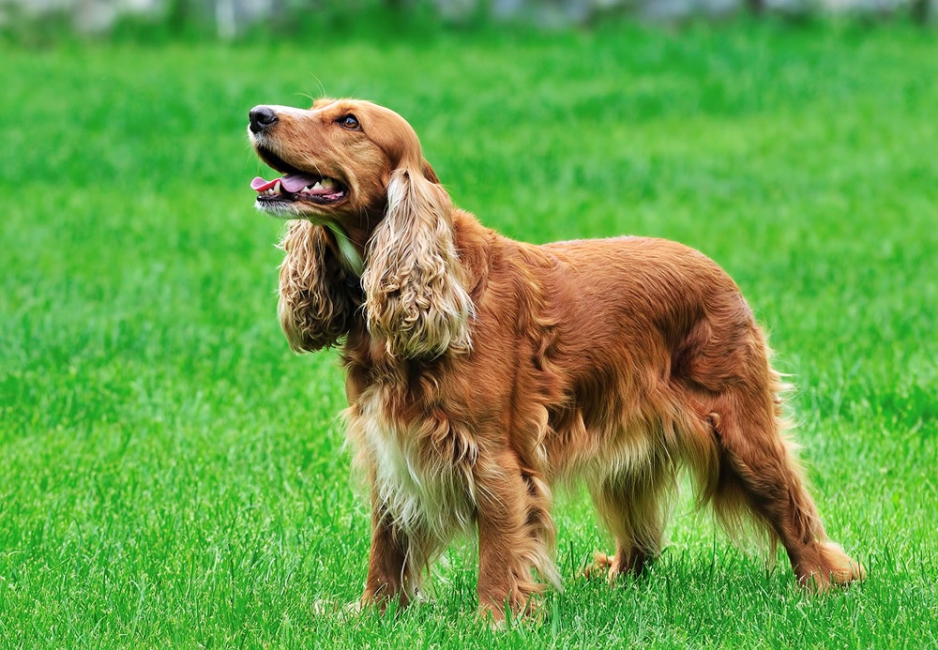
The most common color of the English Cocker Spaniel is golden.
The English Cocker Spaniel is compact in size, no more than 41 cm at the withers for males, 1–2 cm lower for females. Weight varies within the limits of 12–15 kg. All parameters are strictly defined by the described standards, and deviations from them are considered defective.
- The body is square, meaning the height at the withers is equal to the length of the body. The strong, muscular body, proportionate in proportion, with flexible curves, does not create a feeling of heaviness, but rather of endurance and good physical health.
- The head is well-shaped, with a distinct transition from the forehead to the nose. The muzzle is rectangular, the nose is wide, and the bite is scissor-type.
- The eyes are large, always brown, but different shades are possible. The look is intelligent and lively.
- The ears are drooping, thin, and set on the sides of the head at eye level. They are covered with soft, wavy hair and reach down to the dog's nose.
- The limbs are strong, muscular, and generously coated. The hindquarters are more powerful than the forelimbs, which contributes to their speed. The English Cocker Spaniel moves quickly and gracefully, at a gentle gallop.
- The tail is set below the line of the back and docked at half or two-thirds of its length.
- The coat is long and soft, with a dense undercoat, slightly wavy but not curled. The long hair forms a "skirt" along the underside of the body, and fringes form along the entire length of the paws. The breed standard excludes the absence of an undercoat, curls, or down.
When choosing an English Cocker Spaniel puppy, the first consideration is correct conformation due to the strict breeding standards, especially if the puppy is intended for breeding and showing. A healthy English Cocker Spaniel puppy will have a well-fed appearance, a beautiful, shiny coat, a lively and clear gaze, a wet nose, and well-groomed, silky ears.
The English Cocker Spaniel's coat color varies widely and can be solid black, chocolate, sandy/golden, fawn/red, or spotted.

Thanks to the variety of colors, the future owner can choose a black, spotted, red or other English Cocker Spaniel
It's generally accepted that solid-colored puppies don't allow white spots, as they are considered a fault, and such dogs have little chance of winning in the show ring. However, it's important to note that some solid-colored puppies are born with small white markings on the tips of their muzzles and toes, which disappear as the dog matures.
Solid colors are considered rare and not yet recognized: sable, bluish or gray, as well as white with black or brown spots.
Solid white or black English Cockers are rare and are not favored by breeders, especially white ones, as this color often carries a deafness gene.
The most popular coat color of the English Cocker Spaniel in Eastern Europe is golden red.
The difference between the English Cocker Spaniel and the American Cocker Spaniel
There are far more similarities between them than differences, and until the mid-1930s they were not distinguished, but then the English founders of the breed insisted that the differences between the American and English versions be officially recorded.
- The American Cocker Spaniel is more elegant and decorative than the English variety. The English have always emphasized the breed's working qualities. The American variety, however, is distinguished by its luxurious coat and long feathers on its belly and legs.
- The English Cocker Spaniel is 5–7 cm taller than the American Cocker Spaniel.
- The head structure is different. The American has a snub nose and a smaller, rounder head than the Englishman.
- Behavior. The English Cocker Spaniel has retained the habits of an active hunter. He requires exercise and regular walks, while his American counterpart is happy to lie on the couch with his owner.
The English Cocker Spaniel's personality
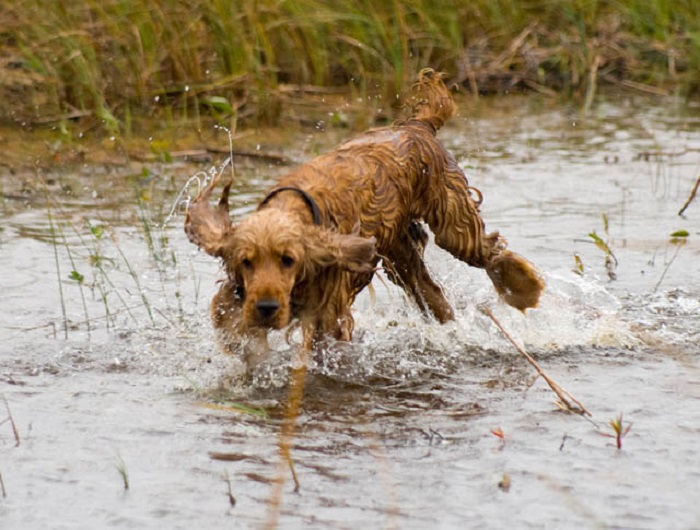
When chasing prey, the English Cocker Spaniel is completely engrossed in the process and completely oblivious to the surrounding conditions.
The English Cocker Spaniel is a versatile dog. She has all the necessary traits to become a loyal friend to a person, a responsive companion, tireless both in games and in hunting.
The English Cocker Spaniel gets along well with a small child. He'll also do well in a family with teenagers. His tireless nature, curiosity, and constant willingness to walk, play, and run around will come in handy. This dog is also a suitable companion for an elderly person.
Due to the fact that this dog is smart and intelligent, it is easy to teach it basic commands and achieve obedience, since Cockers have service to people and a desire to please their owner in their blood.
Features to consider
- The Pursuer's Passion
The English Cocker Spaniel's hunter heritage not only left him with an excellent sense of smell and vision, but also a penchant for all things feathered. He can't sit still if he sees a crow or pigeon taking flight. A hunter's passion flares up, driving the Cocker Spaniel after its prey.
This quality should be taken into account by the owner who decides to let his adventurous pet off the leash in a city with heavy traffic.
- Chooses one owner for himself
Despite all its friendliness and sociability, the English Cocker Spaniel chooses one owner for whom it will feel a real heartfelt affection.
There are cases where a dog's love for its owner is so intense that it becomes completely dependent and dependent. This problem is compounded by the breed's heightened sensitivity. Cocker Spaniels are extremely sensitive to both affection and shouting and harsh treatment. Physical punishment is unacceptable for these dogs.
- Jealous and stubborn
These dogs strive to take a dominant position in the family, with females being particularly prone to dominance.
- Sense of ownership
This behavior manifests itself in relation to their dog toys and accessories. Cocker Spaniels do not like to share them.
- Indiscriminate eating
All spaniels have a good appetite, and English cockers are no exception. They are prone to begging and will resort to various tricks to get a treat. And for them, a treat is anything they can eat.
The owner should take this feature into account so as not to overfeed their pet and upset its stomach.
Care and maintenance

After each walk, the English Cocker Spaniel's coat must be cleaned of dirt.
The beauty of the English Cocker Spaniel lies in its magnificent, shiny, silky coat, large, expressive eyes, and drooping ears. But to maintain all these attributes, the dog requires regular grooming. This is especially true for the English Cocker Spaniel. This breed is not exactly easy to care for.
- Wool
The English Cocker's thick, soft coat with a dense undercoat easily mats if not brushed regularly. Shedding is also a constant, sluggish process, not a seasonal one. To avoid leaving clumps of hair on carpets and furniture, the dog should be brushed with a slicker brush.
Experts also recommend daily massage with a special short-bristled brush, which will combine the beneficial benefits of dry brushing to remove dust and dirt from the coat with a pleasant experience for your pet. Cockers love being brushed.
English Cocker Spaniels shouldn't be bathed frequently. This can dry out their skin, dull their coat, and cause dandruff.
- Ears
Once a week, the ears are examined for discharge and inflammation, and wax is removed. Excess hair inside the ear canal is trimmed.
- Eyes
Every other day, wipe your eyes with a cotton pad soaked in tea leaves or boiled water.
- Walks
This active and athletic dog needs full daily walks with running and games.
What to feed

While eating, the dog's ears may fall into the bowl, so you should buy a special one with a narrowed top.
The challenge for English Cocker Spaniel owners is to avoid overfeeding their pets and preventing them from becoming obese by combining a balanced diet with exercise.
The diet should include:
- raw meat - beef, lamb;
- stewed vegetables (except potatoes);
- porridges (except semolina and pearl barley);
- sea fish (lean varieties);
- cottage cheese, eggs (once a week);
- fermented milk products - yogurt, kefir;
- Water is freely available 24 hours a day.
Dogs should not be given salty, smoked, sweet, or flour-based foods. No supplementary foods or snacks from the owner's table. An adult Cocker Spaniel should be fed twice a day.
Grooming
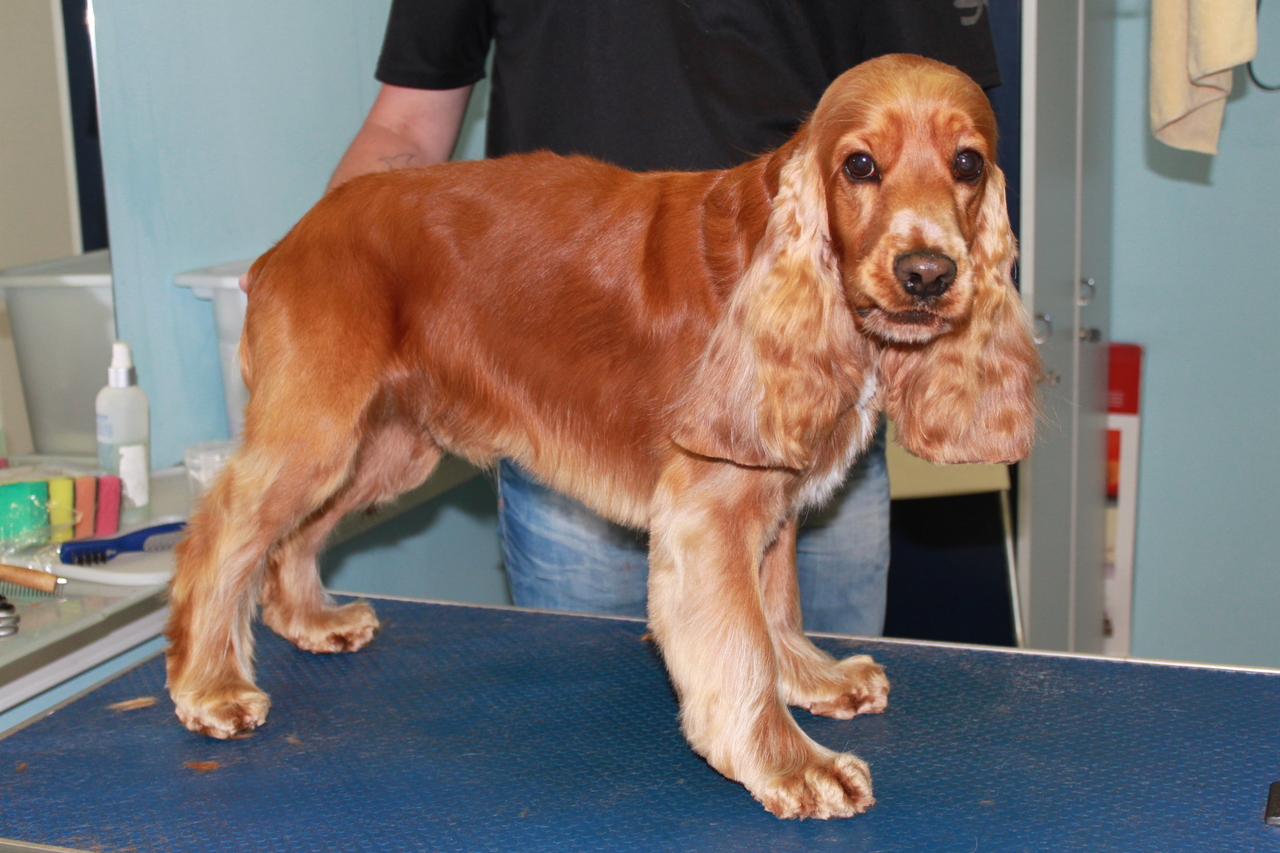
The most important grooming procedure for an English Cocker Spaniel is grooming.
To ensure proper grooming of your English Cocker Spaniel's coat, you'll need a range of tools and supplies:
- 2 combs - with fine and sparse teeth - to prevent tangles;
- massage brush with short bristles for massage and dry cleaning of wool;
- slicker comb for trimming and removing shedding undercoat;
- scissors for cutting hair on the pads of the paws and inside the ears;
- Electric hair clipper for general hair cutting.
A puppy should be accustomed to grooming from puppyhood. It should react calmly to the groomer's table and patiently endure all grooming procedures.
Correct haircut for English Cockers
According to English grooming rules, cocker spaniels are groomed in a natural style, so that the dog appears to have grown its coat naturally. In reality, this effect is achieved through the meticulous work of the groomer.
The haircut has a number of subtleties:
- You need to use thinning scissors.
- Trim in 2 stages: first the head and body, then the paws and ears.
- The hair on the back is not trimmed. Removing the guard hairs will prevent the coat from laying properly. To achieve the desired length, the hair on the back of Cockers is combed out from the undercoat. Only then will the rest of the coat lie evenly and tightly.
- English Cocker Spaniels are groomed early. Most breeders release their puppies to their new owners after their first grooming.
Education and training
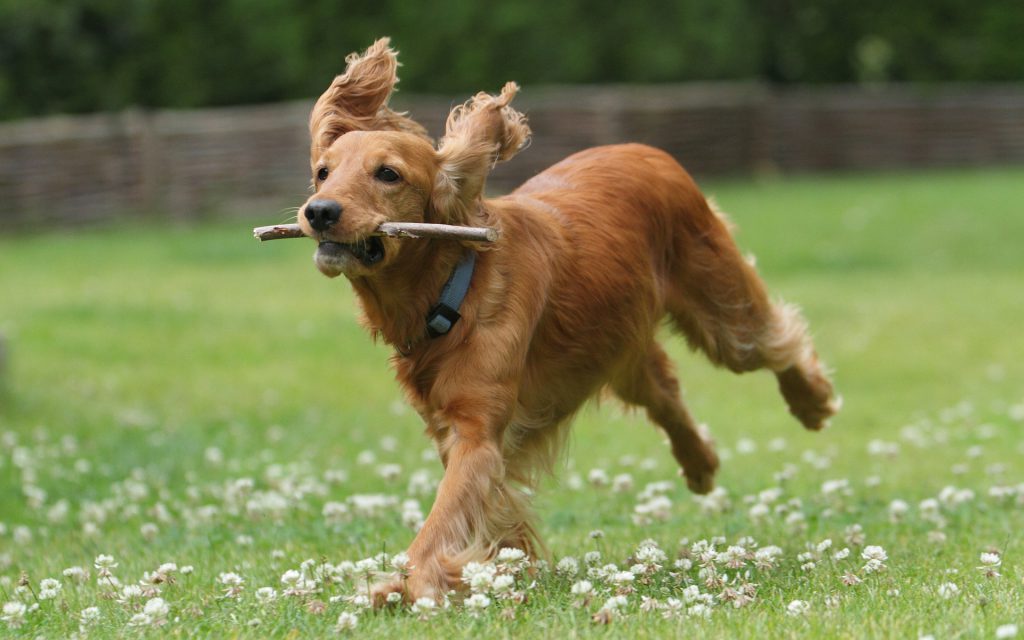
To prevent them from getting bored with the training process, it is important to vary the exercises and introduce a game element.
Training English Cocker Spaniels is easy if you approach the task consistently and take into account the dog's personality and breed characteristics. Cockers are intelligent and quick-witted—they don't need to be told the same command 20 times.
Dogs are vulnerable and sensitive—you can't yell at them or pressure them; the carrot method is much more effective. Food motivation works flawlessly on these little gluttons.
The educational process begins at 3 months of age – teaching and reinforcing basic commands.
The training course will depend on the purposes for which the dog was acquired - for keeping at home as a companion, for exhibitions, or for hunting.
Diseases and treatment
In general, the breed is characterized by good health and rarely gets sick.
Most of the ailments that occur with cockers are hereditary: hysteria, a tendency to panic, aggression, skin allergies, food allergies.
Dogs with a solid color are prone to aggression.
Cockers are susceptible to eye and ear problems. Cataracts, glaucoma, entropion, cherry eye, and otitis are common. If the first symptoms of these problems appear, consult a veterinarian immediately.
Hip dysplasia is rare.
Spaniels don't have problems with appetite, but sometimes they go on hunger strikes. Refusing healthy food can last up to two days. This breed's natural stubbornness comes into play. In such cases, the owner must be stern and persistent. If you give in, the savvy manipulator will resort to his "hunger strike" regularly to get what he wants.
How long do they live?
The normal lifespan of an English Cocker Spaniel is 14–16 years. The dog retains a lively and playful disposition until old age, provided it receives good care, attention and attention.
Breeding
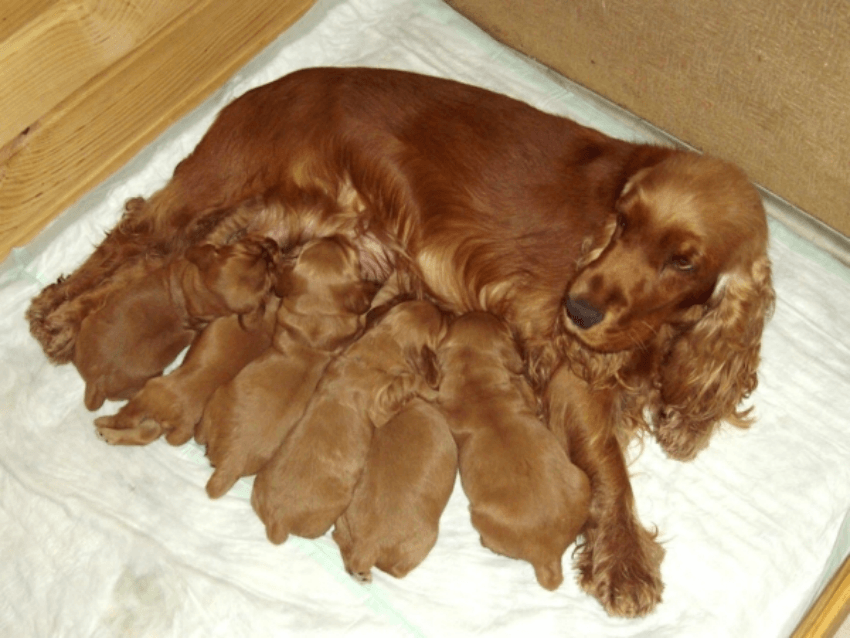
A female English Cocker Spaniel can have between 3 and 10 puppies.
Breeding puppies for sale is a labor-intensive process that requires knowledge, skills, abilities, time, and financial investment.
Knitting
Before mating, the bitch undergoes genetic testing and other tests to confirm her health. Physiological readiness for mating is determined by the number of heat cycles, with the norm being twice a year. The time before the next heat cycle is chosen as the most favorable for fertilization.
The mating process is supervised by the breeders. The animals are given time to get used to each other. During mating, the female is held by the head and under the belly until the "lock" is achieved, which lasts about 10 minutes. It is recommended to repeat the mating after 2-3 days.
Cocker spaniels' gestation period lasts approximately two months. The onset of labor is determined by measuring rectal temperature. A drop to 37°C (98.4°F) indicates preparation. The first birth requires the presence of a veterinarian in case a cesarean section is necessary.
Cocker spaniel birth is a fairly lengthy process. The interval between the first and second puppies is three hours. Subsequent puppies are born more quickly.
Caring for puppies
If the mother does not have milk or there is not enough, the puppies will have to be bottle-fed with warm milk every two hours, including at night.
The first vaccination is given at 2.5 months, before which the puppies do not leave the apartment.
Within the reach of active and mobile children, remove all objects that they could use to harm or damage themselves, such as electrical wires, detergents, cleaning products, medications, books, newspapers, etc.
Small cockers should be picked up with both hands and held firmly. They are very agile and nimble creatures and can fall out.
Cocker Spaniel puppies are placed in their new homes at 1.5 months of age. By this time, they have already stopped sucking and are transitioning to solid food. This can be a premium commercial food or homemade food specially prepared for the puppy.
The following are suitable for a puppy: boiled turkey, chicken, beef, beef liver, homemade cottage cheese, boiled boneless sea fish, omelets, porridge cooked in meat broth (oatmeal, buckwheat).
What to call it

Choosing a name for a puppy is a responsible task for the owner.
The puppy card that the owner receives with their purebred puppy lists the pet's name. It may be "unspeakable," but don't be alarmed. It's best to come up with a catchy, shortened version. Many people give their pet a separate pet name.
Cocker spaniels thrive when given names that reflect their character, temperament, and appearance. The key is to keep the name short, easy to pronounce, and not overly silly.
Nicknames for English Cocker Spaniels
Considering the fact that the breed is English, names such as Jim, Chaplin, Casper, Patrick, Watson, Simon, and Jerry would sound good.
If you want to make your pet stand out from the crowd, you can choose something original: Rolex, Mickey, Hobbit, Tiktok, Fruit.
Owners of interesting coat colors can play up this advantage: Yuki (snow), Brown, Brown, Gray, Goldie, Redhead, Blackie.
For the long-eared and lively little creatures, names such as Dexterous, Sly, Rustle, Jumper, Shaman, Circus Performer, Ringing, Enthusiasm, and Cowboy are suitable.
Nicknames for female dogs
The English accent can also be heard in names for girls: Molly, Gabby, Mary, Daisy, Cherie, Shaya, Yukka, Connie, Linda.
Russian variants with a gentle sound: Pugovka, Knopa, Iriska, Gamma, Snezhka.
Popular Japanese nicknames are often given based on the pet's month of birth or the season: Natsuko (summer), Sakura (cherry, that is, spring), Akito (autumn), Shinju (winter).
For playful and mischievous natures, names such as Quince, Tracy, Laima, Helga, Roxy, Irma, and Ora are suitable.
You can take inspiration from a favorite literary character or TV series hero. The main thing is that the name is catchy and suits your pet, reflecting the essence of her character, and not confusing or unforgiving, like "Milashka" or "Kutka." After all, we're talking about a purebred dog, whose blood is rich with noble and well-deserved genes, the result of centuries of hard work by English dog breeders.
If you value devotion and loyalty, are captivated by enthusiasm and vitality, melt in the depths of brown eyes, and swoon over the shine of a silky coat, then the English Cocker Spaniel is the dog for you. And rest assured, you're in for 15 years filled with the tenderness and touching affection of this intelligent and warm-hearted creature!