When a person gets a four-legged friend, they think about the joy a furry pet will bring to their family, and only then do they consider training the dog. Training should be an integral part of owning a pet, ensuring it knows and obeys basic commands.
To me/Nearby
To teach the "Come" command, keep your pet on a leash. If they don't obey, pull them with the leash and offer them a treat. Reward your four-legged friend every time they perform the command correctly—this can be regular dry food or special training food. Say the command in a confident voice, without shouting, and make a gesture with your right hand toward your hip. Later, once your dog has mastered the command, you can use only the gesture, without words.
The additional "Heel" command is performed on a short leash after your pet has been walked, when they're not distracted by their surroundings. If they do stray from your leg, say, "Heel!" then pull the leash toward you, and reward them with a treat for their obedience. Repeat these movements regularly, and soon you'll be able to remove the leash, and your four-legged friend won't stray too far from you.
Once the above commands have been mastered, you can combine them without using a leash. After the first command, the pet will immediately run to the owner, and after the second, the dog will follow. Otherwise, if a threat arises, such as a passing car or a conflict with other animals, the four-legged friend will disobey and run away.
Sit/lie down
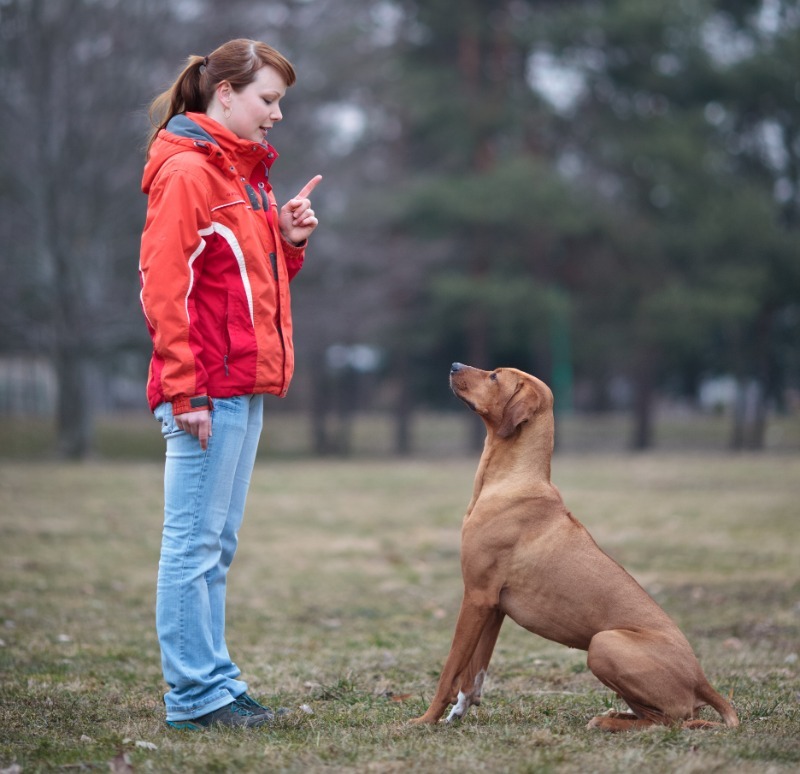
The basic command "Sit" is performed on a short leash with a treat, first shown to your pet and then raised above your head. Place your palm vertically and say, "Sit!" If your four-legged friend doesn't immediately do so, encourage them to do so by rewarding them with food at the end. This will help them understand the cause-and-effect relationship and the sequence of actions. Otherwise, your pet may jump on their owner and other people when it's inappropriate.
Another mandatory command, "Down," is performed on a short leash after successfully completing the previous one. From a sitting position, make a hand gesture (lower your palm horizontally) and, applying gentle pressure to the withers, pull the leash downwards to force the animal to lie down. Then, reward your furry friend with a treat. To reinforce the result, repeat the entire sequence several times. Experienced dogs can perform the "Down" command without first asking "Sit."
Quiet
Sometimes, a pet barks uncontrollably, even in the presence of its owner. The important command "Quiet" can help break your dog of this bad habit. To do this, you'll need a treat. After commanding your four-legged friend "Quiet!" when it barks, immediately give it a treat. If it immediately connects "Quiet" with the treat, immediately reward it again with a pet or a treat. Increase the interval between these actions each time.
It's important to remember that dogs often bark simply to get their owner's attention. Therefore, don't immediately give commands as soon as your dog starts barking. First, pay attention, and if the barking continues, only then give a command and reward. If your pet doesn't comply, give another command, such as "Sit" or "Down," and only then command, "Quiet!"
If these steps don't work, there's one trick. It works if the dog doesn't like water. If it refuses to obey a command, spray water on its face and place the container nearby where it can see it. This approach works in most cases.
Ugh/no way
An untrained four-legged friend will often grab objects on the street (which can lead to dangerous food) or chase someone. Therefore, it's essential to teach them the "No" command. Although these two commands indicate prohibited actions, they are still somewhat different.
The basic command "No" is intended to completely prohibit any action and is used in training "beginners", but for experienced dogs it is practically never used.
You can train your dog by using a sharp tug on the leash. This movement is a categorical prohibition against the pet's misbehavior, which includes chewing furniture, barking at everyone, picking up objects from the street, and showing aggression toward other people and animals. To achieve success, you must demonstrate your strengths and convey your superiority through your tone of voice; otherwise, the dog will not consider you the leader and will not obey the command.
The additional command "No," unlike the previous one, is temporary and indicates that its execution will be followed by a permissive cue. For example, after "No," the dog should not touch the food until the owner gives permission. This strengthens the dog's willpower, and, ideally, the dog will only take the objects or begin eating after the permissive cue.


 Lyudmila Pronina
1 comment