 For many owners, the concept of a "smart and trained cat" raises many questions. First, how to train a cat properly? When should training sessions begin? And second, how often should they be conducted?
First of all, every cat owner should know that these animals are very happy to perform a wide variety of commands, but to do this, it is important to carefully study the rules of training.
Each command is a specific association between the animal and a specific phrase that requires it to perform an action. With this definition, any cat owner can become a true trainer and teach their pet incredible tricks.
The optimal age to start classes
Train your favorite pet should be started at 6-7 monthsIt's during this period that the animal transitions from "childhood" to a more conscious, more conscious, and more clear understanding of the owner's expectations. To understand how to train a cat at this age, it's important to carefully familiarize yourself with all its habits, observe its play style, and note what the animal enjoys most. This attentiveness will strengthen the relationship between owner and kitten, and the animal will trust and obey completely. It's important to understand that the cat's breed also plays a significant role in how it follows commands.
Where to start raising a kitten
Training a kitten should begin not with following specific commands, but with the most important stages of accustoming it to the established order and routine in the room. Among the most important conditions The following are highlighted for future training:
 Choosing the right location. A kitten shouldn't sleep just anywhere, nor should it share a family member's bed; it should have a specific place;
- Personal toys. Little kittens thrive on active play, so toys should be purchased for them right away, or they can be made from the owner's belongings;
- Punishment for a kitten is a stern tone or raised voice. Animals are very good at recognizing their owner's tone and immediately understand that this is not right;
- Choosing a feeding location. A kitten should know where its bowl is from the first days. Avoid giving it food from the table, as this will encourage it to steal food;
- A permanent toilet spot. A kitten should have a single spot for relieving itself. To help it understand that this spot is the toilet, it should be placed there and not allowed to go for a certain amount of time;
- Constant interaction and play. Playing with and petting your kitten is crucial for future training. This allows you to bond with your kitten and develop a trusting relationship.
 Choosing the right location. A kitten shouldn't sleep just anywhere, nor should it share a family member's bed; it should have a specific place;
Teaching a cat to sit
How to train a kitten at home? To ensure all commands are obeyed, the pet should receive praise and rewards in the form of treats. The best option is to train on an empty stomach. Don't perform commands for more than 5 minutes, as your pet will simply tire.
In order for a cat to learn to perform the “Sit” command, you must perform the following steps:
- you need to say the command “Sit” loudly and clearly;
- give a piece of treat and gradually lift it above your head;
- the cat will gradually begin to raise its head and, based on the anatomical structure of the body, will sit on its hind legs;
- After this, the treat must be given to your pet.
After the kitten eats the treat, it needs to be rewarded with affection.
Teaching a cat to lie down
 Once your kitten has learned to "Sit," you can teach it the "Lie Down" command. This command is very important when transporting the animal or visiting the veterinarian. Training follows this plan:
- the cat is given the command "Sit";
- the treat is gradually lowered downwards so that the cat's head also begins to lower;
- After this, the treat needs to be slowly moved to the side so that the cat lies down;
- give a treat and praise the animal.
In the case when the cat does not lie down completely, you can help it gently bend the front legs, she will understand what they want from her.
Jumping through a hoop is healthy and fun!
How do you teach a cat the same commands as circus animals? It's not difficult either. Home training involves the following steps:
- Preparing the hoop. For a small kitten, you can use a regular embroidery hoop. Raise it above the floor and call the kitten's name;
- When the kitten approaches, it is carefully led through the circle and given a treat as a thank you;
- It is essential to say “Up” while executing the command;
- After this, you need to invite the cat to do it on its own, placing a treat outside the circle.
You won't be able to teach a cat to jump through a hoop at home in one go, but after a short period of time, your pet will perform this command quickly and easily.
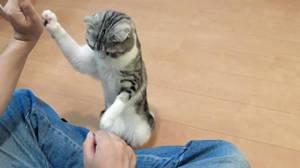
We train our pet to the command "Give paw"
Many cats obey the "Give Paw" command very willingly, and proper training will always help to amuse guests or children.
You can teach a cat to give a paw only after the animal has learned to obey the command “Sit”.
As soon as the cat sits on command, you need to take its paw, say the command, and give it a treat. During this training, it's crucial to control your tone: it should be calm and firm at the same time.
The "Die" team is a great mood booster!
Many owners want their cat to obey the "Die" command, as it is fun and evokes a lot of positive emotions in people. To do this, you need lay the cat on its side and hold it in that position for a few seconds. After that, give it a treat and praise. After just a few training sessions, the cat will naturally move to the side and "die" to receive praise or its favorite treat.
Teaching a cat the "Fetch" command
 Not every cat can train like this at home. It's important to observe your cat closely; if they have a tendency to carry objects in their mouth, you might want to try this command.
First you need to choose a toy or object, which the cat likes, and demonstrate how to carry it in its mouth. Since cats often imitate their owner's behavior, they will understand what to do and how to do it. Training by example often produces quick results.
Overcoming obstacles
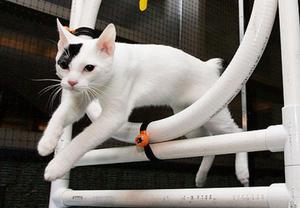
For cats who love to constantly jump from place to place, seeking higher ground, try a hurdle training complex. To begin training, two regular chairs are sufficient. Place the cat on one chair, and place a treat on the other. The cat will jump on its own.
To get the right and quick result, cat chairs should be used in the first stages place at a minimum distanceThe cat should learn that a treat is always waiting on the opposite side. Then the chairs are moved further away. Once this distance is maximized, a hoop can be added to the cat's obstacle system.
The command "Stop!"
This command is performed using your hands. You need to create the appearance of a barrier for the cat; to do this, the owner should bend their arms at a right angle and block the pet's path. It's crucial to choose the right moment to perform this command: the cat should move in your direction. If the cat immediately understands the meaning of the command and follows it, give a treat.
Having decided to train your cat, you need to not only familiarize yourself with the rules for executing commands, but also find an approach to your petDon't force a cat to do exercises or scold it if it does something wrong. It's important to remember that only patience and persistence will lead to results, and your efforts will be rewarded with a well-behaved and exceptionally intelligent cat. Such a cat will become the pride of its owner, a loyal companion, and a friend.