 Every family member needs their own private spot in the house where they can relax. Our four-legged pets are no exception. Most cat owners know that their pets often hide in boxes, cabinets, drawers, and other hidden spots. So why not consider making your pet's home a priority and building a cat house yourself, especially since it's easy to find plans with dimensions and instructions for building even the simplest of structures.
Content
Why do cats need a secluded place?
Many people wonder: does their pet really need a home? The answer is clear: they do, because animals need somewhere to rest from the constant care of their owners. Many people mistakenly believe that cats don't care where they sleep, as they can often be seen sprawled out on the couch or anywhere else. But the fact is, cats rest wherever they please precisely because they don't have a place of their own. Therefore, if owners truly love their pets, they should definitely provide them with a secluded home.
Many people think that making a cat house Making your own or buying one from a store is a completely useless endeavor, as it doesn't mean the cat will like it or sleep in it. This opinion is partly justified. But if the house is ready, and the cat avoids it, don't despair. It's possible the cat is simply sniffing the unfamiliar structure and can't figure out what it's for or what to do with it. And even if the owners help the cat get into its home, it won't necessarily sleep there.
Perhaps your cat simply doesn't like the current location of the house. In this case, try placing the structure in different rooms or corners of the apartment. Cats often like to lie on windowsills, so it might be best to place the house there. Plus, many felines prefer elevated locations, so experimentation is necessary.
Requirements for a cat house
Before you start making a cat house with your own hands, its configuration needs to be determined, which will determine the design's drawings and dimensions. The main requirements for cat houses are the following parameters:
 the height of the house should correspond to the level at which the cat likes to spend most of its time;
- In no case should you allow the presence of unpleasant odors in the cat’s home, as the cat will ignore it;
- the dimensions of the structure must exactly correspond to the physical parameters of the animal;
- The structure must be stable and not tip over, fall, etc.
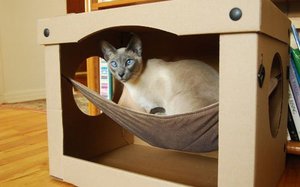 the height of the house should correspond to the level at which the cat likes to spend most of its time;
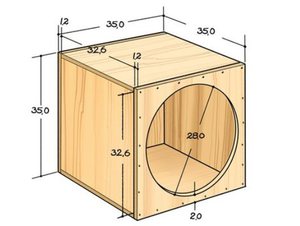
Also of great importance are overall dimensions of the cat's homeBefore building a house yourself, you need to prepare a drawing in accordance with expert recommendations:
- height from 40 cm;
- the perimeter of the structure for medium-sized cats should be 45 by 45 cm;
- The inlet opening should be 15 cm or more in diameter.
To build a cat shelter yourself from scrap materials, a person does not need to be an experienced carpenter or have special knowledge in construction.
What is the difference between cat houses and cat houses?
A cat is also very comfortable on the roof of a cat house, which has only one entrance. After all, all a domestic predator needs is a place to occasionally escape prying eyes, and most importantly, a clear view of the surrounding area.
In turn, cats love it when in their home there is an additional input, and they prefer to observe their surroundings not from the roof, but from an additional stand in front of the home. This is primarily due to the fact that cats view their home not only as a place of privacy but also as a shelter for future offspring. Therefore, for safety reasons, an additional exit is needed to ensure the cat feels comfortable and protected.
Building a cat house with your own hands
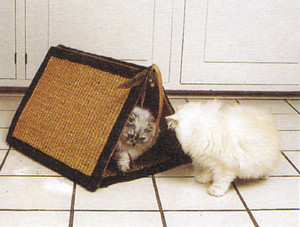 Today, every pet store in our country offers cat houses to suit every taste and budget. A cat house is a very useful item for a pet, allowing them to relax and unwind. They feel cared for by their owners and will reciprocate. But buying a cat house isn't the only way to care for a pet. A proper cat house is quite expensive, and building one yourself from scrap materials like plywood, foam rubber, or even newspaper isn't particularly difficult. But first, you need to understand the specifics of a cat house and the steps involved in its construction.
Let's make a cat house from cardboard boxes
One of the most popular materials for building a cat house is a simple cardboard boxYou don't need to be a construction expert; you can do all the work yourself, just gather the following supplies:
- a box made of thick cardboard;
- soft, dense fabric;
- polyethylene or other water-repellent material;
- stationery knife and scissors;
- odorless adhesive composition;
- drawing set;
- construction tape.
To make a cat house according to the dimensions and drawings, you need to do the following: certain simple steps:
- Using a pencil and compass, mark the entrance to the home. Cut the hole with a knife. The entrance must be sized to accommodate the cat's physical dimensions.
- The box is securely taped around the opening edges. For additional security, the box can be taped at all joints.
- At the next stage, in accordance with the internal dimensions of the box, a water-repellent material is prepared, which is carefully pasted over all the internal walls of the structure.
- After this, you can move on to the exterior finishing work. Again, carpet or other soft material is cut to the outer dimensions of the box. The front wall is cut out entirely, glued in place, and only then the entrance is made. It's important to leave an excess of fabric, which can then be folded over and glued inside the opening.
- The house is left to dry for three days. After this time, a cushion is placed inside the house and the new occupant is let in.
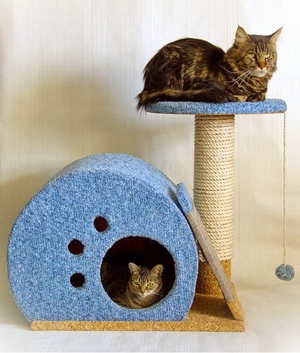 Using a pencil and compass, mark the entrance to the home. Cut the hole with a knife. The entrance must be sized to accommodate the cat's physical dimensions.
Such a cat house can always be modernized in accordance with the wishes of the cat owner or the characteristics of the pet.
Building a shelter from newspapers
Another budget option for making a cat house with your own hands is construction of a structure from ordinary newspapers, which often accumulate on the balcony or in the pantry. And although newspaper seems flimsy, a house made from newspaper tubes will be more durable than its cardboard counterpart. Plus, with a little imagination and patience, a cat bed made from newspaper tubes will look very attractive.
Before you make a newspaper shelter for your pet, it is important to take care of about the availability of the following materials:
- plywood;
- adhesive mixture without strong odors;
- office scissors;
- jigsaw;
- knitting needles;
- a pile of old newspapers.
So, how do you make a cat house out of newspapers with your own hands? Step-by-step instructions:
- The newspaper is cut into strips 7 to 10 cm wide. Each strip is wound around a knitting needle. The result should be a long tube of newspaper, sealed at the end with glue to prevent it from unraveling.
- From two sheets of plywood, you need to make oval blanks in accordance with the physical characteristics of your pet.
- Newspaper tubes are glued around the inside of the plywood circle, like sunbeams. The spacing between adjacent sunbeams should not exceed 20 mm.
- The second plywood piece is glued on top of the first, thereby covering the newspaper tubes.
- All the glued tubes are raised upward, as if forming a bowl. The frame is woven like a basket. The opening is created by changing the method of weaving the additional pieces. To achieve this, the weaving is done not in a circle, but with a forward motion.
- A separate piece is woven to the diameter of the open top of the future house. The piece covers the opening at the top and is secured using the same weaving method, using separate newspaper tubes.
- A small protrusion is made on the lid and the edges of the weave are closed.
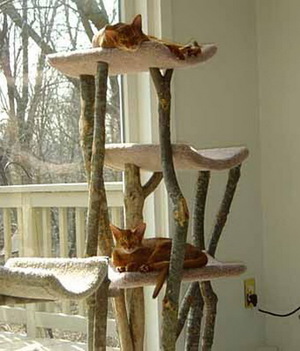 The newspaper is cut into strips 7 to 10 cm wide. Each strip is wound around a knitting needle. The result should be a long tube of newspaper, sealed at the end with glue to prevent it from unraveling.
This completes the wicker pet shelter. For the pet's comfort, both inside and on the roof of the house soft pillows are laid.
Soft cat house made of foam rubber
Special attention should be paid to the soft cat housing, which can be make it yourself from foam rubberHere, you have plenty of opportunities to use your imagination to create a cozy nook for your cat with your own hands. To create this soft structure, you'll need:
- any piece of dense material;
- thick foam rubber;
- sewing accessories including a machine;
- strong thread.
To make a cat house, you need to complete a number of simple steps:
- You need to make patterns of the main parts of the house on paper, which will later be transferred to fabric and foam rubber.
- Once the pattern is applied to the base material (fabric and foam), all pieces are cut out, leaving a 1.5-centimeter overlap. Each piece will consist of two pieces of fabric and one piece of foam.
- All the pieces are folded as follows: foam rubber and two pieces of fabric face up and face down.
- All edges are sewn on a sewing machine so that there is a reserve at the bottom that will serve as a joint on the floor.
- The prepared parts are turned inside out and ironed.
- On the inside of the house, all the individual pieces are sewn together, and the bottom is attached last. The finished structure is turned inside out and shaped into the desired form.
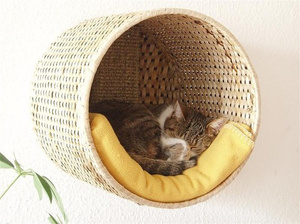 You need to make patterns of the main parts of the house on paper, which will later be transferred to fabric and foam rubber.
As you can see, making a cozy home for a cat with your own hands is not particularly difficult, especially since you can always find everything in the house necessary materials at handThe main condition is to approach the issue with due responsibility and show a little imagination.