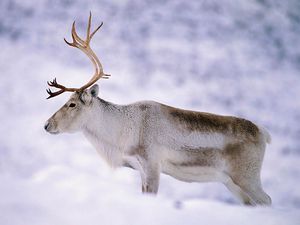
 Reindeer belong to the deer family and are the only living representatives of their genus. The internet is replete with photos of this beautiful and noble animal. This even-toed ungulate can be found in cold climates: Karelia, Western Chukotka, Kamchatka, Sakhalin, northern North America, and Eurasia. They inhabit forest tundra, taiga, and low mountain ranges.
Appearance
Weighing approximately 200 kilograms, these animals can reach a length of two meters. An adult can reach a shoulder height of one and a half meters.
- The body is squat and elongated.
- The ears are small, 13–18 centimeters, and the nose is slightly humped.
- There is a tail that protrudes noticeably from the fur, as its length reaches 20 centimeters.
- Females are slightly inferior to males in all parameters.
- Wild individuals are larger than domestic ones.
The reindeer's skin is covered with thick, warm fur. the hairs are short - only 2 centimeters in summer, and in winter, from 5 to 9 centimeters. The hairs are hollow inside, creating a good air gap, providing adequate protection from frost. There is a small mane on the neck, sometimes almost invisible.
Fur grows almost everywhere: it covers the nose and hooves. On the hooves the fur provides additional support, and on the nose it protects from the cold snow during feeding.
Reindeer are often not uniformly colored. Their fur features patches of darker and lighter shades. In summer, their coloring is closer to gray-brown, and in winter, it's brownish-black.
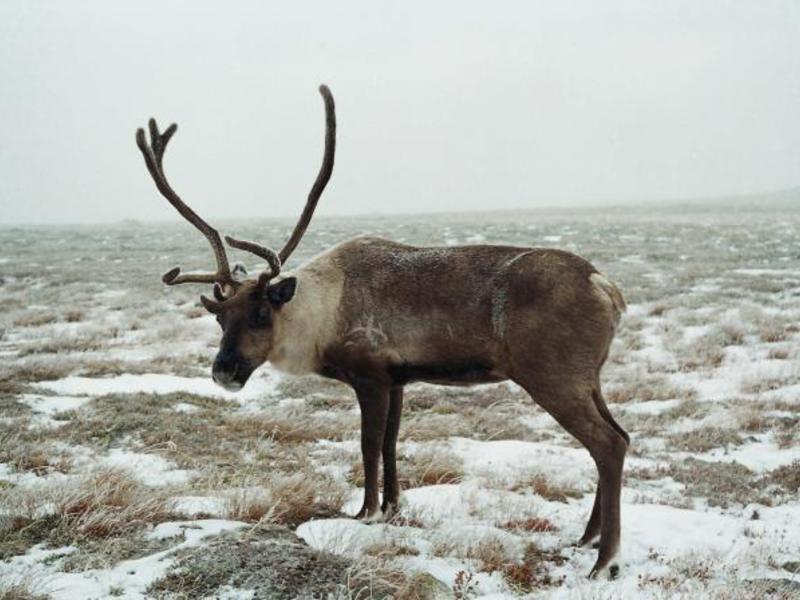
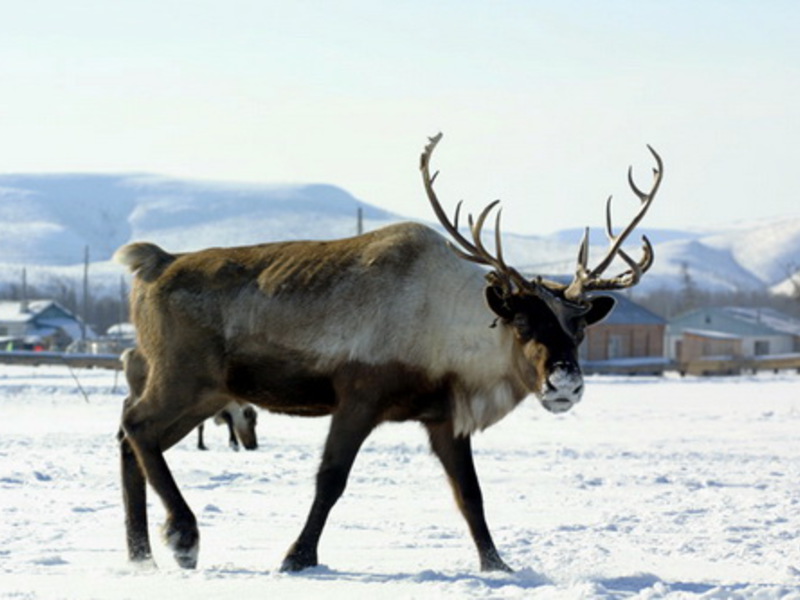
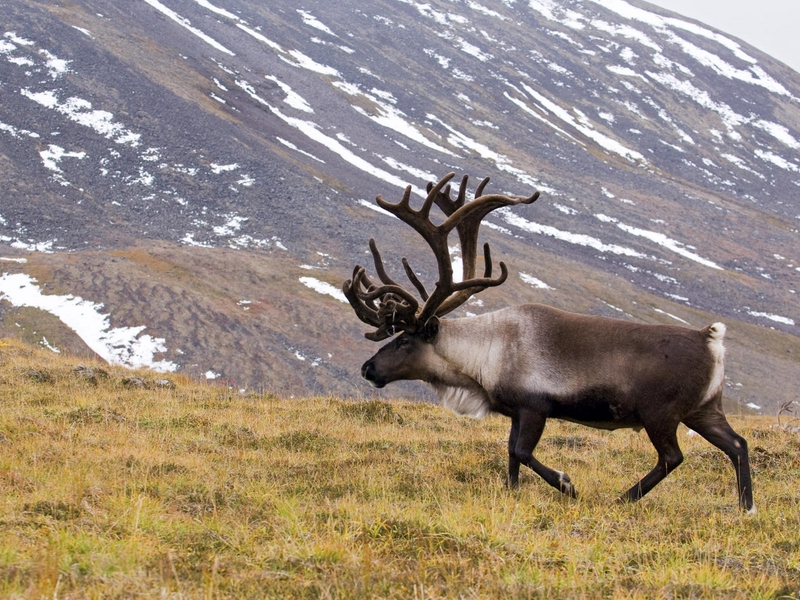
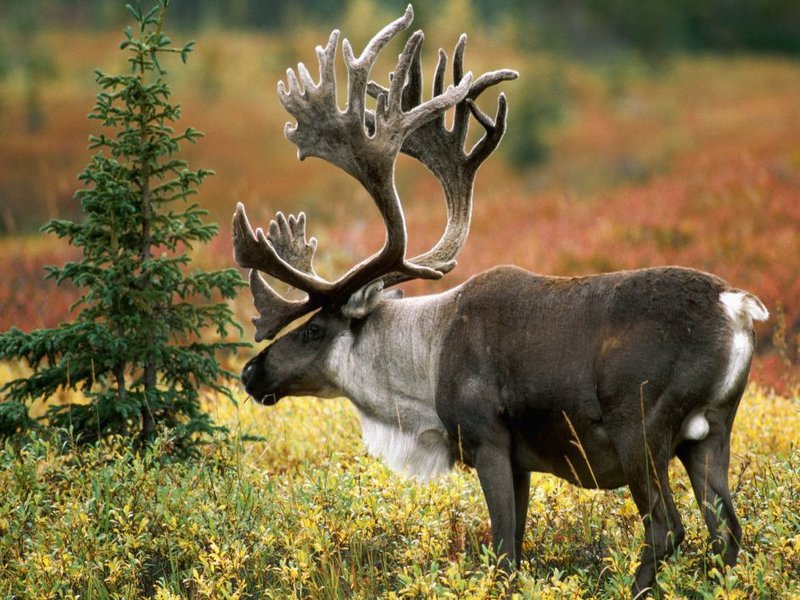
Both females and males of this species have horns. The animal's horns are covered with hairThe horns are long (up to one and a half meters), thin, and curved, with triangular spades with short branches at the tips. In males, the horn span can reach 120 centimeters. Horns are shed annually. Females shed their horns after giving birth around June, and males shed them in the fall.
The legs are quite short compared to the body. The paws have four toes. The joints of the middle toes can bend, raising the phalanges to an almost horizontal positionThe hooves of this species are wide and curved inward, forming a kind of scoop or spoon. The hooves on the side toes are large enough to provide additional support when walking or running. This facilitates digging through snow and icy areas of the ground in search of food.
When moving, the tendons in their legs rub against the bones, creating a characteristic sound that allows animals to locate each other. When running, their legs are raised very high.
The molars are small and short, the incisors are not suitable for cutting grass.
Lifestyle and nutrition
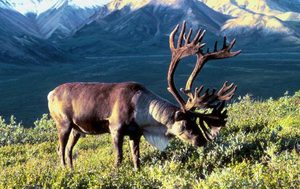 Reindeer lead a nomadic herd lifestyle, migrating annually. A single migration can reach up to 500 kilometers in length. For many years, deer migrate along the same route.When necessary to cross water obstacles, reindeer easily swim across rivers. This lifestyle allows the soil's nutrient-rich layer to fully replenish.
During migration, reindeer are frequently attacked by predators:
- wolverines,
- wolves,
- bears,
- lynxes.
Attacks occur on old and sick members of the group. Wolves and wolverines are the most common predators. Lynxes and bears, however, only approach the herd. in case of an acute shortage of other gameFrightened reindeer flee by galloping. These animals are not particularly active and are primarily diurnal.
Animals eat not only plant food:
- all types of lichen,
- mushrooms,
- other people's eggs,
- algae.
If necessary, deer can even eat adult birds. They are very fond of licking salt, which is a source of potassium and magnesium. Thanks to their powerful legs, deer can find food even under snow. For the same purpose, deer drink large quantities of salty sea water, although they eat ordinary snow to quench their thirst. When the mineral balance in an animal's body is disrupted, they may even gnaw on each other's antlers.
Reproduction
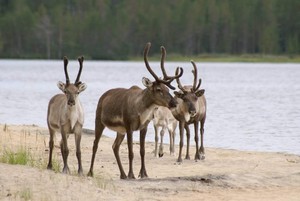 The rut and mating season occur in the fall. A single adult male can be accompanied by up to 13 females. Males fight for females With loud cries and skirmishes. However, these skirmishes do not cause any harm to health. As a rule, the female chooses the largest and strongest male.
Pregnancy lasts almost 8 months. The fawns are born in late spring. There is always only one fawn. At birth, it is completely helpless and cannot stand on its own feet.A week later the fawn is running around briskly, and after a month, they can forage for food, but continue to feed on milk until autumn. The fawns' antlers appear after three weeks.
Calves become independent and self-sufficient at 2–3 years of age. Sexual maturity occurs at 5 years of age. Females retain the ability to bear offspring until age 18. The overall lifespan of reindeer is 25 years.
Classification
Different researchers identify different numbers of species of this animal. Thus, in Eurasia, the following species can be found:
 European reindeer
- Novaya Zemlya reindeer
- Siberian reindeer
- Siberian forest reindeer
- European forest
- Okhotsk
- Barguzinsky
- Reindeer of the Svalbard archipelago.
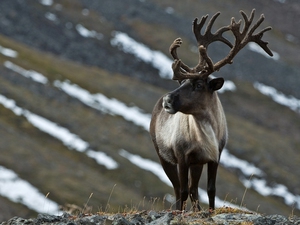 European reindeer
However, zoologists admit that not all forms can be classified as a separate species, so the classification often appears shorter due to unification into larger groupsFor example, the catalog of mammals published in the USSR contained only six species.
There are three subspecies of reindeer in the territory of modern Russia:
- European,
- Siberian,
- Okhotsk.
In addition, scientists know of two subspecies that have disappeared from the planet:
- East Greenlandic
- Queen Charlotte Island reindeer.
Even if we classify deer by habitat, authors can distinguish two or three species:
- tundra,
- taiga,
- mountain.
The last species is not distinguished by all researchers.
Number of people
The reindeer population has currently declined significantly. This is due to several factors.
The emergence of domesticated reindeer is one of the reasons. So, at first, the wild reindeer deer were actively exterminated by humans, as dangerous to domestic animals. It was believed that wild animals were more dangerous to domestic animals than predators, as they could conquer pastures and lead domestic animals back to their own groups. Furthermore, they could carry infectious diseases.
Furthermore, competition with other animals, such as lemmings and voles, has impacted reindeer populations. These competitors destroy vast amounts of food, which is already quite scarce.