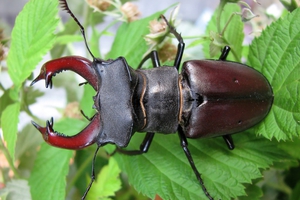
 The stag beetle (Lucanus cervus) is considered one of the largest insect species in Europe. This beetle belongs to the stag beetle family. Its appearance truly lives up to its name: its head is covered with massive horns, the surface of which is covered with spikes whose pointed ends point inward.
This formidable weapon against other insects is not only the main means of defense but also a form of pride: the horns have a beautiful reddish hue, which stands out strikingly against the dark brown body. Interestingly, while the males evoke admiration from researchers, the females are unremarkable (they lack the species' most distinctive feature—horns).
Stag beetle: description of appearance, habitat, species characteristics
The body size of the beetles (including horns) reaches about 7–7.5 cm in length. Their body structure is determined by the presence of three sections: the head, the thorax, and the abdomen. Their head is quite large; in addition to the horns, it houses the organs of sight (two eyes located on the sides of the head) and smell (antennae). The thorax contains three pairs of walking legs. The abdomen is hidden by elytra.
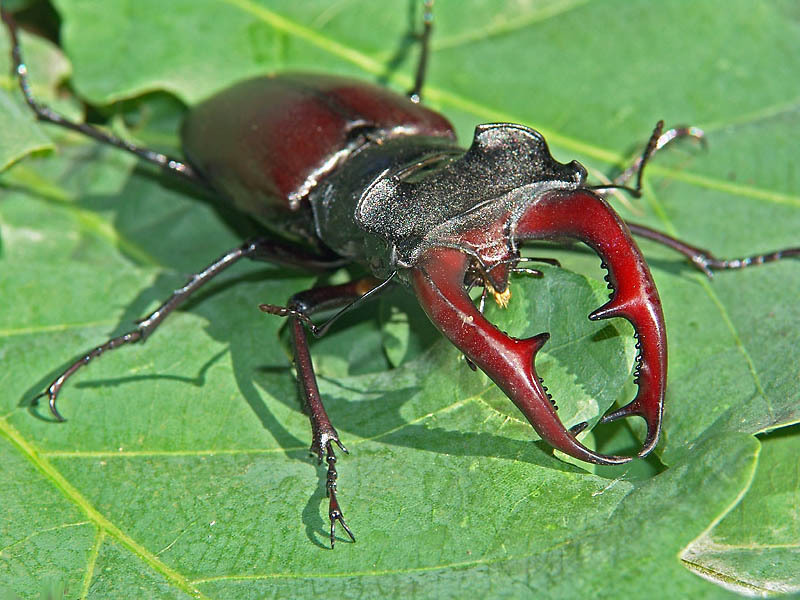
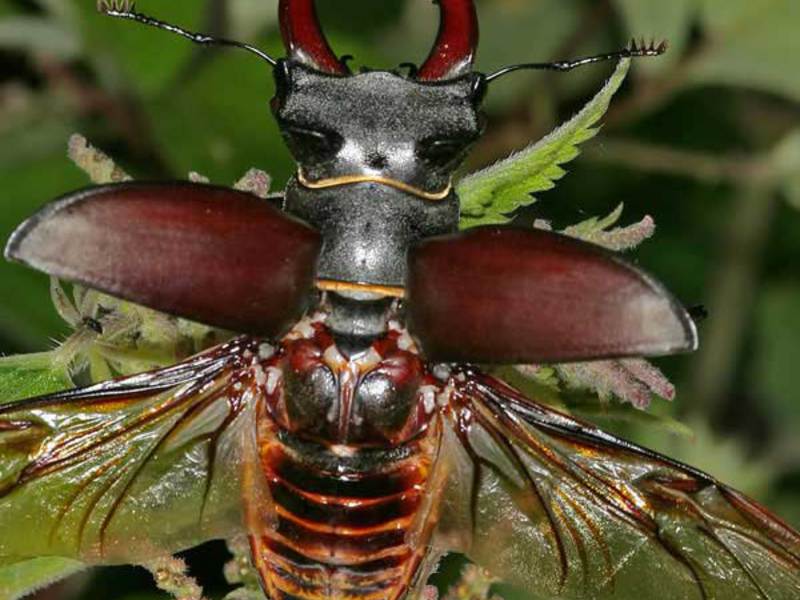
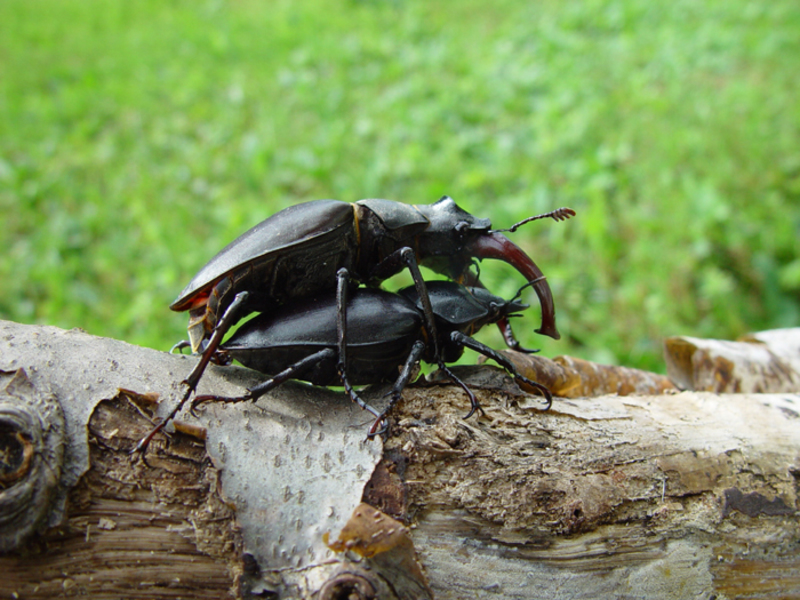
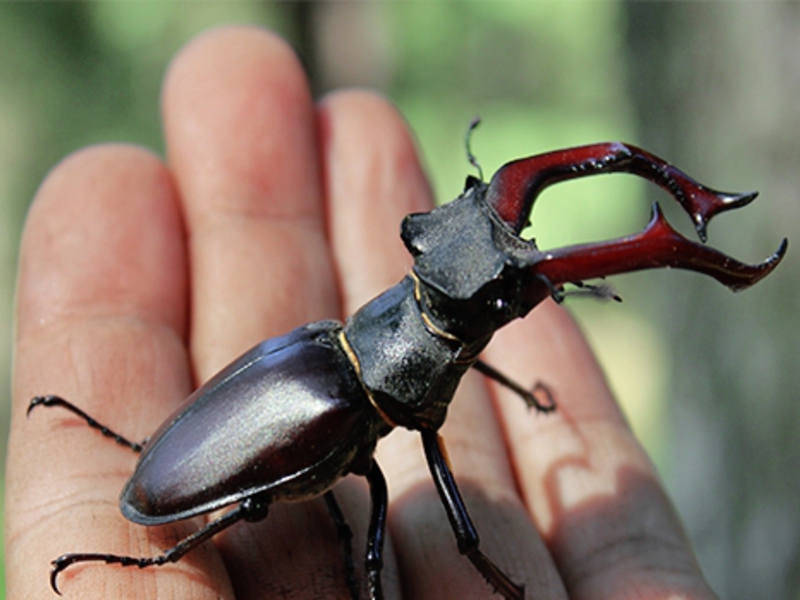
The stag beetle is considered a landmark mainly of European forests, but it can also be found in Iran, North Africa, Syria, and Turkey.
Life cycle and reproductive characteristics of stag beetles
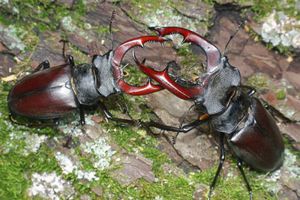 Stag beetles reproduce sexually. The larval cycle averages 4 to 6 months.Their lifespan is short—it can range from a few weeks to a couple of months. But despite not being particularly long-lived, these beetles are very active. They accomplish a lot in their short lives: constantly fighting for food and mates, leaving a "legacy," and then dying.
After fertilization females lay eggs in special cells, which are found deep within dry stumps or trees. After some time (usually 3–4 weeks), the stag beetle larvae emerge to the surface. They have a large head and legs, which enable them to produce a distinctive, chirping sound.
They feed on dead wood particles. At the final stage of larval development, their body size reaches 1–1.3 cm, exceeding the length of the beetle.
The next period is transformation of a larva into a pupaIt develops underground, at a depth of approximately 30–40 cm. The pupation process usually begins in the fall, it spends the winter underground, and in the spring the pupa transforms into an adult beetle.
Classification of stag beetles
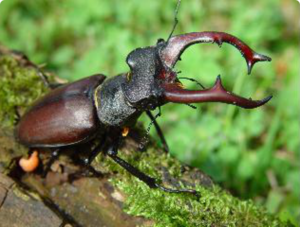 There are several forms of "horned" animals. This division is based on several criteria.: body size, horn size, and proportionality. This difference in size among members of this insect species is explained by the fact that the conditions for larval maturation depend on the population's geographic location. This process is influenced by factors such as nutrient availability, air temperature, humidity, and others. Stag beetles that inhabit arid climates are believed to be smaller. Thus, the following species of stag beetles are distinguished:
- major — the large upper tooth is larger than the apical one
- media — the large upper tooth is smaller than the apical one
- minor - all types of teeth are weakly expressed
Description of the stag beetle's lifestyle
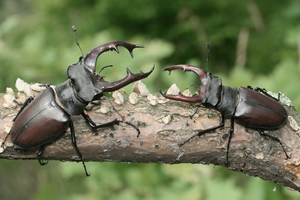
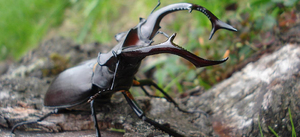 Appearance and The body structure of this insect indicates a high level of belligerence, characteristic of male stag beetles. They duel for the attention of females and for food. During the fight, they try to present a more threatening appearance: they raise their heads and spread their antennae. The battle consists of a clash of horns and a mutual attempt to knock the opponent off the tree and onto the ground. It's worth noting that the blows a stag beetle inflicts on its opponent are not lethal.
Despite the fact that female stag beetles do not have such large mandibles (upper jaws), they can also bite. For humans, their bite can be quite painful.
Stag beetles are insects capable of flight. They fly primarily at night, assuming a vertical position due to the size of their antlers.
Diet of stag beetles
As food Stag beetles use plant juices from trees or other plantsThey swallow it with their lower lip. If you keep them indoors, the best food for them is sugar syrup.
The following factors pose dangers to stag beetles:
- artificial destruction of dry trees, which are a habitat for larvae;
- The Scolia wasp poses a threat to stag beetle larvae, as it is capable of immobilizing them with its sting and laying an egg in their body;
- owl, eagle owl, magpie - this is an incomplete list of birds that hunt beetles, eating only their abdomens;
- Insect collectors also significantly reduce the number of beetles by catching representatives of this species to replenish their collections.
The stag beetle's role in cultural life
The first ones references to these insects can be found in ancient Greek sourcesEven then, the stag beetle inspired poets and playwrights, and it also became a character in various myths. Even then, people believed in the stag beetle's supernatural properties; for example, the ancient Greeks and Romans often wore their heads around their necks as a kind of amulet against evil forces.
 In the Middle Ages in some areas of Germany People believed in the healing power of this beetleCarrying its head was believed to protect children from various illnesses and cure adults of convulsions. At that time, the ashes of this insect were used as an aphrodisiac or diuretic. Even today, they are sometimes used as an accessory to costumes.
For farmers in medieval Britain, the stag beetle was considered a major threat as an omen of poor harvests.
Bright appearance and mythologized image of the stag beetle They have repeatedly inspired artists. Italian Renaissance artists frequently depicted these insects in their paintings. This is largely due to the identification of stag beetles with real deer, whose image in contemporary Christian culture was associated with Christ. Therefore, they can be seen in the works of such masters as Dürer, Hoffmann, de Grassi, and others.
During the silent film era, the stag beetle was often (and with great success) became the central character of feature films and documentariesIn Russia, the first animated film was dedicated specifically to stag beetles, or more precisely, to the peculiarities of duels between males for the favor of a female. It was the first time in the history of world cinema that stop-motion filming was used. Interest in the fighting techniques of stag beetles has repeatedly inspired filmmakers to create films on this topic, primarily due to the figurative similarity to medieval knightly tournaments.
Currently, images of stag beetles can be found on tableware, postage stamps, banknotes and coins of some European countries.