 The discovery of the okapi in the 20th century caused a sensation. These animals were first reported by explorer Stanley G. In 1890, he published a report on the animals living in the forests of the Congo. This information was confirmed nine years later, when Johnston found confirmation of it. Then, in 1900, zoologists published a description of the new species, which was initially called "Johnson's horse."
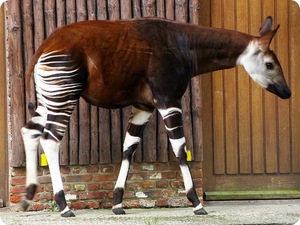
Okapis are a type of even-toed ungulate. These animals look a bit like zebras, but they are related. closer to giraffesThe legs are long, and the neck is elongated, but shorter than a giraffe's. However, the blue tongue, which can reach 35 centimeters, is the same as a giraffe's. Males have horns. The dark fur has a brownish-reddish tint. The legs have horizontal stripes. The fur on the animal's legs is light, and the stripes are brown and black. It is these stripes that give the okapi its zebra-like appearance.
Overall, the animal's body length is approximately two to two and a half meters, excluding the tail, and its height reaches one and a half meters. The tail can reach half a meter in length. At this size, individuals can weigh up to 350 kilograms.
Lifestyle: Nutrition and Reproduction
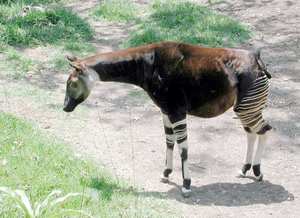 Okapi animals have clearly defined territories. The boundaries of their marked territories are guarded by the animals. Males typically live separately from females and their young. They are most active during the day.
Representatives of this genus eat the same food as giraffes:
- tree leaves,
- fruits.
- mushrooms.
Okapis are quite picky when it comes to choosing food, but despite this, the animal can eat poisonous plants and charred trees, burned by lightning strikes. To compensate for the lack of minerals in its body, the animal feeds on reddish clay near bodies of water.
In the spring, males can be seen fighting for females by clashing necks. Mating season is a rare time when male and female okapi can be seen together. Occasionally, the pair is accompanied by a yearling calf, toward which the male has not yet shown hostility.
A female okapi's pregnancy lasts over a year—approximately 15 months. The birth occurs during the rainy season, which in the Congo begins in August and lasts until October. Births occur in the most remote areas. The newborn baby lies hidden among the vegetation for the first few days. A baby okapi can hum and whistle softly, and, like adults, make coughing sounds. The mother locates her cub in the thicket by its voice. At birth, the cub can weigh up to 30 kilograms.
Nursing lasts for about six months. It's still unclear exactly when the cub becomes independent. After a year, males begin to develop horns. At two years of age, the animals become sexually mature, and by three years, okapis are fully grown. Their lifespan in the wild has not been reliably determined.
Habitat
In the wild, okapi are found only in tropical forests in northeastern Congo. For example, animals can be found:
- in the Salonga Nature Reserve;
- in the Virunga Nature Reserve;
- in the Maiko Nature Reserve.
Okapis inhabit altitudes ranging from five hundred to one thousand meters. They prefer areas with abundant shrubs and thickets, as they hide among them when threatened. Although rare, they are also found on open plains, closer to water.
Males and females have their own feeding territories. These territories may overlap. Males also allow females to pass through their territories.
There are currently no precise data on the number of okapis living in the Congo. Deforestation is negatively impacting the animal's population. Okapi are listed in the Red Book as rare animals..
Life in captivity
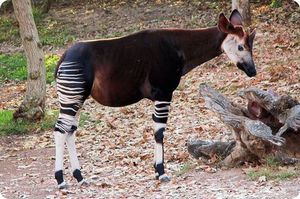 For a long time, zoos were unable to create suitable living conditions for okapis. The first instance of an okapi surviving in captivity for 50 days at the Antwerp Zoo occurred only in 1919. A female okapi lived at the zoo from 1928 to 1943. She died of starvation during World War II. Breeding okapis in captivity also took time. The first offspring born in captivity died. It was only in 1956 that a cub was successfully nursed back to health in Paris.
The okapi is a very picky animal. For example, representatives of this genus do not tolerate sudden temperature changes and air humidity. They are also very sensitive to the composition of food.
However, some progress has been made recently in captive care and breeding of okapis. It has been noted that young specimens adapt to captive conditions more quickly. At first, the animal is kept undisturbed. The diet consists solely of familiar foods. If the animal senses danger, it may die from stress, as its heart cannot withstand the strain.
Once the animal has calmed down and become somewhat accustomed to people, it is transported to the zoo. Males and females must be kept separate in the enclosure, and the lighting must be monitored. There should be no more than one brightly lit area in the enclosure. If the female gives birth in captivity, she and her cub must be isolated. They must be provided with create a dark corner, which would imitate a forest thicket.
Once acclimated, okapis become friendly with people. They may even take food directly from your hands.