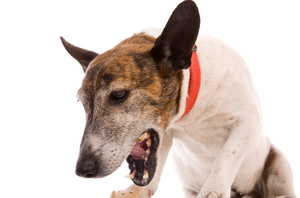
 If a pet starts coughing, it doesn't necessarily mean there's something stuck in their throat. Coughing is caused by something, and there can be many reasons. However, when a dog is truly choking, they begin swallowing and coughing in an attempt to dislodge the obstruction. This coughing may be accompanied by spitting and vomiting. All of this is a reflex action, as the dog attempts to remove the stuck object. In this case, coughing is a defensive reaction. The body attempts to expel the foreign object from the lungs with a force of air. This actually helps when the bone isn't deeply lodged.
If it's clear the dog can't handle it on its own, you can try to help it and remove the object by hand or with tweezers. This will be difficult without an assistant. the dog needs to be held tightly, otherwise the situation can only be made worse by injuring it with the same tweezers when the dog tries to escape from your hands.
First aid procedure
Grasp the upper jaw with one hand and the lower jaw with the other, applying pressure to the gums with your fingers, and force the dog to open its mouth as wide as possible. Look inside, using a flashlight if possible, to assess the situation and decide what to do next. Consider the object's type, its location, whether it can be removed, and whether it could injure the dog's larynx. If, after examining the object, you are confident it can be grasped and removed safely, only then should you risk rendering assistance. If you are not so sure, it is best to seek emergency veterinary care.
It should be noted that all these operations can be performed if the animal is breathing freely.
If your pet starts to choke, urgent action is neededIn this case, don't expect veterinary assistance. He could die from suffocation.
Initially, proceed as described above. Open the dog's mouth and try to remove the object with your hands if you can see it. If not, proceed as follows.
Large dogs
 When the dog is large and conscious, grasp it from behind, around the abdomen (belly), clasp your hands, and apply sharp pressure inward and forward (toward the muzzle). It's important to control the pressure. Repeat the movements several times if necessary. The object should pop out, or at least rise higher. Therefore, after applying pressure, look into the dog's mouth and, if the object appears, remove it with your hands.
 When the dog is large and conscious, grasp it from behind, around the abdomen (belly), clasp your hands, and apply sharp pressure inward and forward (toward the muzzle). It's important to control the pressure. Repeat the movements several times if necessary. The object should pop out, or at least rise higher. Therefore, after applying pressure, look into the dog's mouth and, if the object appears, remove it with your hands.
If the dog is unconscious, then in this case it needs to be laid on its side and, placing your palms just below the animal's back ribs, press sharply, trying to push out the stuck object.
Small dogs
- Handling a small dog requires extra care. Careless handling can lead to irreversible damage. So, turn the dog upside down, pinning its back to you with one hand, and with the fist of your other hand, press several times under the animal's sternum, inward and toward the muzzle. Then, follow the same procedure as with a larger dog, attempting to retrieve the object manually if it hasn't fallen out.
But it is best not to create the conditions for the animal to have to receive emergency assistance because the dog is choking on something.
Possible causes of coughing in dogs
 Don't give your dog tubular bones. Dog he may choke on fish bonesIt's important to closely supervise your pet while out for walks. Splinters from chewed sticks and shards from chewed toys can pose a choking hazard. Training your dog should include discouraging it from picking up anything from the ground.
There can be many reasons why a dog coughs, other than those discussed above. A dog won't cough for fun. Therefore, it's important to investigate the underlying cause.
A dog, just like a man, he might just catch a cold, and the first symptom of the disease will be a cough. You should observe your dog for 24 hours; if it becomes inactive, has a fever, or the cough persists, you should consult a veterinarian, who will prescribe the necessary treatment.
An allergic reaction can also cause coughing and sneezing in dogs, possibly accompanied by watery eyes. A veterinary examination is essential. Only a specialist can prescribe treatment.
Cardiovascular problems can cause coughing in animals. This condition is most common in large breed dogs. The tongue may change color, and the gums may darken. acquire a bluish tintIf your pet's coughing becomes especially intense during sleep, this is a warning sign that requires immediate medical attention. Prompt treatment is always the key to success.
The presence of parasites in an animal's body can also cause coughing. It is necessary to monitor the pet closely and administer regular preventative treatments with anthelmintic medications.
Even a collar that's too tight can cause a dog to cough and wheeze. A properly tightened collar should allow you to easily fit your thumb under it.
Hairballs in a dog's stomach can also cause a cough, as if the dog is choking. The body uses coughing trying to push out the lump.
Bronchitis causes a debilitating, painful, and lingering cough in dogs. Small breeds such as pugs, Chihuahuas, and French bulldogs are particularly susceptible to this disease.
Incidentally, snoring and coughing are often a problem for dogs with specially designed respiratory systems. These include breeds with so-called "squashed" muzzles, such as pugs and Pekingese.
Even nervous overexcitement in “small” breeds of dogs can cause coughing.
As you can see, there are many reasons for a cough, and it is up to the pet owner to first determine what it is connected with.
 When a dog coughs several times, and there is no visible deterioration in its general condition, the cough is not accompanied by the release of worms or blood discharge, there is no need to worry too much, although observe your pet more closely It's still necessary.
If your dog's cough persists for a day or more, interferes with its ability to breathe normally, its temperature rises, or it refuses to eat, you should seek help from a specialist who will examine your pet and prescribe the necessary course of treatment.
Self-medication is contraindicated with pets, just like with people; it can do more harm than good. Before you do anything, before you take any steps, think everything through carefully!