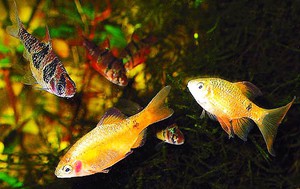
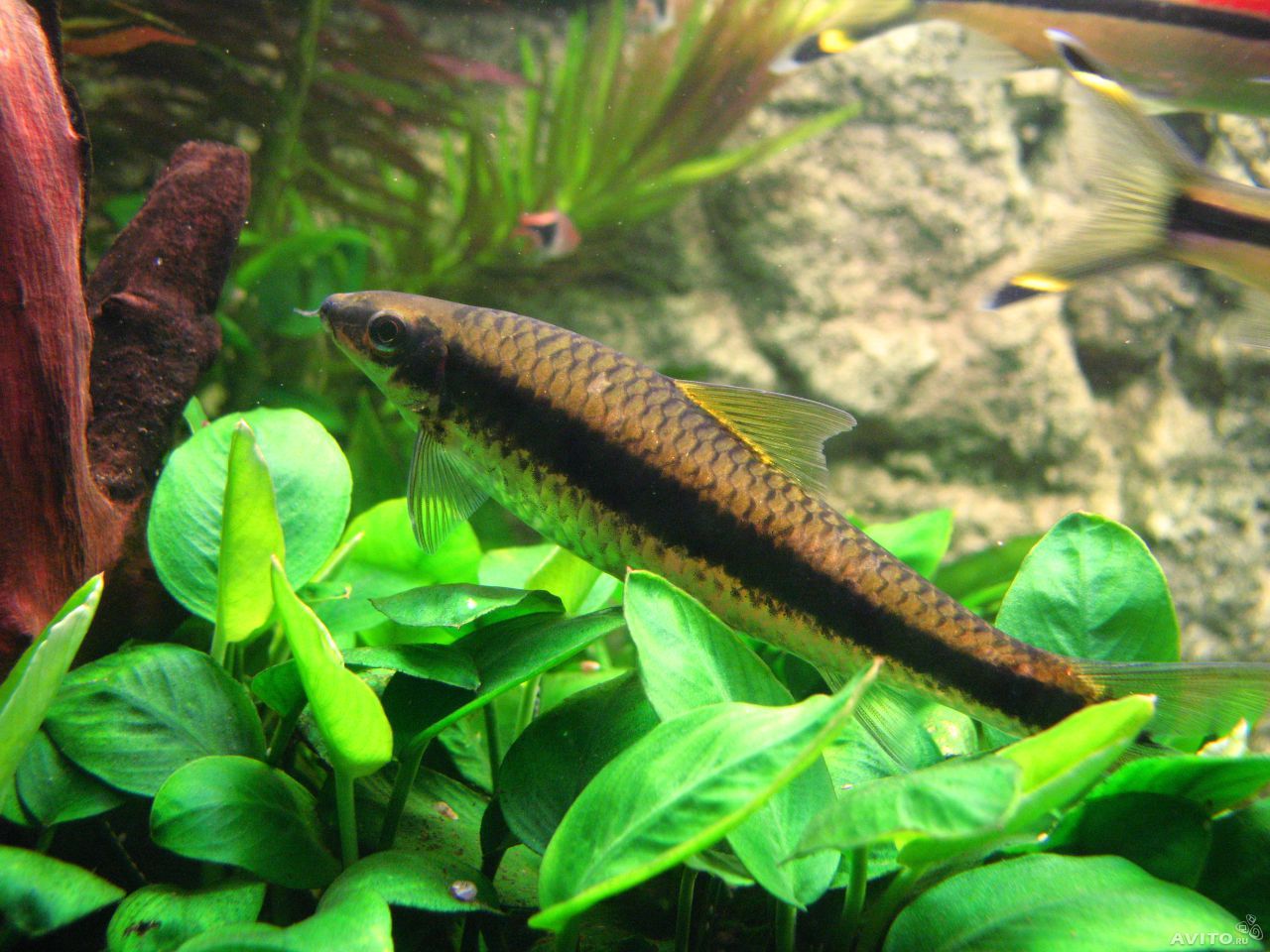
 Barbs are beautiful, cheerful, and very interesting fish to watch. Their behavior is somewhat reminiscent of dogs. Watching them move quickly around the aquarium, wagging their tails and poking their noses into every crevice, makes you want to call them "mongrel" rather than "barbs." They are popular with beginning aquarists due to their low maintenance. They aren't particularly picky about water quality, will eat any food, and rarely get sick. Keeping these aquatic creatures is easy, especially if you consider their activity level and choose the right tankmates.
Content
Who is a barb and where does it live?
This freshwater fish lives in the wild in water bodies of Africa, India, China and IndonesiaThere are several dozen different species of these creatures known, and some of them live in the rivers of our country.
The barb is a semi-predator of the carp family. But although it's only half predatory, if it catches a small fish, it won't rest until it's eaten whole. Therefore, the compatibility of these fish is a separate and very important discussion.
In the wild, this species is large and has tasty meat. In an aquarium, they are quite small, reaching 9-12 cm in the largest species, with the average size being around 4-8 cm.
These are schooling fish and feel most comfortable in a company of 6-8 friendsThen they rarely bother others, focusing more on squabbling within the school. A solitary fish may be overly aggressive towards its neighbors. Conversely, if the school is too large, they begin to terrorize other aquarium inhabitants, claiming territory for themselves.
Some species of these fish are more aggressive than others, so it's worth first understanding the main and most common varieties of barbs.
Sumatran barb
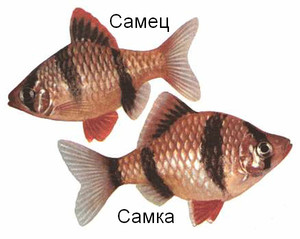
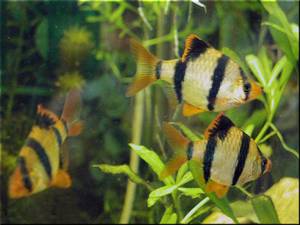
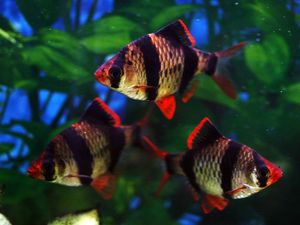 These fish are native to the island of Sumatra. They are also called "tiger fish" due to the black vertical stripes on their golden bodies. They come in four- and five-striped varieties, and are 5-7 cm long. Males are brighter in color than females, but the females are larger. Albino Sumatran fish are also found, which are more dull in color than the other fish.
This is one of the most feisty and pugnacious varieties. It won't miss an opportunity to hang on the long fins of its veiltail neighbors.
Cherry or ruby barb
Originating from Ceylon, these fish are 5-6 cm long, cherry-colored, with a dark stripe running across their entire body. Their sides are flat, and their bodies are elongated.
Green barb
Native to China and Vietnam, this species is slightly larger than the previous ones, reaching 10 cm. There's a subspecies of this fish, the Schubert's barb, that's widespread in America. These fish are very easy to care for and are the calmest and most peaceful of all the creatures in this species.
They have an interesting coloration, which becomes more intense when exposed to ultraviolet radiation.
Everett
These fish are also called clown barbs due to their bright, spotted coloration. In the wild, they live in Southeast Asia. They can reach 12 cm in length. They are also quite compatible with other fish.
Fire barb
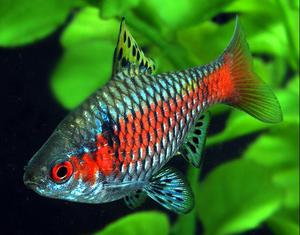
Native to India, these river dwellers reach 14 cm in the wild, but are smaller in aquariums – about 8 cm. They get their name from the male's spawning coloration. During this time, his back is blue-green, while his sides turn fiery red.
Black barb
A native of Sri Lankan waters, this fish has a unique coloration. Its coloration is highly dependent on its surroundings. If the aquarium is sparsely planted, the fish is almost invisible and its coloring is pale. However, if there is a lot of greenery, the black stripes on its body become much brighter, and the light areas between them take on a ruby hue.
Oligolepis
Small fish, 4-5 cm long, from the islands of Indonesia. Their color changes depending on the lighting. The pearly scales and transparent reddish fins with black edges appear more vibrant in the light.
Lined barb
It's also called the striped fish because of the horizontal stripes running across its body. Native to Southeast Asia, it's 7-9 cm long. A peaceful fish, it pairs well with calm tankmates.
Butterfly
This species of barb has a long, elongated body, a brown back, a whitish belly, and several large black spots. The fish is small, no more than 4 cm.
Barylioides barbus
A peaceful species from East Africa, it grows to about 5 cm. They have a reddish, elongated body with narrow vertical black stripes.
Barbus filamentosus
These fish, native to Sri Lanka, can grow up to 15 cm. They have a red fin on their back and a distinctive black and red spot on their tail. This species requires an aquarium of at least 200 liters.
Mutant
A rare and valuable barb species, it reproduces poorly. Its fins are edged in red, and its body is bright green and completely stripeless.
General compatibility rules
There are several rules that must be followed in an aquarium containing barbs and other fish. Here they are:
 The aquarium should be large, preferably rectangular. Barbs love to frolic and move around actively. The fish should have enough space to swim, otherwise they will become territorial and fight.
- The aquarium needs to have a lot of greenery and shelters, so that the barbs' neighbors can hide if they become too annoying.
- It's a good idea to keep several different species of these fish together. This way, they'll spend more time arguing with each other and won't have much time for other tankmates.
- Don't keep barbs with livebearing fish. They'll chase the fry until they've eaten every last one.
- There should be enough food for all the fish so that they do not have to fight for it.
- Don't put veiltails with barbs. It's like a red rag to these energetic, restless fish.
- It's also not a good idea to house slow-moving fish with them. The barbs will also nip at their fins.
- Small fish or shrimp will also have a hard time living with barbs. They'll likely be eaten.
 The aquarium should be large, preferably rectangular. Barbs love to frolic and move around actively. The fish should have enough space to swim, otherwise they will become territorial and fight.
By following these general compatibility rules, you can expect peaceful and conflict-free housing of barbs with their tankmates. Now, let's take a closer look at cohabitation with other fish.
Good compatibility
Botia
The clown loach is a non-aggressive and fast-moving fish that also dislikes long fins. They are similar in many ways and therefore get along well. There's just one caveat: the loach should not be kept alone, otherwise, over time, it will become aggressive toward other fish.
Swordtails
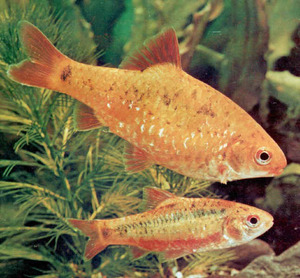 The swordtail is a fast and very agile fish with an active personality. Its speed allows it to compete with barbs, so they can easily coexist. The most challenging aspect is that swordtails have large fins that can irritate their neighbors. Plants are a solution, providing ample cover. In a game of tag, the swordtail easily outshines the striped fish, leaving them far behind and outclassed.
Danio rerio
Danikas are active and fast-moving fish, constantly on the move. They live in schools and go about their business. They lack long fins and don't irritate their neighbors in any way. This allows them to coexist peacefully with one another.
Catfish
The fish live at different levels of the aquarium. Catfish are bottom dwellers and have nothing to compete with those in the upper and middle layers of the water. Barbs and catfish generally don't clash.
Gourami
Not a bad combination. Gourami is a fairly calm, but active fish, quite large.
Barbs of different species
Different barb species coexist best with each other. For example, Sumatran barbs and fire or cherry barbs. The Strauss barb, the most peaceful member of this family, gets along well with all types of barbs.
You can house platies with barbs, but it's important to remember that these fish are viviparous and their offspring will be eaten immediately.
Poor compatibility
- Angelfish. They don't do well together. Angelfish are slow and have fairly large fins that make them tempting to nibble. Angelfish, in turn, are also irritated by the fidgety striped fish's fussiness and sudden leaps.
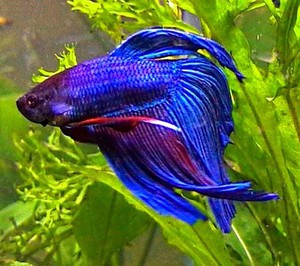
- Bettas. These are definitely not the fish you want to keep in the same house. Bettas are naturally feisty, and they also have very long, beautiful fins and tails.
- Guppies. They won't get along either. Guppies have long fins, and the pests won't rest until they've nipped them off, which could result in the death of the fish.
- Laliuses. Laliuses are sedentary and very timid fish that will be constantly terrorized by restless barbs.
- Astronotus. The large, intelligent, and aggressive Astronotus will be a very poor neighbor for a barb.
- Cichlids. Here, the littlest pests will get their fill, as cichlids are very intelligent and very predatory fish. While bullies are semi-predators, they're not true predators.
 Angelfish. They don't do well together. Angelfish are slow and have fairly large fins that make them tempting to nibble. Angelfish, in turn, are also irritated by the fidgety striped fish's fussiness and sudden leaps.
It turns out that barbs can be housed with other species, but this must be done wisely, observing all necessary conditions. The Sumatran barb is the most difficult to house together, while the Schubert's barb makes the most accommodating neighbor.